
- Atomic number
- 13
- Atomic mass
- 26.98
- Shells
- 2, 8, 3
- Configuration
- 1s² 2s² 2p⁶ 3s² 3p¹
- In the table
- period 3, group 13 (IIIA), p-block
- Kind
- Other metal
- Valency
- 3 (Al³⁺)
- State at 25 °C
- solid
- Melts · boils
- 660 °C · 2,519 °C
- Density
- 2.7 × as heavy as water
- Known since
- 1825
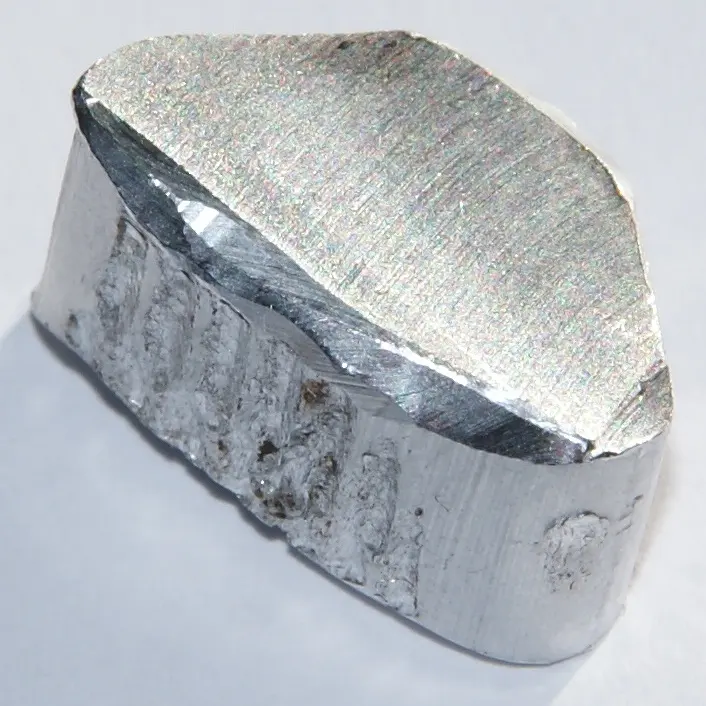
Lift a pressure cooker, a kettle or a big डेक्ची in a Nepali kitchen, and there is a good chance it is made of aluminium. So are the cans of soft drinks, the foil round a packed lunch, many window frames, and the thick cables slung between the pylons that carry electricity across the hills.
Aluminium is the most common metal in the ground beneath your feet. Yet two hundred years ago nobody had ever seen it, and for a few years it cost more than gold. Here is how that happened, and why a metal that reacts so easily with air still lasts for decades.
The aluminium atom
Every aluminium atom has 13 protons in its nucleus, so its atomic number is 13. A neutral atom has 13 electrons too. Almost all aluminium atoms have 14 neutrons, so their mass number is 13 + 14 = 27.
By the 2n² rule Grade 8: Bohr and Bury’s rule, the K shell takes 2 electrons, the L shell 8, and the last 3 go into the M shell: 2, 8, 3. In subshells Grade 10: The Aufbau principle that is 1s² 2s² 2p⁶ 3s² 3p¹: aluminium is the first element of period 3 to put an electron into a p subshell.
Its place in the periodic table
- Period 3, because its electrons are in three shells.
- Group 13, called IIIA in the older naming, because it has three valence electrons. Boron is above it; gallium, indium and thallium below.
- p-block, because its last electron goes into a p subshell.
Aluminium is a metal, the third and last metal of period 3, after sodium and magnesium. Next to it, silicon is a metalloid, and then come the non-metals Grade 8: Characteristics of periods.
An aluminium atom gives away its three outer electrons to get the stable octet of neon, so it forms the ion Al³⁺ and its valency is 3 Grade 9: Positively charged ions. With oxygen (valency 2), the criss-cross method gives Al₂O₃; with chlorine (valency 1), AlCl₃ Grade 9: The criss-cross method.
What is the formula of aluminium sulphate? (The sulphate ion is SO₄²⁻.)
Pick an answer to see why.
How aluminium was found and named
People used aluminium compounds for thousands of years without knowing it. Alum (फिट्किरी), a salt of aluminium and potassium, was used by the ancient Greeks and Romans to fix dyes in cloth and to stop small cuts bleeding. Chemists of the 1700s found that alum held the oxide of an unknown metal, which they called alumina. But no one could get the metal out: aluminium holds on to oxygen far too tightly for charcoal to take it away.
- 1808–1812. The English chemist Humphry Davy tried to split alumina with electricity and failed, but he gave the metal a name: first alumium, then aluminum, from Latin alumen, alum. Other chemists preferred aluminium, to match sodium and potassium. Britain and most of the world kept aluminium; the United States went back to aluminum. Both are correct, and the symbol is Al either way.
- 1825. The Danish scientist Hans Christian Ørsted (the same Ørsted who found that a current moves a compass needle) made a little impure aluminium by heating aluminium chloride with potassium.
- 1827. The German chemist Friedrich Wöhler used the same idea and made purer aluminium, as a gray powder.
In Nepali, aluminium is आल्मुनियम, from the English word: Nepali has no older name, since nobody here (or anywhere) had seen the metal before the 1800s.
Where aluminium is found
In the universe. Aluminium atoms are made inside massive stars, in the stages after they have burnt their helium, and are scattered into space when such a star explodes (Cooking in stars).
In the Earth’s crust. Aluminium makes up about 8% of the crust by mass. Only oxygen and silicon are more common, so aluminium is the most abundant metal in the crust, more common even than iron. Clay, mica and feldspar, the minerals of most rocks and soils, all contain it. But it is never found as the free metal, and from most rocks it costs far too much to extract.
The ore that pays is bauxite, a reddish-brown rock rich in aluminium oxide Grade 10: Ores of aluminium. It forms where heavy rain in a hot climate has soaked through rock for millions of years and washed almost everything else away (Sorted by a river). It is named after the village of Les Baux in France, where it was first described in 1821. In 2024, according to the US Geological Survey, the world mined about 450 million tonnes of bauxite, most in Guinea, Australia and China, and made about 72 million tonnes of aluminium, about 60% of it in China. India is the second-biggest maker.
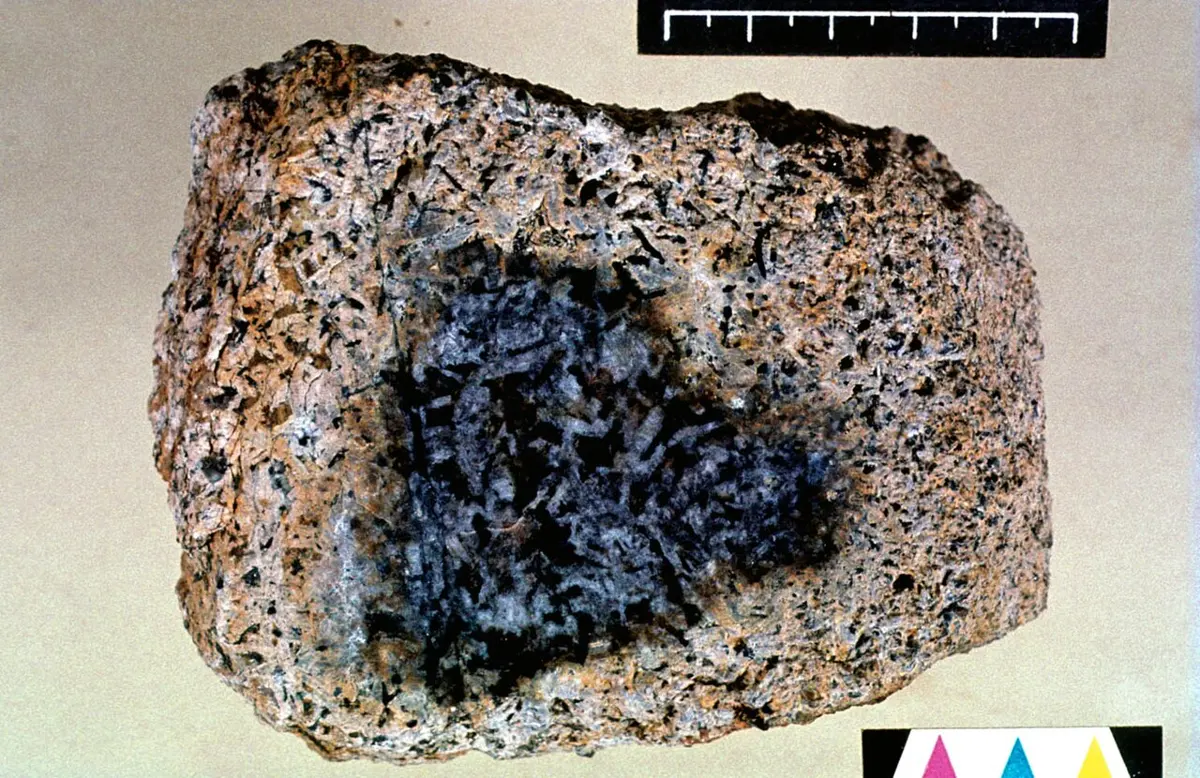
In Nepal. Geologists have found aluminium-rich laterite, a red weathered rock a little like bauxite, in a few districts such as Nuwakot and Kavre, but no bauxite worth mining yet, and Nepal has no plant that makes aluminium. The aluminium in Nepali pots, sheets and wires is brought in from other countries.
In your body. There is very little, and the body has no use for it (see below).
What aluminium is like
- Silvery-white and shiny, though usually a little dull because of its oxide skin. A fresh surface reflects light about as well as silver.
- Light. Its density is 2.70 g/cm³, about a third of iron’s (7.87) or copper’s (8.96). A kilogram of aluminium is a much bigger lump than a kilogram of iron.
- Soft, malleable and ductile. It is one of the most malleable metals, which is why it can be rolled into foil less than 0.02 mm thick Grade 9: Metals are malleable.
- Melts at 660 °C, much lower than iron (1,538 °C), so it is easy to melt again and cast into shapes.
- A good conductor of heat and electricity. That is why cooking pots and power lines are made of it Grade 9: Metals are good conductors of electricity.
- Not magnetic. A magnet does not pick up an aluminium can, which is how cans are separated from steel ones for recycling.
Pure aluminium is too soft for many jobs, so it is usually mixed with a little copper, magnesium, silicon or zinc to make alloys that are several times stronger and still light Grade 8: Alloys. An airplane’s body is mostly aluminium alloy.
The wires inside your house are copper, but the big overhead power lines are aluminium. Why?
Pick an answer to see why.
How aluminium reacts
Aluminium is a reactive metal. In the reactivity series it comes after magnesium and before zinc and iron Grade 9: the reactivity series:
K > Na > Ca > Mg > Al > Zn > Fe > Pb > (H) > Cu > Hg > Ag > Au
So why does an aluminium pot not rust away, when an iron one does? The moment aluminium meets air, its surface reacts with oxygen Grade 9: Metals react with oxygen:
4Al + 3O₂ → 2Al₂O₃
The aluminium oxide forms a skin only about five millionths of a millimeter thick, too thin to see. But it is unbroken and sticks tightly to the metal, so air and water can no longer reach the aluminium underneath, and the reaction stops. Scratch it, and a new skin forms at once. Rust on iron is different: it is loose and flaky, lets air and water through, and falls away, so the iron keeps rusting.
Factories make the skin thicker on purpose by electrolysis, to protect window frames and give them color: this is anodizing.
With dilute acids, aluminium gives hydrogen, as metals above hydrogen do Grade 9: Metals and dilute acids. It is slow at first, until the acid has dissolved the oxide skin; then it fizzes steadily:
2Al + 6HCl → 2AlCl₃ + 3H₂
With bases too. Aluminium oxide is unusual: it reacts with acids, like the oxide of a metal, and also with strong bases such as sodium hydroxide, like the oxide of a non-metal. An oxide that does both is called amphoteric. That is why aluminium pots should not be scrubbed with washing soda or caustic soda: the base eats through the skin and into the metal.
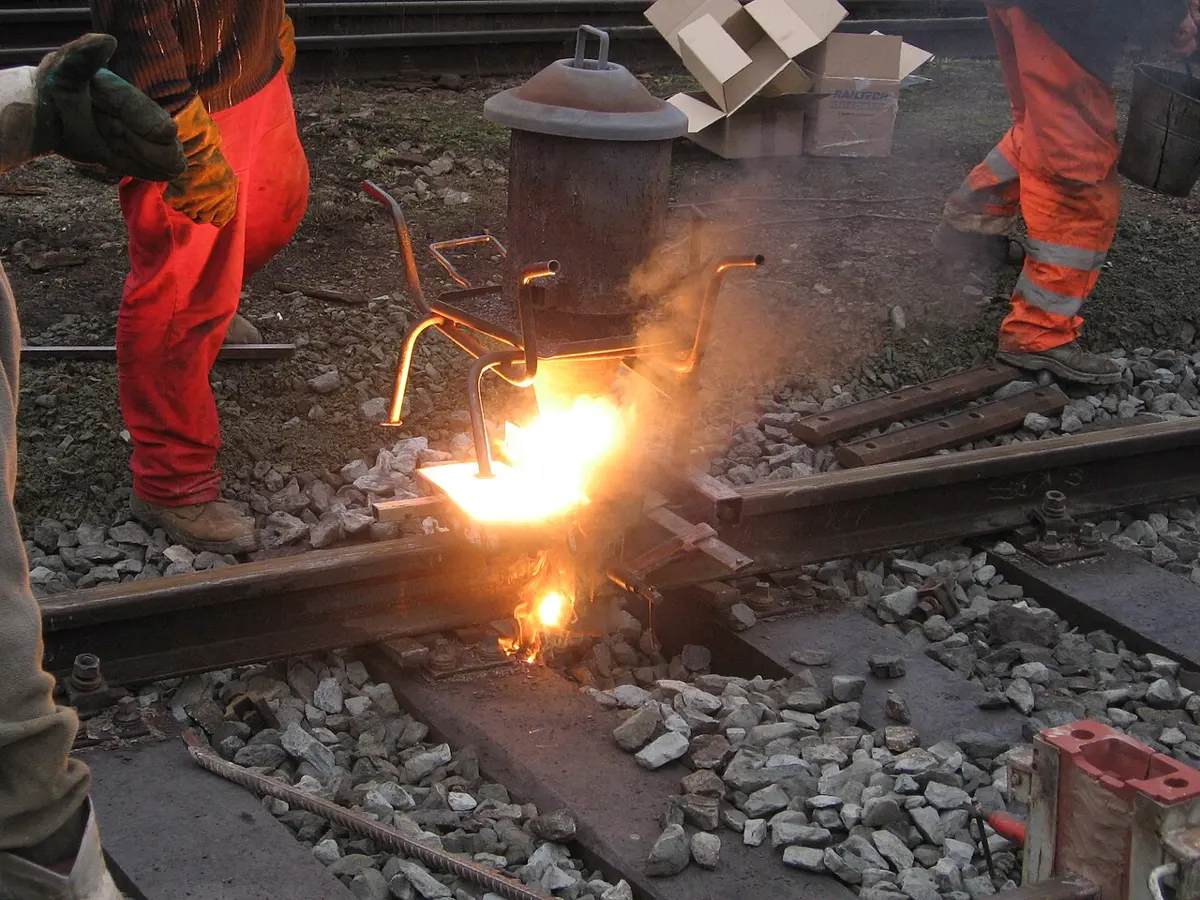
Thermite. Aluminium takes oxygen even from iron oxide. Mix the two powders and light them, and the reaction gives so much heat that the iron comes out molten Grade 9: Exothermic reaction:
2Al + Fe₂O₃ → Al₂O₃ + 2Fe + heat
Railway workers use this thermite reaction to weld rails together on the track.
Aluminium is more reactive than iron. So why does an aluminium window frame last longer outdoors than an iron one?
Pick an answer to see why.
From bauxite to metal
Because aluminium holds oxygen so tightly, carbon cannot reduce its oxide the way it reduces iron oxide in a blast furnace. Only electrolysis works for the most reactive metals Grade 10: Reduction. It is done in two steps.
- The Bayer process (1889): bauxite is dissolved in hot sodium hydroxide solution, which leaves the iron oxide, sand and other impurities behind as a red mud. Pure white alumina, Al₂O₃, is then recovered from the solution.
- The Hall–Héroult process (1886): alumina melts at over 2,000 °C, far too hot to work with. But it dissolves in molten cryolite (Na₃AlF₆) at about 960 °C. A strong current is passed through this melt in a steel pot lined with carbon. Aluminium ions take electrons at the carbon lining (the cathode) and become molten aluminium, which sinks to the bottom and is siphoned off. At the carbon blocks on top (the anodes) the oxygen joins the carbon to make carbon dioxide, so the anodes slowly burn away and must be replaced.
Making aluminium needs a lot of electricity: about 15 kilowatt-hours for each kilogram, enough to run a 100-watt bulb for about six days. So smelters are built where electricity is cheap, often beside big hydropower stations, as in Canada, Norway and Iceland.
Aluminium in daily life and in Nepal
- In the kitchen. Pressure cookers, kettles, डेक्ची and plates: aluminium is light, carries heat quickly from the flame to the food, and does not rust. Its specific heat capacity, 884 J/(kg °C), is more than twice copper’s, so for its weight an aluminium pot stores a lot of heat Grade 10: Specific heat capacity.
- Packaging. Cans, foil, the lids of yoghurt cups, and the thin layer inside juice cartons and the packets of noodles and chips that keeps light, air and damp out.
- Electricity. The overhead lines of Nepal’s grid are aluminium round a steel core.
- Buildings and transport. Window and door frames, ladders, buses, bicycles and airplanes.
- Water treatment. Alum makes the fine mud in water clump together and sink, so the clear water above can be drawn off. Water works use aluminium sulphate the same way, and many people in Nepal clear muddy water with a lump of फिट्किरी. (It does not kill germs: boil or filter the water as well.)
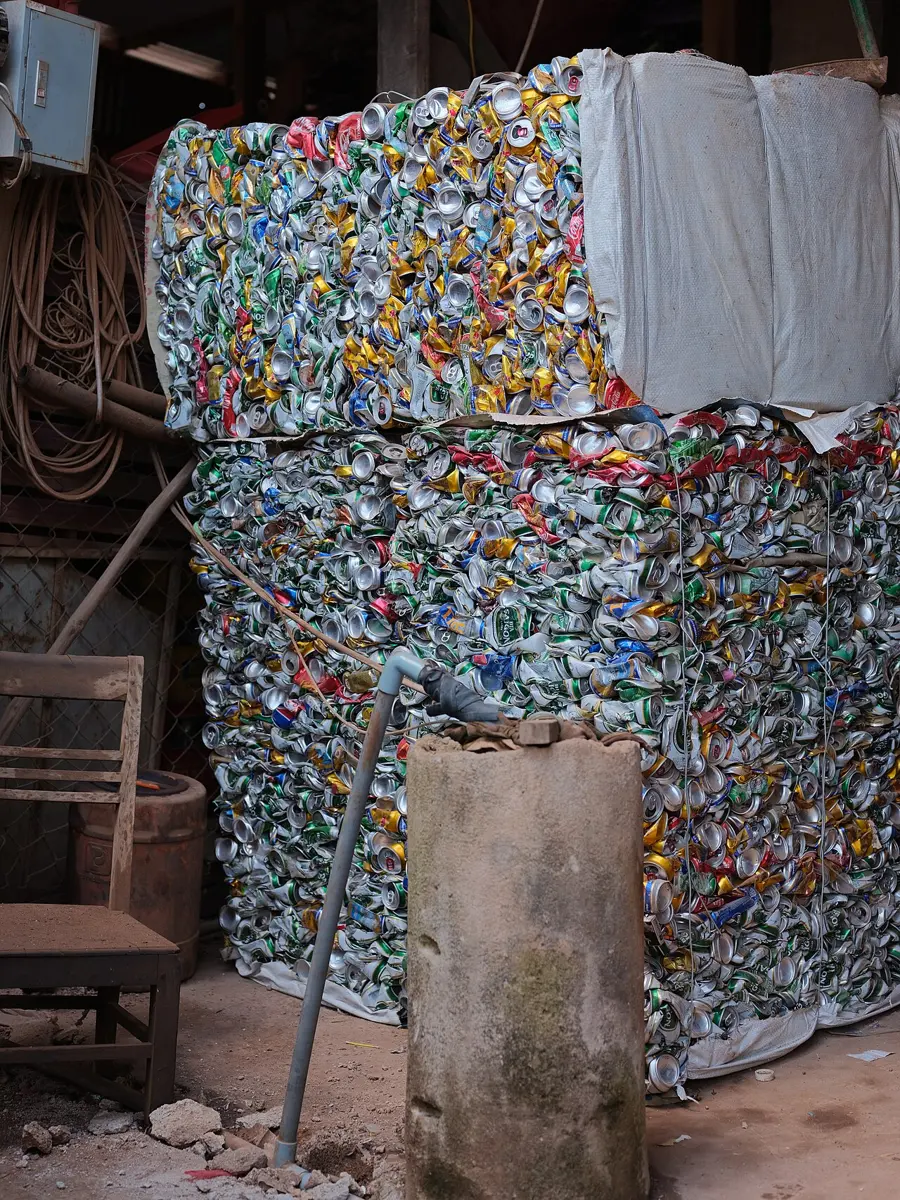
Recycling. Melting down old aluminium needs only about 5% of the energy needed to make it from bauxite, and it can be recycled again and again without getting worse. So about three-quarters of all the aluminium ever made is still in use.
Isotopes of aluminium
Natural aluminium has only one stable isotope, aluminium-27, so its atomic mass, 26.98, is almost a whole number, unlike copper’s 63.5 Grade 9: Atomic mass. A radioactive isotope, aluminium-26 (half-life about 717,000 years), was plentiful when the Solar System formed, and its heat helped melt the first small planets.
Aluminium and your health
Aluminium has no known use in the body, and the body is good at getting rid of the little it takes in, through the kidneys. It is in some medicines: antacids for acidity often contain aluminium hydroxide, a base that neutralizes stomach acid. For many years people worried that aluminium pots cause Alzheimer’s disease, a loss of memory in old age; after over 40 years of research, no good evidence has been found that they do.
Surprising facts and records
- Rubies and sapphires are crystals of aluminium oxide, corundum, the second-hardest natural mineral after diamond. A trace of chromium makes it red (ruby); traces of iron and titanium make it blue (sapphire).
- The first artificial radioactivity. In 1934 Irène and Frédéric Joliot-Curie hit aluminium foil with alpha particles and made a radioactive kind of phosphorus, the first radioactive atoms made by people (Nobel Prize in Chemistry 1935).
In your science books
- Grade 8: atoms and symbols, the 2n² rule, valency, periods and alloys.
- Grade 9: ions, the criss-cross method, properties of metals, the reactivity series and the thermite reaction.
- Grade 10: electronic configuration, ores of aluminium, reduction by electrolysis and specific heat capacity.
- Going further: how ores form, the energy in metals and why to reuse them and counting atoms by weighing them.
More to explore
- Nobel Prizes with aluminium in them: the first artificial radioactive atoms (1935, made from aluminium foil), quasicrystals (2011, first found in an alloy of aluminium and manganese) and the lithium-ion battery (2019).
- Play: make aluminium oxide in Molecule Kitchen, or find aluminium in Guess the Element and the Periodic Table Jigsaw.
- Read more: aluminium at the Royal Society of Chemistry and at PubChem.