
- Atomic number
- 12
- Atomic mass
- 24.3
- Shells
- 2, 8, 2
- Configuration
- 1s² 2s² 2p⁶ 3s²
- In the table
- period 3, group 2 (IIA), s-block
- Kind
- Alkaline earth metal
- Valency
- 2 (Mg²⁺)
- State at 25 °C
- solid
- Melts · boils
- 650 °C · 1,090 °C
- Density
- 1.7 × as heavy as water
- Known since
- 1808
Look at any green leaf: a mango leaf, a blade of grass, a leaf of saag. Its green color comes from chlorophyll, the substance that catches sunlight to make the plant’s food, and in the middle of every chlorophyll molecule sits one atom of a metal: magnesium.
The same metal, as a thin ribbon held in a flame, burns with a light so bright that you must not look straight at it. It is in the white powder of an antacid, the bricks that line steel furnaces, the frame of a laptop and the rocks of Dolakha. Here is its story.
The magnesium atom
A magnesium atom has 12 protons, so its atomic number is 12, and 12 electrons. Most magnesium atoms have 12 neutrons too, so their mass number is 12 + 12 = 24.
By the 2n² rule the K shell takes 2 electrons, the L shell 8, and the last 2 go into the M shell: 2, 8, 2 Grade 8: Bohr and Bury’s rule. In subshells it is 1s² 2s² 2p⁶ 3s² Grade 10: The Aufbau principle.
A magnesium atom gives away its two outer electrons and becomes the magnesium ion, Mg²⁺: 12 protons and 10 electrons, arranged 2, 8, like the noble gas neon (Neon’s shells, everywhere). So magnesium’s valency is 2 Grade 8: Valency.
Its place in the periodic table
- Period 3, because its electrons are in three shells. It sits between sodium (11) and aluminium (13).
- Group 2 (IIA), because it has two outer electrons.
- s-block, because they are in an s subshell.
The metals of group 2 are the alkaline earth metals: beryllium, magnesium, calcium, strontium, barium and radium Grade 8: Characteristics of groups. Their oxides were once called “earths”, and they make alkalis with water. They are reactive, but less so than the alkali metals beside them in group 1: pulling two electrons off an atom takes more energy than pulling one. So magnesium is less reactive than sodium, and less reactive than calcium below it.
Magnesium and calcium are in group 2. Which is true?
Pick an answer to see why.
When magnesium burns, each atom gives its two outer electrons to an oxygen atom. Magnesium becomes Mg²⁺ and oxygen becomes O²⁻, and the two ions hold together in magnesium oxide, MgO Grade 9: Formation of magnesium oxide.
How magnesium was found and named
Another white powder, magnesia, was sold by chemists as a medicine. It came from rocks found near Magnesia, a district of Thessaly in Greece, and it looked like lime (calcium oxide). In 1755 the Scottish chemist Joseph Black showed that they were different substances: magnesia held an element of its own.
Getting the metal out was harder. In 1808 the English chemist Humphry Davy, who had made sodium and potassium the year before with electricity, made a tiny amount of magnesium by electrolysis. He wanted to call it magnium, because “magnesium” was then being used for manganese, but magnesium won. In 1831 the French chemist Antoine Bussy made the first lump of magnesium big enough to study, by heating magnesium chloride with potassium. Its symbol is Mg. Nepali writes it म्याग्नेसियम; it has no older Nepali name.
Where magnesium is found
In the universe. Magnesium is made in the cores of big stars, as they fuse carbon and then neon at temperatures of around a billion degrees (Each fuel needs a hotter core), and is scattered when they explode.
In the Earth. Magnesium is the eighth most common element in the Earth’s crust, and far more common deeper down: the mantle, the thick layer under the crust, is made mostly of rock rich in magnesium and iron (Inside the Earth). It is never found as the metal. Its main ores are:
- magnesite, magnesium carbonate, MgCO₃;
- dolomite, calcium magnesium carbonate, CaCO₃·MgCO₃, a rock like limestone;
- sea water, which holds about 1.3 g of magnesium in every liter, and salt lakes.
In 2024 the world made about 1 million tonnes of magnesium metal, about 95% of it in China (USGS, 2025).
In Nepal. Nepal has magnesite in Dolakha, Udayapur and Palpa Grade 8: Minerals in Nepal. The deposit at Kharidhunga in Dolakha is one of the largest known: surveys have estimated about 180 to 200 million tonnes of magnesite. A government company, Nepal Orind Magnesite, mined it at Lakuri Danda and roasted it into magnesia for furnace bricks, but its plant has been closed since 1997, and plans to restart it have not yet succeeded.
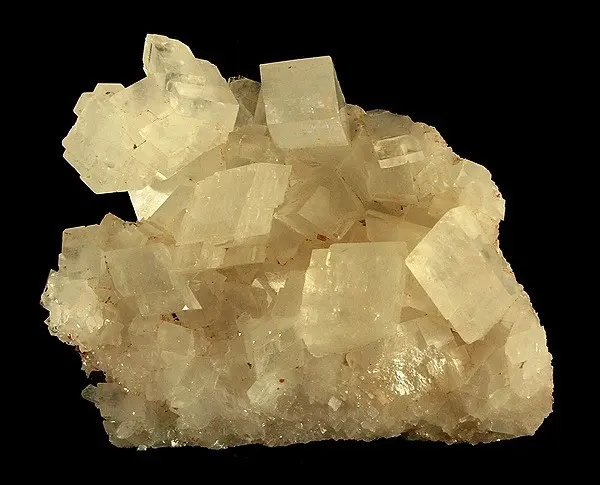
Farmers in Nepal also spread powdered dolomite on acid soil: it makes the soil less acid and gives plants magnesium and calcium Grade 8: Minerals in agriculture.
In water. Water that has run through rocks picks up magnesium and calcium salts and becomes hard water, which wastes soap and leaves scale in kettles Grade 8: Hardness of water.
What magnesium is like
- A shiny, silvery-white metal, which turns dull gray in air as a thin layer of oxide forms. The oxide protects the metal underneath.
- Very light for a metal: its density is 1.74 g/cm³. It is the lightest metal strong enough to build with: about two-thirds as heavy as aluminium, and less than a quarter as heavy as steel.
- Melts at 650 °C, and boils at 1,090 °C.
- Conducts heat and electricity well, like every metal.
How magnesium reacts
Magnesium is a reactive metal, high in the reactivity series, but well below sodium and calcium.
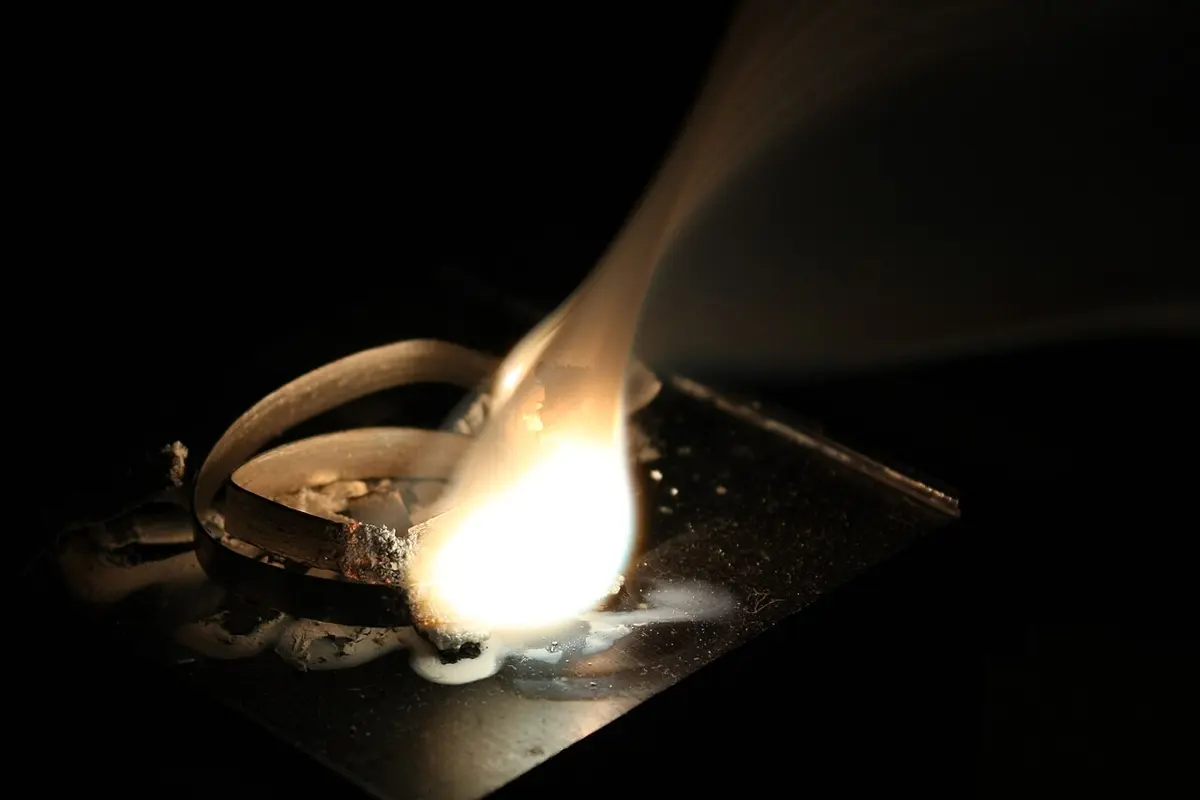
With oxygen. Held in a flame, magnesium ribbon catches fire and burns with a dazzling white light, leaving a white ash of magnesium oxide Grade 9: Metals react with oxygen:
2Mg + O₂ → 2MgO
The light is so bright that before electric flashes, photographers lit their pictures with burning magnesium powder; fireworks, sparklers and emergency flares still use it.
Magnesium oxide is a basic oxide. Shaken with water, a little dissolves as magnesium hydroxide, which turns red litmus blue:
MgO + H₂O → Mg(OH)₂
With water. Cold water attacks magnesium only very slowly: a few bubbles of hydrogen in a day. With hot water it is faster, and with steam it burns with a white glow, giving magnesium oxide and hydrogen:
Mg + H₂O → MgO + H₂
With dilute acids. Magnesium fizzes fast in dilute hydrochloric acid, getting warm and slowly disappearing as it gives off hydrogen Grade 8: Acids react with metals:
Mg + 2HCl → MgCl₂ + H₂
With carbon dioxide. Carbon dioxide puts out most fires, but not burning magnesium. Magnesium pulls the oxygen out of carbon dioxide and goes on burning, leaving white magnesium oxide speckled with black carbon Grade 10: Chemical properties of carbon dioxide:
2Mg + CO₂ → 2MgO + C
A strip of magnesium is dropped into blue copper sulphate solution. What happens?
Pick an answer to see why.
Magnesium’s useful compounds
| Compound | Formula | Uses |
|---|---|---|
| magnesium oxide (magnesia) | MgO | bricks that line steel furnaces and kilns (it melts only above 2,800 °C), animal feed, fertilizer |
| magnesium hydroxide (milk of magnesia) | Mg(OH)₂ | an antacid for acidity, and a laxative Grade 8: Uses of bases |
| magnesium sulphate (Epsom salt) | MgSO₄·7H₂O | fertilizer, bath salts, a laxative, medicine in hospitals |
| magnesium carbonate | MgCO₃ | the white “chalk” that gymnasts and climbers rub on their hands to keep them dry |
| magnesium chloride | MgCl₂ | making magnesium metal; in tofu-making |
How magnesium metal is made
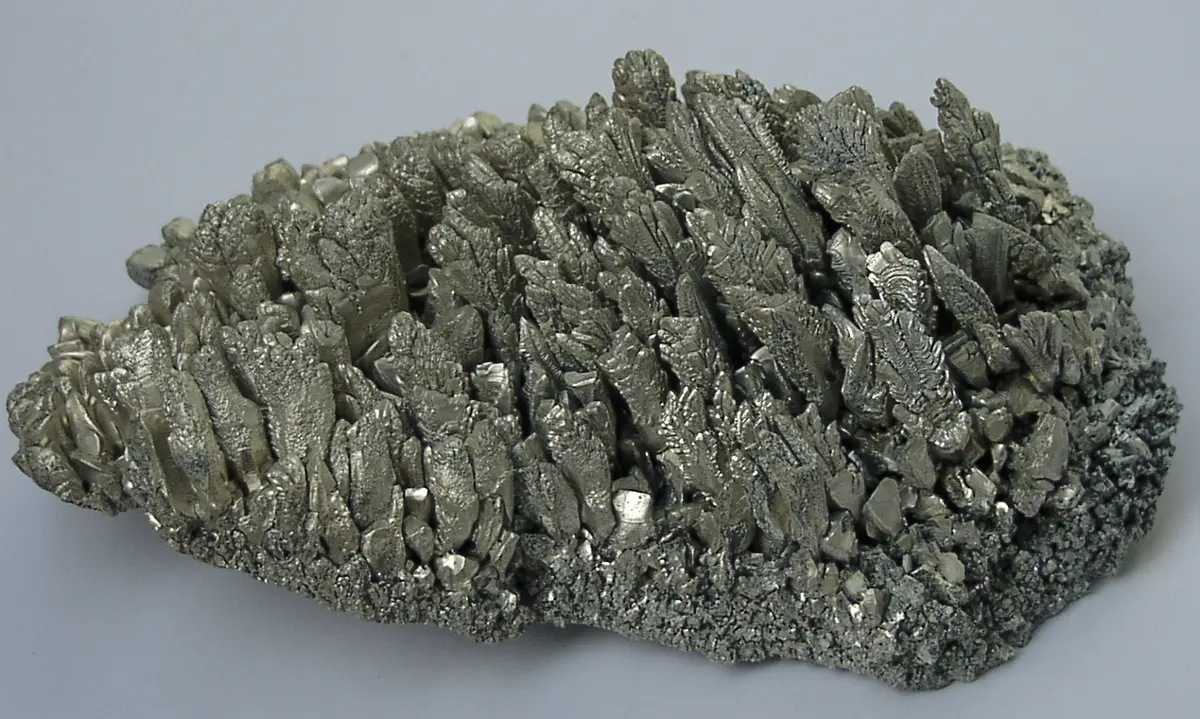
Most magnesium, nearly all of it in China, is made by the Pidgeon process: dolomite is roasted to drive off carbon dioxide, then heated with ferrosilicon (an alloy of iron and silicon) in steel tubes, without air, to about 1,200 °C. Silicon takes the oxygen from the magnesium oxide, and magnesium boils off as a vapor that condenses as crystals at the cool end of the tube, like the ones in the photo at the top of this page.
The other way, used where sea water or salt lakes are handy, is like sodium’s: magnesium chloride is melted and split by electricity, giving magnesium at the cathode and chlorine at the anode (Mg²⁺ + 2e⁻ → Mg).
Magnesium in daily life
- Light alloys. Most magnesium is mixed into aluminium to make it stronger and easier to shape: the aluminium of drink cans and window frames, and duralumin for aircraft, hold a little magnesium Grade 8: Alloys. Alloys that are mostly magnesium are used where every gram counts: laptops, cameras, power tools, car seats and steering wheels.
- Making iron and steel. A little magnesium stirred into molten iron removes sulphur, which makes steel brittle.
- Saving steel from rust. Many electric water heaters (geysers) have a rod of magnesium inside. Magnesium is more reactive than iron, so the water attacks the rod instead of the steel tank: the rod is eaten away slowly and is replaced every few years.
- Light and heat. Flares, fireworks and sparklers, and food heaters for soldiers and mountaineers, which warm a meal with magnesium powder and salt water (A heater without fire).
Magnesium in living things
In every green leaf
Chlorophyll is a large molecule shaped like a flat ring of carbon and nitrogen atoms, with a long tail. Right in the middle of the ring, held by four nitrogen atoms, is one magnesium ion. Without magnesium, a plant can’t make chlorophyll, and can’t make its food by photosynthesis. Your blood’s hemoglobin has a very similar ring, but with iron in the middle instead.
Magnesium is one of the secondary nutrients that plants need from the soil Grade 9: Necessary nutrients for plants. A plant short of it moves the magnesium from its old leaves to its new ones, so the older leaves turn yellow between the veins, while the veins stay green. Farmers add dolomite or Epsom salt.
Why do the leaves of a plant short of magnesium turn yellow?
Pick an answer to see why.
In your body
An adult’s body holds about 20 to 25 g of magnesium, more than half of it in the bones. The rest helps hundreds of enzymes do their work: releasing energy from food (every molecule of ATP, the cell’s energy carrier, works together with a magnesium ion), making proteins and DNA, and keeping nerves and muscles, including the heart, working.
You need about 300 to 400 milligrams a day. Green leafy vegetables such as saag (for the chlorophyll), dal and other beans, whole grains, nuts and seeds give plenty. Too little can cause muscle cramps and a weak heartbeat; too much, usually from medicines, causes diarrhea, which is why magnesium salts are laxatives.
Isotopes of magnesium
Natural magnesium is a mixture of three isotopes, none of them radioactive: about 79% magnesium-24, 10% magnesium-25 and 11% magnesium-26 Grade 9: Atomic mass.
Surprising facts and records
- Ash that weighs more. Burn a magnesium ribbon and the white ash weighs more than the ribbon did: oxygen atoms from the air have joined it. Weighing the ash is a classic way to find the formula of magnesium oxide (Evidence from the laboratory).
- Magnesium from the sea. The sea holds so much magnesium that every cubic kilometer of sea water has more than a million tonnes of it.
- Magnesium at the start of a famous Nobel experiment. In 1978 David Wineland and his team trapped magnesium ions and cooled them with laser light, the first step to the experiments that won the Nobel Prize in Physics in 2012.
In your science books
- Grade 8: the 2n² rule, valency, the criss-cross method (MgO), acids and metals, hard water and minerals in Nepal.
- Grade 9: formation of magnesium oxide, metals and oxygen, metals and acids and plant nutrients.
- Grade 10: the Aufbau principle, metals in the periodic table, combination and displacement reactions and magnesium in carbon dioxide.
- Going further: weighing magnesium oxide, the mantle and where magnesium is made.
More to explore
- Nobel Prizes with magnesium in them: the photosynthetic reaction center (1988, the light-catching machine built round magnesium-centered chlorophylls), RNA as an enzyme (1989, which works only with magnesium ions), joining carbon atoms (2010, which began with Grignard’s magnesium) and trapping single ions (2012).
- Play: make magnesium oxide and Epsom salt in Molecule Kitchen, or find magnesium in Guess the Element and the Periodic Table Jigsaw.
- Read more: magnesium at the Royal Society of Chemistry and at PubChem.