
- Atomic number
- 10
- Atomic mass
- 20.18
- Shells
- 2, 8
- Configuration
- 1s² 2s² 2p⁶
- In the table
- period 2, group 18 (0), p-block
- Kind
- Noble gas
- Valency
- 0 (it forms no compounds)
- State at 25 °C
- gas
- Melts · boils
- −249 °C · −246 °C
- Density
- lighter than air
- Known since
- 1898
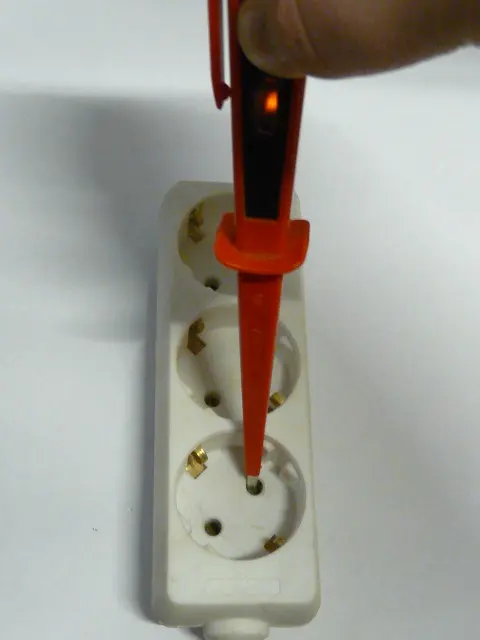
Watch an electrician check a socket in Nepal. They touch it with a screwdriver that has a clear handle, put a finger on the cap at the back, and if the wire is live, a tiny lamp inside the handle glows orange. That little glow comes from neon, the same gas as in the bright red shop signs of the world’s big cities.
Neon is a gas you breathe in with every breath, yet it is so rare in the air, and so unwilling to join with anything, that it was only found in 1898. Here is its story.
The neon atom
A neon atom has 10 protons, so its atomic number is 10, and 10 electrons. Most neon atoms have 10 neutrons as well, so their mass number is 10 + 10 = 20.
By the 2n² rule the K shell takes 2 electrons and the L shell, which can hold 8, takes the other 8: 2, 8 Grade 8: Bohr and Bury’s rule. In subshells it is 1s² 2s² 2p⁶: the 2s and 2p subshells of the second shell are both completely full Grade 10: The Aufbau principle.
Eight electrons in the outer shell are an octet Grade 9: Octet and octet rule. An atom with a full outer shell is stable: it has no electron it wants to lose and no room it wants to fill. So neon doesn’t lose, gain or share electrons, and its valency is 0.
Its place in the periodic table
- Period 2, because its electrons are in two shells. It is the last element of the period, after fluorine.
- Group 18, called group 0 in the older naming many books use, at the far right of the table.
- p-block, because its last electrons go into a p subshell.
Neon is the second of the noble gases or inert gases: helium, neon, argon, krypton, xenon and radon Grade 8: Position of inert gases. All are colorless gases made of single atoms, and all have a full outer shell.
Why doesn’t neon take part in chemical reactions?
Pick an answer to see why.
Neon’s shells, everywhere
When other atoms react, many of them end up with exactly neon’s arrangement, 2, 8. A sodium atom (2, 8, 1) loses its one outer electron to become the ion Na⁺: 2, 8. Magnesium (2, 8, 2) loses two to become Mg²⁺. Fluorine (2, 7) gains one to become F⁻, and oxygen (2, 6) gains two to become O²⁻ Grade 9: Ions. That is what “reaching an octet” means: getting the same stable shells as the nearest noble gas.
A particle has 12 protons and 10 electrons. What is it?
Pick an answer to see why.
How neon was found and named
By 1898 the Scottish chemist William Ramsay had already found two noble gases: argon in the air (with Lord Rayleigh, 1894) and helium in a mineral (1895). There was an empty place in his table between them, so he was sure there was another gas, and he guessed it was hiding in the air.
Working in London with the young English chemist Morris Travers, he cooled air until it turned into a liquid, then let it warm up slowly and collected the gases one by one as they boiled off. In the summer of 1898 they found three new elements:
- Krypton, at the end of May, in the gas left behind after most of the liquid had boiled away.
- Neon, in June, in the gas that boiled off first from solid argon: the lighter gas they had been looking for.
- Xenon, soon after.
When they passed electricity through a tube of the new light gas, it lit up a brilliant red. Travers wrote: “the blaze of crimson light from the tube told its own story and was a sight to dwell upon and never forget.”
The name. Ramsay’s son suggested novum, Latin for new. Ramsay used the Greek word for new instead, neos: hence neon, and the symbol Ne. Nepali writes it नियोन; it has no older Nepali name.
Where neon is found
In the universe. Neon is common: about the fifth most common element, after hydrogen, helium, oxygen and carbon. Most of it is made in the cores of big stars, more than about eight times the mass of the Sun, where carbon atoms fuse together at hundreds of millions of degrees (Each fuel needs a hotter core), and scattered when the star explodes.
On the Earth, neon is rare. Only about 18 parts in a million of the air are neon Grade 9: Gases around us: a whole room, 4 m by 4 m by 3 m, holds less than a liter of neon. When the Earth formed, light gases like neon, which join with nothing, could not be held in its rocks, and most of them escaped. The little that remains is in the air, and the air is where all our neon comes from.
How it is collected. Factories that make liquid oxygen and nitrogen cool air to about −200 °C, until it is liquid, and then separate the gases by their boiling points, fractional distillation. Neon, which boils at −246 °C, is among the last gases to become liquid and the first to boil off, together with helium; then charcoal soaks up the neon and lets the helium through. The neon in about 55,000 liters of air makes just 1 liter of neon gas, which is why neon is expensive.
What neon is like
- A colorless gas with no smell or taste, made of single atoms, Ne.
- Lighter than air: a liter weighs about 0.9 g at 0 °C, while a liter of air weighs 1.3 g. A neon balloon would rise, but more slowly than one filled with helium.
- Very cold liquid: neon becomes liquid at −246 °C and freezes at −249 °C. It is a liquid for only about 2½ degrees (from −248.6 to −246.0 °C), the narrowest range of any element.
- It doesn’t burn and doesn’t help anything burn.
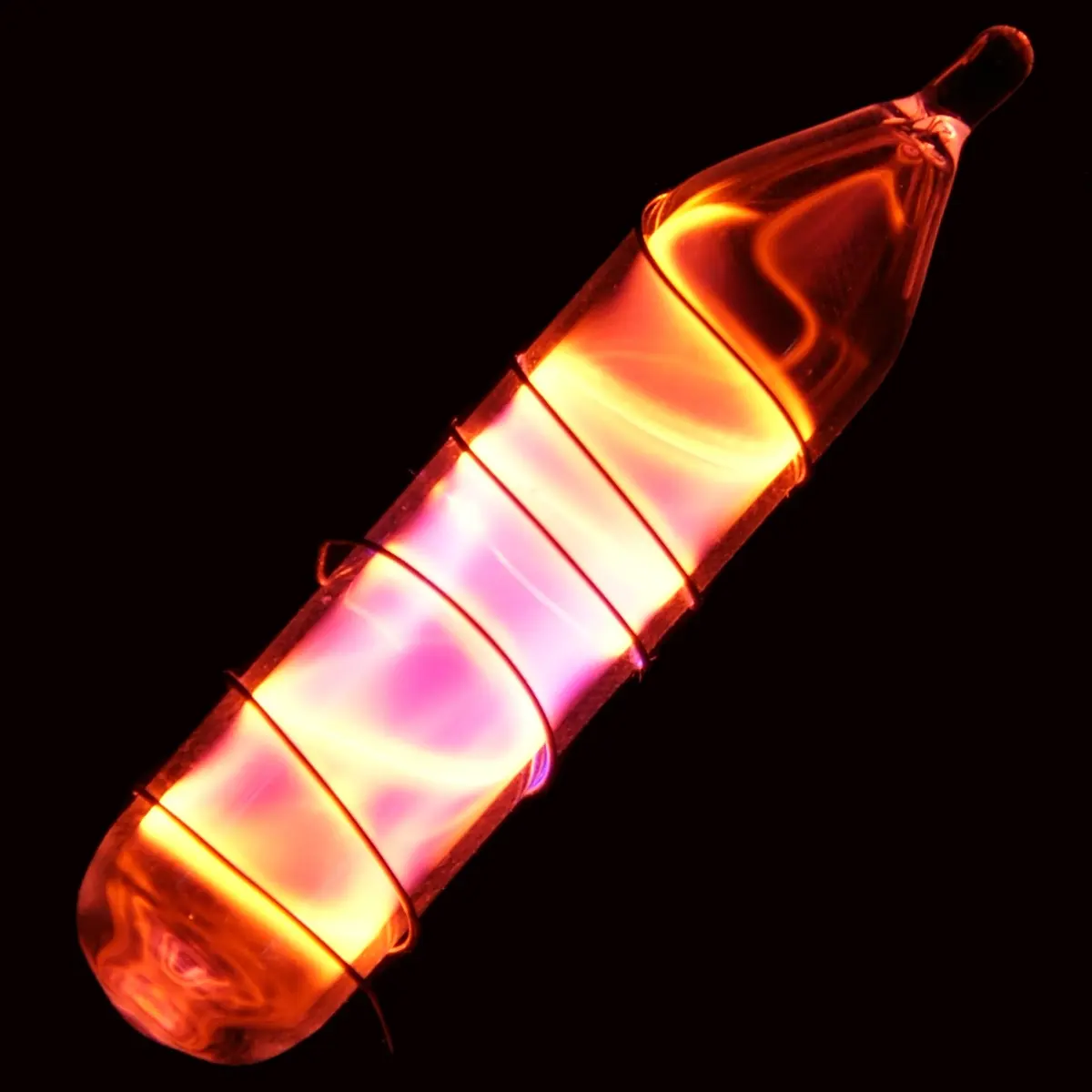
- It glows a bright orange-red when electricity passes through it at low pressure.
Why doesn’t neon form molecules, as oxygen and nitrogen do (O₂, N₂)? Two neon atoms have nothing to share: each already has its octet. So neon stays as single atoms, which pull on each other only very weakly. That is why it stays a gas down to such low temperatures (Molecules with no charged ends).
Why neon glows
Inside a neon tube the gas is at low pressure, and a high voltage between the two ends drives electrons through it. When a fast electron hits a neon atom, it gives one of the atom’s electrons a kick to a higher energy level, further from the nucleus. A moment later that electron drops back, and the energy comes out as a flash of light (Why each element has its own lines).
Each element’s atoms have their own energy levels, so they give out their own exact colors, seen through a spectroscope as bright lines. Neon has dozens of lines in the red, orange and yellow, and hardly any in the blue: together they look orange-red.
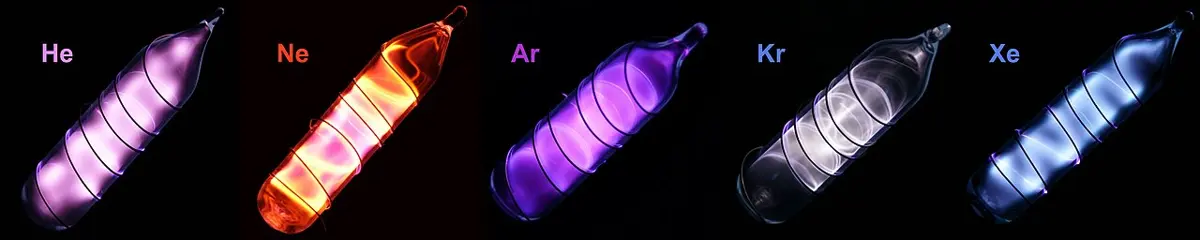
You can see the bright lines of glowing gases for yourself with the Spectroscope at Science Playground (The Spectroscope), and see glowing gas at the Plasma Ball (Plasma Ball), whose ball holds a mixture of noble gases at low pressure.
Neon in daily life
Neon signs
In December 1910, at a motor show in Paris, the French engineer Georges Claude lit two long glass tubes of neon. His company liquefied air to sell oxygen, and neon was a leftover. He tried selling neon tubes as lamps for homes, but people didn’t want their rooms lit red. Advertisers did: in 1912 a barber’s shop in Paris bought the first neon sign, and within twenty years glowing signs lit up cities around the world.
A neon sign is a glass tube heated and bent into letters or shapes, emptied of air, filled with a little gas, and sealed with a metal electrode at each end. A transformer raises the mains voltage to several thousand volts, enough to drive electrons through the long tube of gas.

Only the red and orange signs hold neon. Other colors come from other gases (argon with a little mercury gives blue) or from a coating inside the glass, which turns ultraviolet light into other colors, as in a tube light. Today most new glowing signs, including many that are still called “neon”, are strips of LEDs, which use less electricity.
A shop sign glows bright blue. Is it filled with neon?
Pick an answer to see why.
The neon lamp in a tester
Small neon lamps, a pea-sized glass bulb with two wires inside and a pinch of neon, glow orange with very little current. They were the “power on” light of many switches and appliances, and many are still used.
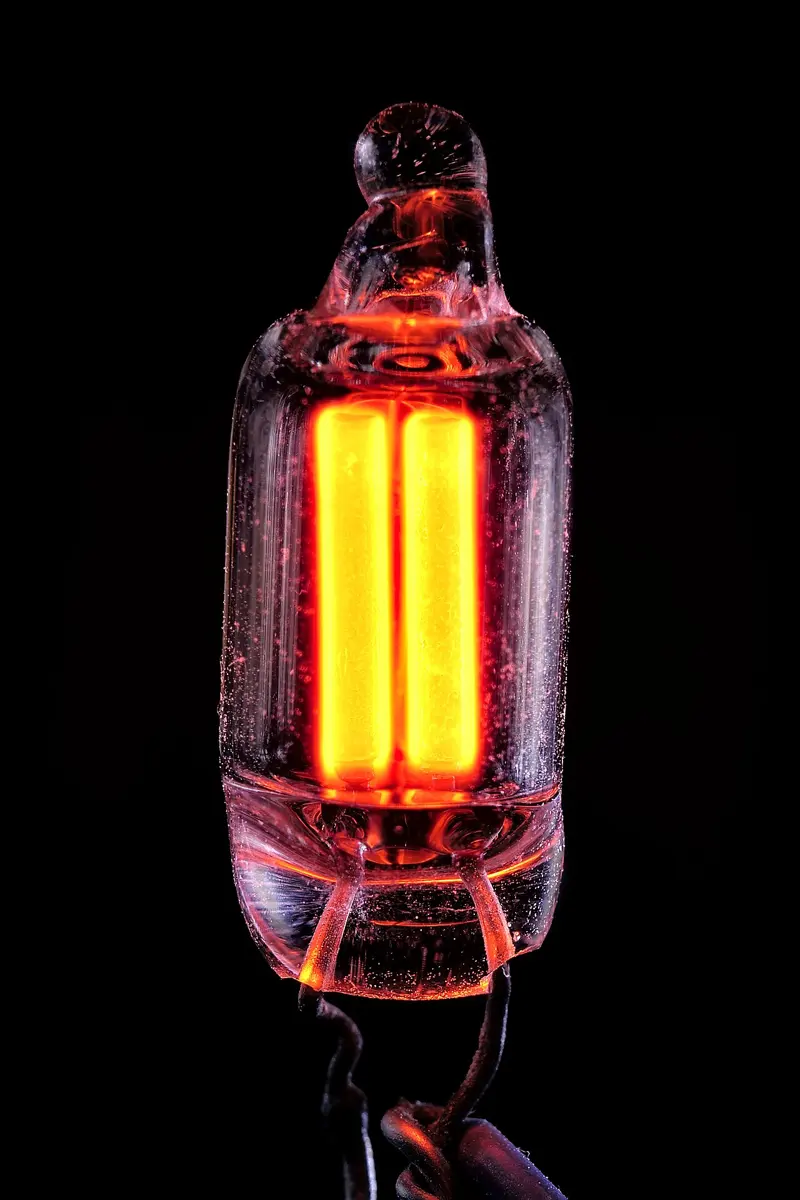
The screwdriver tester (line tester) that electricians use has one inside its handle, in series with a resistor of very high resistance. Touch the tip to a live wire and your finger to the cap, and a tiny current, far too small to feel, flows through the lamp and your body to the ground, enough to make the neon glow.
Lasers and cold
- The helium–neon laser. In 1960 Ali Javan and his colleagues in the United States made the first laser that worked with a gas and shone continuously, using a mixture of helium and neon (Masers and lasers). Its later versions gave a red beam, at 632.8 nm, one of neon’s own red lines. Such a laser read the barcodes in the first supermarket scanner, in 1974, and they still line up instruments in laboratories.
- Making computer chips. Neon is mixed with other gases in the powerful ultraviolet lasers that print the tiny patterns on computer chips.
- A refrigerant. Liquid neon cools things to about −246 °C. A liter of it can absorb about 40 times more heat as it boils than a liter of liquid helium.
- Lightning arresters and old plasma TV screens used glowing neon too.
Isotopes of neon
Natural neon is a mixture of three isotopes, none of them radioactive: about 90.5% neon-20 (10 neutrons), 0.3% neon-21 (11 neutrons) and 9.3% neon-22 (12 neutrons) Grade 9: Atomic mass.
Neon and your health
Neon has no job in the body and is not poisonous: you breathe a little in and out with every breath. But like any gas, a lot of it in a closed room would push out the oxygen you need. Liquid neon, at −246 °C, burns skin like fire.
Surprising facts and records
- Neon in your breath. You breathe out the same neon you breathe in: your body can’t use it, and it can’t join with anything in your blood.
- A fixed point of temperature. The temperature at which solid, liquid and gas neon can all exist together, −248.6 °C, is one of the fixed points scientists use to calibrate thermometers.
- Neon on the Moon. In 2015 NASA’s LADEE spacecraft found neon in the Moon’s very thin atmosphere.
In your science books
- Grade 8: the first 20 elements, the 2n² rule, valency and inert gases.
- Grade 9: octet and octet rule, ions and the gases of the air.
- Grade 10: the Aufbau principle and non-metals and noble gases.
- Going further: why each element has its own lines, where neon is made and why single atoms boil so low.
More to explore
- Nobel Prizes: masers and lasers (1964, the helium–neon laser) and Bohr’s atom (1922, why each element gives its own colors).
- Play: find neon in Guess the Element, the Periodic Table Jigsaw and Higher or Lower.
- Read more: neon at the Royal Society of Chemistry and at PubChem.