
- Atomic number
- 24
- Atomic mass
- 52
- Shells
- 2, 8, 13, 1
- Configuration
- 1s² 2s² 2p⁶ 3s² 3p⁶ 4s¹ 3d⁵
- In the table
- period 4, group 6 (VIB), d-block
- Kind
- Transition metal
- Valency
- 3 and 6 (Cr³⁺ as in Cr₂O₃; chromate and dichromate), sometimes 2
- State at 25 °C
- solid
- Melts · boils
- 1,907 °C · 2,671 °C
- Density
- 7.2 × as heavy as water
- Known since
- 1797
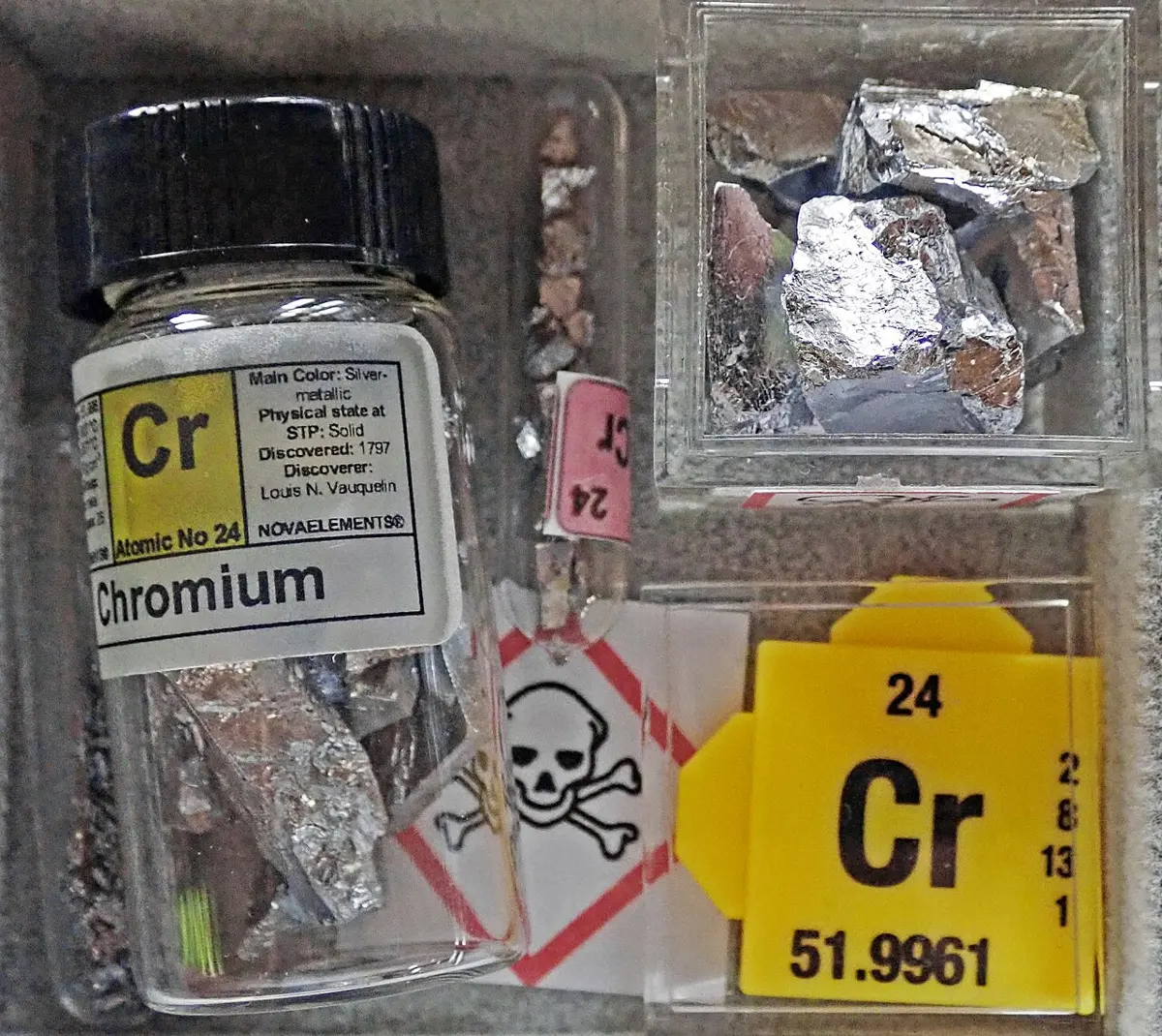
Eat from a steel thali, stir tea with a steel spoon, or wash your hands at a shiny tap, and you are using chromium. It is the metal that makes stainless steel stainless, and the bright mirror finish on taps, bicycle bells and motorbike parts. It also puts the red in rubies and the green in emeralds.
Its name comes from the Greek word for color, because almost every one of its compounds is brightly colored. Here is its story.
The chromium atom
A chromium atom has 24 protons, so its atomic number is 24, and 24 electrons. Most chromium atoms have 28 neutrons, so their mass number is 24 + 28 = 52.
By shells, the electrons are 2, 8, 13, 1: only one electron in the outer N shell, where you might expect two.
Its electronic configuration
In Grade 10 you write electrons in subshells Grade 10: The Aufbau principle. After argon’s 18 electrons, 4s fills first, then 3d. So you would expect chromium’s 24 electrons to be:
1s² 2s² 2p⁶ 3s² 3p⁶ 4s² 3d⁴
But the real atom is:
1s² 2s² 2p⁶ 3s² 3p⁶ 4s¹ 3d⁵
One electron moves from 4s into 3d. Then each of the five 3d boxes (orbitals) holds exactly one electron, and the 3d subshell is half full. A half-full subshell, like a completely full one, is especially stable. Chromium and copper are the two famous exceptions in period 4: copper moves an electron to make 3d full, chromium to make it half full.
Which is the electronic configuration of a chromium atom (Z = 24)?
Pick an answer to see why.
Its place in the periodic table
- Period 4, because its electrons are in four shells.
- Group 6, called VIB in the older naming, between vanadium (23) and manganese (25).
- d-block, because its last electrons go into a d subshell: chromium is a transition metal Grade 10: Metals.
Below chromium in group 6 are molybdenum (42) and tungsten (74). Like chromium, they are hard and melt only at very high temperatures; tungsten melts at 3,422 °C, the highest of all metals, which is why it was used for the glowing filaments of old light bulbs.
Valency. Chromium’s six outer electrons (4s¹ 3d⁵) can all take part in bonds, so its highest valency is 6, as in yellow chromates and orange dichromates. Its commonest valency is 3, as in the green oxide Cr₂O₃ and the ion Cr³⁺. It shows valency 2 as well Grade 9: Variable valency.
How chromium was found and named
In 1761 a bright orange-red mineral was found in a gold mine in the Ural Mountains of Russia. People called it “Siberian red lead”, and painters loved its color. Today it is called crocoite, and it is lead chromate (PbCrO₄).
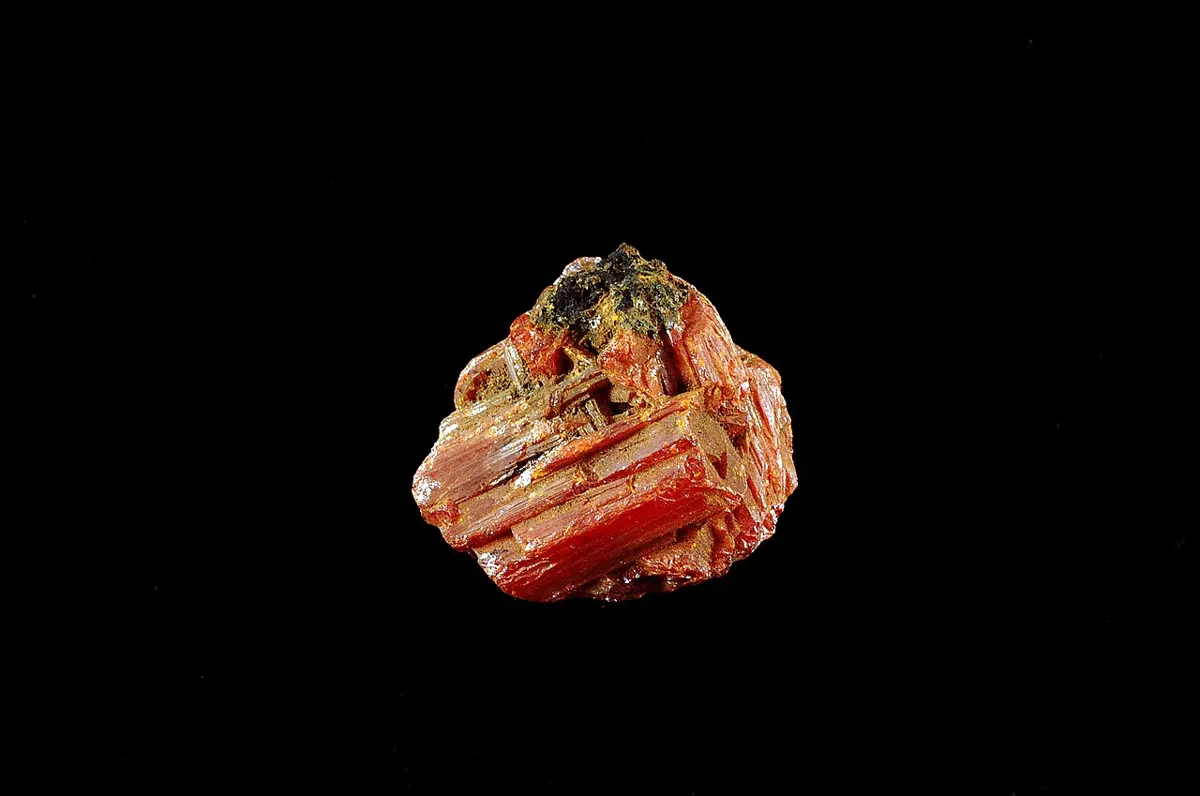
In 1797 the French chemist Louis-Nicolas Vauquelin analyzed it. He removed the lead and found the oxide of a new metal; heating that oxide with charcoal, which took away its oxygen Grade 10: Reduction, he got the metal itself. Its compounds came out in so many colors (yellow, orange, red, green) that he named it from the Greek chroma, “color”. The symbol is Cr. Soon after, he found chromium in rubies and in emeralds, and showed that it gives them their color.
Where chromium is found
In the universe. Chromium is made in big stars and in their explosions as supernovae, along with its neighbors manganese and iron (Cooking in stars up to iron).
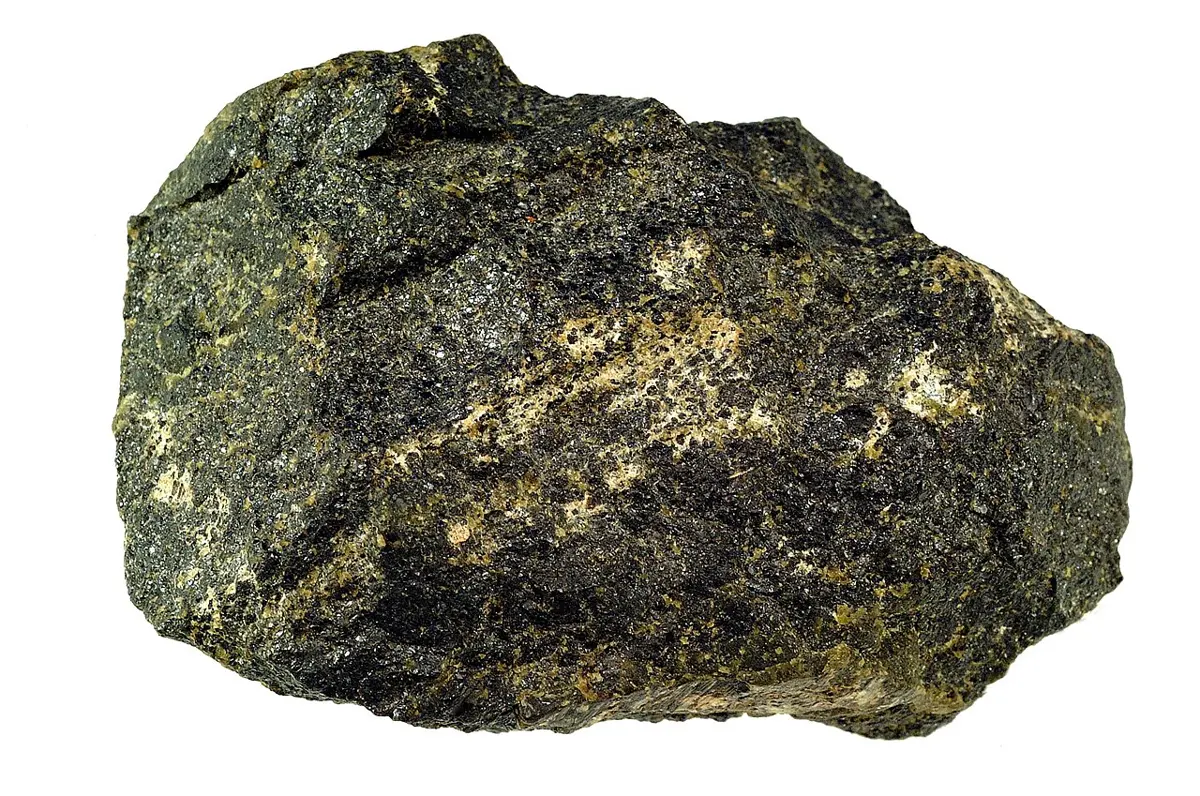
In the Earth’s crust. Chromium makes up only about 0.01% of the crust (about 100 grams in a tonne of rock), the 21st most common element. Almost all of it is mined as chromite, a heavy black oxide of iron and chromium (FeCr₂O₄). In 2025 the world mined about 51 million tonnes of chromite. South Africa mined almost half of it, then Turkey, Kazakhstan and India. Nearly all the world’s known chromium is in Kazakhstan and southern Africa (USGS, 2026).
What chromium is like
- Color. Silvery, with a faint blue tinge. It takes a very high polish and then reflects like a mirror.
- Very hard. Chromium is one of the hardest metals: it can scratch glass and even quartz.
- High melting point: 1,907 °C, much higher than iron (1,538 °C).
- Brittle when pure, so, like manganese, it is used mostly mixed into other metals and as a coating.
How chromium reacts
Chromium is more reactive than iron: it comes just above iron in the reactivity series. Yet a piece of chromium left in damp air stays bright for years. Why?
The moment fresh chromium meets air, its surface atoms join with oxygen and form a layer of chromium oxide (Cr₂O₃) only a few millionths of a millimeter thick. You cannot see it, but it is tight and unbroken, and it sticks to the metal. It keeps air and water away from the metal underneath, so the reaction stops almost as soon as it starts. Such a protected metal is called passive. If the layer is scratched, the chromium underneath at once reacts with the air and the layer grows back.
Rust on iron is quite different. It is flaky and full of cracks, and it falls off, so air and water keep reaching fresh iron Grade 9: Metals react with oxygen.
Once its oxide layer is removed, chromium reacts with dilute hydrochloric acid, giving hydrogen and a blue solution of chromium(II) chloride, which slowly turns green in air as the chromium changes to valency 3:
Cr + 2HCl → CrCl₂ + H₂
The colors of chromium
Chromium’s compounds are famous for their colors:
- Chromium(III) oxide, Cr₂O₃, is a dull green powder, used as a paint pigment (“chrome green”);
- Potassium chromate, K₂CrO₄, is yellow;
- Potassium dichromate, K₂Cr₂O₇, is orange; add a base to it and it turns back into yellow chromate, add an acid and it turns orange again;
- Lead chromate, the crocoite of the Urals, made in factories, is the bright chrome yellow of many paints.
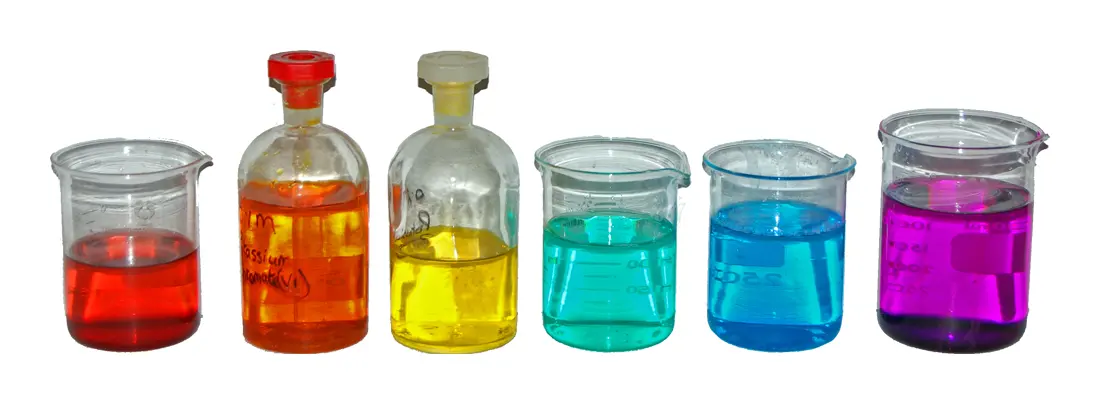
Dichromate is a strong oxidizing agent. When it takes electrons from another substance, its chromium goes from valency 6 to valency 3, and the orange changes to green. The first breath-testing devices used by police worked this way: alcohol in a driver’s breath, passed through a tube of acidified dichromate crystals, turned them from orange to green.
Stainless steel contains a lot of iron. Why doesn’t it rust like ordinary steel?
Pick an answer to see why.
How chromium is made and used
Most chromium is never made pure. Chromite ore is heated with carbon (coke) in an electric furnace. The carbon takes away the oxygen and leaves ferrochrome, an alloy of iron and chromium, which goes straight into stainless steel.
For pure chromium, its oxide is reduced with aluminium, which is more reactive and grabs the oxygen in a very hot reaction (like the thermite reaction):
Cr₂O₃ + 2Al → 2Cr + Al₂O₃
Stainless steel
Stainless steel is steel with at least about 11% chromium Grade 8: Steel and stainless steel. The commonest kind has 18% chromium and 8% nickel: look under a steel plate or spoon and you may find it stamped 18/8 or 304. The chromium gives the protective layer; the nickel makes the steel easier to bend and shape, and tougher.
Nichrome (about 80% nickel, 20% chromium) is the wire in the heating elements of heaters, kettles, irons and rice cookers Grade 9: Heating effect. Its chromium oxide skin lets it glow red-hot for years without burning away.
Chrome plating
The shine on a tap, a bicycle handlebar or a motorbike’s exhaust is usually chrome plating: a layer of chromium only about 0.0002 mm thick, put on by electricity over a layer of nickel, on steel, brass or even plastic. The object is hung in a tank of a chromium compound as the cathode, and chromium builds up on it, much as copper builds up on the cathode in electro-refining Grade 10: Electro-refining. It is hard, doesn’t tarnish and is easy to clean.
Leather and colors
Most of the world’s leather, the leather in shoes, belts and bags, is tanned with a chromium(III) salt, which links the fibers of the animal skin together so it doesn’t rot. And chromium compounds color paints, plastics and glass yellow, orange and green.
Chromium in jewels
A ruby is a crystal of aluminium oxide (Al₂O₃) in which a few of the aluminium atoms, usually less than one in a hundred, have been replaced by chromium. Pure aluminium oxide is colorless. The Cr³⁺ ions absorb green and yellow light from the white light passing through, and what is left looks red.
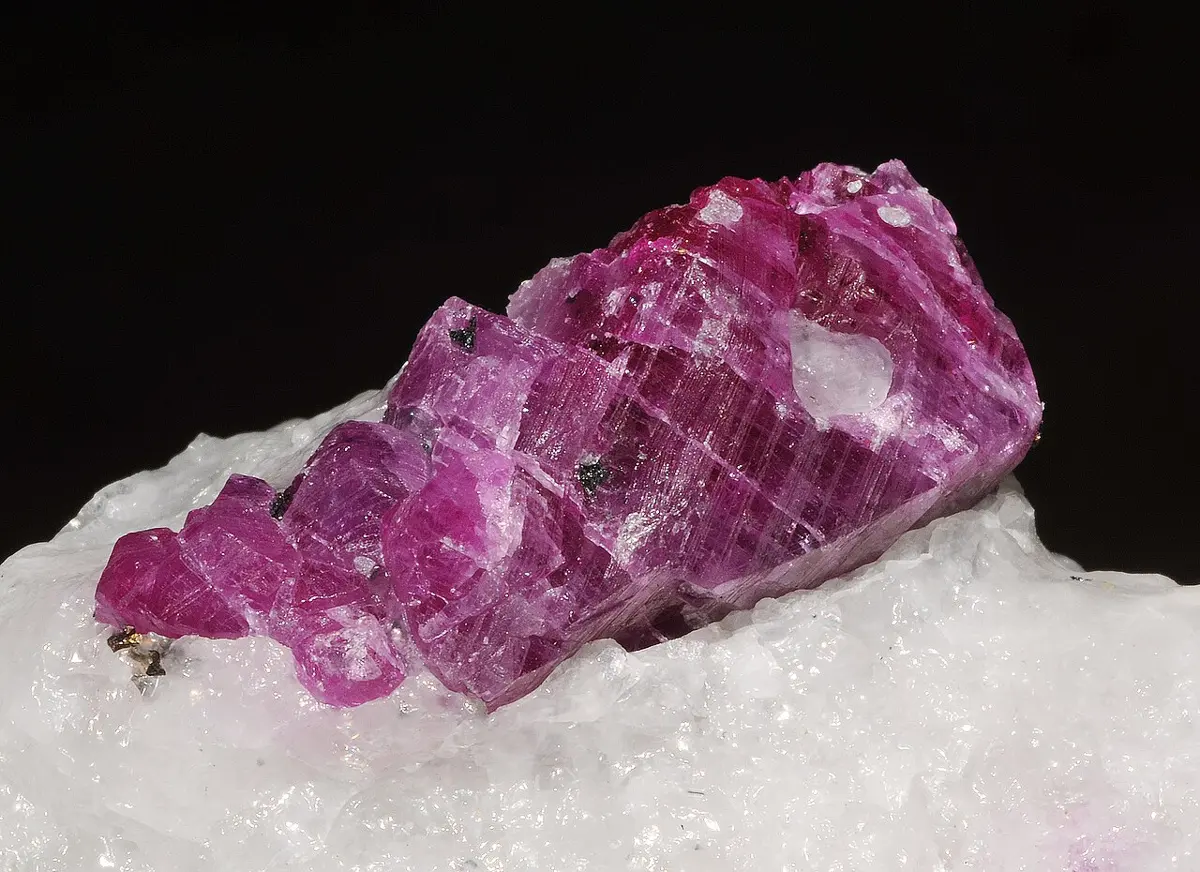
An emerald is a crystal of beryl, a mineral of beryllium; in most emeralds the green comes from chromium too, in some from vanadium. In 1960 the American physicist Theodore Maiman built the first laser from a rod of ruby: its chromium ions gave out the beam of red light (Masers and lasers).
Isotopes of chromium
Natural chromium is a mixture of four stable isotopes: chromium-50, -52, -53 and -54. Chromium-52 (24 protons, 28 neutrons) makes up about 84% of it Grade 9: Atomic mass.
A radioactive isotope, chromium-51 (half-life about 28 days), is used to label blood cells: doctors and scientists can then follow them, or measure how many have broken open. The 1996 Nobel Prize in Medicine was won with this test.
Chromium and your health
Chromium in valency 3, Cr³⁺, is found in tiny amounts in food: whole grains, meat, broccoli and other vegetables. It was long thought that the body needs a few millionths of a gram a day to use sugar properly. Scientists now disagree: Europe’s food safety agency decided in 2014 that there is no good evidence the body needs it at all. Either way, a normal diet gives plenty, and chromium pills are not needed.
Chromium in valency 6 (chromates and dichromates) is a different matter. It is poisonous, burns the skin, and its dust, breathed in over years, causes lung cancer. Workers in chrome-plating and chromate factories must be protected, and waste from tanneries and plating works must not reach rivers.
Surprising facts and records
- Chrome-plated car parts became the fashion in the 1920s. During the Second World War the US government banned chrome plating on cars to save chromium for weapons, so for a while car makers painted the trim instead.
- The hardest pure metal. On the Mohs scale of scratch hardness chromium scores about 8.5: among pure elements only diamond and boron are harder.
- The steel that wouldn’t rust. The first stainless steels were made in Germany and England around 1912–1913, when metallurgists noticed that steel with plenty of chromium in it stayed bright in acids that ate other steels.
In your science books
- Grade 8: steel and stainless steel and alloys used in daily life.
- Grade 9: variable valency, metals and oxygen, nichrome and the heating effect and atomic mass.
- Grade 10: electronic configuration, transition metals, reduction and electro-refining.
- Going further: where the atoms in your body came from.
More to explore
- Nobel Prizes with chromium in them: the first laser (1964, a ruby rod and its chromium atoms), giant magnetoresistance (2007, iron layers a nanometer apart, with chromium between them) and how killer T cells find infected cells (1996, measured with radioactive chromium).
- Play: make aluminium oxide, the crystal of ruby, in Molecule Kitchen, or find chromium in Guess the Element and the Periodic Table Jigsaw.
- Read more: chromium at the Royal Society of Chemistry and at PubChem.