
- Atomic number
- 96
- Atomic mass
- 247.07
- Shells
- 2, 8, 18, 32, 25, 9, 2
- Configuration
- 1s² 2s² 2p⁶ 3s² 3p⁶ 4s² 3d¹⁰ 4p⁶ 5s² 4d¹⁰ 5p⁶ 6s² 4f¹⁴ 5d¹⁰ 6p⁶ 7s² 5f⁷ 6d¹
- In the table
- period 7, group none (f-block), f-block
- Kind
- Actinide
- Valency
- 3 (Cm³⁺), and 4 in a few solids such as CmO₂
- State at 25 °C
- solid
- Melts · boils
- 1,345 °C · 3,127 °C
- Density
- 13.5 × as heavy as water
- Known since
- 1944
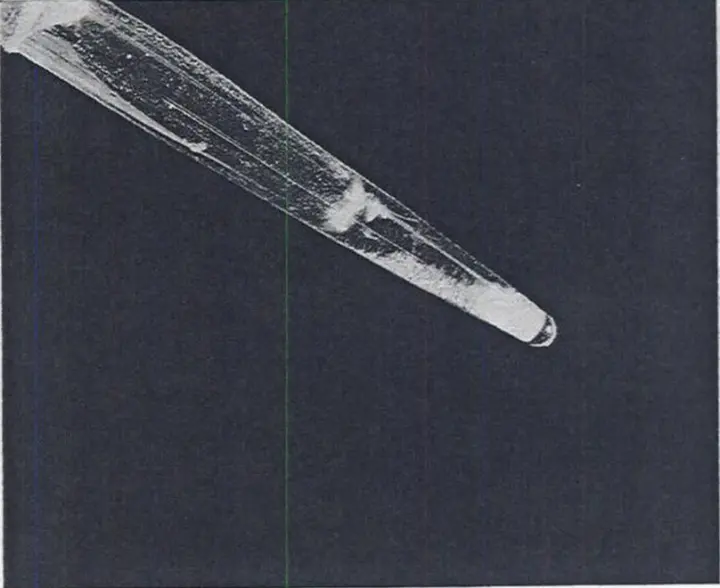
How do you find out what a rock on Mars is made of, when no geologist can go there? You send a rover with an instrument that fires tiny particles at the rock and listens to what comes back. The particles come from a speck of curium, element 96, named after the most famous scientists of radioactivity, Marie and Pierre Curie.
The curium atom
A curium atom has 96 protons (atomic number 96) and 96 electrons. The kind used on the rovers, curium-244, has 148 neutrons: 96 + 148 = 244. By shells, the electrons are 2, 8, 18, 32, 25, 9, 2, and in subshells Grade 10: The Aufbau principle:
… 6p⁶ 7s² 5f⁷ 6d¹
Here is an exception to the filling order. Following the order, all eight of curium’s newest electrons would go into 5f. But americium, just before it, already has seven 5f electrons, one in each of the seven 5f orbitals: a half-full subshell, which is extra stable. So curium’s eighth electron goes into 6d instead, and the half-full 5f is kept. Gadolinium, the element directly above curium among the lanthanides, does exactly the same (4f⁷ 5d¹).
Curium is in period 7, the eighth of the actinides in the f-block Grade 10: Features of the modern periodic table, and a metal. It gives away three electrons (two from 7s, one from 6d) to form Cm³⁺, keeping its half-full 5f. Only in a few solids, such as the oxide CmO₂, does it give away four.
How many neutrons are in a curium-244 nucleus?
Pick an answer to see why.
How curium was made and named
In the summer of 1944, Glenn Seaborg, Ralph James and Albert Ghiorso used the cyclotron at Berkeley, California, to fire alpha particles (helium nuclei, 2 protons and 2 neutrons) at plutonium-239. A plutonium nucleus that captured one gained 2 protons and became element 96; it threw out a neutron, leaving curium-242. The tiny sample was sent to the University of Chicago, where the new element was separated and identified. It was found a few months before americium, element 95.
Like americium, it was a wartime secret, first told to the public by Seaborg on a children’s radio show, Quiz Kids, in November 1945, a few days before the official announcement.
The team noticed that element 96 sits directly below gadolinium, named after the Finnish chemist Johan Gadolin. So they named it after scientists too: Marie Curie and Pierre Curie, who had discovered polonium and radium in 1898 and gave us the word “radioactivity”. Its symbol is Cm.
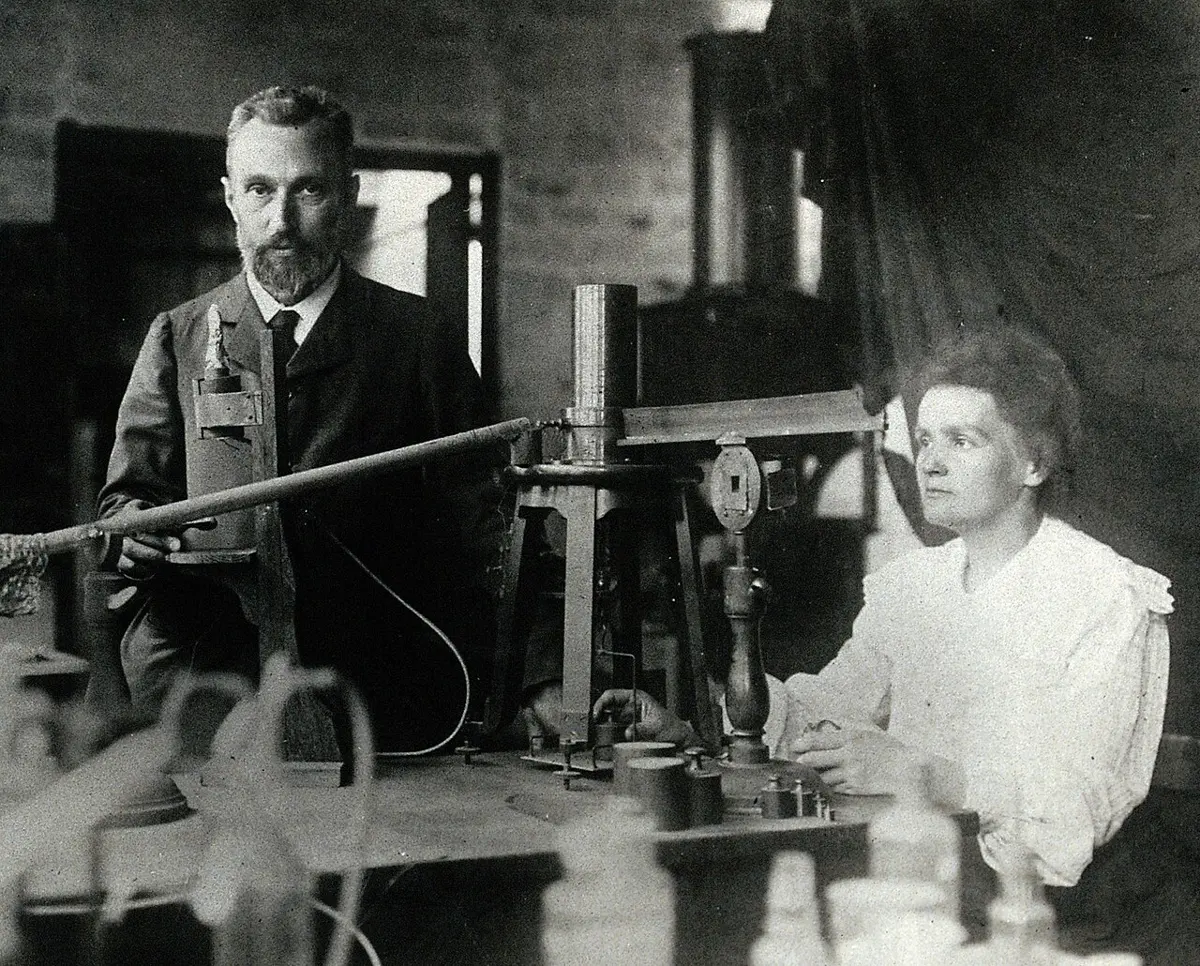
Marie Curie was born in Poland, and named polonium after her homeland.
Where curium is found
Curium’s longest-lasting kind, curium-247, has a half-life of about 16 million years, short next to the Earth’s 4.5 billion, so no curium from the Earth’s birth is left. All the curium we use is made in nuclear reactors, where plutonium and americium nuclei catch neutrons one after another. Only a few grams are made each year.
What curium is like
What has been measured:
- It is a hard, silvery metal that tarnishes in air.
- It melts at about 1,340 °C, much higher than plutonium or americium. (Sources give 1,340 or 1,345 °C.)
- It is dense: about 13.5 g/cm³.
- It is strongly radioactive: curium-244, with a half-life of 18 years, gives out so many alpha particles that a piece of it heats itself up. Curium compounds in solution glow orange when ultraviolet light shines on them.
What is only estimated: its boiling point. The facts card’s 3,127 °C (other tables give 3,100 or 3,110 °C) comes from calculations; the Royal Society of Chemistry lists it as unknown.
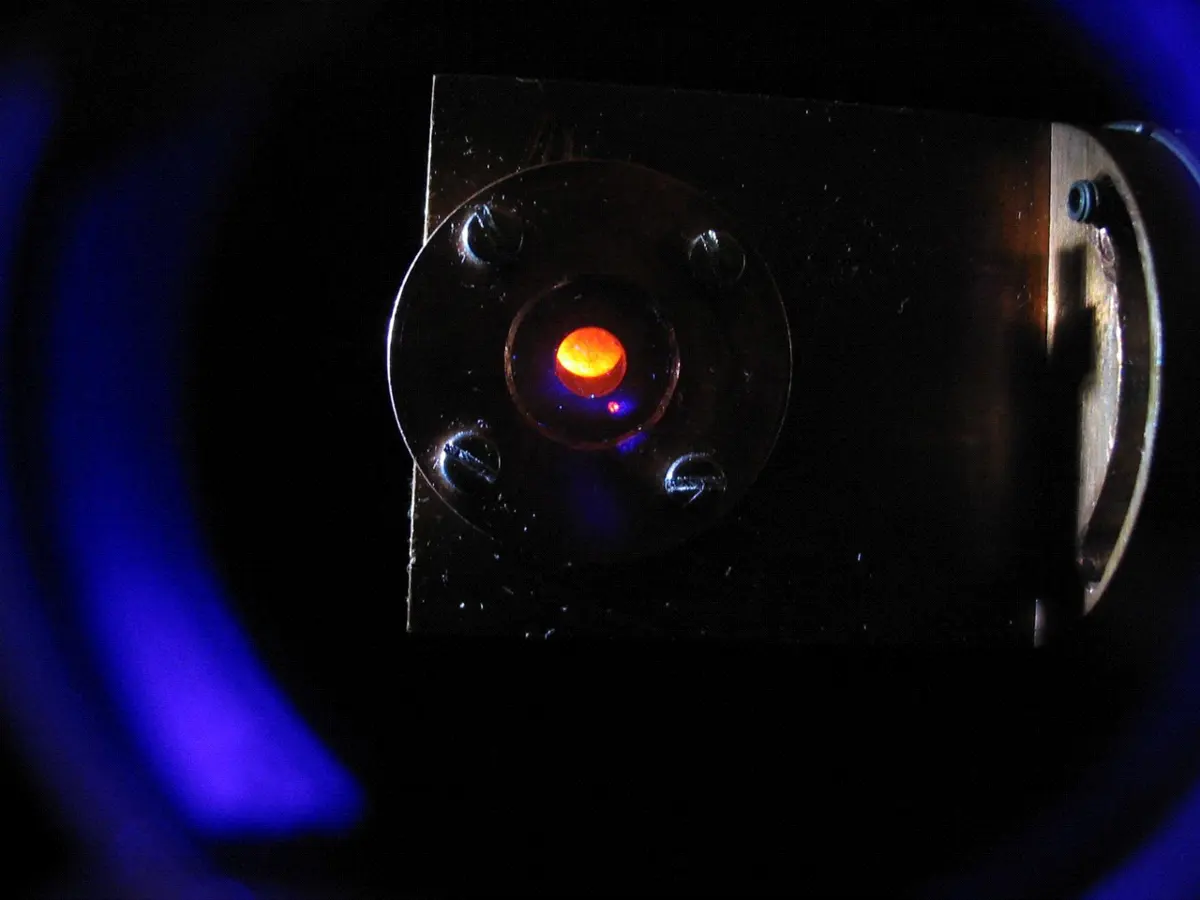
Curium on Mars
Every element’s atoms give out X-rays with energies that belong to that element alone, when something knocks an electron out of the inner shells of the atom and another electron falls into its place. (X-rays are light with far more energy than visible light.) Measure the energies of the X-rays coming from a rock, and you know which elements are in it; measure how many there are of each, and you know how much.
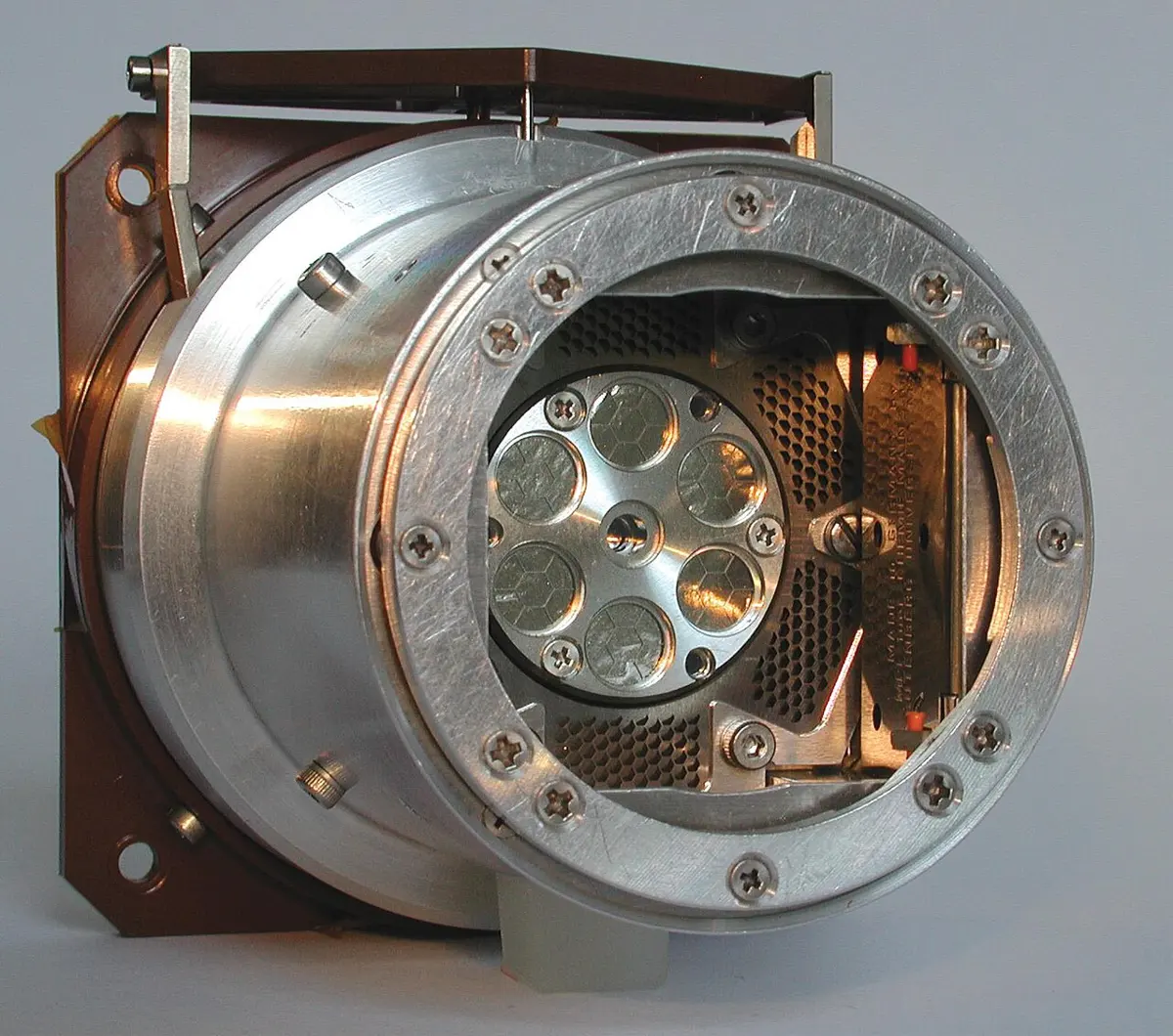
That is what an alpha particle X-ray spectrometer (APXS) does. On its face is a ring of tiny sealed curium-244 sources. A rover’s arm holds the face just above a rock, for anything from minutes to hours. Curium’s alpha particles strike the rock; some bounce straight back, and others knock inner electrons out of the rock’s atoms, which then give out X-rays. A detector in the middle counts the X-rays and sorts them by energy.
Curium-244 is just right for the job: it gives out plenty of alpha particles, almost all with the same energy, and its half-life of 18 years outlasts any mission. An APXS with curium has traveled on the rovers Sojourner (1997), Spirit and Opportunity (2004) and Curiosity (since 2012), and on the Philae lander, which landed on a comet in 2014. Perseverance, NASA’s newest rover, uses a different instrument with an X-ray tube. India’s Pragyan rover carried an APXS to the Moon in 2023. Curiosity’s APXS has measured hundreds of rocks and soils on its way across Gale Crater, once the bed of an ancient lake.
An APXS finds a tall X-ray peak at the energy that belongs to iron. What does that tell the scientists?
Pick an answer to see why.
Curium and your health
The body has no use for curium. If it is breathed in or swallowed, it settles in the bones, lungs and liver, where its alpha particles damage the cells around it and can cause cancer. Curium is handled only in sealed glove boxes. The sources in an APXS are sealed, and they are far away, on Mars.
In your science books
- Grade 9: radioactive elements, X-rays and shells and their energy.
- Grade 10: the actinides and the Aufbau principle.
- Going further: alpha decay and what ionizing radiation does.
More to explore
- Nobel Prizes: the Curies’ discovery of radioactivity (1903), Marie Curie’s radium and polonium (1911), and Seaborg and McMillan’s prize (1951) for the elements beyond uranium.
- Its neighbors: americium, the element before it, plutonium, from which it was first made, and polonium and radium, the Curies’ elements.
- Play: find curium in Guess the Element and the Periodic Table Jigsaw.
- Read more: curium at the Royal Society of Chemistry and at PubChem.