
- Atomic number
- 6
- Atomic mass
- 12.01
- Shells
- 2, 4
- Configuration
- 1s² 2s² 2p²
- In the table
- period 2, group 14 (IVA), p-block
- Kind
- Non-metal
- Valency
- 4 (by sharing electrons)
- State at 25 °C
- solid
- Turns to gas
- 3,642 °C, never melts
- Density
- 2.3 × as heavy as water
- Known since
- ancient times
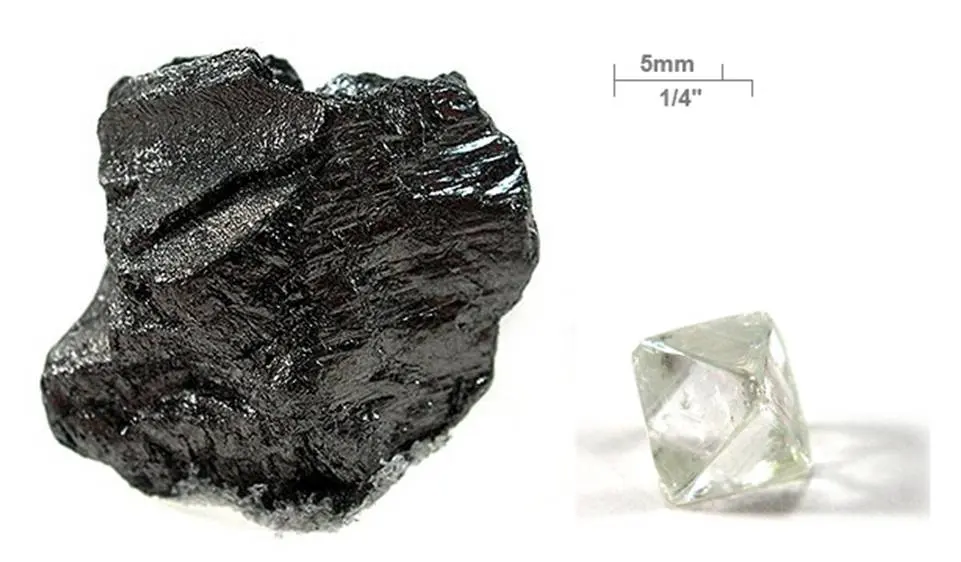
The tip of your pencil, the charcoal glowing in a winter brazier, the soot on the bottom of a pot and the diamond in a ring are all the same element. So is about a fifth of your body: carbon is in the rice and dal you ate, the cotton of your shirt and the DNA of every cell. Each time you breathe out, you send carbon into the air as carbon dioxide, and every tree around you is built from carbon it took back out.
Carbon is element 6, and no element does more. Grade 9 has a whole unit on it Grade 9: Carbon and its compounds. This page tells its whole story, from the atom to the air.
The carbon atom
Every carbon atom has 6 protons, so carbon’s atomic number is 6, and a neutral atom has 6 electrons. Most carbon atoms also have 6 neutrons: mass number 6 + 6 = 12.
By the 2n² rule Grade 8: Bohr and Bury’s rule, the shells are 2, 4: exactly half of the eight the L shell can hold. In subshells Grade 10: The Aufbau principle that is 1s² 2s² 2p².
Its place in the periodic table
- Period 2, because it has two shells, between boron (5) and nitrogen (7).
- Group 14, called IVA in the older naming, because it has four outer electrons.
- p-block, because its last electrons go into a p subshell. Carbon is a non-metal Grade 10: Non-metals.
Below carbon in group 14 are silicon and germanium (metalloids), then tin and lead (metals). Going down, the family changes from non-metal to metal.
Its valency: four, by sharing
To reach an octet, a carbon atom would have to lose four electrons or gain four. Both take far too much energy, so carbon does neither: it shares its four outer electrons, forming four covalent bonds Grade 9: Covalent bond. Its valency is 4. In methane, CH₄, the gas in biogas, one carbon atom shares a pair of electrons with each of four hydrogen atoms.
How does a carbon atom usually reach a stable outer shell?
Pick an answer to see why.
Why carbon makes so many compounds
Chemists know more compounds of carbon than of all the other elements put together, many millions. Three things about the carbon atom make this possible:
- Four bonds. Each carbon atom can join to four other atoms, so molecules can branch in many directions.
- Chains. Carbon atoms bond strongly to each other, making chains and rings of any length, from 2 atoms to millions. This is called catenation Grade 9: Catenation.
- Double and triple bonds. Two carbon atoms can share two or three pairs of electrons, giving even more kinds of molecule Grade 10: Hydrocarbons.
The chemistry of carbon compounds is called organic chemistry, because chemists once thought these compounds could only be made by living things. In 1828 Friedrich Wöhler made urea, a compound in urine, from non-living chemicals, and showed that they were wrong.
How carbon was found and named
Carbon is so old that no one discovered it. People have made charcoal in their fires since the Stone Age, and drew on cave walls with it tens of thousands of years ago. What took longer was understanding that charcoal, soot, graphite and diamond are one element.
- In 1694, two scientists in Florence focused sunlight onto a diamond with a large lens. The diamond grew hot and simply disappeared.
- In 1772, the French chemist Antoine Lavoisier burned diamond and charcoal and found that both gave only carbon dioxide.
- In the 1790s, the English chemist Smithson Tennant showed that the same weight of diamond and of charcoal gives the same amount of carbon dioxide: diamond is pure carbon.
The name. Lavoisier named the element carbone, from the Latin carbo, “charcoal”, and listed it among the elements in 1789. Hence carbon and the symbol C Grade 8: The first 20 elements. In Nepali it is कार्बन, but the Nepali dictionary also gives an older word of our own: प्राङ्गार, the stuff of coal and charcoal (अँगार). It lives on in प्राङ्गारिक, the word the Nepali books use for organic: प्राङ्गारिक यौगिक, organic compounds, are the compounds of carbon, and प्राङ्गारिक मल is organic manure.
Where carbon is found
In the universe. Carbon is one of the most common elements in the universe. It was made inside stars, by joining three helium nuclei: two make beryllium-8, which falls apart in an instant unless a third arrives in time (Helium into carbon). Dying giant stars blew it into space, where it became part of new stars, planets and you.
On the Earth. The crust holds only about 200 grams of carbon per tonne, yet carbon is everywhere:
- in rocks, mostly as carbonates: limestone and marble (CaCO₃), the raw material of Nepal’s cement factories Grade 8: Non-metallic minerals;
- in fossil fuels, coal, petroleum and natural gas, made from plants and tiny sea creatures buried millions of years ago Grade 8: Energy minerals;
- as pure carbon: graphite and diamond. In 2025 the world mined about 1.8 million tonnes of graphite, about four-fifths of it in China, and about 69 million carats (14 tonnes) of gem diamonds, most in Russia, Botswana, Canada and Angola (USGS, 2026);
- in the air, as carbon dioxide, and dissolved in the sea;
- in every living thing.
In your body. Carbon is about 18% of your weight, second only to oxygen (in water). A 50 kg student holds about 9 kg of carbon.
Pure carbon: one element, many forms
Different forms of the same element, in the same state, are called allotropes Grade 9: Allotropes. Carbon has more than any other element, because its atoms can join to each other in so many patterns.
| Diamond | Graphite | |
|---|---|---|
| bonds per carbon atom | 4, in all directions | 3, in flat sheets |
| look | clear, sparkling | black, shiny, greasy |
| hardness | the hardest natural substance | so soft it rubs off on paper |
| conducts electricity? | no | yes |
| density | 3.5 g/cm³ | 2.2 g/cm³ |
| used for | jewelry, cutting and drilling | pencils, electrodes, lubricant, batteries |
In diamond, every atom holds four neighbors with strong bonds, in a network running in all directions, so there is no weak direction to break along. In graphite, each atom bonds to only three neighbors, in flat sheets of hexagons. Only weak forces hold the sheets together, so they slide: a pencil leaves a trail of sheets on the paper. Each atom’s fourth electron is free to move along its sheet, so graphite conducts electricity, the only non-metal that does it well.
Newer forms were found in the last forty years:
- Fullerenes (1985): hollow balls of carbon atoms, the best known with 60 atoms, shaped like a football (Buckyballs).
- Graphene (2004): a single sheet of graphite, one atom thick, very strong and an excellent conductor (Graphene).
- Carbon nanotubes: graphene rolled into tubes thousands of times thinner than a hair.
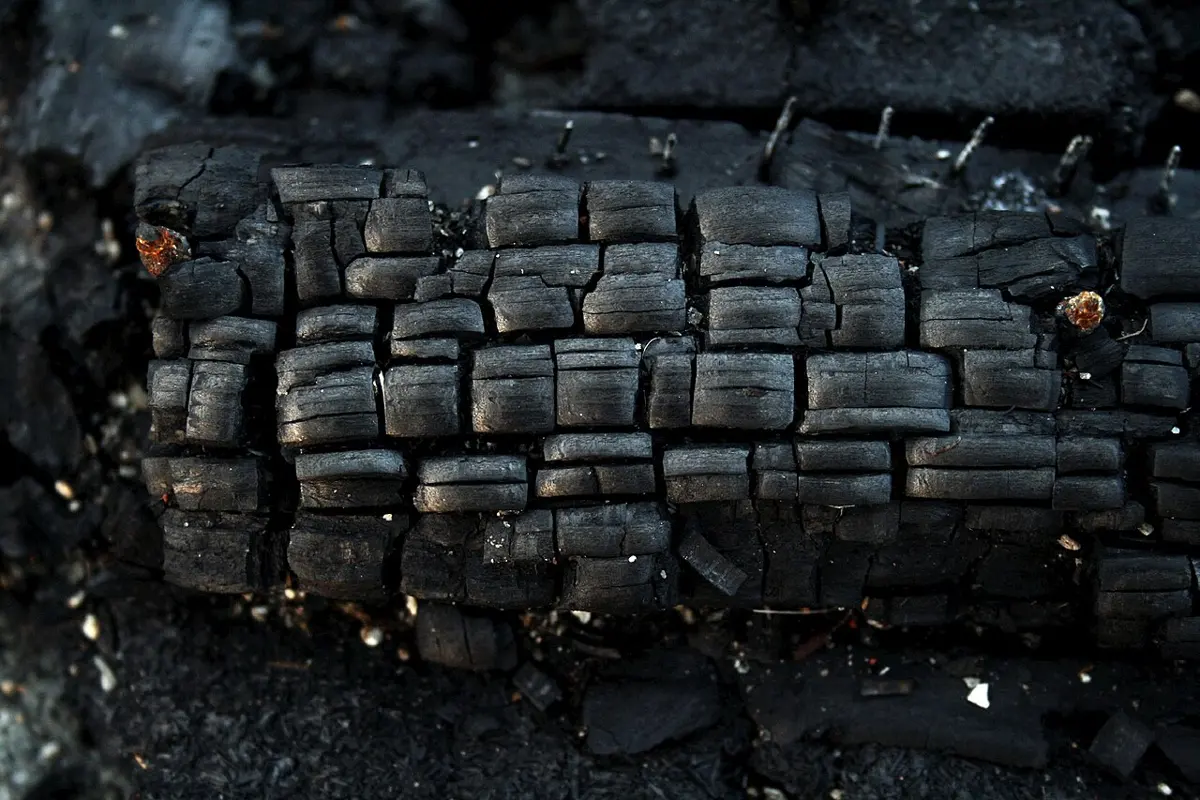
Amorphous carbon has no regular pattern: charcoal, made by heating wood with little air; coke, made the same way from coal; soot (मोसो); and activated charcoal, charcoal full of tiny pores, a few grams of which have the surface of a football field, used in water filters and gas masks to trap impurities.
Diamond and graphite are both pure carbon. Why does graphite conduct electricity but diamond does not?
Pick an answer to see why.
What carbon is like
- A solid in every form, and the hardest of all elements to turn into a liquid or gas. At ordinary pressure graphite does not melt at all: at around 3,600 to 3,800 °C it turns straight into a gas (it sublimes), a higher temperature than any other element needs.
- Stable at room temperature: it does not react with air, water or most acids. A charcoal drawing or a pencil note lasts for centuries.
- Burns when hot, giving a lot of heat, which is why charcoal and coal are fuels.
How carbon reacts
Grade 9 lists carbon’s reactions Grade 9: Chemical properties of carbon. The four to know:
1. Burning. With plenty of air, carbon burns to carbon dioxide:
C + O₂ → CO₂ + heat
With too little air, it burns to carbon monoxide, a poisonous gas:
2C + O₂ → 2CO + heat
2. Taking oxygen from metal oxides. Hot carbon pulls oxygen out of the oxides of less reactive metals, leaving the metal. Carbon is a reducing agent Grade 9: Reducing property. This is how iron, zinc, lead and copper are got from their ores Grade 10: Smelting:
ZnO + C → Zn + CO
3. With metals, at high temperatures, it forms carbides, such as calcium carbide, CaC₂:
Ca + 2C → CaC₂
4. With steam, red-hot carbon gives water gas, a fuel made of carbon monoxide and hydrogen:
C + H₂O → CO + H₂
In a furnace, zinc oxide is heated with coke (carbon). What happens to the zinc oxide?
Pick an answer to see why.
Carbon in daily life and in Nepal
- Fuel. Firewood, charcoal, coal, kerosene, petrol, diesel and the LPG in a cooking cylinder (propane and butane, Hydrocarbons) all give their heat by turning carbon into carbon dioxide.
- Steel. Iron with a little carbon, up to about 2%, is steel: much harder and stronger than pure iron.
- Pencils are graphite mixed with clay: more clay makes a harder, lighter pencil (H), more graphite a softer, darker one (B).
- Batteries. The black rod in the middle of a dry cell is graphite Grade 8: In energy, and the lithium batteries of phones and electric cars store their lithium between graphite sheets.
- Kajal. गाजल, put round the eyes, is traditionally made of soot (मोसो) mixed with oil.
- Strong, light materials. Carbon fiber, threads of almost pure carbon set in plastic, makes bicycle frames, tennis rackets, aircraft and racing cars stiff and light.
- Diamonds at work. Most diamonds are not jewels: small and dark ones, and diamonds made in factories, tip the saws and drills that cut stone and concrete.
Carbon in the air: the carbon cycle
Carbon moves round and round between the air, living things, the sea and the rocks: the carbon cycle (Where does the carbon go?).
- Plants take carbon dioxide from the air and, in photosynthesis, build it into sugar with the energy of sunlight: 6CO₂ + 6H₂O → C₆H₁₂O₆ + 6O₂.
- Animals eat the plants, and both plants and animals respire, turning the sugar back into carbon dioxide.
- Decomposers return the carbon of dead bodies and fallen leaves to the air.
- Burning wood and fossil fuels returns carbon too, in a few seconds, that took plants years or millions of years to collect.
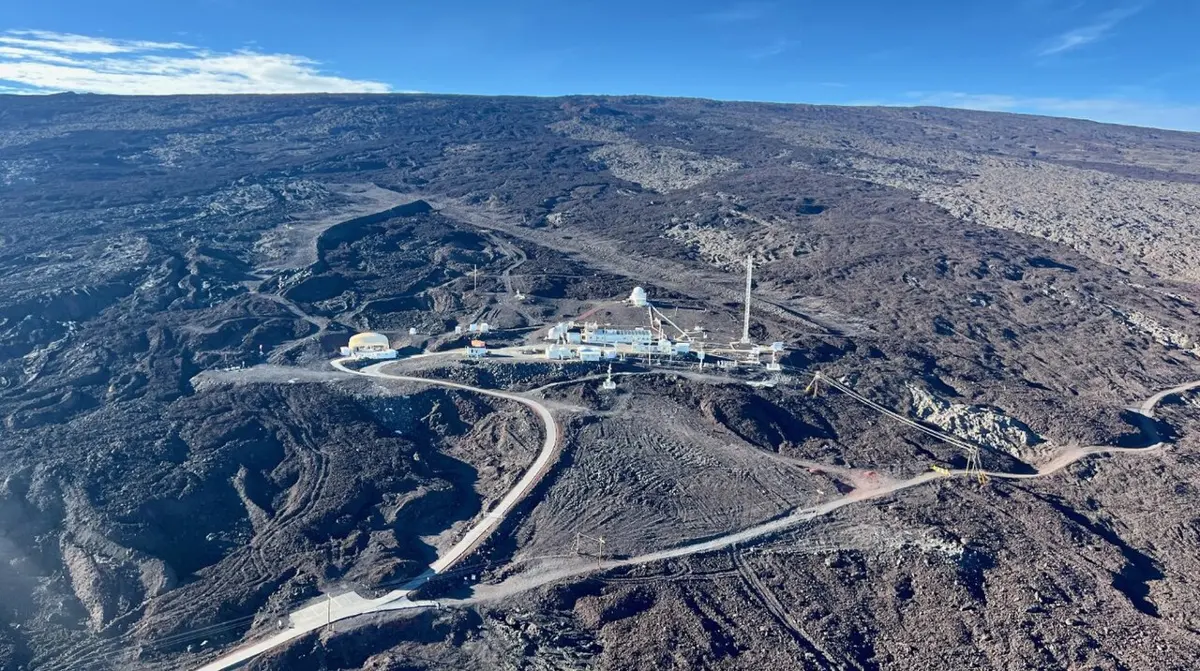
For thousands of years, the air held about 280 parts per million of carbon dioxide: 280 molecules in every million. Since people began burning coal, oil and gas in large amounts, it has risen faster and faster. In 2025 it reached about 427 ppm at the Mauna Loa Observatory in Hawaii, where it has been measured since 1958 (NOAA, 2026). Carbon dioxide traps heat (the greenhouse effect, Greenhouse effect), so the Earth is warming, and Nepal’s glaciers are shrinking.
Isotopes of carbon
Natural carbon is a mixture of carbon-12 (98.9%, 6 neutrons) and carbon-13 (1.1%, 7 neutrons), both stable, with a trace of radioactive carbon-14 (8 neutrons).
Carbon-12 is the standard for all atomic masses. The atomic mass unit is defined as one-twelfth of the mass of a carbon-12 atom, so carbon-12 is exactly 12 Grade 9: Atomic mass.
Carbon-14: a clock in every living thing
Cosmic rays hitting nitrogen high in the air make a little carbon-14 all the time. It becomes part of the carbon dioxide that plants take in, so every living thing holds a tiny, steady share of it. When a plant or animal dies, it takes in no more, and its carbon-14 slowly decays. Every 5,700 years or so (its half-life), half of what is left is gone. Measure how much remains in a piece of wood, bone or cloth, and you know how long ago it died. This is radiocarbon dating, worked out by the American chemist Willard Libby in the late 1940s; it works back to about 50,000 years.
Carbon and your health
Your food is carbon compounds: carbohydrates (rice, roti, potatoes), fats and proteins. Your body burns them with oxygen to get energy, and you breathe out the carbon as carbon dioxide. Carbon itself, as graphite or charcoal, is harmless; activated charcoal is even given in hospitals to soak up some poisons in the stomach.
The dangers are two gases and a dust:
- Carbon monoxide (CO), from fires burning without enough air. It has no color and no smell. It holds on to the hemoglobin in your blood far more strongly than oxygen does, so the blood stops carrying oxygen, and people asleep in a closed room with a burning heater can die without waking.
- Too much carbon dioxide in a closed room causes headaches and sleepiness; in a deep well or pit, where the heavy gas collects, it can suffocate.
- Soot: the tiny black specks of unburnt carbon from smoky stoves, diesel engines, brick kilns and burning rubbish, which carry other harmful chemicals deep into the lungs.

Surprising facts and records
- Diamonds burn. Heat a diamond in air to about 800 °C and it burns away to carbon dioxide, just like charcoal.
- The blackest black. Vantablack, a coating of tiny carbon nanotubes standing on end like a forest, absorbs more than 99.9% of the light that falls on it. At the Science Playground you can compare how black different blacks are: The Blackest Black.
In your science books
- Grade 8: atoms and symbols, the 2n² rule, graphite and diamond among the minerals and coal and the energy minerals.
- Grade 9: the whole unit on carbon: catenation, diamond, graphite and fullerene, carbon’s reactions and organic compounds; also covalent bonds and methane.
- Grade 10: electronic configuration, carbon dioxide, the greenhouse effect, hydrocarbons and smelting.
- Going further: what a molecule looks like, where does the carbon go? and how stars make carbon.
More to explore
- Nobel Prizes about carbon: buckyballs (1996), graphene (2010), joining carbon atoms with palladium (2010), plastic that conducts electricity (2000) and working backwards to make a molecule (1990).
- Play: make carbon dioxide, methane, glucose and many more in Molecule Kitchen, or find carbon in Guess the Element and the Periodic Table Jigsaw.
- Read more: carbon at the Royal Society of Chemistry and at PubChem.