
- Atomic number
- 67
- Atomic mass
- 164.93
- Shells
- 2, 8, 18, 29, 8, 2
- Configuration
- 1s² 2s² 2p⁶ 3s² 3p⁶ 4s² 3d¹⁰ 4p⁶ 5s² 4d¹⁰ 5p⁶ 6s² 4f¹¹
- In the table
- period 6, group none (f-block), f-block
- Kind
- Lanthanide
- Valency
- 3 (Ho³⁺)
- State at 25 °C
- solid
- Melts · boils
- 1,474 °C · 2,700 °C
- Density
- 8.8 × as heavy as water
- Known since
- 1878
A kidney stone is one of the most painful things that can happen to a person. Today a doctor can often break one up without cutting the body at all: a thin tube goes in the way urine comes out, and flashes of invisible light turn the stone into dust. The light comes from a crystal containing holmium (say HOLE-mee-um), the eleventh lanthanide. Holmium has another claim to fame: of all the elements, its atom is the strongest tiny magnet.
The holmium atom
A holmium atom has 67 protons and 67 electrons. Natural holmium has only one isotope, holmium-165, with 98 neutrons: 67 + 98 = 165. So its atomic mass, 164.93, is very close to a whole number Grade 9: Atomic mass.
By shells its electrons are 2, 8, 18, 29, 8, 2. In subshells it ends 6s² 4f¹¹ Grade 10: The Aufbau principle.
Its place and valency
- Period 6, the eleventh lanthanide (f-block), between dysprosium (66) and erbium (68) (fifteen near-twins).
- It loses three electrons and becomes Ho³⁺, with a valency of 3: holmium chloride is HoCl₃ and holmium oxide Ho₂O₃.
Holmium has only one natural isotope, holmium-165. How many neutrons are in its nucleus?
Pick an answer to see why.
How holmium was found and named
Holmium is one more element from the black mineral of Ytterby in Sweden (yttrium’s story). Out of it came the earth erbia, the oxide of erbium. In 1878 two Swiss chemists in Geneva, Marc Delafontaine and Jacques-Louis Soret, looked at the light given out by erbia and saw lines that belonged to no known element (Why each element has its own lines). They called it “element X”.
At the same time the Swedish chemist Per Teodor Cleve, in Uppsala, found that erbia’s weight changed depending on where it came from: it had to be a mixture. In 1879 he split it into three: erbia itself, a brown oxide and a green one. He named the brown one holmia, from Holmia, the Latin name of Stockholm, his home city. The green one became thulium, after Thule, a land in old stories of the far north. Holmium’s symbol is Ho. (Some sources date Cleve’s work to 1878.)
Cleve’s holmia was still not pure: in 1886 dysprosium was separated out of it.
Where holmium is found
In the universe, holmium is made in stars by catching neutrons (Catching neutrons). Like most elements with an odd atomic number, it is less common than its even-numbered neighbors, dysprosium and erbium.
In the Earth’s crust there is only about 1 gram in a tonne of rock. Even so, that makes it some fifteen times more common than silver: “rare earth” is an old name, not a measure. It is mined with the other rare earths from monazite and from clays in southern China, and almost all of it comes from China. In 2025 holmium oxide cost about 70 US dollars a kilogram (USGS, 2026).
In Nepal and in your body. Nepal mines no rare earths. Your body has no use for holmium.
What holmium is like and how it reacts
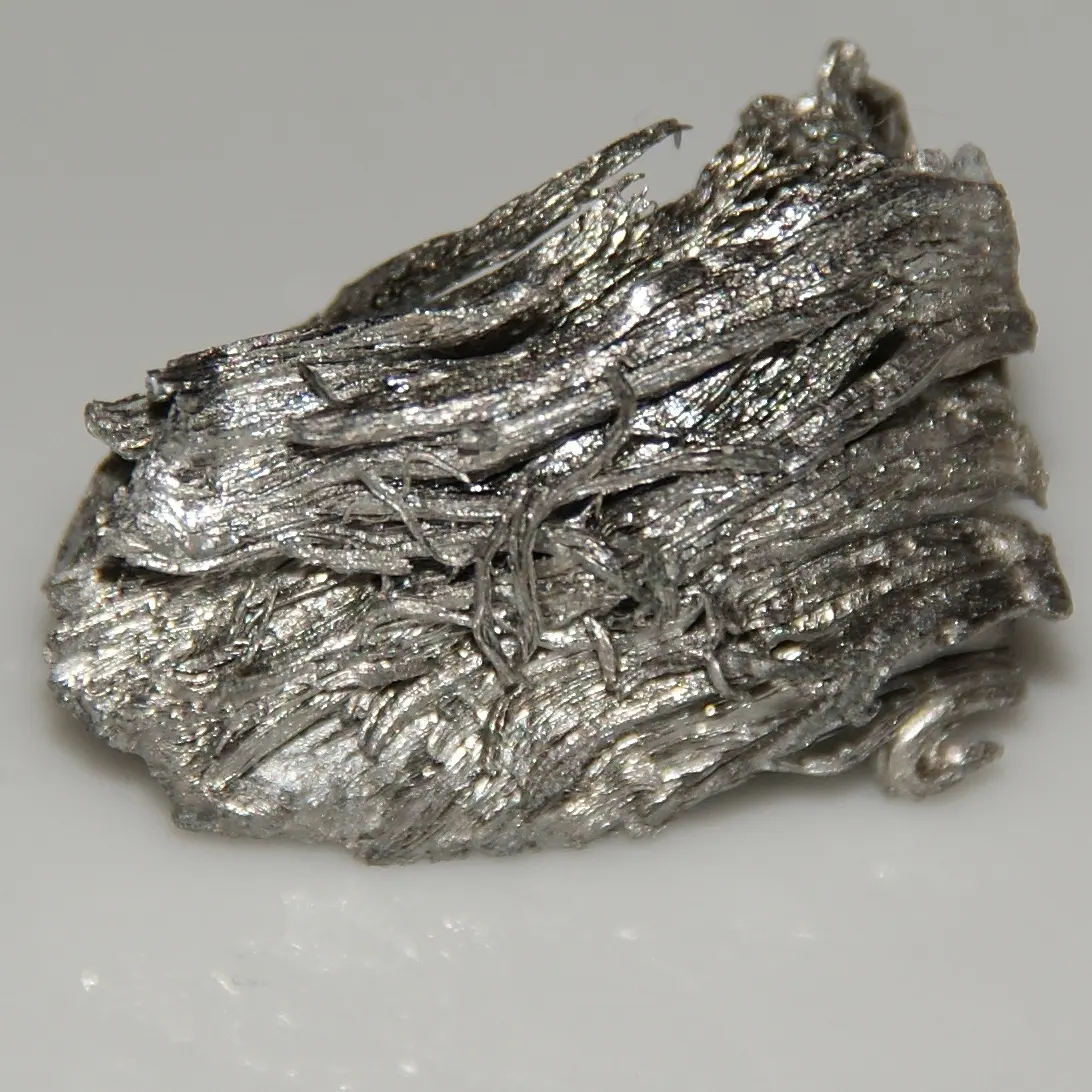
- A soft, silvery metal that can be hammered into shape Grade 9: Properties of metals.
- Fairly steady in dry air; in moist air it slowly gets a yellowish coat of oxide. Heated, it burns: 4Ho + 3O₂ → 2Ho₂O₃.
- With water, slowly when cold and faster when hot, giving holmium hydroxide and hydrogen Grade 9: Very reactive metals and water:
2Ho + 6H₂O → 2Ho(OH)₃ + 3H₂ - With dilute acids, readily, giving yellow solutions of Ho³⁺.
An oxide that changes color
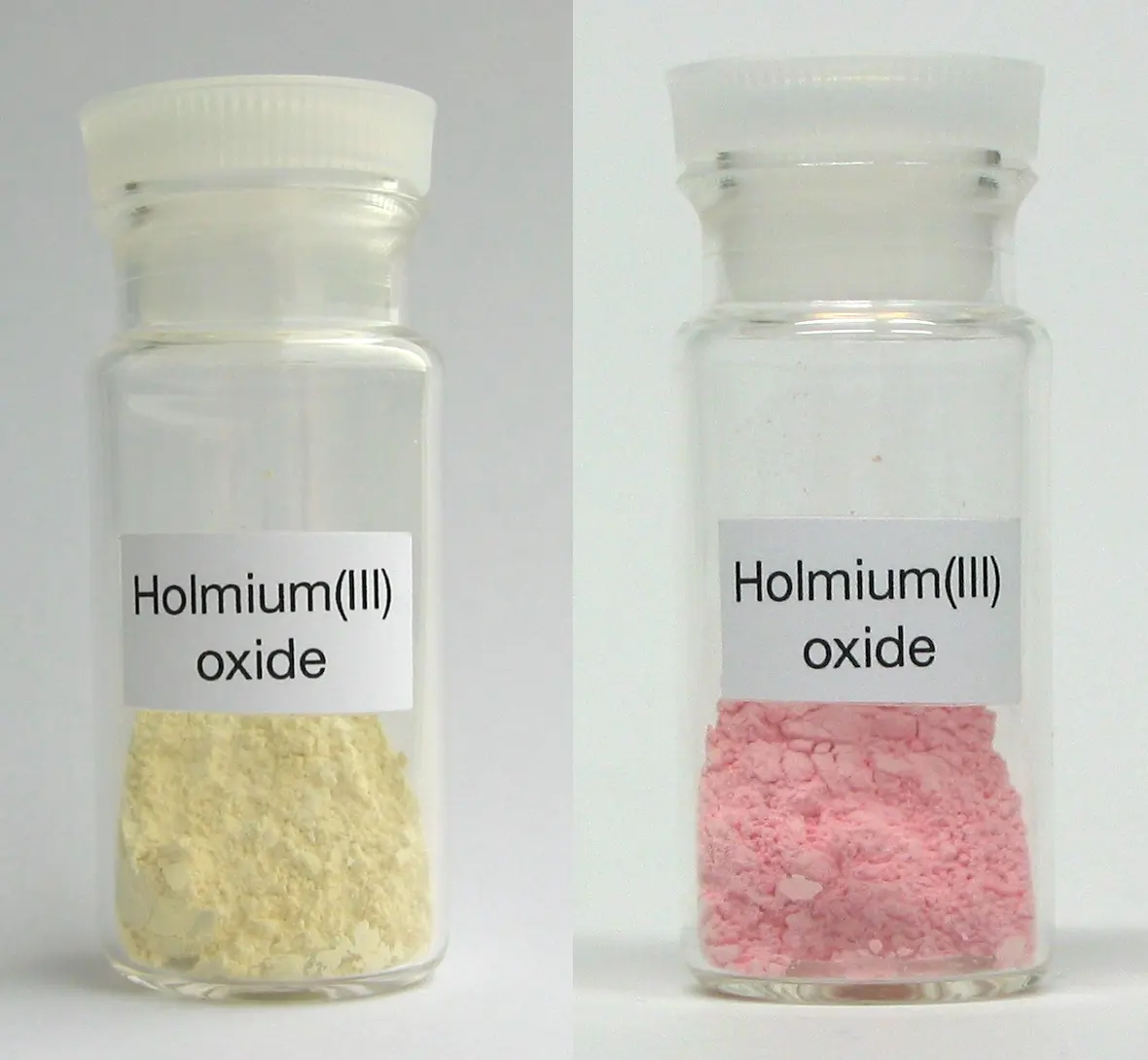
Holmium oxide, Ho₂O₃, is a pale yellow powder in daylight. Carry it under a tube light, and it turns pink. The holmium hasn’t changed: the light has. Ho³⁺ ions absorb a few very narrow bands of color, because their 4f electrons can jump only by exact amounts of energy. Sunlight contains every color, so taking away a few narrow bands leaves the powder looking yellowish. A three-color tube light gives out only a few narrow colors (terbium’s lamps), and holmium happens to absorb some of them strongly, so what is left looks pink.
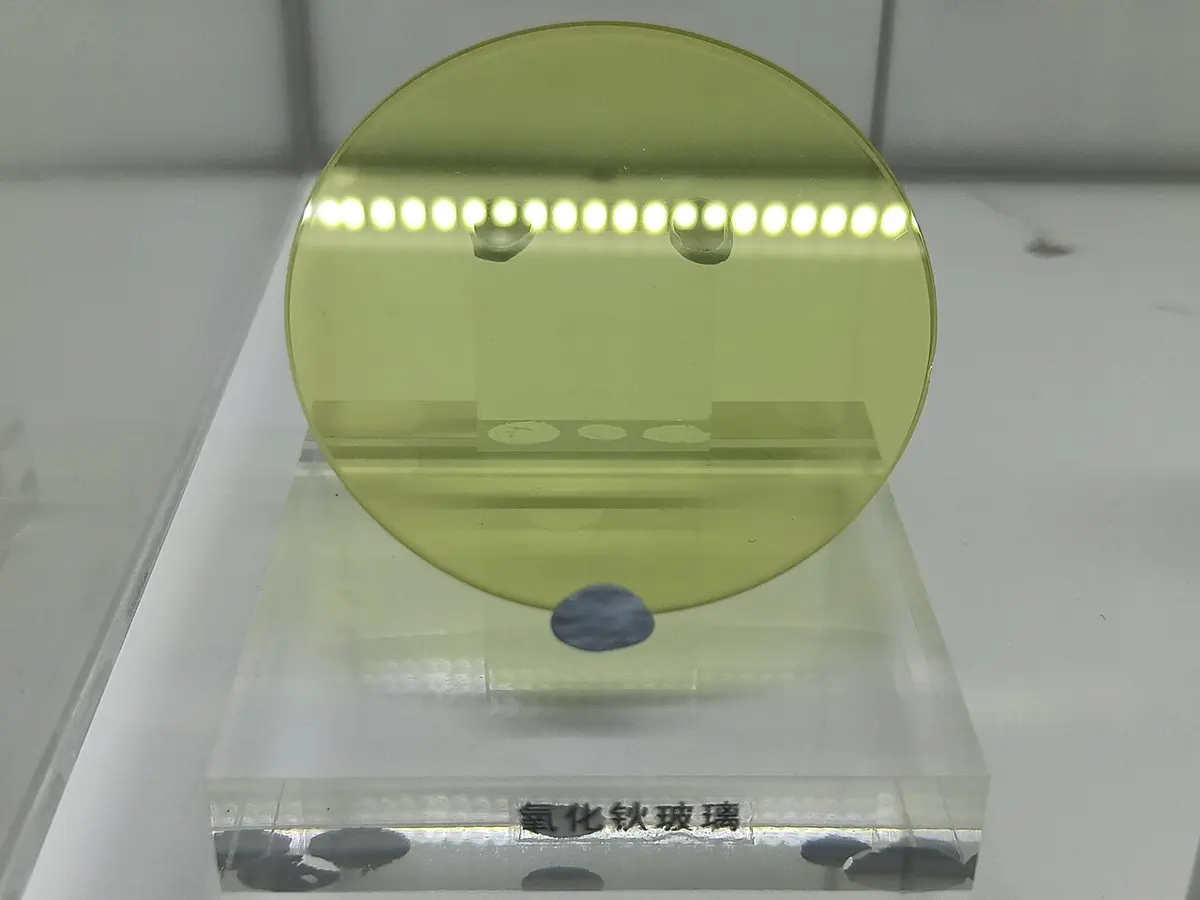
Those sharp bands are useful. Laboratories check that their instruments for measuring light (spectrophotometers) read wavelengths correctly with a filter of glass colored with holmium oxide: its dark bands always fall at exactly the same places.
The strongest atomic magnet
Each holmium atom is a tiny magnet, because many of its eleven 4f electrons are unpaired (count the single arrows in Figure 1). Holmium’s atom is the strongest of these tiny magnets of any element. At room temperature, heat keeps them pointing in all directions, so a lump of holmium is not a magnet itself; but put it in a magnetic field and it becomes one very strongly Grade 8: Molecular theory of magnetism. Only when cooled to about −250 °C does it stay magnetized on its own.
So pieces of holmium are put at the ends of some very powerful electromagnets, where they gather the field together and make it stronger. Such holmium pole pieces help make the strongest steady magnetic fields in laboratories.
Breaking kidney stones with light
A kidney stone is a hard lump of salts, such as calcium oxalate or uric acid Grade 10: Uric acid, that grows in the kidney. A small one passes out in the urine; a bigger one can block the tube to the bladder and cause terrible pain.
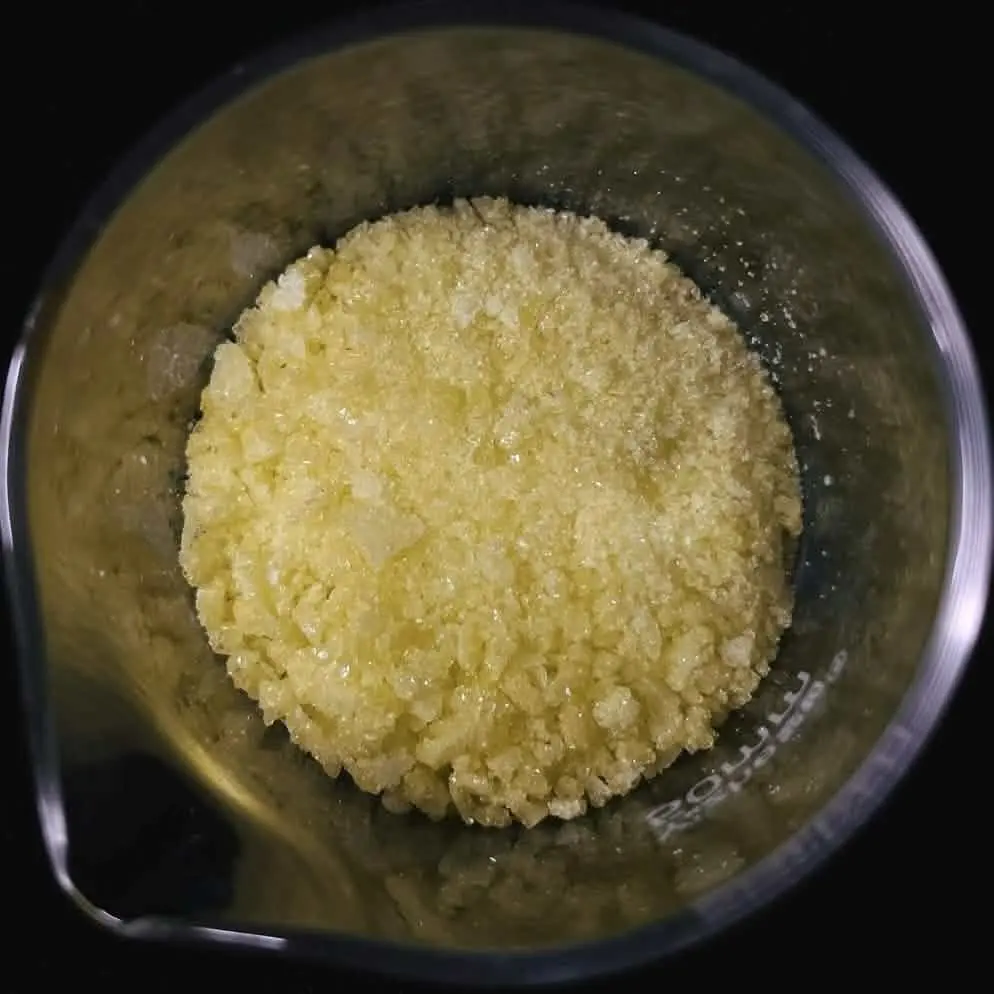
A crystal of yttrium aluminium garnet (YAG) with a little holmium in it makes the holmium laser (Ho:YAG). It gives out short, powerful pulses of infrared light with a wavelength of 2,100 nm, about three times that of red light, invisible to us Grade 9: Infrared rays. The doctor passes a thin, bendy tube with a camera, a ureteroscope, in through the urethra and the bladder and up to the stone, without any cut. A glass fiber inside the tube carries the laser light to the stone, the way an optical fiber carries light around bends Grade 10: Optical fibers.
Why this wavelength? Light of 2,100 nm is soaked up very strongly by water. Each flash heats the water at the fiber’s tip so fast that it bursts into a tiny bubble of steam, and the energy goes into the stone right in front of it. A little farther away, the water has already absorbed the light, so the tissue around is hardly harmed. The stone breaks into pieces and dust that are washed out. Doctors use the same laser for some operations on the prostate. Since the 1990s the holmium laser has been the standard tool for this; lasers made with another lanthanide, thulium, are now starting to compete with it.
Why is the holmium laser’s infrared light good for breaking stones inside the body?
Pick an answer to see why.
Other uses
- Nuclear reactors. Holmium is good at catching neutrons, so it is used to help control the chain reaction Grade 9: Nuclear fission.
- Color. Holmium oxide gives cubic zirconia, the cheap sparkling stone sold in place of diamonds, a pink color, and glass a yellow one.
Holmium and your health
Holmium has no known job in the body. It is of low toxicity; its salts that dissolve in water are slightly harmful if swallowed, and as a fine powder the metal can catch fire.
In your science books
- Grade 8: the molecular theory of magnetism.
- Grade 9: infrared rays, atomic mass, nuclear fission and the properties of metals.
- Grade 10: the Aufbau principle, the lanthanides, optical fibers in medicine, uric acid and binary numbers.
- Going further: why each element has its own lines and where holmium is made.
More to explore
- Its neighbors: dysprosium before it, which was hiding inside it, and erbium after it, out of which it was separated; yttrium, whose YAG crystals carry holmium in lasers, and lanthanum, with the story of the whole row.
- Play: find holmium in Guess the Element, the Periodic Table Jigsaw and Higher or Lower.
- Read more: holmium at the Royal Society of Chemistry and at PubChem.