
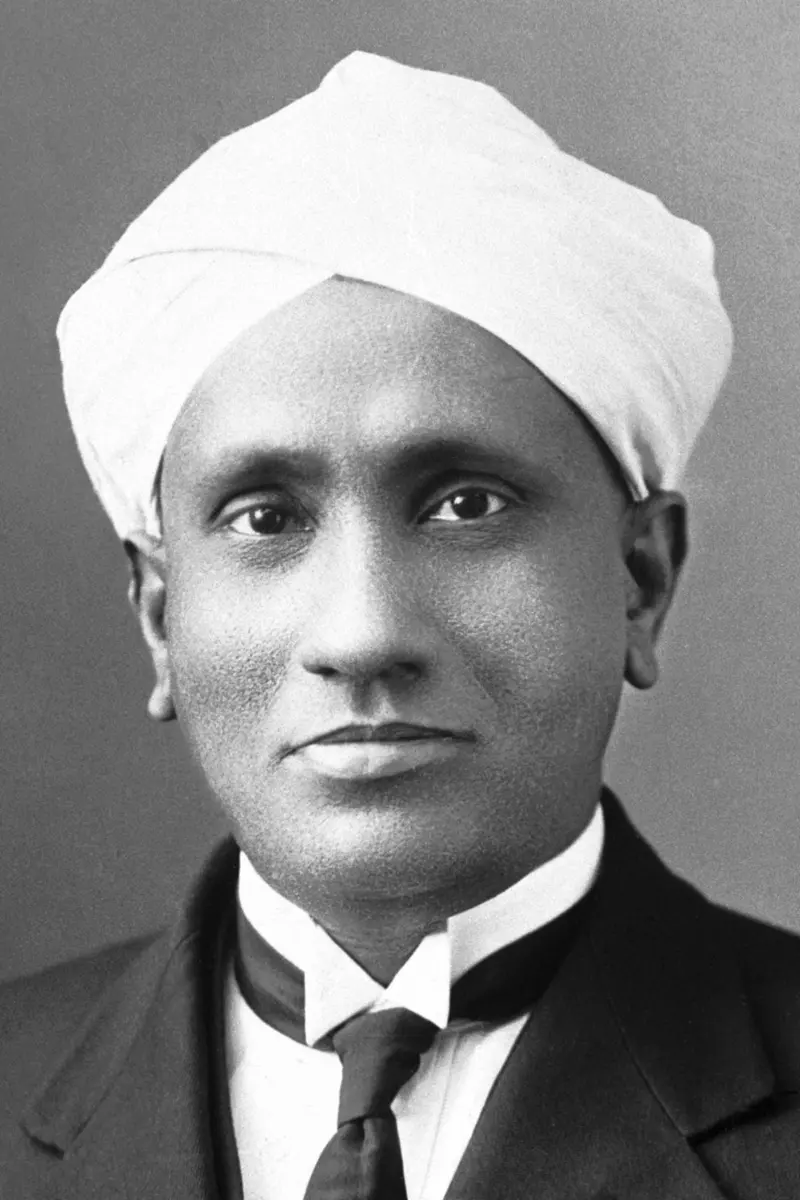
C. V. Raman
1888–1970, born in India
He did his first research in the evenings, after his day’s work as a government accounts officer, in a small laboratory in Calcutta. He was the first Asian to win a Nobel Prize in science.
Photo: Nobel Foundation, Public domain
Shine a torch through a glass of water in a dark room and look at it from the side. You can hardly see the beam. Now stir in a few drops of milk and look again: the beam glows clearly, because the tiny drops of fat in the milk send some of its light off sideways, towards your eye. Even a clear sky does this with sunlight. That is why the sky over the Himalaya is bright and blue, not black.
Sending light off in new directions like this is called scattering. For a long time everyone thought that scattered light keeps exactly the color it came in with. In 1928, in Calcutta (now Kolkata), C. V. Raman and his student K. S. Krishnan found that a tiny part of it does not. It comes out a slightly different color, and the change is different for every substance. This became known as the Raman effect, and it won Raman the Nobel Prize in Physics in 1930.
The problem: why is the sea blue?
In 1921 Raman sailed to England for a meeting of scientists, and back again. Crossing the Mediterranean Sea, he was struck by its deep blue color. The famous British physicist Lord Rayleigh had explained why the sky is blue: the molecules of the air scatter blue light much more than red light, so blue light reaches us from every part of the sky. But Rayleigh thought the sea is blue mostly because it reflects the blue sky, like a mirror.
Raman did not believe it. On the ship he looked at the sea through a special prism, a Nicol prism, which, turned the right way, blocks the sky’s light reflected off the water’s surface. The water still looked deep blue. He decided that the molecules of water themselves scatter light, just as the molecules of air do. As soon as he was home in Calcutta, he began to study how light is scattered by liquids. He did not stop for seven years.
How light bounces off molecules
To follow what Raman found, you need two ideas.
First, light comes in packets. Light is a wave, and its color depends on its wavelength: violet and blue light have short wavelengths, red light longer ones Grade 9: The electromagnetic spectrum. But light is also given out and taken in as tiny packets of energy called photons. A photon of blue light carries more energy than a photon of red light. So if a photon loses some of its energy, its light becomes redder; if it gains energy, bluer (Einstein’s packets of light).
Second, molecules wobble. A molecule is made of atoms joined by bonds Grade 9: Covalent bond. The bonds are not stiff rods. They behave more like springs: the atoms can vibrate back and forth. Like the strings of a sarangi, each molecule can only vibrate at certain frequencies of its own, set by how heavy its atoms are and how stiff its bonds are. Each vibration can only take in energy in fixed amounts.
Now, when a photon meets a molecule, three things can happen.
- Most photons bounce off with the same energy they came in with. The scattered light has the same color. This is ordinary scattering, the kind that makes the sky blue, now called Rayleigh scattering.
- A very few photons give part of their energy to the molecule and set it vibrating. They come out with less energy, so their light is a little redder.
- Even fewer meet a molecule that is already vibrating, take its vibration energy, and come out with more energy: a little bluer.
The amount of energy a photon loses (or gains) is exactly the energy of one of the molecule’s vibrations. So the change of color tells you how the molecule vibrates, and that depends on which atoms it has and how they are joined. This is the Raman effect.
Some blue light is scattered by a liquid, and a little of it comes out green. What happened to the photons that came out green?
Pick an answer to see why.
Why it was hard
The changed light is extremely faint. Light scattered sideways by a clear, clean liquid is already much weaker than the glow you saw with the milk. The light that changes color is only a few hundredths of that. In daylight, in an ordinary room, you would never notice it.
There were other traps. A speck of dust scatters far more light than millions of molecules, so the liquids had to be purified again and again. Some substances fluoresce: they soak up light of one color and give out another, the way a highlighter pen glows, and a trace of one could fool you. And there were no lasers until 1960: Raman had sunlight, colored glass and, later, a mercury lamp.
In fact, Raman’s team had seen a faint glow of the “wrong” color as early as 1923: his student K. R. Ramanathan found it in very pure water and alcohol. But it was so weak that, for five years, nobody could say what it was.
What Raman did, step by step
Raman and his team in Calcutta
C. V. Raman was born in Tiruchirappalli, in South India, in 1888. He finished his master’s degree in Madras (now Chennai) at 18, with top marks, but there were few jobs for scientists in India then, so in 1907 he joined the government’s Finance Department and moved to Calcutta. Before and after work, he did experiments in the laboratory of the Indian Association for the Cultivation of Science, a society founded in 1876 by the doctor Mahendralal Sarkar so that Indians could do science of their own. In 1917 he became a professor of physics at the University of Calcutta.
- 1921–1922, the question. Back from the voyage, Raman set his students to measure how light is scattered in gases, liquids and solids.
- 1923–1927, a puzzle. Ramanathan, and later Krishnan, kept finding a feeble light of a different color in the scattered light. It stayed even in the purest liquids, so it was not dirt and not fluorescence. In 1923 the American physicist Arthur Compton had shown that X-rays bounce off electrons and come out with longer wavelengths. Raman began to wonder: could ordinary light do something like it, off molecules?
- Around the end of 1927, glycerine. A student, S. Venkateswaran, found that sunlight scattered by very pure glycerine looked green, not blue. That was a much stronger case of the puzzle, and easier to study.
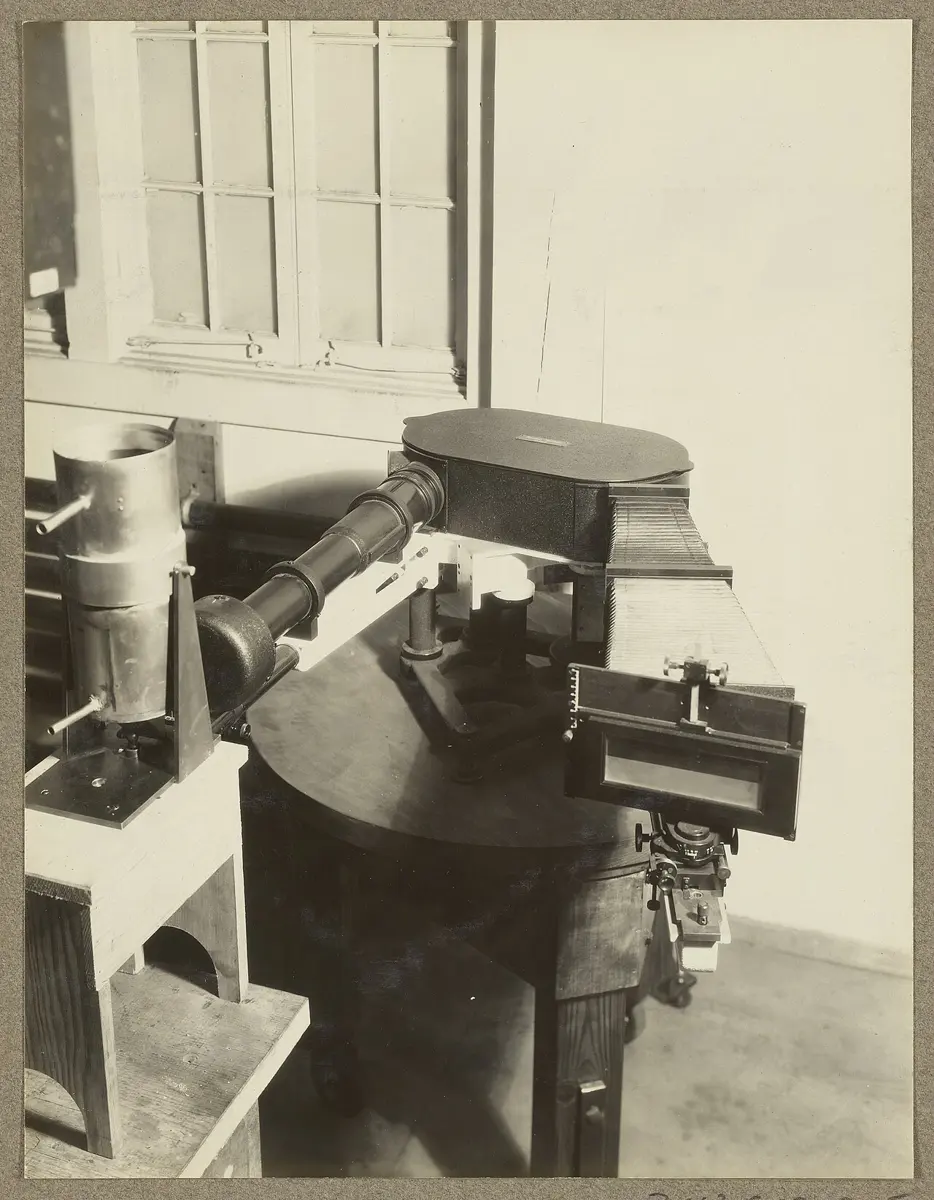
- Early 1928, the filter trick. Raman focused sunlight into the liquid with a telescope whose main lens was 7 inches (18 cm) across. In the beam he put a blue-violet filter. Then he looked at the scattered light through a second, yellow-green filter, which blocks blue-violet light completely. If any light still got through, its color must have changed inside the liquid. It did, in liquid after liquid.
- 16 February 1928, the letter. Raman and Krishnan sent a short letter, A new type of secondary radiation, by telegram to the journal Nature in London. They had seen the changed light in about sixty liquids. It was printed at the end of March.
- 28 February 1928, the lines. Raman replaced the sunlight with a mercury lamp, which gives light of only a few exact colors, and looked at the scattered light through a spectroscope, which spreads light out into its colors. Beside the bright mercury lines there were new, sharp lines that the lamp did not give out at all. When he used a different mercury line, the new lines moved with it, always by the same amount. Soon Krishnan found lines on the bluer side as well.
How it works now: a fingerprint for every substance
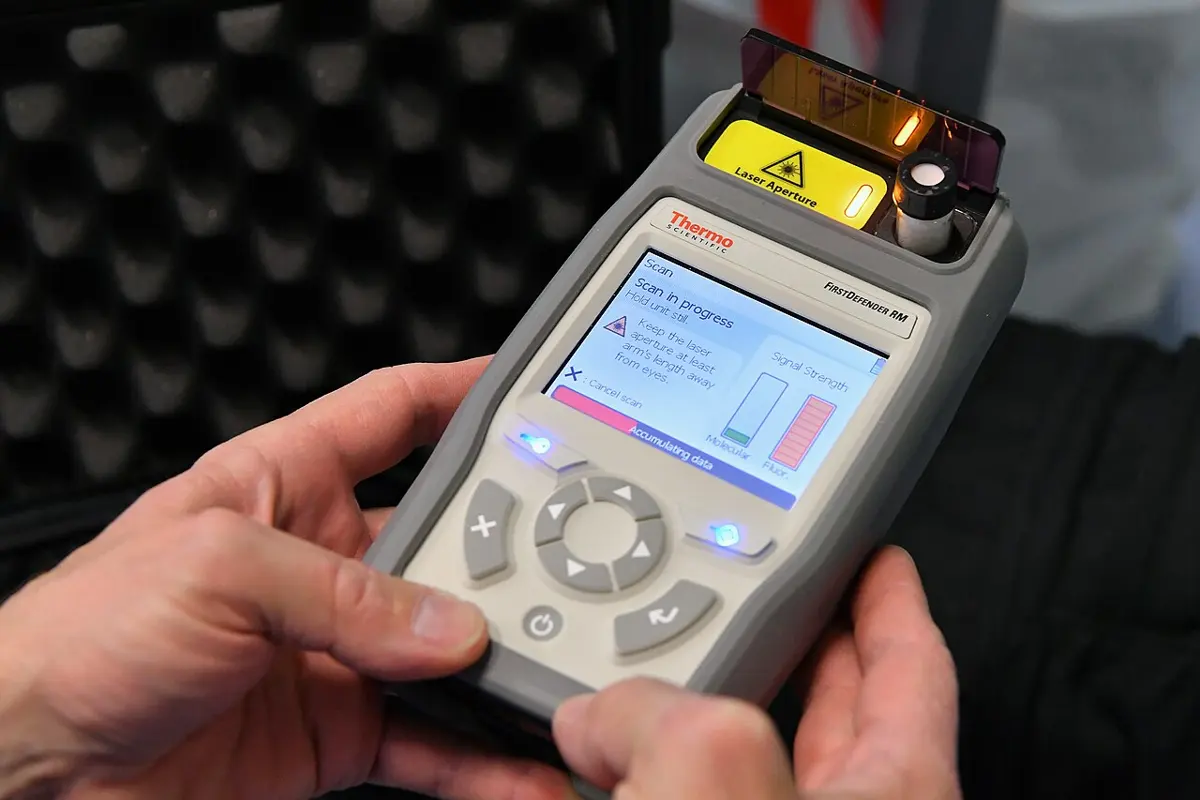
Every kind of molecule has its own set of vibrations, so every substance gives its own set of Raman lines, a pattern as personal as a fingerprint. Measure the pattern, compare it with a library of known patterns, and you know what the substance is, without touching it, cutting it or dissolving it. This is Raman spectroscopy.
Since the 1960s the light comes from a laser. A filter removes the much brighter light of the laser’s own color, and a spectrometer spreads the rest onto a light sensor, like a phone camera’s.
The redder lines are stronger than the bluer ones, because at room temperature only a few molecules are already vibrating, ready to give their energy away.
Why does Raman spectroscopy work as a “fingerprint” for a substance?
Pick an answer to see why.
In your life today
- Fake medicines. A handheld Raman scanner can check the tablets in a sealed packet, through the plastic or glass, in a few seconds. Medicine regulators and customs officers in many countries use them to catch fake or poor-quality medicines.
- Gems. Jewelers and gem laboratories use Raman spectroscopy to tell a real diamond or ruby from a cheaper copy, and to tell natural stones from ones made in a factory.
- Unknown powders and old paintings. Firefighters and inspectors identify a spilled chemical without opening its bag; museums find out which pigments an old painting was made with, without taking any paint off.
- On Mars. NASA’s Perseverance rover, which landed on Mars in 2021, carries two instruments that use the Raman effect: SHERLOC, on the end of its arm, and SuperCam, on its mast. They identify the minerals in Martian rocks and search for carbon-based molecules that might be signs of ancient life.
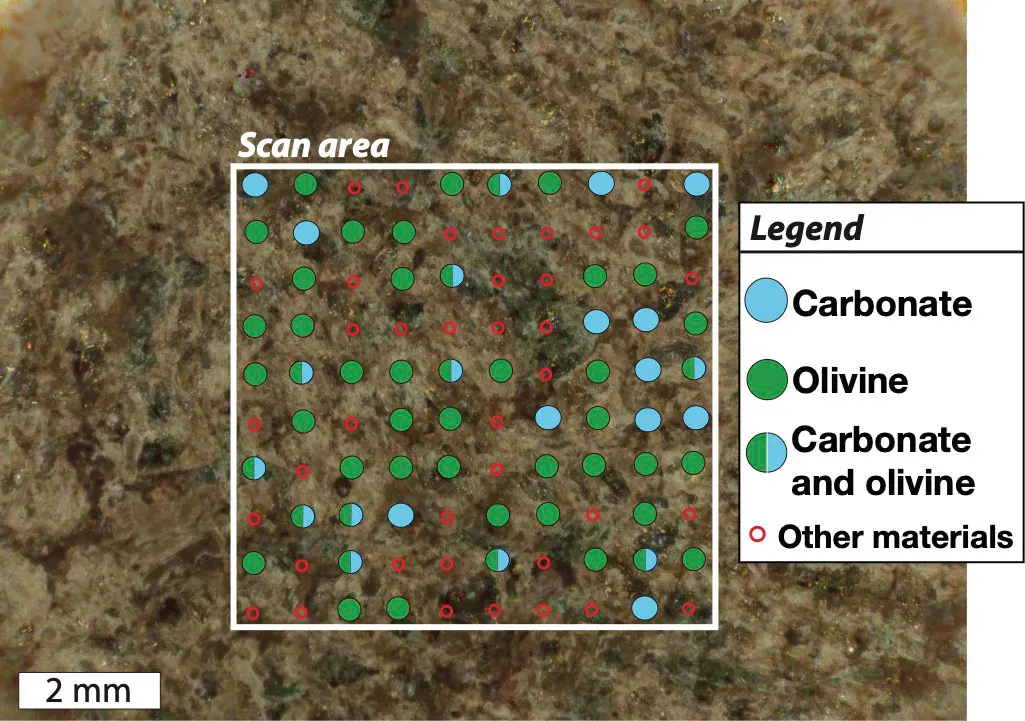
What came next
- Honors. Raman was knighted in 1929, becoming Sir C. V. Raman, and received the Nobel Prize in Stockholm on 10 December 1930. In 1948 he founded the Raman Research Institute in Bangalore (now Bengaluru), and worked there until his death in 1970.
- National Science Day. India celebrates National Science Day every year on 28 February, the day Raman saw the lines, with science fairs and open days in schools and laboratories.
- Krishnan. K. S. Krishnan, who did much of the work with Raman, did not share the prize. He went on to be a leading physicist himself and the first director of India’s National Physical Laboratory in New Delhi.
- Far stronger signals. In the 1970s scientists found that molecules sitting on rough silver or gold surfaces give Raman signals millions of times stronger than usual. Doctors are testing Raman probes that could tell a surgeon, during an operation, which tissue is cancer and which is healthy.
An open question: the Raman effect is weak because only a tiny share of photons change color. Could Raman scanners be made small and cheap enough to sit in every health post and every phone, so that anyone could check whether a medicine is real? Engineers are working on it.
In your science books
- Grade 8: light and the color of an object.
- Grade 9: the electromagnetic spectrum, visible light, and the covalent bond, the “spring” that vibrates.
- Grade 10: dispersion of light, white light spread into its colors.
- Going Further: Einstein’s packets of light, why a bluer photon carries more energy; three kinds of spectrum and how to make a spectroscope; and why light can’t get through a brick, on light meeting particles.
Learn more
- The prize at nobelprize.org: The Nobel Prize in Physics 1930, with the presentation speech, which explains the new lines and why they moved with the light.
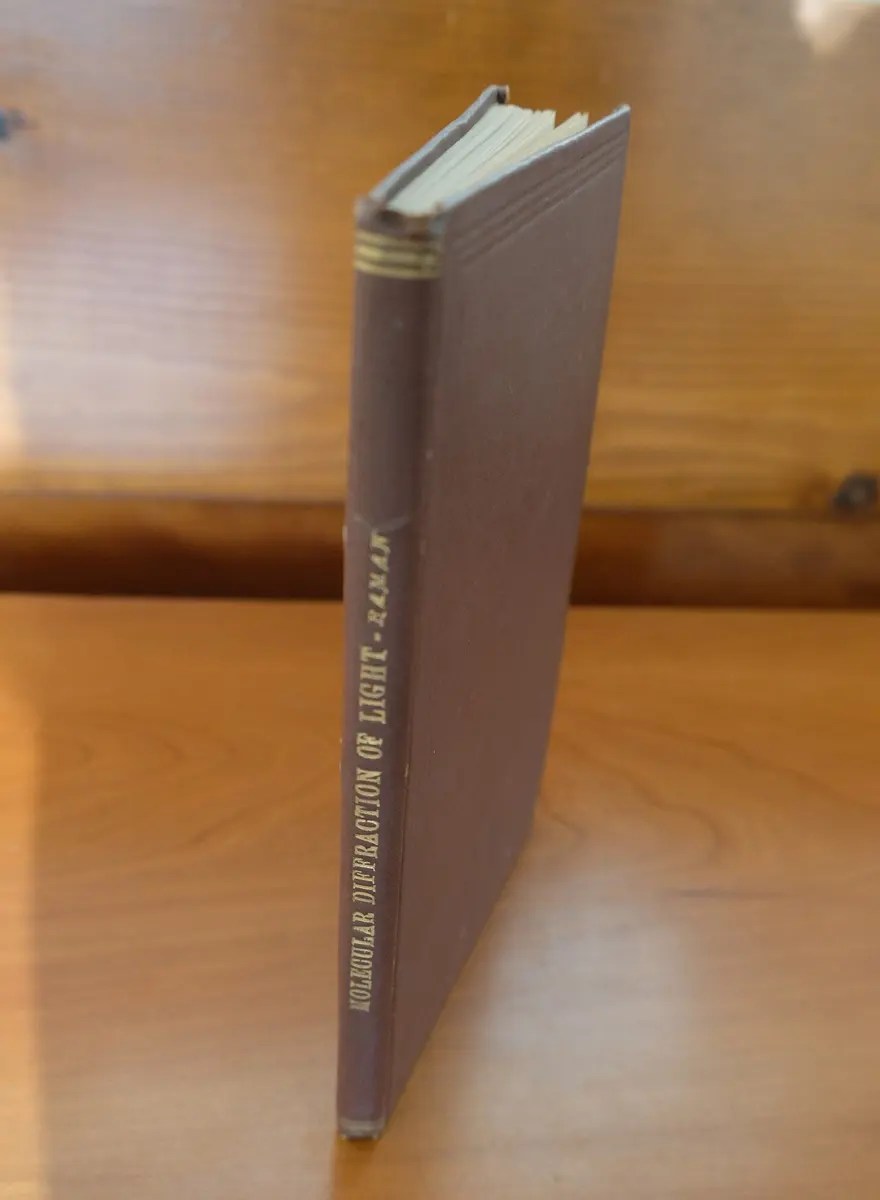
- Raman’s Nobel lecture, The molecular scattering of light, 11 December 1930, which begins with the color of the sea and tells how the team found the effect, year by year.
The official reason
The prize was given “for his work on the scattering of light and for the discovery of the effect named after him.”