
- Atomic number
- 35
- Atomic mass
- 79.9
- Shells
- 2, 8, 18, 7
- Configuration
- 1s² 2s² 2p⁶ 3s² 3p⁶ 4s² 3d¹⁰ 4p⁵
- In the table
- period 4, group 17 (VIIA), p-block
- Kind
- Halogen
- Valency
- 1 (bromide, Br⁻); also 5 with oxygen (bromate, BrO₃⁻)
- State at 25 °C
- liquid
- Melts · boils
- −7 °C · 59 °C
- Density
- 3.1 × as heavy as water
- Known since
- 1826
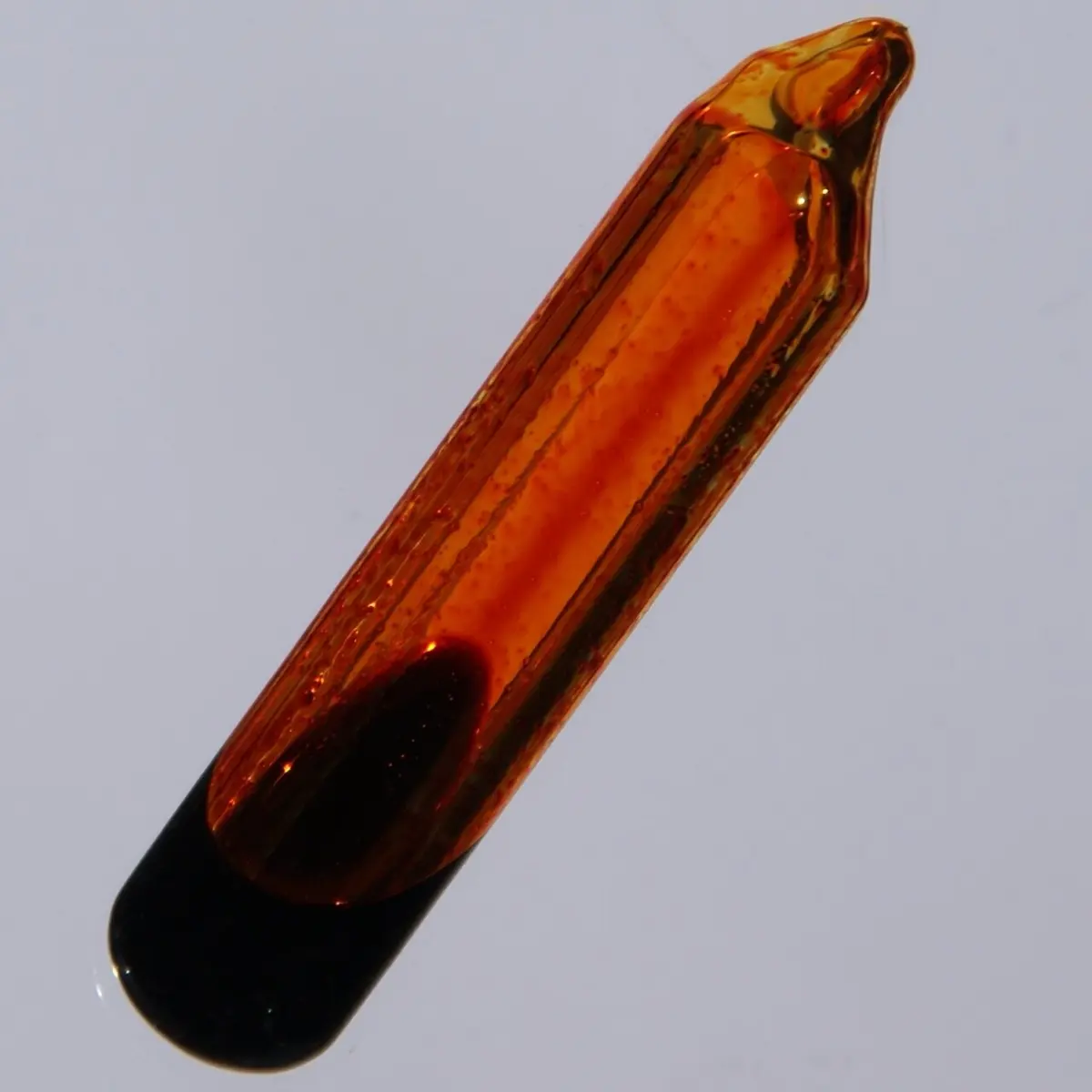
Pick up a glass of water, a spoon of honey or a drop of mustard oil: at room temperature, almost every liquid you know is a compound. Of all the 118 elements, only two are liquids at room temperature. One is mercury, the silver metal of old thermometers. The other is bromine, a heavy, dark red-brown liquid that gives off an orange-brown vapor with a sharp, choking smell.
You may never see bromine itself, but it is probably in the room with you. Bromine compounds help stop the plastic of a television, the foam of a sofa and the cables in a wall from catching fire. Here is the story of the element named after a bad smell.
The bromine atom
Every bromine atom has 35 protons, so bromine’s atomic number is 35, and a neutral atom has 35 electrons. About half of all bromine atoms have 44 neutrons (bromine-79) and the other half have 46 (bromine-81).
By the 2n² rule Grade 8: Bohr and Bury’s rule, the shells hold 2, 8, 18, 7. In subshells Grade 10: The Aufbau principle:
1s² 2s² 2p⁶ 3s² 3p⁶ 4s² 3d¹⁰ 4p⁵
After 4s, the ten places of 3d fill before 4p. That is why the M shell ends up with 18 electrons, not 8. The outer shell is 4s² 4p⁵: seven electrons, one short of an octet Grade 9: Octet rule.
Its place in the periodic table
- Period 4, because its electrons are in four shells. It sits between selenium (34) and krypton (36).
- Group 17, called VIIA in the older naming, because it has 7 outer electrons.
- p-block, because its last electron goes into a p subshell. It is a non-metal Grade 10: Non-metals.
Bromine is a halogen, between chlorine above it and iodine below. Like them, it takes one electron from a metal to become the bromide ion, Br⁻, with the electrons 2, 8, 18, 8, like krypton Grade 9: Ions. So its valency is 1, as in potassium bromide, KBr. Two bromine atoms share a pair of electrons to make the molecule Br₂ Grade 9: Covalent bond.
Bromine is in the middle of the halogens in every way. It is less reactive than chlorine, because its atom is bigger and pulls on an extra electron less strongly, and more reactive than iodine Grade 10: Chemical reactivity. Its color, between yellow-green chlorine and violet-black iodine, is red-brown.
A bromine atom has 35 electrons. How many electrons does a bromide ion, Br⁻, have, and how are they arranged?
Pick an answer to see why.
How bromine was found and named
In 1825, a young chemistry student in Germany, Carl Löwig, found a red-brown liquid in the water of a salt spring near his home town, Bad Kreuznach. His professor asked him to make more of it to study. While he was doing so, a French chemist beat him to it.
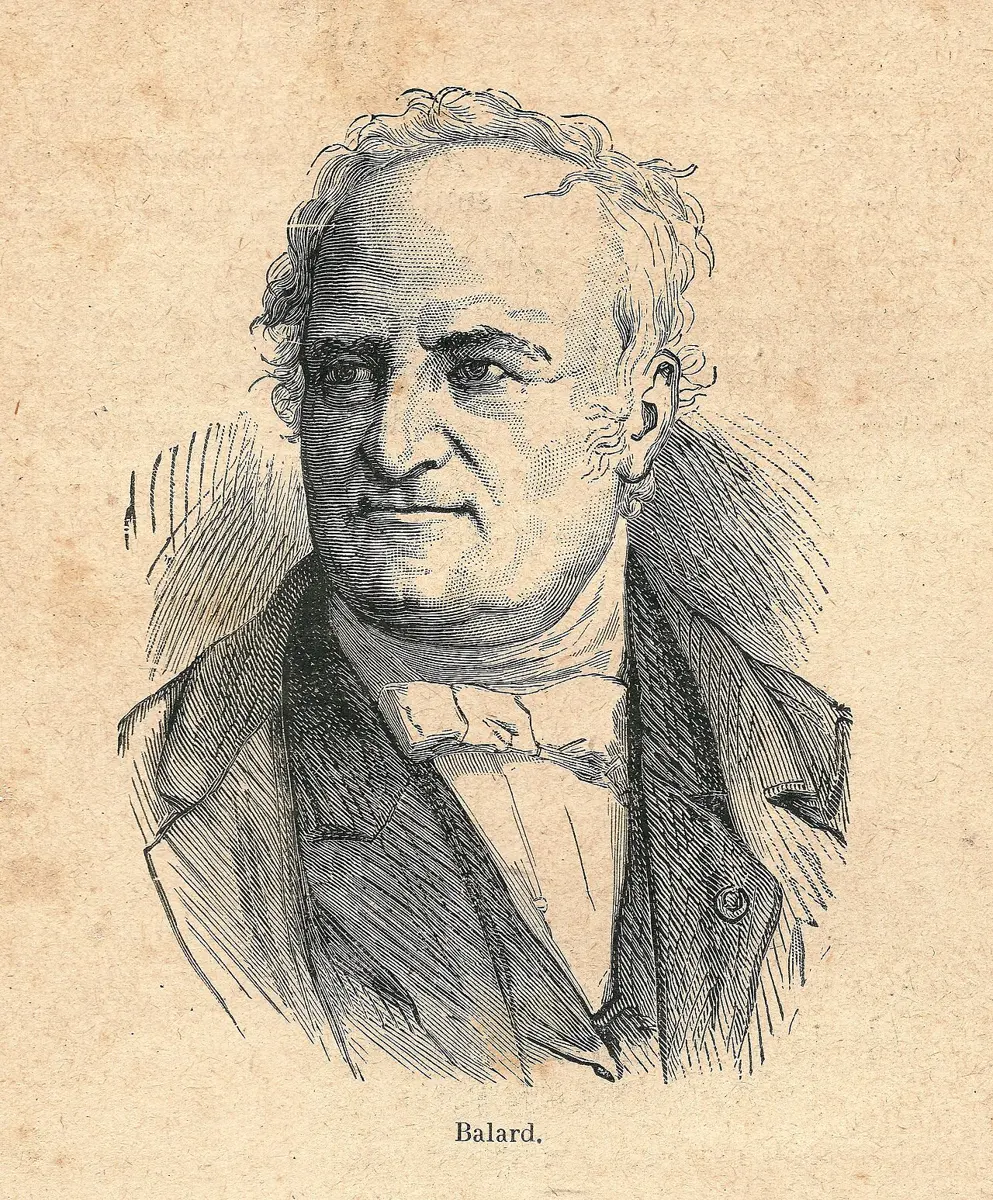
In Montpellier, in the south of France, Antoine-Jérôme Balard, then 23, was studying the bitter liquid left over after sea salt is made from seawater in salt marshes. When he bubbled chlorine through it, it turned yellow-brown. With some work he collected a dark red liquid with a terrible smell, and showed that it was a new element, a cousin of chlorine and iodine. He announced it in 1826, so he is called its discoverer.
The French Academy of Sciences named it brome, from the Greek bromos, stench (a bad smell): hence “bromine” and the symbol Br. In Nepali it is ब्रोमिन, a borrowed name.
Where bromine is found
In the universe. Bromine is heavier than iron, so it was made mostly by atoms catching neutrons, slowly in giant stars and in a flash when dead stars collide (Heavier than iron).
In the sea. Bromine is too reactive to be found free. Almost all of it is in the sea as bromide ions: about 65 milligrams in each liter of seawater, much more than iodine but about 300 times less than chloride. Salty lakes hold even more. The Dead Sea, between Israel and Jordan, has some of the most bromide-rich water on Earth.
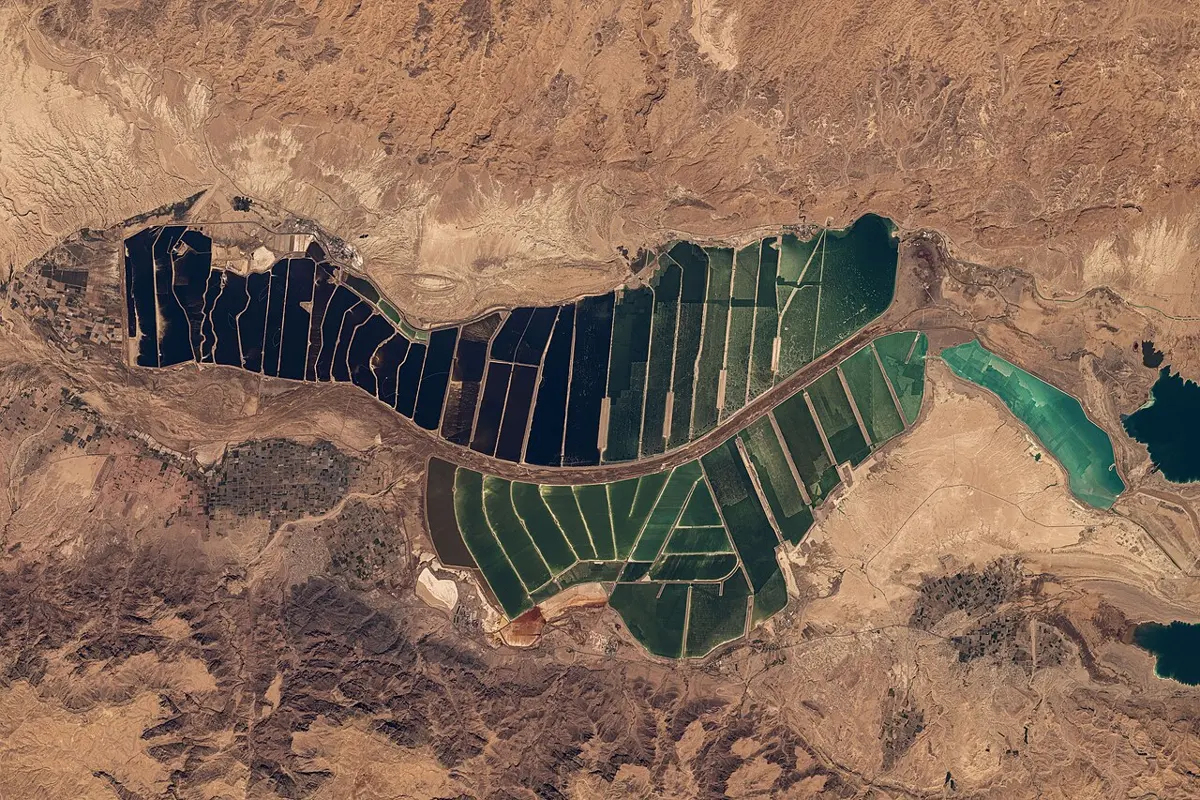
Most bromine comes from that region and from underground brines. In 2025 Israel made about 200,000 tonnes, Jordan 110,000 tonnes and China 90,000 tonnes; the world made about 430,000 tonnes, not counting the United States, which keeps its figure secret (USGS, 2026). India makes some from the brine left by its salt pans in Gujarat.
In Nepal. Nepal has no sea or salt lakes, and makes no bromine.
In your body. Your blood carries a little bromide, from food and water. Whether people actually need it is still unsettled (see below).
What bromine is like
- A dark red-brown liquid at room temperature, the only non-metal that is a liquid Grade 9: Metals and non-metals compared.
- Heavy: its density is 3.1 g/cm³, three times that of water. A 100 mL bottle of it would weigh over 300 g.
- Freezes at −7 °C and boils at 59 °C. It evaporates easily even at room temperature, so a bottle is always full of orange-brown vapor, which is heavier than air.
- Smells sharp and choking, and its vapor stings the eyes and nose.
- Dissolves a little in water, giving an orange-yellow solution called bromine water.
Why is bromine a liquid when chlorine is a gas and iodine a solid? All three are made of molecules of two atoms, held to each other by weak forces between molecules. The bigger the molecule, the more electrons it has, and the stronger these forces. Cl₂ is small, so its molecules fly apart even at −34 °C. I₂ is big, so its molecules stay packed together as a solid up to 114 °C. Br₂ is in between: its molecules hold together as a liquid, but not tightly enough to make a solid at room temperature.
Which of these elements is a liquid non-metal at room temperature?
Pick an answer to see why.
How bromine reacts
With metals. Bromine reacts with most metals to make bromides, often fiercely. A piece of aluminium foil dropped into liquid bromine reacts with flashes and sparks:
2Al + 3Br₂ → 2AlBr₃
With hydrogen it makes hydrogen bromide, HBr, a gas that dissolves in water as the strong hydrobromic acid:
H₂ + Br₂ → 2HBr
Displacing and being displaced. Chlorine is more reactive than bromine, so chlorine pushes bromine out of bromides; bromine, in turn, pushes iodine out of iodides Grade 10: Single displacement:
Cl₂ + 2KBr → 2KCl + Br₂
Br₂ + 2KI → 2KBr + I₂
The first of these is how bromine was discovered, and how it is made today.
A test for double bonds. Orange-yellow bromine water shaken with an alkene such as ethene loses its color at once: the bromine adds across the double bond Grade 10: Alkenes. With an alkane such as methane, which has only single bonds, the color stays.
C₂H₄ + Br₂ → C₂H₄Br₂
A silver bromide test. Silver nitrate added to a solution of a bromide gives a cream-colored precipitate of silver bromide, AgBr. (Chloride gives white, iodide pale yellow.)
Chlorine water is added to colorless potassium bromide solution. What do you see?
Pick an answer to see why.
How bromine is made
Bromine is made from brine, salty water rich in bromide, using the reaction Balard used: chlorine pushes the bromine out. Steam or air blown through the mixture carries the bromine away as vapor, which is cooled until it turns into liquid.
Bromine in daily life
- Fire safety. The biggest use of bromine is in flame retardants: bromine compounds mixed into the plastic cases of televisions and computers, circuit boards, cables, building foam and furniture. When the plastic gets hot, they release bromine atoms that stop the chain of reactions in a flame. Some of them, though, last for years in the environment and build up in living things, so the most harmful ones have been banned.
- Drilling for oil and gas. Solutions of calcium bromide and zinc bromide are so dense that they are pumped down oil and gas wells to hold back the pressure from below.
- Clean water. Bromine compounds kill germs in swimming pools, hot tubs and the cooling water of factories.
- Photography. Before digital cameras, every photographic film and print was coated with tiny crystals of silver bromide, which change when light falls on them.
- Medicines and dyes. Bromine is used in making many medicines, pesticides and dyes.
Calming medicines. In 1857 an English doctor found that potassium bromide calmed fits of epilepsy, the first useful medicine for it. Bromides were then given for nerves and sleeplessness for nearly a hundred years. They made people so dull that in English a “bromide” came to mean a boring, worn-out remark. Today better medicines are used for people, but vets still give potassium bromide to dogs with epilepsy.
Bromine and the ozone layer
Some bromine compounds harm the ozone layer, the thin shield of ozone high in the air that blocks the Sun’s harmful ultraviolet rays Grade 9: Depletion of the ozone layer. Halons, once used in fire extinguishers, and methyl bromide, a gas used to kill pests in soil and stored grain, drift up to the stratosphere. There, sunlight sets free bromine atoms, and each destroys ozone even faster than chlorine does: about 60 times as much, atom for atom. Under the Montreal Protocol, making new halons has stopped, and methyl bromide is banned around the world except for a few uses, such as killing pests in goods shipped between countries. The chemistry of the ozone hole won the Nobel Prize in Chemistry in 1995.
Isotopes of bromine
Natural bromine is an almost equal mixture of two isotopes, neither radioactive: bromine-79 (44 neutrons) and bromine-81 (46 neutrons). That is why bromine’s atomic mass is close to 80, though no bromine atom has a mass of 80 Grade 9: Atomic mass.
Bromine and your health
Bromine has no proven job in the human body. In 2014, scientists found that fruit flies need a trace of bromide to build a protein that holds tissues together, and that the same chemistry happens in other animals, so it may turn out to be needed by people too, in tiny amounts. Food and water give far more than that.
As a liquid and vapor, bromine itself is dangerous. It burns skin, causing painful sores that heal slowly, and its vapor damages the eyes, nose and lungs. Chemists handle it only in a fume cupboard, with gloves and goggles.
Surprising facts and records
- One of two. Bromine and mercury are the only elements that are liquid at room temperature; bromine is the only liquid non-metal.
- The first element taken from seawater. In the 1930s, factories in the United States began pulling bromine out of plain seawater, for leaded petrol.
- Halfway house. Bromine’s atomic weight, about 80, is almost exactly the average of chlorine’s (35.5) and iodine’s (127): (35.5 + 127) ÷ 2 = 81. In 1829 the German chemist Döbereiner noticed such triads of similar elements, one of the first clues to the periodic table.
In your science books
- Grade 8: non-metals in the periodic table (bromine, the liquid non-metal), groups and the 2n² rule.
- Grade 9: metals and non-metals compared, the octet rule, ions, atomic mass and the ozone layer.
- Grade 10: the Aufbau principle, reactivity down a group, single displacement and alkenes.
- Going further: where heavy atoms were made.
More to explore
- Nobel Prizes with bromine in them: the ozone layer (1995), watching molecules collide (1986, potassium meeting bromine), joining carbon atoms with palladium (2010, a bromine “handle” marks where carbon atoms join) and plastic that conducts (2000, a little bromine made the plastic conduct).
- The other halogens: fluorine, chlorine and iodine; and the other liquid element, mercury.
- Play: find bromine in Guess the Element and the Periodic Table Jigsaw.
- Read more: bromine at the Royal Society of Chemistry and at PubChem.