
- Atomic number
- 106
- Atomic mass
- 269.13
- Shells
- 2, 8, 18, 32, 32, 12, 2
- Configuration
- 1s² 2s² 2p⁶ 3s² 3p⁶ 4s² 3d¹⁰ 4p⁶ 5s² 4d¹⁰ 5p⁶ 6s² 4f¹⁴ 5d¹⁰ 6p⁶ 7s² 5f¹⁴ 6d⁴
- In the table
- period 7, group 6 (VIB), d-block
- Kind
- Transition metal
- Valency
- 6 (as in SgO₂Cl₂)
- State at 25 °C
- solid
- Melts · boils
- not known · not known
- Known since
- 1974
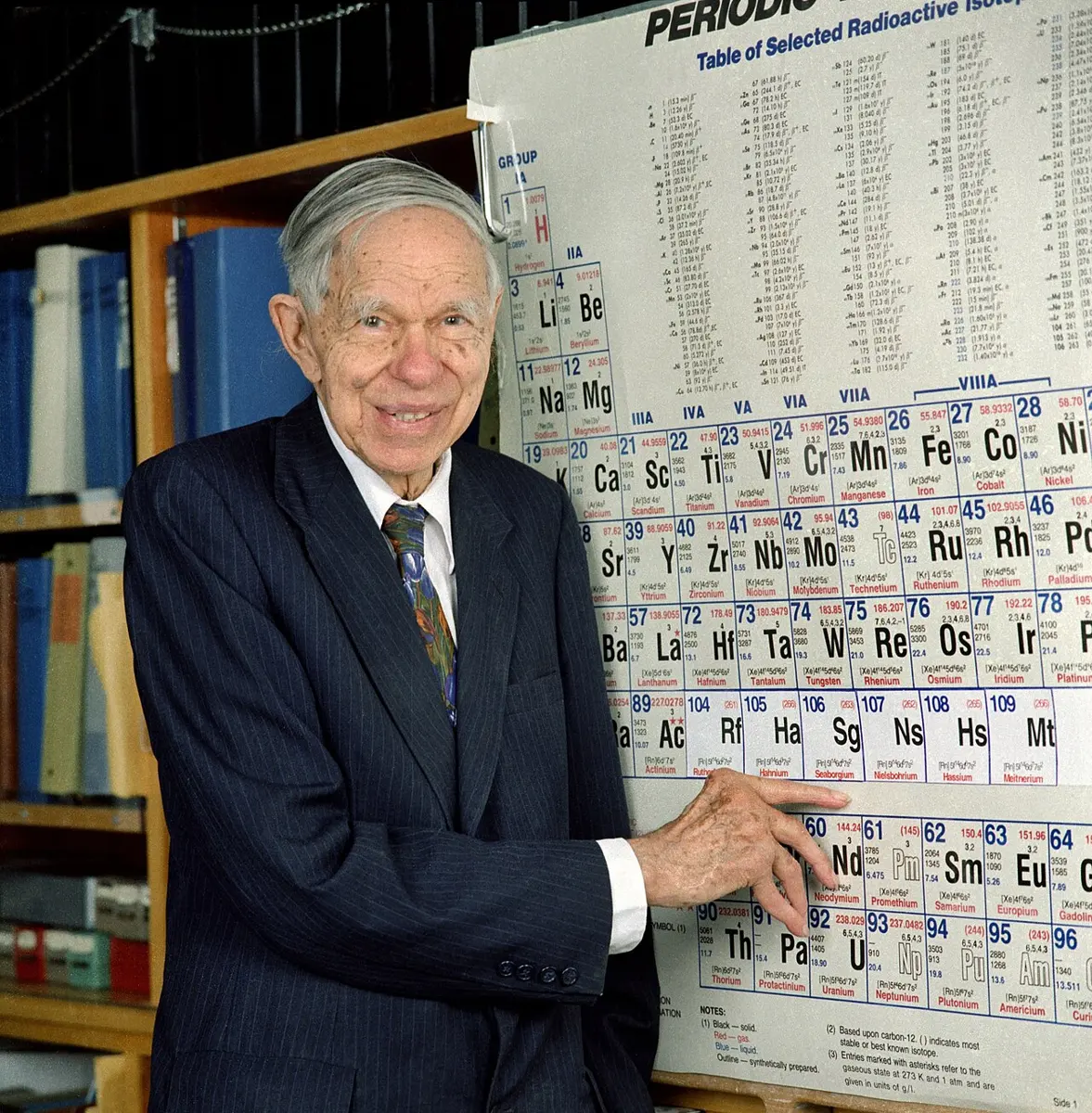
Most elements named after people honor scientists who had died long before. Seaborgium, element 106, was named after Glenn Seaborg while he was still alive, and he could find his own name on the periodic table. The rule-makers tried to stop it, and failed.
The seaborgium atom
A seaborgium atom has 106 protons (atomic number 106) and 106 electrons. Its first known kind, seaborgium-263, has 263 − 106 = 157 neutrons. By shells the electrons are 2, 8, 18, 32, 32, 12, 2, and in subshells Grade 10: The Aufbau principle:
… 7s² 5f¹⁴ 6d⁴
It is a transition metal in period 7 and group 6, under chromium, molybdenum and tungsten, the metal of old light bulb filaments Grade 10: Features of the modern periodic table. Like them it has six electrons outside the full subshells, and it uses all six: its valency is 6.
Tungsten’s oxide is WO₃: tungsten has valency 6, oxygen valency 2. What would you expect seaborgium’s oxide to be?
Pick an answer to see why.
Found in 1974
Two teams made element 106 in 1974. At Dubna, near Moscow, Yuri Oganessian’s team fired chromium nuclei (24 protons) at lead (82): 82 + 24 = 106. A few months later, a team at Berkeley and Livermore, California, led by Albert Ghiorso, fired oxygen-18 (8) at californium-249 (98): 98 + 8 = 106. They made seaborgium-263, with a half-life of about 0.9 seconds, and proved it by its decay: it gave out an alpha particle and became rutherfordium-259, which gave out another and became nobelium-255, two atoms already well known. In 1993, the international working group found the Berkeley evidence convincing and Dubna’s not, so the right to name it went to Berkeley.
The name
The team suggested many names: Newton, Edison, Leonardo da Vinci, Magellan. Then Ghiorso had another idea: seaborgium, after their colleague of fifty years. Seaborg agreed, and the name and the symbol Sg were announced in March 1994.
That August, IUPAC decided that no element could be named after a living person, and in its list of names that year, seaborgium was gone (Dubnium shows that list). Chemists around the world protested, and the American Chemical Society kept using the name in its journals. Seaborg said that never before had the “acknowledged and uncontested discoverers” of an element been refused the right to name it. IUPAC gave way, and in 1997 seaborgium became the official name.
Seaborg called it the greatest honor he had ever received, better even than his Nobel Prize. He died on 25 February 1999, aged 86. In 2016 a second element was named after a living person: oganesson, element 118, after Yuri Oganessian.
Who was Glenn Seaborg?
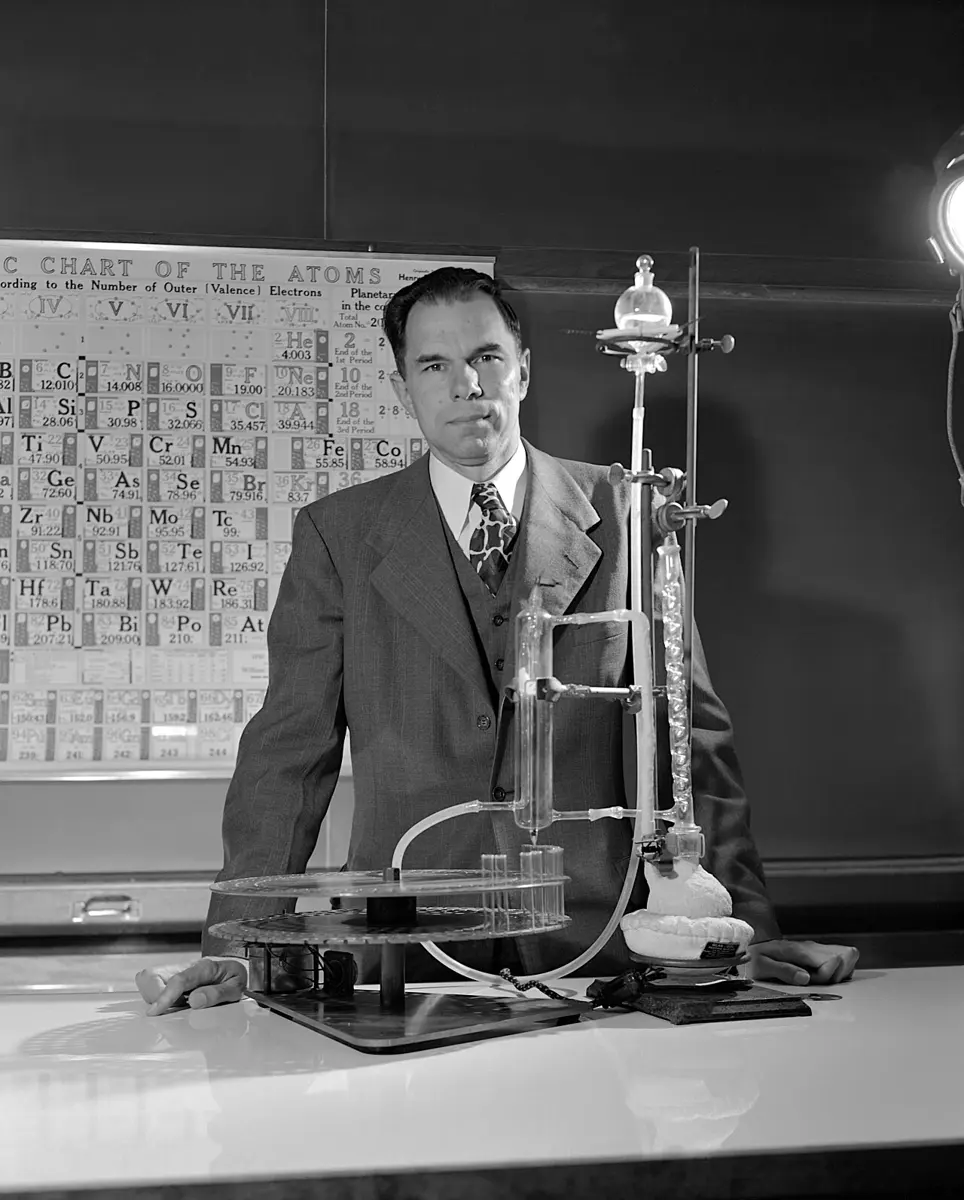
Glenn Seaborg (1912–1999) was an American chemist at Berkeley. In 1941 his team discovered plutonium, and over the next years he helped find nine more elements, from americium to nobelium and then seaborgium. In 1944 he suggested that the elements from actinium onwards form a row of their own, the actinides, printed under the lanthanides: the shape of the periodic table in your book Grade 10: Features of the modern periodic table. He shared the 1951 Nobel Prize in Chemistry with Edwin McMillan.
Seaborgium’s chemistry
Seaborgium’s longest-lasting kinds have half-lives of a few minutes. (Measurements disagree, from about 2 to over 10 minutes, because so few atoms have been seen.) That is long enough for chemistry, one atom at a time.
What has been measured:
- In 1995–96, at Darmstadt in Germany, a few atoms of seaborgium reacted with oxygen and hydrogen chloride and formed a gas, the oxychloride SgO₂Cl₂. It behaved like the oxychlorides of molybdenum and tungsten, and traveled a little less easily, as expected down the group.
- In 1997–98, in acid solutions, seaborgium behaved much like tungsten, though not in every test.
- In 2014, an international team working in Japan made seaborgium hexacarbonyl, Sg(CO)₆: one seaborgium atom holding six molecules of carbon monoxide. It behaved like tungsten’s W(CO)₆. It was the first molecule of its kind made with a superheavy element.
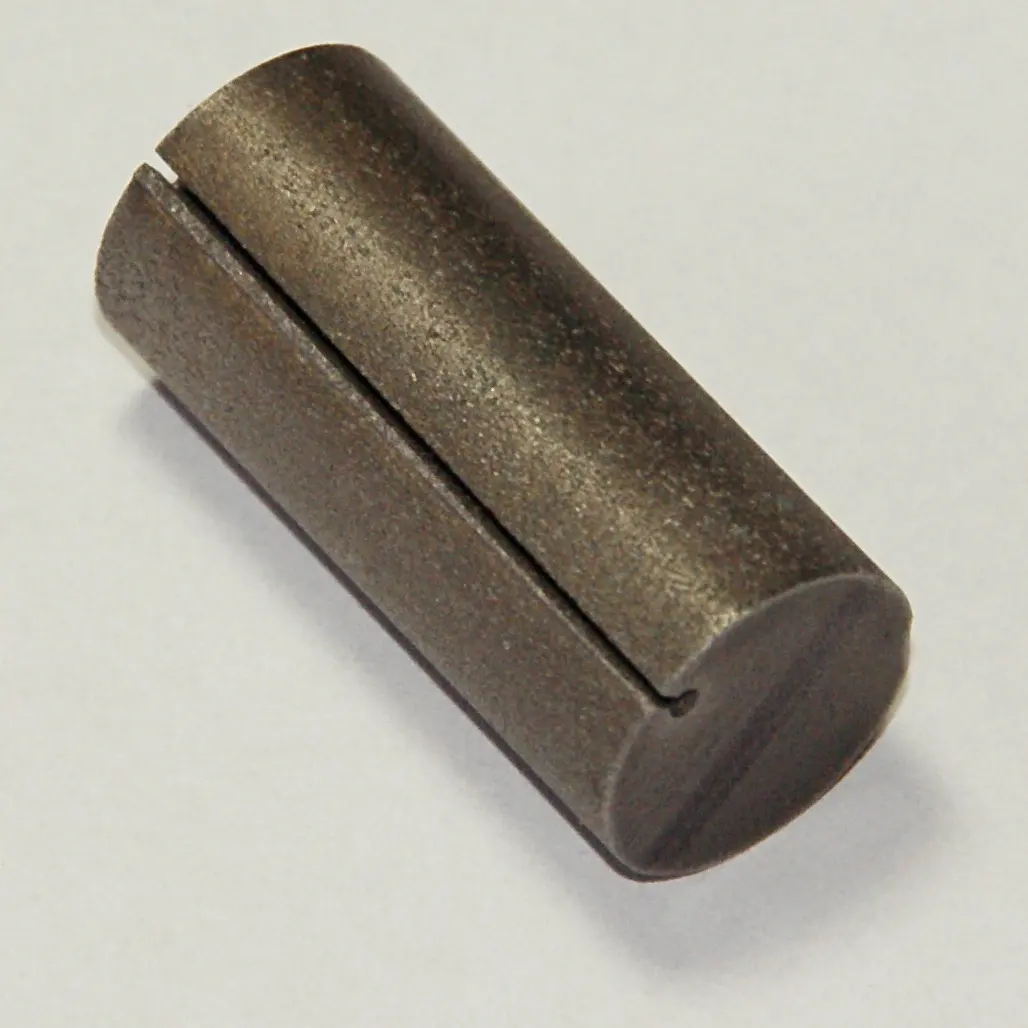
What is only predicted: that seaborgium is a solid, dense metal like tungsten (about 23–24 g/cm³ by recent calculations, against tungsten’s 19.3), and its melting and boiling points.
In your science books
- Grade 9: radioactive elements and variable valency.
- Grade 10: features of the modern periodic table, the Aufbau principle and valency.
- Going further: alpha decay.
More to explore
- Nobel Prizes: Seaborg and McMillan’s prize (1951) for the elements beyond uranium.
- Its neighbors: dubnium, the element before it, bohrium, the element after it, and tungsten and molybdenum, above it in group 6. Seaborg’s first element: plutonium.
- Play: find seaborgium in Guess the Element and the Periodic Table Jigsaw.
- Read more: seaborgium at the Royal Society of Chemistry and at PubChem.