
- Atomic number
- 65
- Atomic mass
- 158.93
- Shells
- 2, 8, 18, 27, 8, 2
- Configuration
- 1s² 2s² 2p⁶ 3s² 3p⁶ 4s² 3d¹⁰ 4p⁶ 5s² 4d¹⁰ 5p⁶ 6s² 4f⁹
- In the table
- period 6, group none (f-block), f-block
- Kind
- Lanthanide
- Valency
- 3, sometimes 4 (Tb³⁺, Tb⁴⁺)
- State at 25 °C
- solid
- Melts · boils
- 1,356 °C · 3,230 °C
- Density
- 8.2 × as heavy as water
- Known since
- 1843
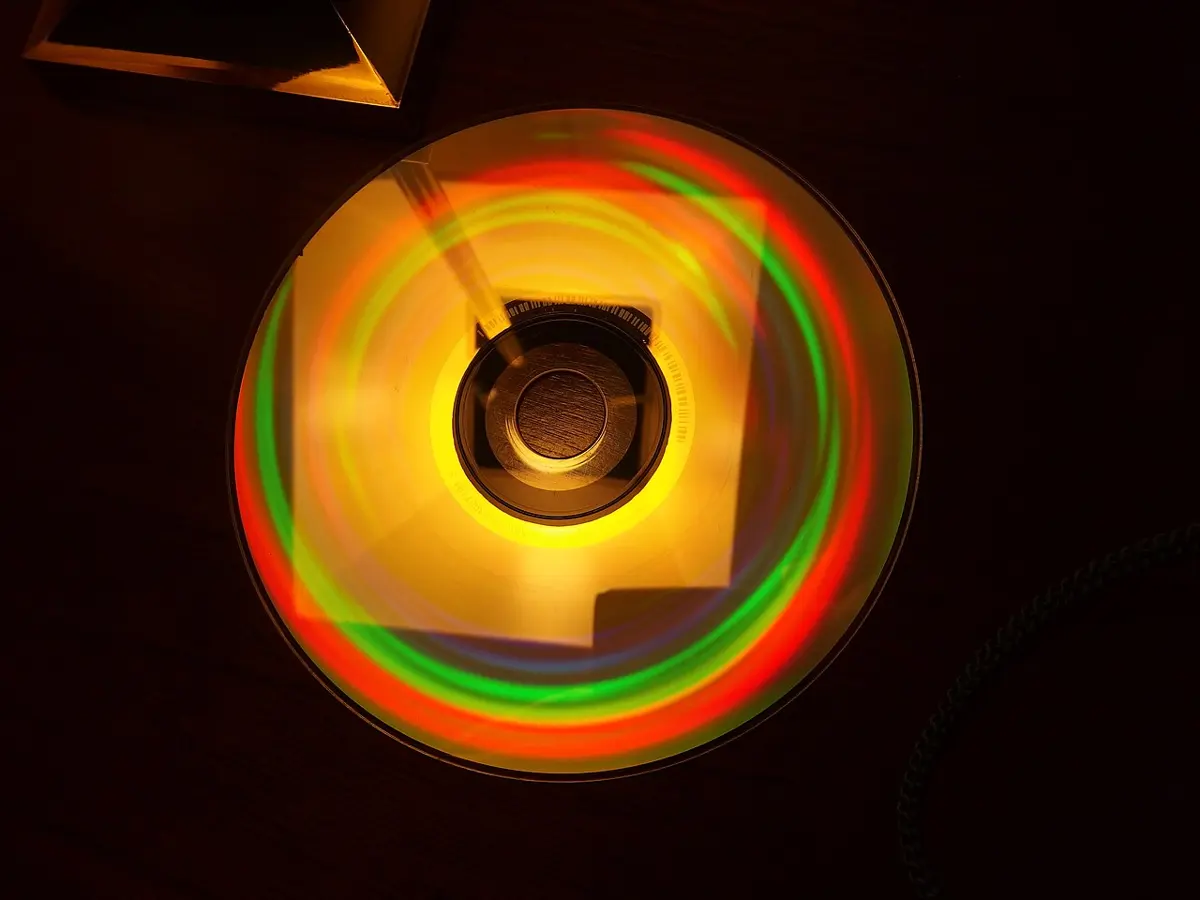
Look closely at the white light of a tube light through a cheap spectroscope, or the shiny side of a CD, and it splits into a few separate stripes of color instead of a smooth rainbow. The brightest is a pure green. That green comes from terbium (say TUR-bee-um), the ninth lanthanide. It is one of the most expensive of the rare earths, and it has one more surprise: mixed with iron and dysprosium, it makes a metal that grows longer in a magnetic field.
The terbium atom
A terbium atom has 65 protons and 65 electrons. Natural terbium has only one isotope, terbium-159, with 94 neutrons: 65 + 94 = 159. Because there is no mixture to average, its atomic mass, 158.93, is very close to a whole number Grade 9: Atomic mass.
By shells its electrons are 2, 8, 18, 27, 8, 2. In subshells it ends 6s² 4f⁹ Grade 10: The Aufbau principle. Unlike gadolinium before it, terbium has no 5d electron: past the half-full 4f⁷, the 4f subshell simply goes on filling, now by pairing electrons in its boxes.
Its place and valency
- Period 6, the ninth lanthanide (f-block), between gadolinium (64) and dysprosium (66) (fifteen near-twins).
- Usually it loses three electrons and becomes Tb³⁺, with a valency of 3: terbium chloride is TbCl₃.
- Losing a fourth electron leaves Tb⁴⁺ with the stable, half-full 4f⁷, so terbium can also have a valency of 4, like cerium Grade 9: Variable valency. When terbium burns, it forms a dark brown oxide, Tb₄O₇, that holds both Tb³⁺ and Tb⁴⁺.
Terbium forms an oxide TbO₂. What is terbium’s valency in it?
Pick an answer to see why.
How terbium was found and named
The black mineral from the quarry at Ytterby, near Stockholm in Sweden, held a new earth, yttria (yttrium’s story). In 1843 the Swedish chemist Carl Gustaf Mosander, who had already found lanthanum hiding in ceria, split yttria into three parts: yttria itself and the oxides of two new elements. He named them, too, after the village: terbium and erbium. The symbol is Tb.
The two were so alike, and so hard to purify, that chemists argued about them for years. In the confusion their names were swapped: what Mosander called “erbia”, a yellowish oxide, is the one we now call terbia, and his rose-colored “terbia” is today’s erbia. The swapped names stuck. Pure terbium metal was made only after chemists learned to separate the rare earths by ion exchange, which pulls the ions apart by their tiny differences in size.
Ytterby gave its name to four elements in all: yttrium, terbium, erbium and ytterbium.
Where terbium is found
In the universe, it is made in stars by catching neutrons (Catching neutrons).
In the Earth’s crust there is only about 1 gram in a tonne of rock. Monazite holds only about 0.03% terbium; the richest sources are clays in southern China. So terbium is costly: in 2025 terbium oxide cost about 1,010 US dollars a kilogram, fourteen times as much as neodymium oxide (USGS, 2026). Almost all of it comes from China, which in April 2025 began to limit its export (USGS, 2026).
In Nepal and in your body. Nepal mines no rare earths. Your body has no use for terbium.
What terbium is like and how it reacts
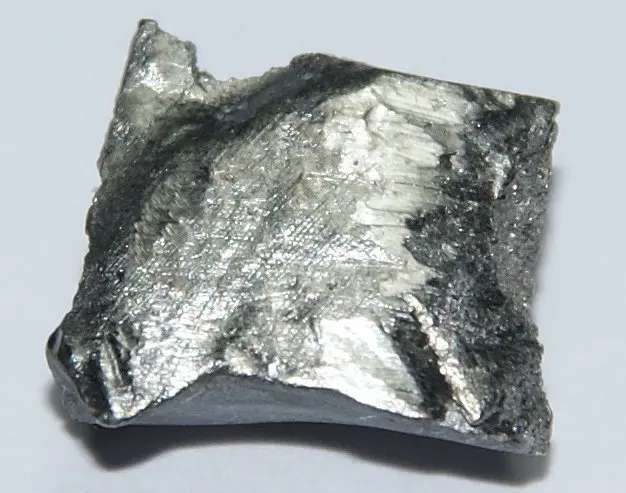
- A silvery-gray metal, soft enough to cut with a knife Grade 9: Properties of metals.
- Fairly steady in air for a lanthanide; slowly it forms the dark brown oxide Tb₄O₇.
- With water, slowly, giving terbium hydroxide and hydrogen Grade 9: Very reactive metals and water:
2Tb + 6H₂O → 2Tb(OH)₃ + 3H₂ - With dilute acids, readily, giving the salts of Tb³⁺, which are white or colorless.
Green light
Terbium’s salts look plain white. But under an ultraviolet lamp they glow a brilliant green. As in europium, the UV lifts an electron of the ion to a higher energy level, and when it falls back, the light comes out at one exact color, because the jump happens in the 4f subshell, deep inside the ion.
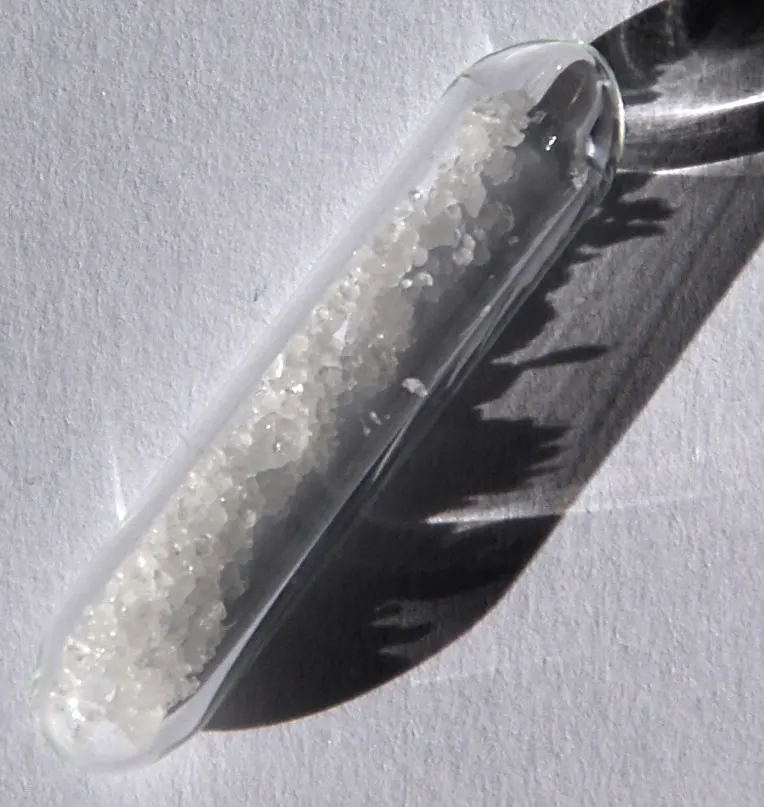
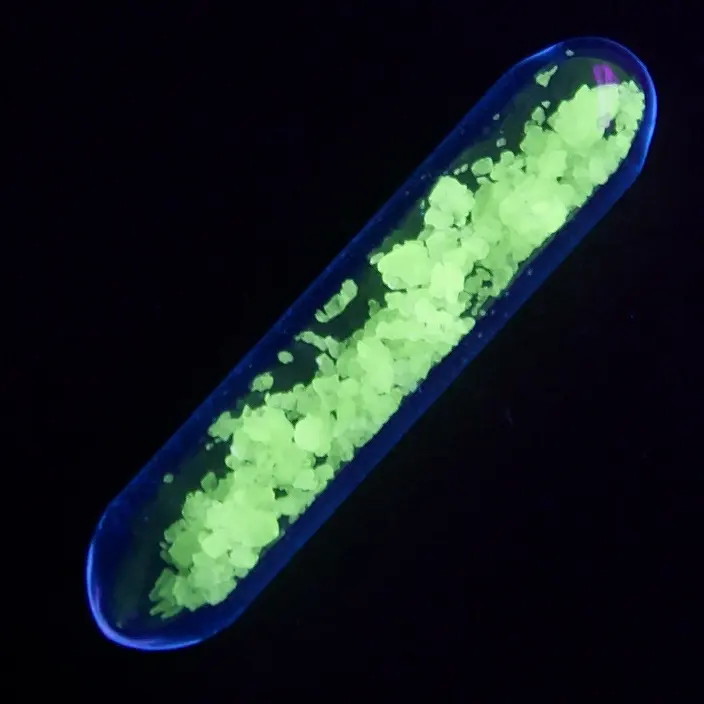
Tube lights. Inside a tube light or an energy-saving lamp, mercury gas gives out ultraviolet, and a white powder on the inside of the glass turns it into visible light Grade 9: Ultraviolet rays. In the better lamps the powder is a mixture of three: blue from Eu²⁺, green from Tb³⁺ and red from Eu³⁺ (see europium). Our eyes see the three together as white. Such lamps give much more light for the same electricity than old filament bulbs, and they have been the main use of the world’s terbium.
X-ray pictures. An X-ray picture is taken on a screen coated with a powder that turns X-rays into visible light, which is easier to record Grade 9: X-ray imaging. A powder of gadolinium oxysulphide with a little terbium glows green under X-rays and does this very well, so the same picture needs a shorter, safer dose of X-rays.
Terfenol-D: a metal that stretches
Every magnetic material changes its length very slightly when it is magnetized, far too little to notice. In the 1970s, scientists at the US Naval Ordnance Laboratory, looking for a better way to make sound under water for sonar, made an alloy of terbium, dysprosium and iron that does this more than any other alloy: a rod of it grows longer in a magnetic field, by about a thousandth of its length. They named it Terfenol-D: Ter for terbium, Fe for iron, NOL for the laboratory, D for dysprosium.
A thousandth sounds small, but the rod pushes with great force, and it can grow and shrink thousands of times a second. Put it inside a coil Grade 10: The magnetic field around a solenoid, pass the current from a music player through the coil, and the rod grows and shrinks with the music. Stand it on a table or press it on a window, and the whole table or window becomes the loudspeaker.
Terfenol-D is also used in sonar and in tiny, precise pushers called actuators. And a little terbium or dysprosium in a neodymium magnet keeps it strong when it gets hot, in the motors of electric cars.
Terbium and your health
Terbium has no known job in the body. It is thought to be of low toxicity, though it has been little studied, as is true of most rare earths.
In your science books
- Grade 9: ultraviolet rays and tube lights, X-ray imaging, variable valency, atomic mass and the properties of metals.
- Grade 10: the Aufbau principle, the lanthanides and the magnetic field of a solenoid.
- Going further: mass into energy and where terbium is made.
More to explore
- Its neighbors: gadolinium before it, europium, its partner in tube lights, yttrium, with the story of Ytterby, and lanthanum, with the story of the whole row. The other lanthanides with pages: cerium, praseodymium, neodymium, promethium and samarium.
- Play: find terbium in Guess the Element, the Periodic Table Jigsaw and Higher or Lower.
- Read more: terbium at the Royal Society of Chemistry and at PubChem.