
- Atomic number
- 94
- Atomic mass
- 244.06
- Shells
- 2, 8, 18, 32, 24, 8, 2
- Configuration
- 1s² 2s² 2p⁶ 3s² 3p⁶ 4s² 3d¹⁰ 4p⁶ 5s² 4d¹⁰ 5p⁶ 6s² 4f¹⁴ 5d¹⁰ 6p⁶ 7s² 5f⁶
- In the table
- period 7, group none (f-block), f-block
- Kind
- Actinide
- Valency
- 3, 4, 5 and 6 (as in Pu³⁺ and PuO₂); 4 is the most common
- State at 25 °C
- solid
- Melts · boils
- 640 °C · 3,228 °C
- Density
- 19.8 × as heavy as water
- Known since
- 1940
In 1977 two spacecraft, Voyager 1 and Voyager 2, left the Earth for Jupiter and Saturn. Almost fifty years later they are still sending messages home from beyond the planets, farther away than anything else people have made. Out there the Sun is just a bright star, far too faint for solar panels. What keeps them working is a few lumps of plutonium, hot from their own radioactivity.
Plutonium is a metal made almost entirely by people. It powers spacecraft and nuclear power stations, and it is one of the most closely guarded materials on Earth.
The plutonium atom
A plutonium atom has 94 protons (atomic number 94) and 94 electrons. Its best-known kind, plutonium-239, has 145 neutrons: 94 + 145 = 239. By shells, the electrons are 2, 8, 18, 32, 24, 8, 2, and in subshells Grade 10: The Aufbau principle:
… 6p⁶ 7s² 5f⁶
Unlike uranium and neptunium before it, plutonium puts no electron in 6d: all its newer electrons go into 5f.
It is in period 7 (seven shells), the sixth of the actinides in the f-block Grade 10: Features of the modern periodic table, and a metal. It can give away 3, 4, 5 or 6 electrons Grade 9: Variable valency, and in water all four kinds of plutonium ion can be present at the same time, each with its own color.
Plutonium-238 and plutonium-239 are both plutonium. What is different about them?
Pick an answer to see why.
How plutonium was made and named
In December 1940, at the University of California in Berkeley, Glenn Seaborg, Edwin McMillan, Joseph Kennedy and Arthur Wahl fired the nuclei of heavy hydrogen at uranium in a machine called a cyclotron. This made neptunium-238, which gave out a beta particle: one of its neutrons became a proton, and element 93 became element 94 (A neutron becomes a proton). By early 1941 they had shown it was a new element. Because of the Second World War, the discovery was kept secret until after 1945.
Uranium had been named after the planet Uranus, and neptunium after Neptune, so element 94 was named after Pluto, then the next planet (found in 1930; since 2006 called a dwarf planet). Seaborg later said that he chose the symbol Pu, rather than Pl, as a joke: “pee-yoo” is what American children say about a bad smell.

Where plutonium is found
Plutonium’s longest-lasting kind, plutonium-244, has a half-life of about 80 million years, short next to the Earth’s 4.5 billion. The young Earth’s plutonium has decayed. Only tiny traces are found in uranium ores, made when a uranium nucleus catches a stray neutron.
Nearly all plutonium is made in nuclear reactors. In the fuel, a uranium-238 nucleus catches a neutron and becomes uranium-239; two beta decays then turn it into neptunium-239 and then plutonium-239. Plutonium-239 nuclei can themselves split Grade 9: Nuclear fission, so a power station’s fuel makes some of its own new fuel as it runs: about a third of the energy from a typical reactor comes from plutonium made inside it.
What plutonium is like
- It is a silvery metal that tarnishes in air, first yellowish, then to a dull olive-gray.
- It is very dense: about 19.8 g/cm³, more than gold (19.3). (Sources give 19.7 to 19.9.)
- It melts at 640 °C, low for such a heavy metal, and boils at about 3,230 °C.
- It is a strange metal, with six different solid forms at ordinary pressure, more than any other element; it grows and shrinks as it changes from one to another. For a metal, it conducts electricity poorly.
- It is radioactive. A lump of plutonium-239 is always slightly warm, from the energy of its own alpha particles (Alpha decay).
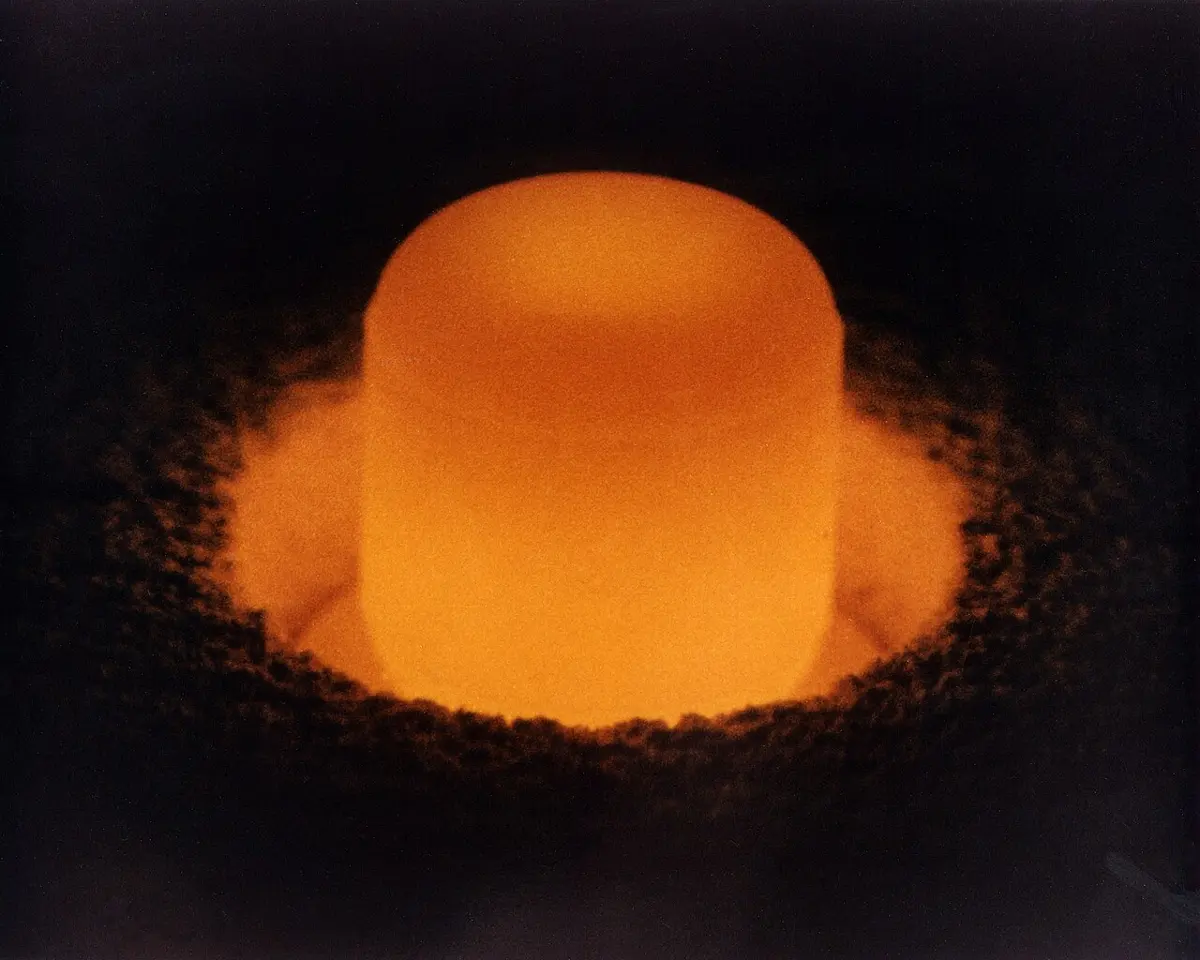
Plutonium-238 decays much faster: its half-life is 88 years, compared with 24,100 years for plutonium-239. The faster an isotope decays, the more heat it gives out each second, so plutonium-238 gets red-hot by itself, as in the photo at the top of this page.
Batteries for deep space
A spacecraft near the Earth or Mars can use solar panels. Far from the Sun they don’t work: near Pluto, sunlight is over a thousand times weaker than here. On Mars, dust storms can cover the panels, and winters are long. So some spacecraft carry a nuclear battery (in full, a radioisotope thermoelectric generator, or RTG).
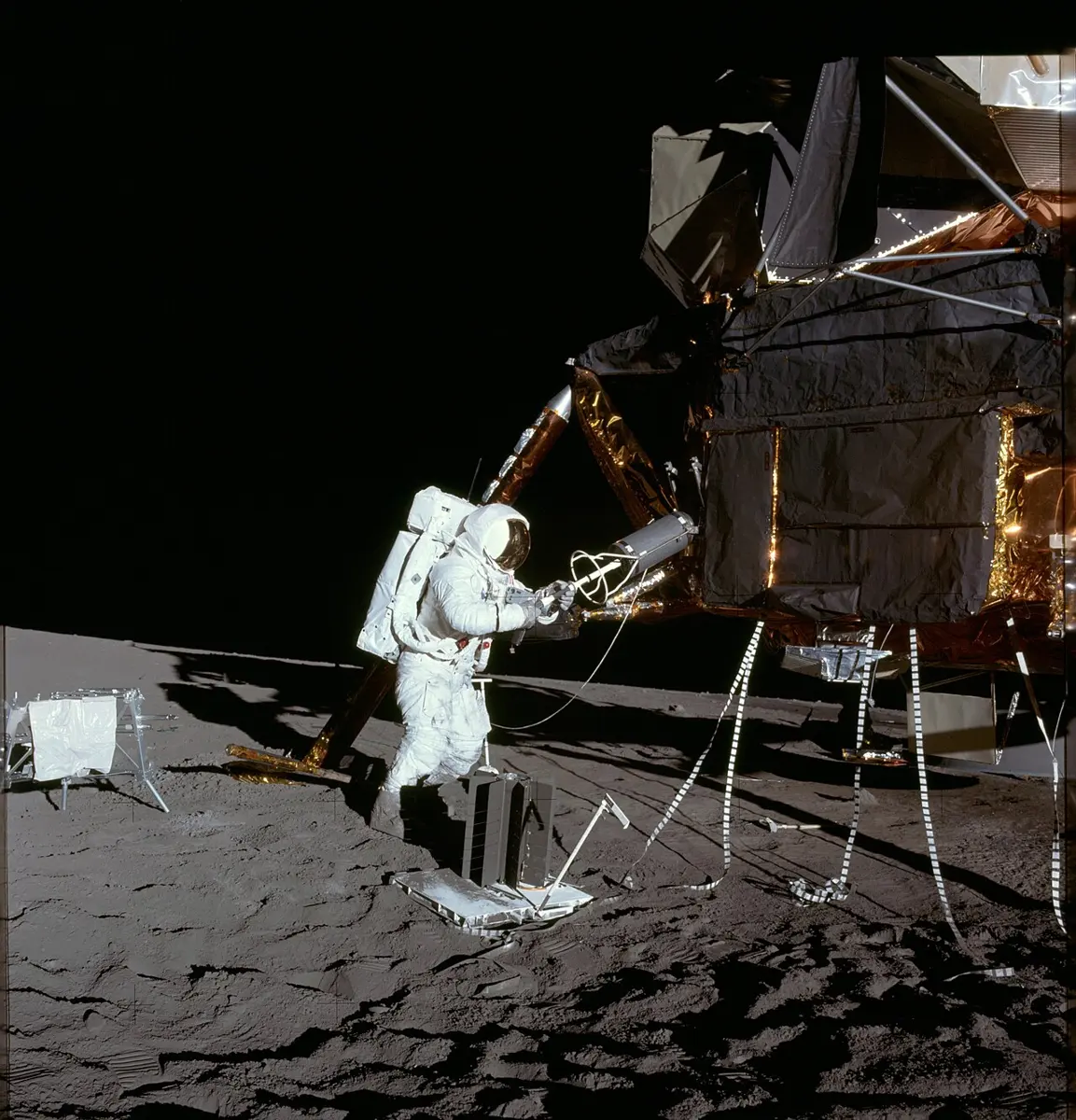
Plutonium-238 stays hot for decades. Around it are thermocouples: pairs of different materials joined together, which make a small electric current whenever heat flows through them from a hot side to a cold side. Fins on the outside give the leftover heat away into space. There are no moving parts to wear out.
Each Voyager carries three of these batteries, which together gave about 470 watts at launch. Every year there is less, and engineers have switched Voyager’s instruments off one by one to keep the rest working. The rovers Curiosity (on Mars since 2012) and Perseverance (since 2021) each carry one, which keeps them working through Martian nights and winters, and New Horizons, which flew past Pluto itself in 2015, ran on plutonium too.

The plutonium in a spacecraft is a ceramic, plutonium oxide, hard like a coffee mug, so that an accident would break it into large pieces, not a dust that could be breathed in. Plutonium-238 is not the kind used in weapons.
Why does a nuclear battery use plutonium-238 (half-life 88 years), and not plutonium-239 (half-life 24,100 years)?
Pick an answer to see why.
Why plutonium is guarded
Plutonium-239 nuclei split when they catch a neutron, and each split gives out more neutrons: a chain reaction. In a power station that reaction is controlled and makes electricity. But the same material could be used to make a bomb, and that is why plutonium is guarded.
The atomic bomb dropped on Nagasaki, Japan, on 9 August 1945 was made with plutonium; it killed tens of thousands of people. Since then, almost every country has signed the Treaty on the Non-Proliferation of Nuclear Weapons (1970). Inspectors from the International Atomic Energy Agency visit nuclear plants and check that all their plutonium is accounted for.
Plutonium and your health
The body has no use for plutonium. Its alpha particles cannot get through a sheet of paper or the dead outer layer of your skin, so outside the body it is not very dangerous. Inside is different. If plutonium dust is breathed in, it can stay in the lungs, or move to the bones and liver, for many years. There its alpha particles damage the cells around them and can cause cancer. That is why people who work with it handle it only inside sealed glove boxes.
In your science books
- Grade 9: radioactive elements, nuclear fission, atomic energy and variable valency.
- Grade 10: the actinides and the Aufbau principle.
- Going further: alpha decay, beta decay and fission.
More to explore
- Nobel Prizes: the first radioactive atoms made by people (1935), and Seaborg and McMillan’s prize (1951) for the elements beyond uranium.
- Its neighbors: uranium, from which it is made, and neptunium, which plutonium-238 is made from.
- Play: find plutonium in Guess the Element and the Periodic Table Jigsaw.
- Read more: plutonium at the Royal Society of Chemistry and at PubChem.