
Sit very still on a chair in Bhaktapur. Are you at rest? Ask the chair, and it says yes. Ask the Sun, and it says no: the spinning Earth is carrying you east at about 1,480 km/h, faster than a passenger jet. Both answers are right. Whether something is moving depends on what you compare it with.
This unit has three parts. First, motion: how to say how fast something goes, in which direction, and how quickly it speeds up or slows down. Second, the lever, the simplest machine of all, which lets a child lift a rock and a farmer pound rice with a dhiki. Third, pressure: why a sharp knife cuts, why a dam is thick at the bottom, and why the air around you pushes on every square centimeter of your body as hard as a 1 kg bag of rice resting on it.
Rest, motion and the reference point
Picture a scene. A house and a tree stay where they are. A boy kicks a football, a bird flies, a girl runs, a ball rolls, a bee buzzes from flower to flower, the hands of a clock turn, the pendulum of a tall clock swings, and the Earth goes round the Sun. A man leans on a table: it stays put until he pushes or pulls it.
Everything in the universe is either at rest or in motion. But to say which, you must compare it with something: a point, a place, or the things around it. That something is called the reference point (a whole set of surroundings used this way is a frame of reference, or reference frame). A flying bird, a moving bus and a walking person are all in motion compared with the ground, the trees and the houses around them.
A table at rest only starts moving when it is pushed or pulled. A force is needed to change the state of an object from rest to motion, or from motion to rest.
6.1 Motion
An object is in motion if it changes its position compared with a reference point or its surroundings. A flying airplane, a moving bus, a walking person and a rolling ball are all in motion compared with the ground.
An object is at rest if it does not change its position compared with a reference point or its surroundings. Houses, trees and buses in a parking area are at rest compared with the ground.
Now sit in a moving bus. Your friend in the next seat stays next to you the whole time: compared with the bus, she is at rest. But compared with the shops and trees outside, she is changing position all the time, so she is in motion. The same person is at rest and in motion at the same time, depending on the reference point. That is why we say rest and motion are relative.
Uniform and non-uniform motion
Watch a bus on the Arniko Highway. On a long, straight, empty stretch it might cover 15 meters in every second, second after second. In town, it speeds up, slows down for a cow, stops for passengers, and starts again.
- An object in uniform motion covers equal distances in equal intervals of time, however short those intervals are.
- An object in non-uniform motion covers unequal distances in equal intervals of time.
Almost all real motion is non-uniform: a bus, a motorcycle, a running dog, a falling mango. Uniform motion is what a vehicle does for a while on cruise control on a straight road.
A girl cycles 50 m in the first 10 seconds, 80 m in the next 10 seconds and 50 m in the 10 seconds after that. Her motion is
Pick an answer to see why.
Speed
Which runs faster, a deer or a cheetah? The cheetah: for a few seconds it can reach about 100 km/h. Some things move fast and some slowly. To compare them we measure the distance covered in one unit of time. That is the speed.
The SI unit of speed is the meter per second (m/s). On the road we usually use kilometers per hour (km/h).
- A car moving at 20 m/s covers 20 meters every second.
- Sound in cold air at 0 °C travels at about 332 m/s: 332 meters every second. (On a warm day it is a little faster, about 343 m/s.)
Speed has a size (a magnitude) but no direction: “20 m/s” says how fast, not where to. A quantity like this, with magnitude only, is called a scalar quantity.
Distance and displacement
You walk from your house to the shop by the lanes, turning left and right: that’s 500 m of walking. But the shop is only 300 m from your house in a straight line, towards the north.
- Distance is the length of the whole path traveled, whatever its shape (500 m). It has magnitude only: a scalar.
- Displacement is the shortest, straight-line distance from the start to the end, in a particular direction (300 m north). It has magnitude and direction: a vector quantity.
Velocity
Velocity is the distance traveled in one unit of time in a particular direction. Put another way, it is the rate of change of displacement:
Its SI unit is also the meter per second (m/s). But a velocity is only complete with its direction: “20 m/s towards the east”. A quantity that needs both magnitude and direction is a vector quantity. So speed is a scalar, and velocity is a vector.
In daily life people use “speed” and “velocity” to mean the same thing. In science they are different quantities. A bus going round a bend at a steady 30 km/h has a constant speed, but its velocity is changing, because its direction is changing.
Which of these is a velocity, not just a speed?
Pick an answer to see why.
6.1.1 Relative velocity
Think about these before you read on.
Any fixed point, line or place from which we compare the motion of an object is the reference point (or reference line). In Figure 6.2, the line MN is the reference line and P is the reference point. Car A moves away from it at 10 m/s towards the west, and car B at 15 m/s towards the east.
So far, every velocity was measured from the ground. But you can also measure it from another moving object. The velocity of a body compared with a reference point or with another body is called its relative velocity.
We write for “the velocity of A relative to B”: how A seems to move to someone sitting in B. It is found by subtracting B’s velocity from A’s:
A direction must be chosen as positive. If A and B go the same way, both velocities are positive. If they go opposite ways, one of them is negative, and the subtraction becomes an addition. Let’s see the three cases.
(a) Same direction, same speed
Buses A and B leave the reference line PQ side by side on a two-lane road, both at 22 m/s. After 1 second each has gone 22 m, so they are still side by side (Figure 6.3). Bus A has not moved at all compared with bus B, and B has not moved compared with A. The passengers in both buses feel that they are at rest, as long as they look only at the other bus.
(b) Same direction, different speeds
Now bus A goes at 10 m/s and bus B at 15 m/s, the same way. After 1 second, A has gone 10 m and B 15 m, so B is 5 m ahead (Figure 6.4). Every second, B pulls 5 m further ahead. To the people in B, bus A seems to slide backwards at 5 m/s; to the people in A, bus B seems to creep forward at 5 m/s.
The size of the relative velocity is 5 m/s, the difference of the two speeds. (The minus sign only says that A falls behind B; seen from A, B moves ahead at +5 m/s.)
(c) Opposite directions
Buses A and B move away from the reference line PQ in opposite directions, both at 20 m/s (Figure 6.5). Take A’s direction as positive. B goes the other way, so its velocity is negative: −, where is its speed. Then
So when two bodies move in opposite directions, the size of their relative velocity is the sum of their speeds: 20 + 20 = 40 m/s. After 1 second they are 40 m apart. The people in each bus feel that they are going much faster than their own bus really is.
A motorcycle at 60 km/h overtakes a truck going the same way at 40 km/h. How fast does the motorcycle seem to move, to the truck driver?
Pick an answer to see why.
6.1.2 Average velocity
An object in uniform motion keeps the same velocity. In non-uniform motion the velocity keeps going up and down, so no single number tells you “the” velocity. Instead, we use the average velocity: the total displacement (total distance traveled in a particular direction) divided by the total time taken.
Here (read “v bar”) is the average velocity, the total displacement and the total time taken.
There is a second formula. If an object speeds up (or slows down) steadily, from an initial velocity at the start to a final velocity at the end, its average velocity is halfway between the two:
A car that speeds up steadily from 0 to 20 m/s has an average velocity of (0 + 20) ÷ 2 = 10 m/s. (This formula works only when the velocity changes steadily, at a constant rate. For any other journey, use total displacement ÷ total time.)
6.1.3 Acceleration
The velocity of a car, motorcycle or bus is usually non-uniform: it goes up and down. A bicycle speeds up going down a slope; a dropped stone keeps speeding up. The change in velocity in one unit of time is called acceleration. It is the rate of change of velocity. It is written , and its SI unit is the meter per second squared (m/s²).
Suppose a bicycle moving with velocity speeds up to velocity in time . Its velocity has changed by , so
An acceleration of 2 m/s² means the velocity goes up by 2 m/s every second: 0, 2, 4, 6 m/s…
Retardation
When the driver brakes, the bus slows down: its final velocity is less than its initial velocity (). Then is negative, so the acceleration is negative. The rate of decrease of velocity is called retardation (or deceleration). In short: negative acceleration is retardation.
A car moves at a steady 60 km/h along a straight road. Its acceleration is
Pick an answer to see why.
Exercise (6.1 Motion)
1. Choose the best alternative
a. What is the condition of an object called if it doesn’t change its position with respect to the reference point or its surroundings?
Pick an answer to see why.
b. What is the formula for the relative velocity of two bodies moving in opposite directions?
Pick an answer to see why.
c. What is the shortest distance between two points, in a particular direction, called?
Pick an answer to see why.
d. In which condition is the average velocity of an object calculated?
Pick an answer to see why.
e. What is the SI unit of acceleration?
Pick an answer to see why.
f. Which one of these statements is true?
Pick an answer to see why.
2. Differentiate between
Distance and displacement
Answer
| Distance | Displacement |
|---|---|
| The length of the whole path traveled. | The shortest straight-line distance from the start to the end, in a particular direction. |
| Has magnitude only: a scalar quantity. | Has magnitude and direction: a vector quantity. |
| Depends on the path taken. | Depends only on the start and end points. |
| Can never be less than the displacement. | Can be zero even after a long journey (a round trip). |
Average velocity and relative velocity
Answer
| Average velocity | Relative velocity |
|---|---|
| The total displacement of a body divided by the total time taken. | The velocity of a body compared with another body (or a reference point). |
| Is about one body over a period of time. | Compares two bodies. |
| Formulas: , or for a steady change. | Formulas: (same direction), (opposite directions). |
| e.g. a bus covers 27 km towards the east in 1 hour: 27 km/h east. | e.g. buses at 15 m/s and 10 m/s going the same way: 5 m/s. |
Acceleration and retardation
Answer
| Acceleration | Retardation |
|---|---|
| The rate of increase of velocity. | The rate of decrease of velocity. |
| Final velocity is more than initial velocity (). | Final velocity is less than initial velocity (). |
| is positive. | is negative: retardation is negative acceleration. |
| e.g. a bus starting from a bus stop. | e.g. a bus braking to stop. |
3. Answer the following questions
Define reference point.
Answer
A reference point is a fixed point, line or place (or object) with which we compare the position of an object to decide whether it is at rest or in motion, and how it is moving.
What is acceleration?
Answer
Acceleration is the rate of change of velocity of a body: the change in its velocity in one unit of time. . Its SI unit is m/s².
What do you understand by retardation?
Answer
Retardation is the rate of decrease of velocity of a body. It happens when the final velocity is less than the initial velocity, as when a vehicle brakes. It is negative acceleration. For example, a bus that slows from 20 m/s to rest in 4 s has a retardation of 5 m/s².
What is meant by relative velocity?
Answer
The relative velocity of a body is its velocity compared with another body (or a reference point): how it seems to move to an observer on that other body. For example, a bus at 15 m/s seen from a bus going the same way at 10 m/s seems to move at only 5 m/s.
Write down the formulas for the relative velocity of bodies moving in the same and in opposite directions, with examples.
Answer
Same direction: . Example: two buses at 15 m/s and 10 m/s going the same way: = 15 − 10 = 5 m/s.
Opposite directions: . Example: the same two buses going opposite ways: = 15 + 10 = 25 m/s.
What is average velocity?
Answer
Average velocity is the total displacement (total distance traveled in a particular direction) of a body divided by the total time taken: .
In which condition is the average velocity of a body calculated? Write down the formulas to calculate average velocity.
Answer
Average velocity is calculated when a body is in non-uniform motion, so that its velocity keeps changing.
and, when the velocity changes steadily from an initial velocity to a final velocity ,
4. Solve these numerical problems
A bus covers 4.2 km in 7 minutes. Calculate its average velocity. (Answer: 10 m/s)
Answer
= 4.2 km = 4200 m; = 7 min = 7 × 60 = 420 s.
A car starts from rest, and its velocity becomes 30 m/s in 12 seconds. Find its acceleration. (Answer: 2.5 m/s²)
Answer
= 0, = 30 m/s, = 12 s.
A car starts from rest with an acceleration of 5 m/s². Find its final velocity after 6 seconds, and its average velocity in that time. (Answer: 30 m/s and 15 m/s)
Answer
= 0, = 5 m/s², = 6 s.
From : 30 m/s.
The velocity rises steadily, so
The brakes are applied to a car moving with uniform velocity. It has a retardation of 2 m/s² and stops after 4 seconds. Calculate its initial velocity. (Answer: 8 m/s)
Answer
= 0, retardation 2 m/s², so = −2 m/s²; = 4 s.
From : , so 8 m/s.
Two motorcycles are moving at 50 km/h and 60 km/h in the same direction. Calculate their relative velocity. What would it be if they were moving in opposite directions? (Answer: 10 km/h and 110 km/h)
Answer
Same direction: = 60 − 50 = 10 km/h.
Opposite directions: = 60 + 50 = 110 km/h.
6.2 Lever
A boy pushes a long iron bar under a big rock, rests it on a small stone, and presses down on the far end. The rock lifts. A carpenter pulls a nail out with the claw of a hammer. Both use the same idea.
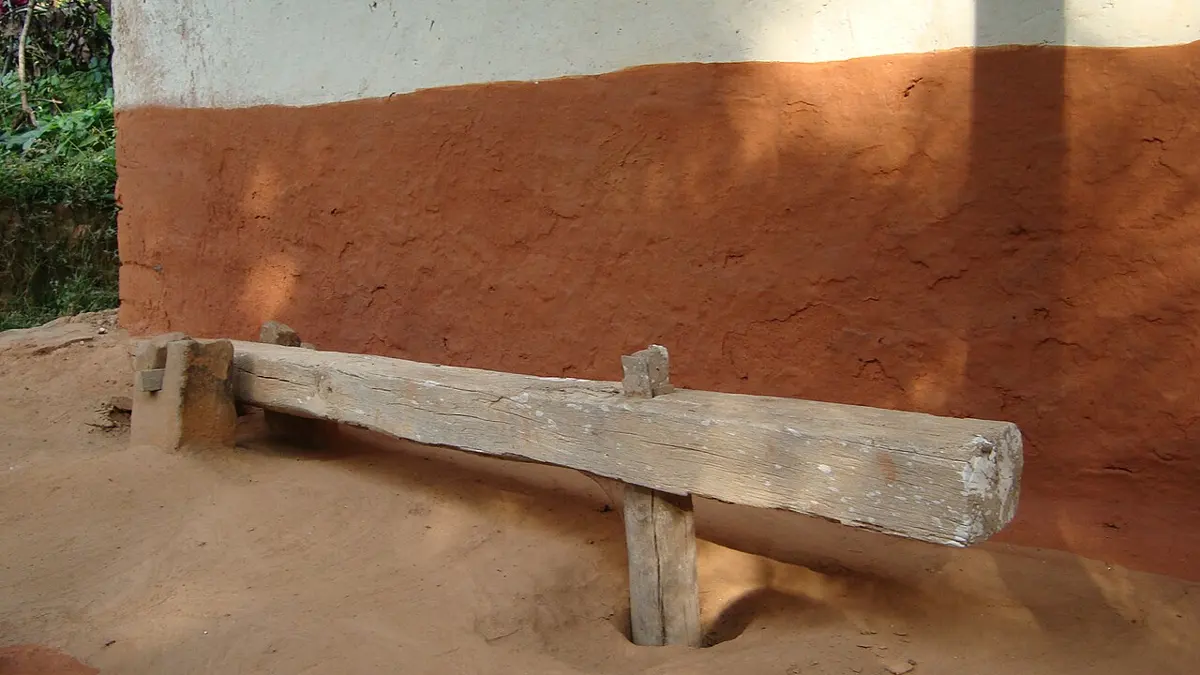
You have seen a beam balance, a dhiki, scissors, tongs, a wheelbarrow and a crowbar. Each of them turns about a fixed point to lift or move a load. They are all levers.
A lever is a rigid bar that can turn about a fixed point. That fixed point is called the fulcrum.
Every lever has five things to name (Figure 6.6):
- The fulcrum (F): the fixed point the lever turns about.
- The effort (E): the force we apply to the lever.
- The load (L): the object to be lifted or moved, or the force the lever has to overcome.
- The load distance (L.D.): the distance from the fulcrum to the load. That part of the bar is the load arm.
- The effort distance (E.D.): the distance from the fulcrum to the effort. That part of the bar is the effort arm.
Types of lever
Levers are sorted into three classes by what is in the middle: the fulcrum, the load or the effort.
(a) First-class lever
In a first-class lever, the fulcrum is between the load and the effort. The effort is at one end and the load at the other. Examples: a beam balance, a see-saw, scissors, a pair of pliers, a dhiki, a crowbar, and the claw of a hammer pulling a nail.
(b) Second-class lever
In a second-class lever, the load is between the fulcrum and the effort. The fulcrum is at one end and the effort at the other. Examples: a nutcracker, a lemon squeezer, a bottle opener and a wheelbarrow (the wheel’s axle is the fulcrum, the load sits in the tray, and you lift the handles).
(c) Third-class lever
In a third-class lever, the effort is between the fulcrum and the load. The fulcrum is at one end and the load at the other. Examples: fire tongs (chimta), tweezers, a shovel, a broom, a fishing rod, and a hammer when you swing it to hit a nail (your wrist is the fulcrum).
A third-class lever needs more effort than the load, because the effort is closer to the fulcrum. What it gives you instead is speed and reach: a small movement of your hand makes the far end move a long way, fast. Your own forearm is a third-class lever: the elbow is the fulcrum, the biceps muscle pulls just below it, and the load is in your hand.
In a wheelbarrow, what lies in the middle?
Pick an answer to see why.
Which of these is a third-class lever?
Pick an answer to see why.
Working principle of a lever
This is the principle of the lever. When a lever is balanced,
It tells us how to lift a heavy load with a small effort: make the effort distance long and the load distance short. If the effort distance is short, a big effort is needed. Every lever, of every class, balances by this rule.
Mechanical advantage
A lever lets a small effort lift a big load. How many times bigger? The ratio of the load to the effort is called the mechanical advantage (MA). It tells you how many times the lever multiplies your effort.
MA is a ratio of two forces (newtons ÷ newtons), so it has no unit.
For example, if a person needs an effort of 150 N to lift a load of 600 N with a lever:
An MA of 4 means the lever lifts a load 4 times as heavy as the effort.
- If MA > 1, the lever multiplies the effort: the load is bigger than the effort (a crowbar, a wheelbarrow).
- If MA < 1, the effort has to be bigger than the load (tongs, a broom); such a lever gives speed or convenience instead.
MA is found from the real forces, so friction affects it. Friction at the fulcrum means you must push a little harder, which lowers the mechanical advantage.
Velocity ratio
When a lever lifts a load, the load and the effort both move, but not by the same distance. Push the long end of a crowbar down by 30 cm, and the rock at the short end rises only 10 cm. The effort moves farther, in the same time, so it moves faster than the load. The ratio of the velocity of the effort to the velocity of the load is called the velocity ratio (VR).
The effort and the load move for the same time , so the times cancel and VR is just a ratio of distances:
For a lever, the two ends turn through the same angle, so the distance each one moves is in proportion to its distance from the fulcrum. That gives a handy formula:
VR depends only on the shape and size of the lever (where the fulcrum is), not on the forces, so friction does not affect it. But friction does lower the MA. So in every real machine, the mechanical advantage is less than the velocity ratio.
Efficiency
Lifting a load means doing work (work = force × distance moved in the direction of the force).
- The work done by the effort on the machine is the input work: input work () = effort × distance moved by the effort.
- The work done by the machine on the load is the output work: output work () = load × distance moved by the load.
The output work divided by the input work, written as a percentage, is the efficiency of the machine. It is written η (the Greek letter eta).
Rearrange the fraction, and it becomes MA divided by VR:
For a lever, the distances moved are in the same proportion as the arms (E.D. ÷ L.D.), so its efficiency can also be found from the arm lengths:
Friction always turns part of the input work into heat, so the output work is always a little less than the input work. That is why MA is always less than VR, and why the efficiency of a real machine is always less than 100%. An imaginary machine with no friction at all, with 100% efficiency and MA equal to VR, is called an ideal or perfect machine.
Oiling the hinge of a lever reduces friction. What happens?
Pick an answer to see why.
Exercise (6.2 Lever)
1. Choose the best alternative
a. Which one of these simple machines is a second-class lever?
Pick an answer to see why.
b. What is the principle of a lever in balance?
Pick an answer to see why.
c. What is the work done by the effort called?
Pick an answer to see why.
d. Which one of these is not affected by friction?
Pick an answer to see why.
e. Which of these statements is true?
Pick an answer to see why.
2. Differentiate between
Mechanical advantage and velocity ratio
Answer
| Mechanical advantage (MA) | Velocity ratio (VR) |
|---|---|
| The ratio of load to effort. | The ratio of the velocity (or distance moved) of the effort to that of the load. |
| MA = L ÷ E | VR = distance moved by effort ÷ distance moved by load (= E.D. ÷ L.D. for a lever) |
| Affected by friction: friction lowers it. | Not affected by friction. |
| Always less than VR in a real machine. | Always more than MA in a real machine. |
Input work and output work
Answer
| Input work | Output work |
|---|---|
| The work done by the effort on the machine. | The work done by the machine on the load. |
| Input work = effort × distance moved by the effort. | Output work = load × distance moved by the load. |
| Always more than the output work in a real machine. | Always less than the input work, because some work is lost to friction. |
3. Give reasons
The efficiency of a lever is never 100%.
Answer
Some of the input work is always used up against friction at the fulcrum (and in bending the lever), and turns into heat. So the output work is always less than the input work, and output ÷ input × 100% is less than 100%.
It is easier to lift the load in a wheelbarrow when the load is shifted towards its wheel.
Answer
A wheelbarrow is a second-class lever with its fulcrum at the wheel. Moving the load towards the wheel makes the load distance shorter, while the effort distance (wheel to handles) stays the same. By , a smaller load distance needs a smaller effort.
Mechanical advantage is always less than velocity ratio.
Answer
VR depends only on the distances, but MA depends on the real effort. Because of friction, the real effort is always a little more than it would be in a perfect machine, so the MA (load ÷ effort) is always a little less than the VR. They would be equal only in an ideal machine with no friction.
4. Answer the following questions
How can we lift a heavy load by using a lever?
Answer
Put the fulcrum close to the load and apply the effort far from the fulcrum. A long effort distance and a short load distance mean, by , that a small effort balances, and then lifts, a big load. For example, with the load 0.5 m from the fulcrum and the effort 1.5 m from it, an effort of 267 N lifts 800 N.
Which class of lever is a pair of scissors?
Answer
A first-class lever: the pivot (fulcrum) is between the blades, which cut the cloth or paper (load), and the handles, where the fingers press (effort).
What can be done with a lever whose mechanical advantage is more than 1?
Answer
It multiplies the effort: it can lift or move a load that is heavier than the effort applied. For example, with an MA of 4, an effort of 150 N lifts a load of 600 N.
What are the other advantages of a lever, besides making our work easier?
Answer
- It can change the direction of the force: push down on a crowbar and the rock goes up.
- It can give speed and reach: a third-class lever such as a broom, a fishing rod or our forearm makes the far end move a long way, fast, for a small movement of the hand.
- It lets us work safely and conveniently: tongs keep our fingers away from hot coal, and pliers grip what fingers can’t.
What is the work done by the effort in a machine called?
Answer
Input work: input work = effort × distance moved by the effort.
5. Solve these numerical problems
An effort of 75 N is needed to lift a load of 300 N with a lever. Calculate the effort distance if the load is 25 cm from the fulcrum. (Answer: 100 cm)
Answer
= 75 N, = 300 N, L.D. = 25 cm.
: 75 × E.D. = 300 × 25
Sarad weighs 550 N and Nirmal weighs 300 N. They are playing on a see-saw, and Sarad sits 1.5 m from the center. How far from the center must Nirmal sit to balance him? (Answer: 2.75 m)
Answer
Take Nirmal as the effort and Sarad as the load: = 300 N, = 550 N, L.D. = 1.5 m.
: 300 × E.D. = 550 × 1.5 = 825
Nirmal sits 2.75 m from the center, on the other side.
An effort of 300 N lifts a load of 900 N with a lever 2 m long. The load is at one end, 50 cm from the fulcrum, and the effort is applied at the other end. Calculate the mechanical advantage, velocity ratio and efficiency of the lever. (Answer: MA = 3, VR = 3, η = 100%)
Answer
L.D. = 50 cm = 0.5 m; the effort is at the other end of the 2 m lever, so E.D. = 2 − 0.5 = 1.5 m.
On paper this lever is a perfect machine, because the problem ignores friction. A real lever would need a little more than 300 N.
6.3 Pressure
Both activities say the same thing. When a force acts on a large area, its effect is small; when the same force acts on a small area, its effect is big. This effect of a force on an area is called pressure. Pressure is the force acting perpendicularly (at right angles) on a unit area of a surface.
Measurement of pressure
Pressure grows when the force grows. And for the same force, the smaller the area, the greater the pressure. So pressure depends on the size of the force and on the area it acts on. If a force acts on a surface of area , the pressure on it is
In SI, force is measured in newtons (N) and area in square meters (m²), so the SI unit of pressure is the newton per square meter (N/m²), also called the pascal (Pa), after the French scientist Blaise Pascal.
One pascal is the pressure of a force of 1 N acting perpendicularly on an area of 1 m².
A pascal is tiny: a sheet of paper lying flat on a table presses on it with about 1 Pa. So larger pressures are often given in kilopascals (1 kPa = 1000 Pa).
Applications of pressure in daily life
Sometimes we want more pressure, so we make the area small:
- A plowshare is made of iron and has a sharp edge, so even a modest pull drives it into the soil.
- Sickles, knives and axes are sharpened so that their thin edge cuts and chops easily.
- A nail and a screw have pointed tips, so they go into wood or a wall easily.
Sometimes too much pressure is a problem, so we make the area large:
- The back wheels of a tractor are big and wide, so it doesn’t sink into a soft, plowed field.
- Buses have pairs of tyres on their back wheels, and heavy trucks have many wheels, so their weight is spread over a bigger area of road, and they don’t damage it.
- A porter’s namlo (head strap) and a school bag’s straps are made wide, so they don’t cut into the skin.
Why does a sharp knife cut better than a blunt one?
Pick an answer to see why.
A truck carrying cement has 10 wheels instead of 4. This is to
Pick an answer to see why.
Pressure of a liquid
A liquid has weight, so, like a solid, it presses on whatever it rests on. But a liquid can flow, so unlike a solid, it presses in all directions: down on the bottom of the container, sideways on its walls, and even upwards on anything put in it. The pressure exerted by a liquid on a unit area of its container (or of anything in it) is called liquid pressure.
Measuring the pressure of a liquid
Take a container whose base has an area , filled to a height with a liquid of density (Figure 6.14). The acceleration due to gravity there is . Let’s find the pressure on the base.
The force on the base is the weight of all the liquid above it. So the pressure on the base is
Weight is mass × acceleration due to gravity, :
Mass is density × volume, :
The liquid is a block of base and height , so its volume is :
The cancels, and
So the pressure of a liquid depends on three things only: the depth of the liquid, the density of the liquid, and the acceleration due to gravity . It grows with depth, and it is bigger in a denser liquid. The area has canceled out: the pressure at a depth does not depend on how wide the container is.
Applications of liquid pressure in daily life
The pressure of a liquid increases with depth, and that matters in many places:
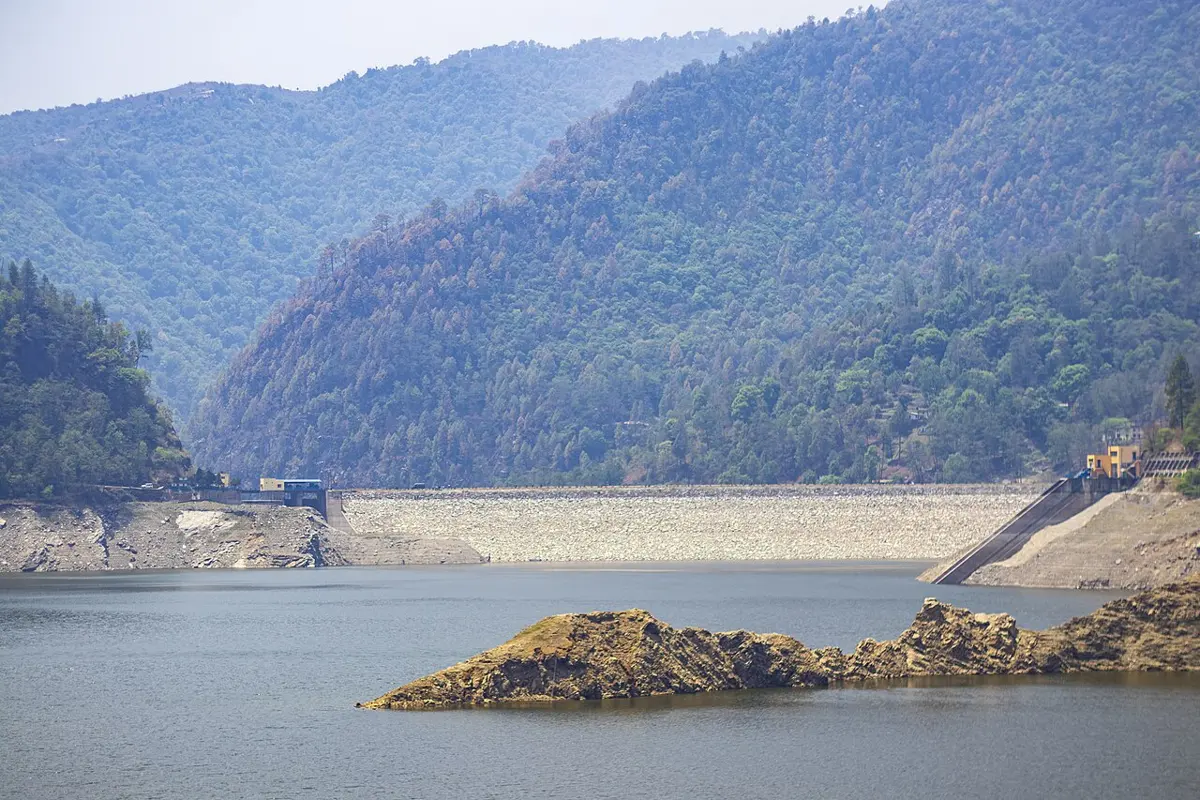
- a.A dam is built much thicker at the bottom than at the top, and the base of a water tank is made thicker, because the water pushes hardest at the greatest depth.
- b.A deep-sea diver wears a special suit (or goes down in a strong submarine), because deep in the sea the water pushes with a very great pressure.
- c.A water tank is kept as high as possible on a house. The taps are then far below the water level, so the water comes out with a greater pressure.
- d.A bottle for mercury has a thicker bottom than bottles for other liquids, because mercury is 13.6 times as dense as water, so its pressure at the same depth is 13.6 times as great.
Air pressure
Have you pumped up a football with a pump, or seen the tubes of bicycle and motorcycle tyres filled with air? Have you seen an oxygen cylinder in a hospital? In each, air (or oxygen) has been squeezed into a small space. A gas can be compressed: its volume made smaller. A machine that does this is called a compressor.
When air is compressed, its pressure rises, and it also gets warm (feel the barrel of a bicycle pump after pumping hard). The pressure of compressed air is greater than the pressure of the air around us.
Compressed air stores energy, so it is used to carry energy in industry and on the road:
- It drives air hammers, drills and wrenches (the machine a mechanic uses to undo the nuts of a bus wheel in seconds), and works automatic air cylinders that move parts in factories.
- Air brakes on large trains, buses and trucks use compressed air to push the brakes on, and stop these heavy vehicles safely.
- It powers cleaning sprays, spray-painting guns and air rifles, and is used more and more.
The pressure of compressed air is measured with a pressure gauge (Figure 6.16), the dial you see on a tyre pump at a petrol pump. Gauges read in bar or psi (pounds per square inch); 1 bar = 100,000 Pa, and 1 millibar (mbar) = 100 Pa. Weather reports give the air pressure in millibars, and atmospheric pressure is also given in millimeters of mercury (mmHg), as you will see next.
Atmospheric pressure
Why does the card hold up the water? And what crushed the can? The air. In Activity 6.7, the air pressure acting from below holds the card up. In Activity 6.8, before heating, the air pressure inside and outside the can was the same, so the can stayed as it was. When the water boiled, the steam pushed most of the air out of the can. After the lid was closed and the can cooled, the steam condensed back into a few drops of water, leaving almost nothing inside to push outwards. The pressure inside fell far below the pressure outside, and the air outside crushed the can.
The Earth is wrapped in a layer of air hundreds of kilometers thick, called the atmosphere. Air is light, but it does have weight, and all that air above us presses down on the ground and on everything on it. The pressure of the air of the atmosphere is called atmospheric pressure: the force of the air on each unit area of the Earth’s surface.
- Atmospheric pressure is greatest at sea level, and gets less as you go higher, because there is less air above you.
- At sea level it is about 760 mmHg (it holds up a column of mercury 760 mm tall), which is about 100,000 Pa (1.01 × 10⁵ Pa). This is called the standard atmospheric pressure.
- Atmospheric pressure is measured with a barometer.
- Air flows from places of higher pressure to places of lower pressure: differences in atmospheric pressure over the Earth’s surface make the winds.
100,000 Pa means that the air pushes on every square centimeter of you with a force of about 10 N, like a 1 kg bag of rice resting on it. We aren’t crushed because the air and the fluids inside our bodies push outwards just as hard.
Airplanes fly at heights of about 10 km, where the air pressure is less than a third of that at sea level. Too little to breathe. So the cabin of a passenger plane is pressurized: air is pumped in to keep the pressure inside close to that on a high hill town, so the passengers can breathe normally during the flight. Atmospheric pressure affects every object and every living thing on the Earth.
Which instrument measures atmospheric pressure?
Pick an answer to see why.
Manometer
The pressure of a fluid (a liquid or a gas) can be measured with a manometer (also called a pressure gauge). The simplest kind, the U-tube manometer, is a glass or plastic tube bent into a U, partly filled with a liquid such as colored water.
When both ends are open to the air, the liquid stands at the same level in both arms. Now connect one arm to a gas or liquid whose pressure you want to measure. If its pressure is greater than the air’s, it pushes the liquid down in that arm and up in the other. The difference in height between the two levels measures the extra pressure: the bigger the pressure, the bigger .
Applications of atmospheric pressure
We use atmospheric pressure all the time:
- Filling a syringe with medicine, and a fountain pen with ink.
- Drinking through a straw.
- Pumping air into a bicycle tube.
- Lifting water with a hand pump (tube well).
In each, pulling out a piston (or sucking) makes the pressure inside less than the air pressure outside, and the atmosphere then pushes the liquid or gas in. Without atmospheric pressure, none of these would work.
Exercise (6.3 Pressure)
1. Choose the best alternative
a. What is the SI unit of pressure?
Pick an answer to see why.
b. Which of these statements is true?
Pick an answer to see why.
c. What is the atmospheric pressure at sea level?
Pick an answer to see why.
d. What is the pressure of water at a depth of 60 m, where g = 9.8 m/s²? (Density of water = 1000 kg/m³)
Pick an answer to see why.
e. What is the instrument used to measure atmospheric pressure?
Pick an answer to see why.
f. Which instrument is used to measure the pressure of compressed air?
Pick an answer to see why.
g. What does an air-braking system work on?
Pick an answer to see why.
2. Give reasons
Football boots have studs on their soles.
Answer
The studs touch the ground over a small area, so the player’s weight makes a large pressure under each stud. The studs sink into the grass and soil and grip it, so the player doesn’t slip when running and turning.
A plowshare is made sharp to plow the field.
Answer
A sharp plowshare has a very small area at its edge. By , the pull of the oxen or tractor then makes a very large pressure there, so the plowshare cuts into the soil easily.
The bottom of a dam is made wider than its top.
Answer
The pressure of water increases with depth (), so the water pushes hardest at the bottom of the dam. A wider, thicker base is stronger, and can stand that greater pressure without breaking.
A bucket fills faster on the ground floor than upstairs.
Answer
The tap on the ground floor is farther below the water level in the tank than a tap upstairs. The pressure of the water at a tap grows with this depth (), so the water comes out of the ground-floor tap with greater pressure and faster, and the bucket fills sooner.
3. Answer the following questions
What is pressure? Write down any three applications of pressure in daily life.
Answer
Pressure is the force acting perpendicularly on a unit area of a surface: . Its SI unit is N/m² or pascal (Pa).
Applications:
- i.Knives, sickles and axes are sharpened, so their thin edge makes a large pressure and cuts easily.
- ii.Nails and drawing pins have pointed tips, so they go into wood or a wall easily.
- iii.Tractors have wide back wheels, and trucks have many wheels, to spread their weight and reduce the pressure on the ground.
How can we tell that a liquid exerts pressure?
Answer
Make holes at different heights in the side of a bottle full of water (Activity 6.6). Water spurts out of every hole, sideways: the water is pushing on the walls. The jet from the lowest hole is the strongest, which shows that the pressure is greatest at the greatest depth. Also, a balloon or an empty bottle pushed under water is pushed back up, and a funnel covered with rubber lowered into water pushes the liquid in a manometer (Activity 6.10).
Write down any two applications of liquid pressure in daily life.
Answer
- i.A dam is made thicker at the bottom than at the top, because the water pressure is greatest at the bottom.
- ii.A water tank is kept high on a house, so the water reaches the taps below with a good pressure.
(Also: deep-sea divers wear special suits; mercury bottles have thick bottoms.)
What is atmospheric pressure? Mention any two of its uses.
Answer
Atmospheric pressure is the pressure exerted by the air of the atmosphere on a unit area of the Earth’s surface, because of the weight of the air above it. At sea level it is about 760 mmHg, or about 100,000 Pa.
Uses:
- i.Filling a syringe with medicine, or a fountain pen with ink: pulling the plunger lowers the pressure inside, and the atmosphere pushes the liquid in.
- ii.Drinking through a straw, and lifting water with a hand pump.
Prove that the pressure exerted by a liquid is , where the symbols have their usual meanings.
Answer
Take a container with a base of area , filled to a height with a liquid of density , where the acceleration due to gravity is .
Volume of the liquid:
Mass of the liquid:
Weight of the liquid (the force on the base):
Pressure on the base:
Hence proved: .
Draw a neat, labeled diagram of a manometer.
Answer
Draw a U-shaped tube with a liquid (colored water) in its bend. Label: the U-tube, the liquid, the left arm joined to the gas whose pressure is measured (pressure P₂), the right arm open to the air (pressure P₁), the scale beside it, and the difference in levels, h. If P₂ is greater than P₁, the liquid must be drawn lower in the left arm and higher in the right, as in Figure 6.21.
What is atmospheric pressure? Explain with examples.
Answer
Atmospheric pressure is the pressure exerted by the air of the atmosphere on a unit area of the Earth’s surface. Air has weight; the whole layer of air above us presses down on everything, with about 100,000 Pa (760 mmHg) at sea level, and less at higher places.
Examples that show it:
- i.A glass full of water, covered with a card and turned upside down, doesn’t spill: the air pushes up on the card (Activity 6.7).
- ii.A can with a little boiling water, closed and then cooled, is crushed: the steam inside condenses, the pressure inside falls, and the air outside crushes the can (Activity 6.8).
- iii.A syringe fills, and juice rises up a straw, because the air pushes the liquid in when the pressure inside is lowered.
Describe one experiment that shows the atmosphere has pressure.
Answer
The crushed can (Activity 6.8): put a little water in a tin can with a tight lid and boil it until steam comes out. Turn off the heat, close the lid tightly at once, and pour cold water over the can. The can is crushed with a loud noise.
Why: while the water boils, the steam drives most of the air out of the can. Cooling turns the steam into a few drops of water, so the pressure inside becomes much lower than outside. The pressure of the air outside crushes the can, which shows that the atmosphere has pressure.
(The glass of water covered with a card and turned upside down, Activity 6.7, is also a good answer.)
Write any two uses of atmospheric pressure.
Answer
- i.Filling a syringe with medicine: pulling the plunger lowers the pressure inside the syringe, and the air pressing on the medicine’s surface pushes it in.
- ii.Lifting water with a hand pump (and drinking through a straw): pulling the piston lowers the pressure inside the pipe, and the air pressing on the water in the well pushes it up.
What is the force applied at right angles on a unit area called?
Answer
Pressure: . Its SI unit is N/m², or the pascal (Pa).
What is the pressure in the atmosphere, caused by the weight of the air, called?
Answer
Atmospheric pressure. At sea level it is about 760 mmHg (about 100,000 Pa), and it is measured with a barometer.
How is the density of a liquid related to its pressure?
Answer
From , at the same depth the pressure of a liquid is proportional to its density: the denser the liquid, the greater the pressure. For example, mercury is 13.6 times as dense as water, so at the same depth its pressure is 13.6 times as much.
What is the instrument used to measure the pressure of a liquid called?
Answer
A manometer (such as a U-tube manometer): the difference between the liquid levels in its two arms measures the pressure.
4. Solve these numerical problems
A box weighs 750 N and its base has an area of 25 m². What pressure does it put on the ground? (Answer: 30 N/m²)
Answer
Given: force (weight) = 750 N, area = 25 m².
The box puts 30 N/m² (30 Pa) on the ground.
A pond holds water 8 m deep. Find the pressure of the water at the bottom. (g = 9.8 m/s², density of water = 1000 kg/m³) (Answer: 78,400 Pa)
Answer
Given: = 8 m, = 1000 kg/m³, = 9.8 m/s².
A liquid in a container is 2 m deep, and its pressure at the bottom is 24,696 N/m². Find the density of the liquid. (g = 9.8 m/s²) (Answer: 1260 kg/m³)
Answer
Given: = 2 m, = 24,696 N/m², = 9.8 m/s². To find: .
From :
The liquid’s density is 1260 kg/m³: denser than water, about the same as glycerine.
Some books print this problem with 500 N/m², which gives 25.5 kg/m³, lighter than any liquid; the method is the same.
Worksheet: Force and Motion: motion (PDF, 4 pages)
Practice every question in the book, and keep track of the ones you miss →