
- Atomic number
- 100
- Atomic mass
- 257.1
- Shells
- 2, 8, 18, 32, 30, 8, 2
- Configuration
- 1s² 2s² 2p⁶ 3s² 3p⁶ 4s² 3d¹⁰ 4p⁶ 5s² 4d¹⁰ 5p⁶ 6s² 4f¹⁴ 5d¹⁰ 6p⁶ 7s² 5f¹²
- In the table
- period 7, group none (f-block), f-block
- Kind
- Actinide
- Valency
- 3 (Fm³⁺), and 2 (Fm²⁺)
- State at 25 °C
- solid
- Melts · boils
- 1,527 °C · not known
- Known since
- 1952
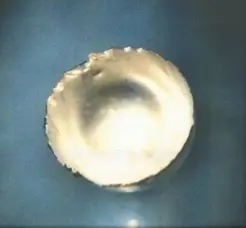
Every element in the periodic table up to fermium, element 100, can be built in a nuclear reactor by adding neutrons to lighter atoms, one at a time. Not one element after it can. Fermium is where that road ends, and the reason is a single kind of atom that falls apart in less than a thousandth of a second.
The fermium atom
A fermium atom has 100 protons (atomic number 100) and 100 electrons. Its longest-lasting kind, fermium-257, has 257 − 100 = 157 neutrons. By shells, the electrons are 2, 8, 18, 32, 30, 8, 2, and in subshells Grade 10: The Aufbau principle:
… 6p⁶ 7s² 5f¹²
Fermium is in period 7, the twelfth of the actinides in the f-block Grade 10: Features of the modern periodic table. In water it forms Fm³⁺, and it can also form Fm²⁺.
How many electrons does a fermium atom have in its outermost shell?
Pick an answer to see why.
How fermium was found and named
Fermium was found in the same place as einsteinium: the dust from the first hydrogen-bomb test, in the Pacific Ocean in November 1952. Albert Ghiorso’s team at Berkeley found einsteinium in it in December, and in the first weeks of 1953, in more of the material collected after the test, element 100. The atoms they found, fermium-255, had a half-life of about 20 hours.
The discovery was kept secret until 1955. Meanwhile, in 1954, scientists at the Nobel Institute for Physics in Stockholm, Sweden, made element 100 on their own, by firing oxygen nuclei at uranium: 92 protons + 8 protons = 100. The Berkeley team had found it first, and named it.
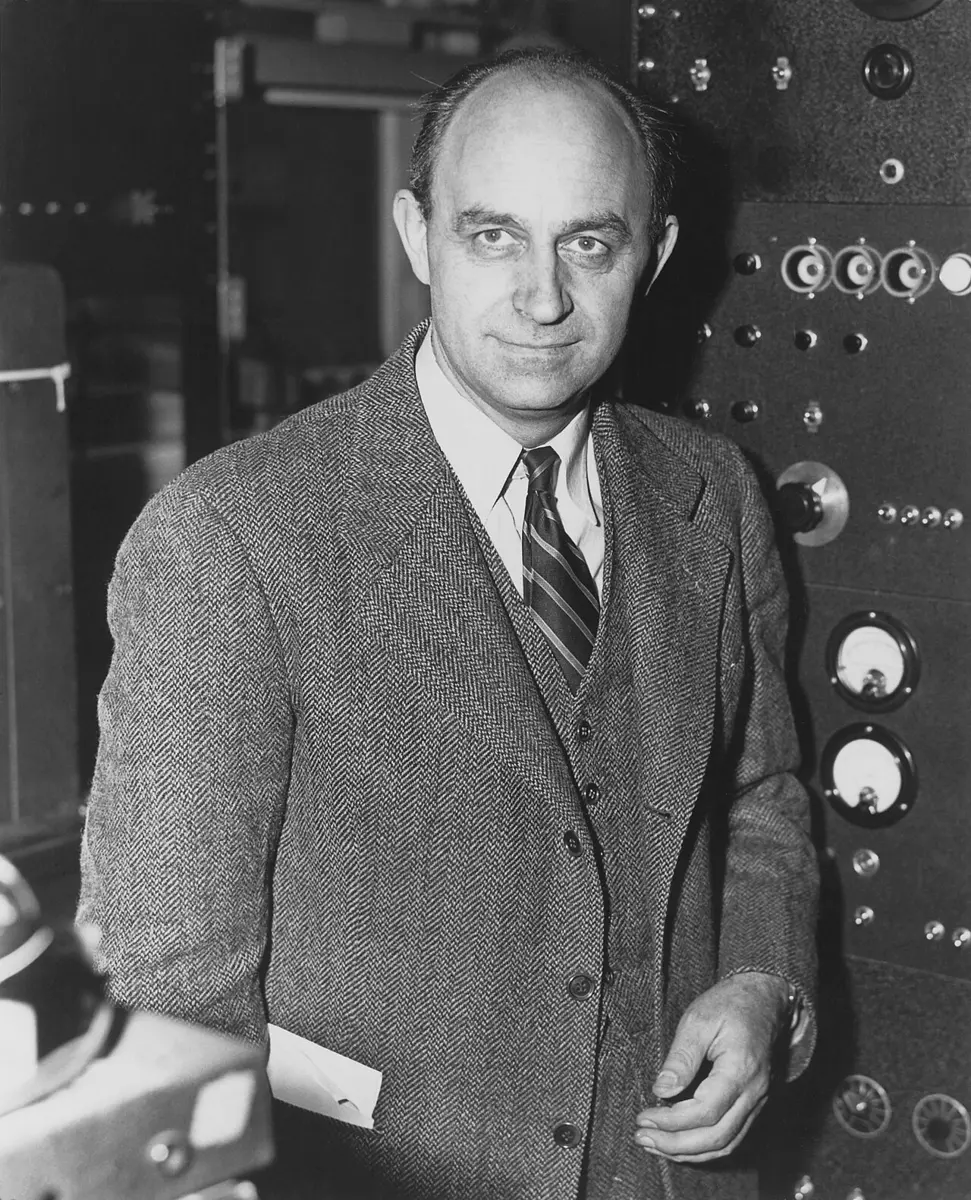
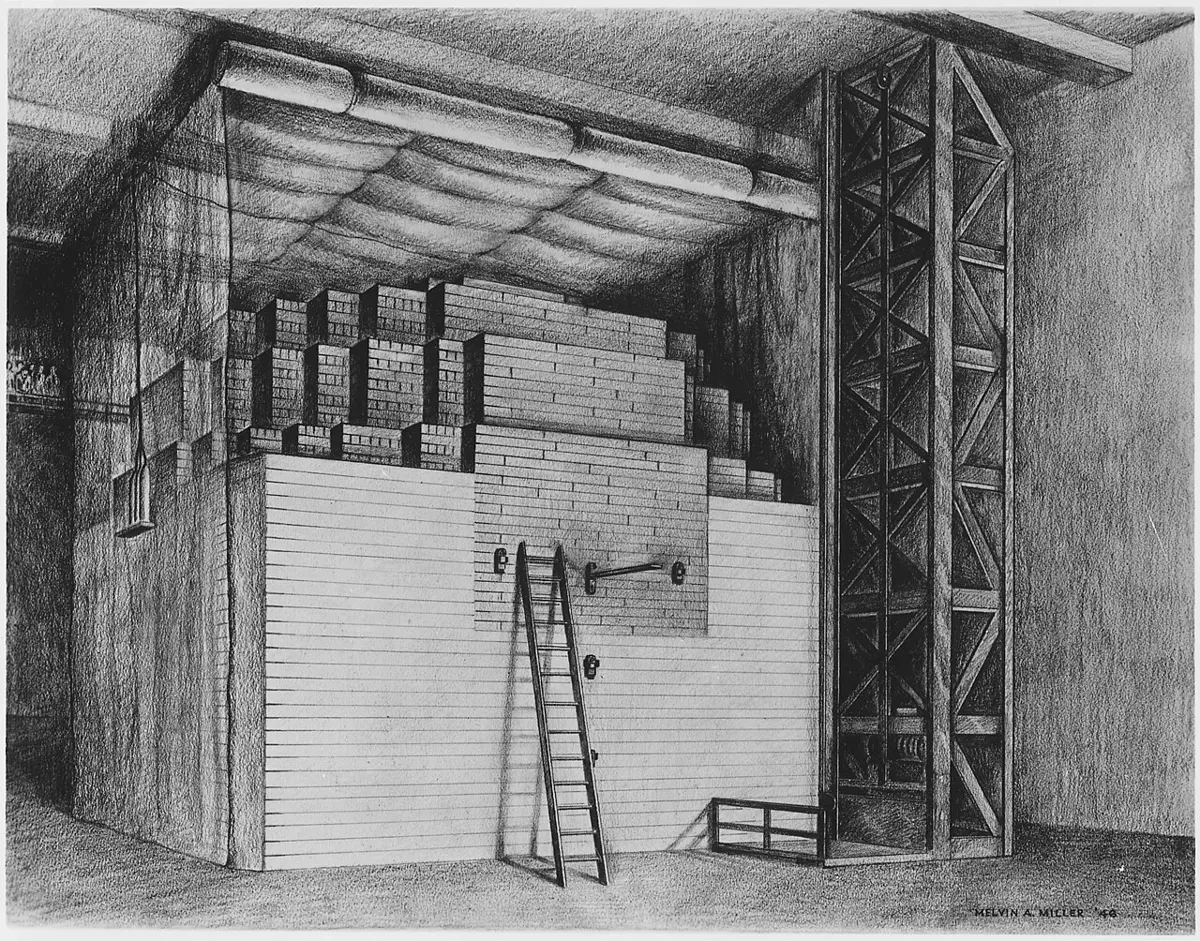
They chose Enrico Fermi, the Italian physicist who won the 1938 Nobel Prize in Physics for making new radioactive atoms with neutrons, and who in 1942 in Chicago built the first nuclear reactor. Fermi died in November 1954, before the name was announced. Its symbol is Fm.
Where fermium comes from, and why it is the last
No fermium is left from the Earth’s birth: fermium-257 has a half-life of only about 100 days. It is made in the High Flux Isotope Reactor at Oak Ridge, USA. Out of a run that starts with tens of grams of curium, only trillionths to billionths of a gram of fermium come out: far too little to see.
In the reactor, nuclei catch neutrons, and every so often one of their neutrons turns into a proton by beta decay (beta decay), moving the nucleus one place along the table. Step by step, curium becomes berkelium, californium, einsteinium and fermium.
Then the ladder breaks. When fermium-257 catches one more neutron, it becomes fermium-258, which splits in two by itself (fission) in less than half a thousandth of a second: far too quickly to catch another neutron or to turn into element 101. And no kind of fermium that a reactor makes turns into element 101 by beta decay. So every element after fermium has to be made another way: by firing one nucleus at another in an accelerator, a few atoms at a time.
What fermium is like
Almost nothing about fermium has been measured directly, because no one has ever had enough to make a piece of the metal. Chemists have studied it only in tiny traces dissolved in water, and found that it behaves like the other late actinides.
So the facts card’s values for fermium are estimates: that it would be a solid metal, and that it would melt at about 1,527 °C. They come from calculations and from how its neighbors behave, not from a sample.
Fermium and your health
The body has no use for fermium. Like the other heavy actinides, it would be harmful mainly because of its radiation, but so little exists, and for so short a time, that almost no one ever meets it outside a few laboratories.
In your science books
- Grade 9: radioactive elements, nuclear fission and shells and their energy.
- Grade 10: the actinides and the Aufbau principle.
- Going further: beta decay, fission and catching neutrons in a flash.
More to explore
- Nobel Prizes: Fermi’s prize (1938) and Seaborg and McMillan’s prize (1951) for the elements beyond uranium.
- Its neighbors: einsteinium, found with it, californium, from which it is built up, and erbium, the element above it.
- Play: find fermium in Guess the Element and the Periodic Table Jigsaw.
- Read more: fermium at the Royal Society of Chemistry and at PubChem.