
- Atomic number
- 19
- Atomic mass
- 39.1
- Shells
- 2, 8, 8, 1
- Configuration
- 1s² 2s² 2p⁶ 3s² 3p⁶ 4s¹
- In the table
- period 4, group 1 (IA), s-block
- Kind
- Alkali metal
- Valency
- 1 (K⁺)
- State at 25 °C
- solid
- Melts · boils
- 63 °C · 759 °C
- Density
- floats on water
- Known since
- 1807
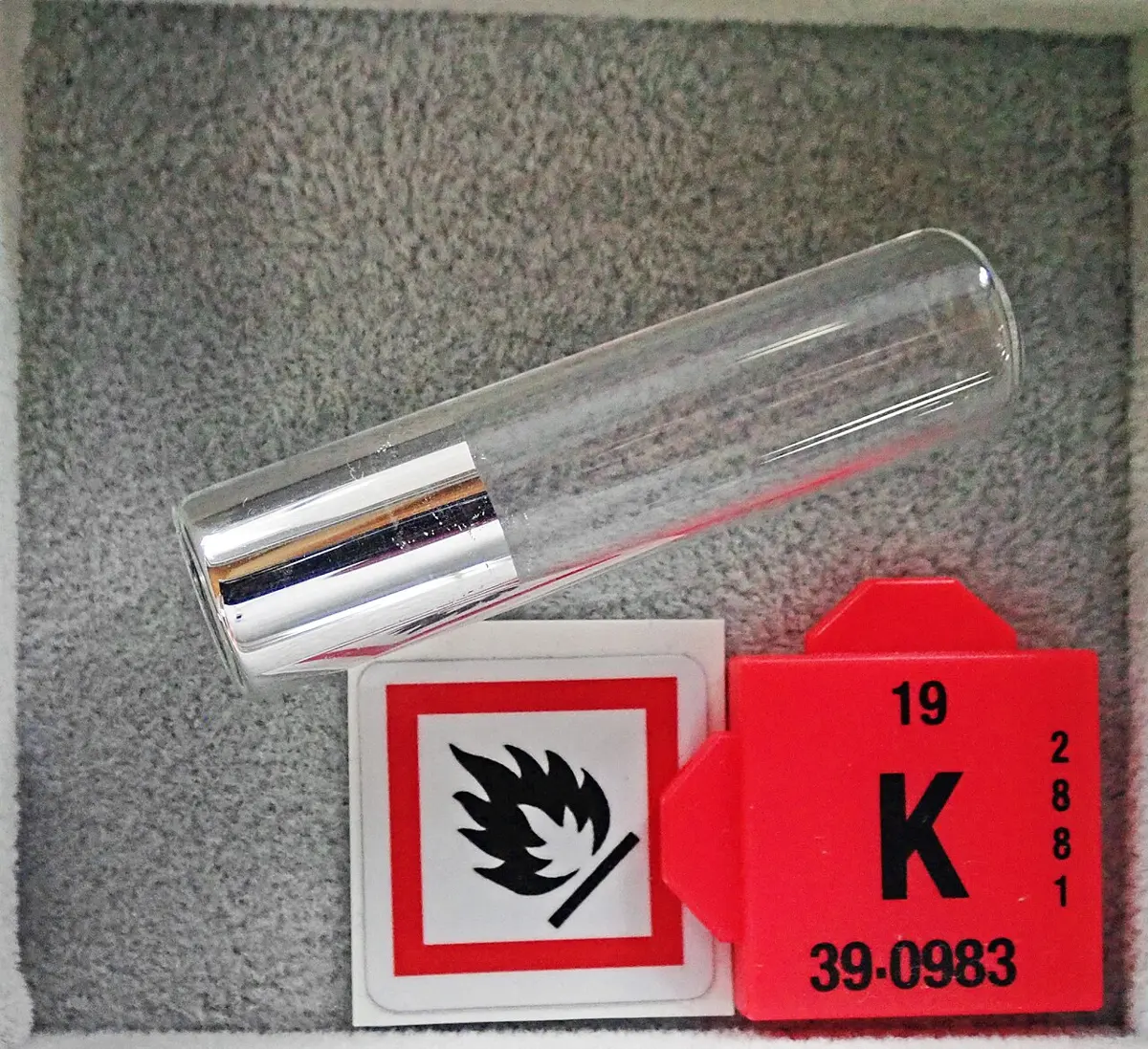
Every time you eat a banana, a potato or a bowl of dal, you take in potassium. Every time you think, move a finger or feel your heart beat, potassium is at work: your nerves and muscles could not send a single signal without it. And every sack of fertilizer marked “NPK” on a farm in Nepal has potassium as its K.
Yet the pure element is a soft, silvery metal so reactive that it catches fire when it touches water. Here is its story.
The potassium atom
A potassium atom has 19 protons, so its atomic number is 19, and 19 electrons. Most potassium atoms have 20 neutrons, so their mass number is 19 + 20 = 39.
By the 2n² rule the K and L shells take 2 and 8 electrons Grade 8: Bohr and Bury’s rule. That leaves 9. The M shell could hold 18, so you might expect 2, 8, 9. But the real atom is 2, 8, 8, 1: the 19th electron starts a new shell, the N shell.
Why? In Grade 10 you learn that shells are made of subshells, and that they fill in order of energy Grade 10: The Aufbau principle. After 3s and 3p are full (18 electrons, the same as argon), the next subshell up in energy is 4s, not 3d. So potassium is:
1s² 2s² 2p⁶ 3s² 3p⁶ 4s¹
Why are potassium’s electrons arranged 2, 8, 8, 1 and not 2, 8, 9?
Pick an answer to see why.
That single outer electron is easy to lose. What is left, 2, 8, 8, has a full outer shell, an octet, like argon. So potassium gives the electron away to become the potassium ion, K⁺ Grade 9: Cations, and its valency is 1.
Its place in the periodic table
- Period 4, because its electrons are in four shells. Potassium is the first element of period 4.
- Group 1 (IA), because it has one outer electron.
- s-block, because that electron is in an s subshell.
Potassium is an alkali metal, below lithium and sodium. All three are soft, shiny metals that fizz in water. Potassium’s outer electron is in the fourth shell, further from the nucleus than sodium’s, so it is held less tightly and lost more easily: potassium is more reactive than sodium and lithium Grade 10: Chemical reactivity. It is at the very top of the reactivity series of the common metals Grade 9: Metals and water.
How potassium was found and named
People used potassium’s compounds for thousands of years without knowing the element was there. They soaked wood ash in water, then boiled the liquid dry in iron pots. The white solid left behind was potash, “pot ashes”, mostly potassium carbonate. It was used to make soap and glass. Saltpeter, potassium nitrate, was used to make gunpowder.
Chemists suspected these held a metal, but no fire was hot enough to free it. Then, in 1807, the English chemist Humphry Davy, at the Royal Institution in London, tried the new tool of the age: electricity. He passed a strong current from a large battery through slightly damp caustic potash (potassium hydroxide, KOH). Tiny shining beads like mercury appeared at the negative wire. Some burst into flame as they formed. It was a new metal, and Davy named it potassium, after potash. A few days later he used the same trick on caustic soda and found sodium.
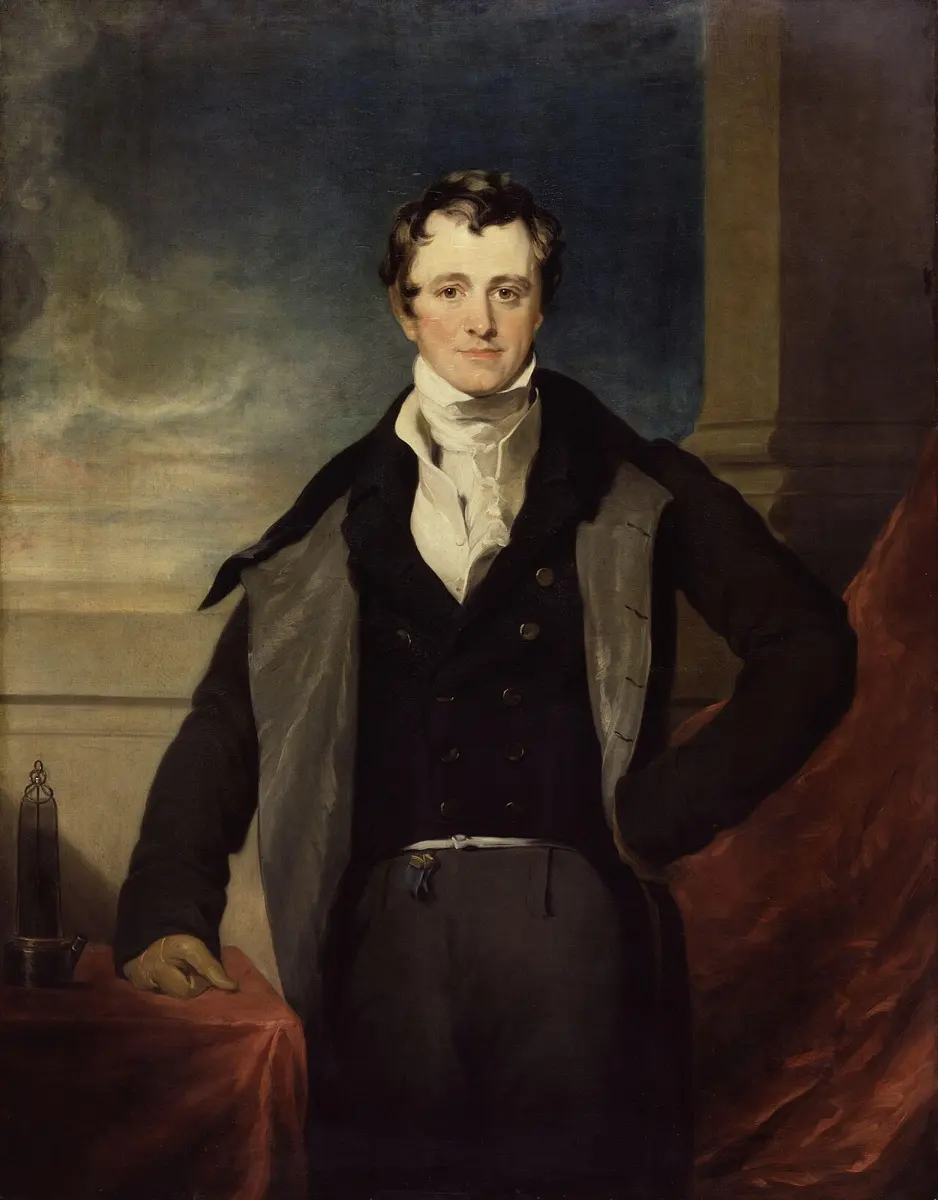
The symbol. Why K, when there is no K in “potassium”? It comes from kalium, the name used in German and Latin, from the Arabic al-qali, “plant ashes” Grade 8: Symbols from Latin names. The same Arabic word gave us alkali, because ashes make water alkaline. Nepali writes पोटासियम, from the English. The ash itself, खरानी, has always been used by farmers in Nepal on their fields and by families to scrub pots: both work because of its potassium carbonate Grade 10: Wood ash.
Where potassium is found
In the universe. Potassium atoms were made inside big stars, near the end of their lives, and scattered when those stars exploded (Getting the atoms out).
In the Earth’s crust. About 2% of the crust is potassium, making it one of the eight most common elements there. It is never found as the metal, which is far too reactive. Most of it is locked in rock-forming minerals, such as the pink feldspar and shiny mica of granite. The light-colored granite of many high Himalayan peaks, such as Manaslu, is full of both. But potassium in those minerals is hard to get out and dissolves only slowly.
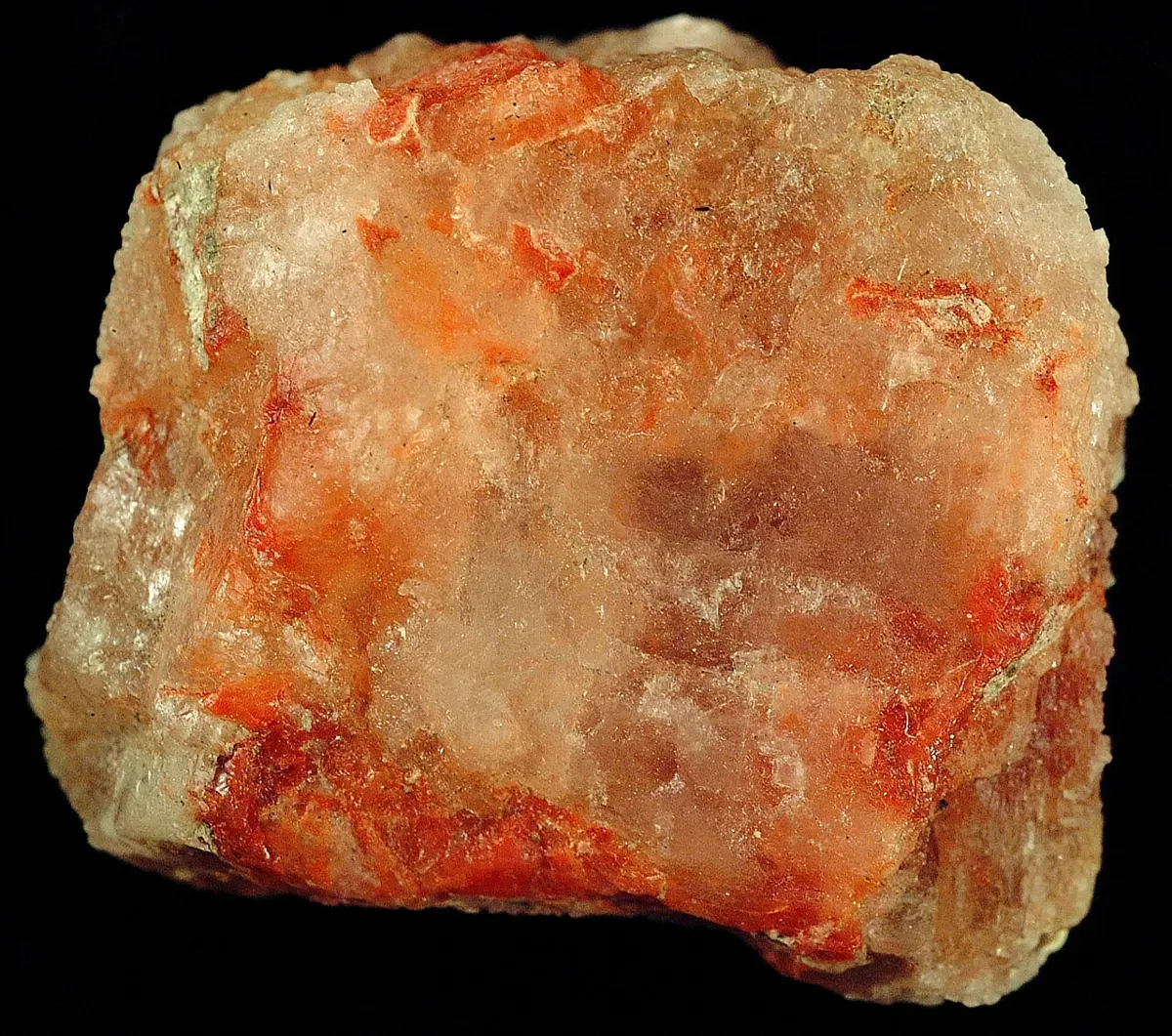
So potassium is mined from the salt beds left behind when ancient seas and lakes dried up. The main mineral is sylvite, potassium chloride (KCl), often mixed with rock salt. These salts are called potash too. In 2025 the world mined potash containing about 49 million tonnes of potassium oxide (K₂O, the way the trade counts it). Canada produced nearly a third, then Russia, China and Belarus (USGS, 2026).
In the sea. Seawater holds about 0.4 grams of potassium per liter, much less than its 10.8 grams of sodium. Rivers carry both to the sea, but potassium sticks to clay in soils on the way, while sodium washes through.
In Nepal, no potash is mined. The potash fertilizer Nepal’s farmers use is imported, along with urea and DAP.
In your body: about 140 grams in an adult, almost all of it inside your cells.
What potassium is like
- Soft, silvery and light. You can cut it with a knife, like cold butter. A fresh cut shines like silver, but within seconds it goes dull as it reacts with the air.
- Lighter than water. Its density is about 0.89 g/cm³, so it floats.
- Melts at only 63 °C, the temperature of a hot cup of tea, and boils at 759 °C.
- Conducts heat and electricity, as all metals do, through its sea of free electrons, one per atom.
Why so soft, light and easy to melt? Each potassium atom gives only one electron to the sea of electrons that holds a metal together, and its atoms are large (four shells), so the free electrons are spread thin around them. The bond between the atoms is weak: they slide past one another easily, they pack loosely, and little heat is needed to shake them apart.
How potassium reacts
Potassium is one of the most reactive metals, so it is kept under paraffin oil, away from air and water.
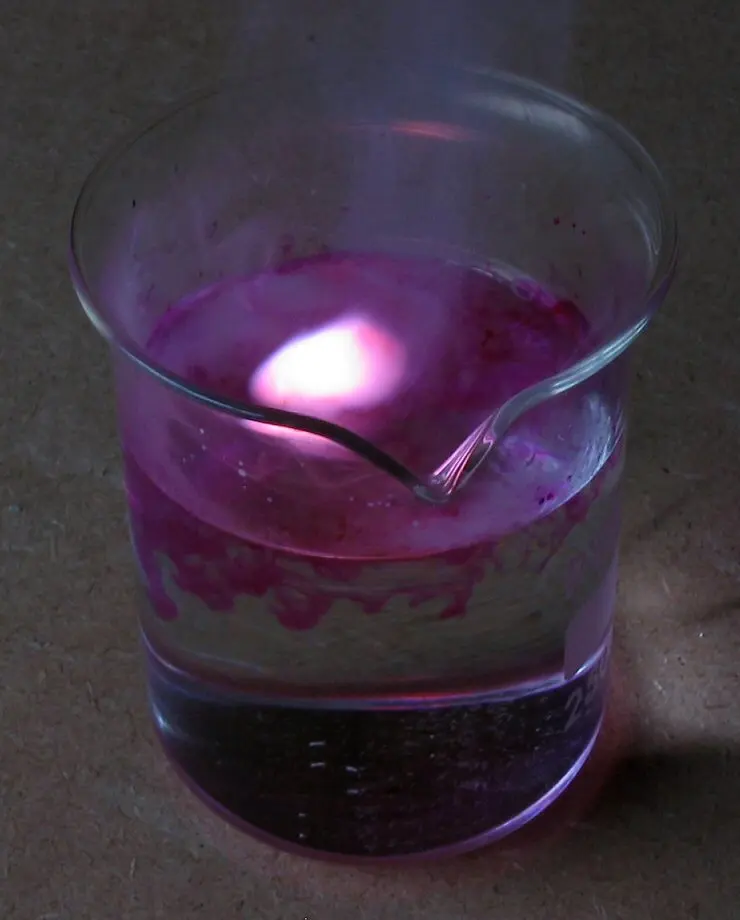
With water. A small piece floats, rushes about, and at once bursts into a lilac (pale purple) flame. It is making hydrogen gas, and the reaction gives out so much heat that the hydrogen catches fire. What is left in the water is potassium hydroxide, caustic potash, a strong alkali that turns red litmus blue:
2K + 2H₂O → 2KOH + H₂
With oxygen. Cut potassium tarnishes within seconds, forming potassium oxide:
4K + O₂ → 2K₂O
Burned in plenty of air, it makes mostly a yellow compound with more oxygen, potassium superoxide (KO₂). That compound gives out oxygen when it takes in the carbon dioxide and moisture of breath, so it is used in some breathing sets for miners and firefighters.
With chlorine it makes potassium chloride, an electrovalent (ionic) compound of K⁺ and Cl⁻ ions, just as sodium makes common salt Grade 9: Electrovalent bond:
2K + Cl₂ → 2KCl
Its flame color. Any potassium compound in a flame colors it lilac. The color is faint and easily hidden by the yellow of sodium, which is in almost everything, so chemists look at it through blue cobalt glass, which blocks the yellow (Flame colors).
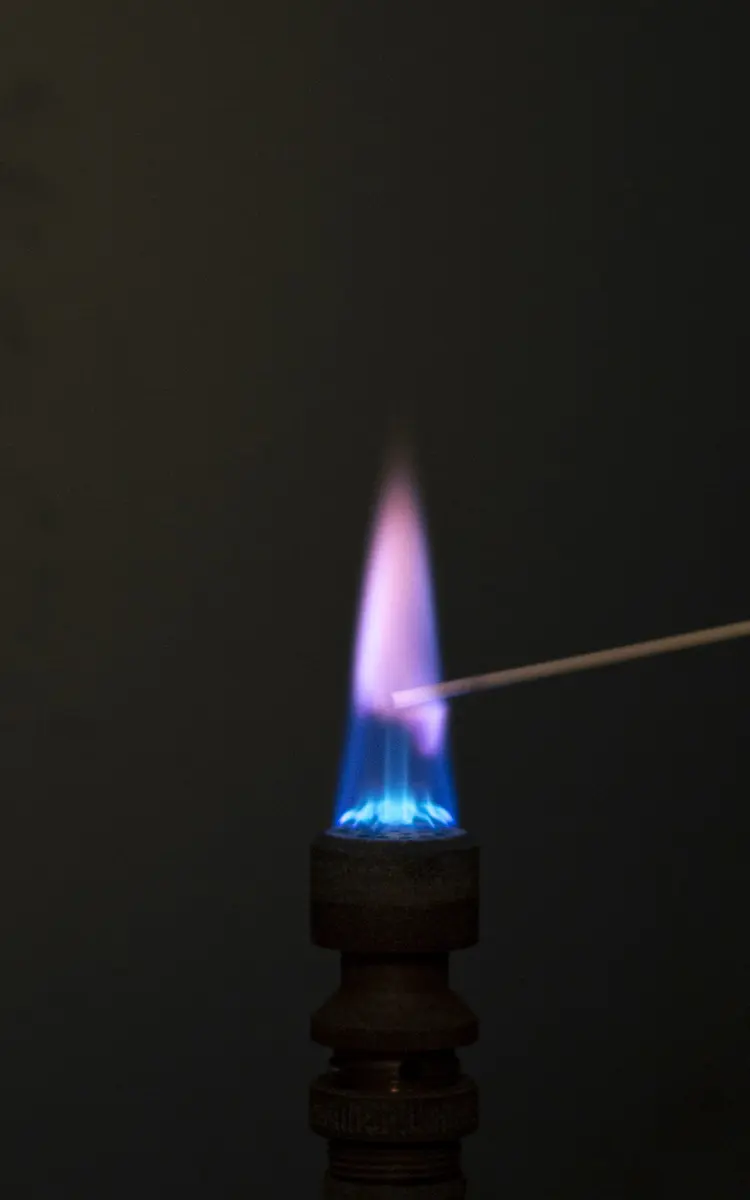
A piece of potassium is dropped into water with a few drops of red litmus solution. What do you see?
Pick an answer to see why.
Potassium compounds you know
| Compound | Formula | Where you meet it |
|---|---|---|
| potassium chloride (muriate of potash) | KCl | fertilizer; “low-sodium” salt; ORS |
| potassium nitrate (saltpeter) | KNO₃ | fertilizer; gunpowder and fireworks |
| potassium hydroxide (caustic potash) | KOH | soft and liquid soaps; alkaline batteries |
| potassium carbonate (potash) | K₂CO₃ | wood ash; glass |
| potassium chlorate | KClO₃ | match heads; making oxygen in the laboratory Grade 9: Oxygen by heating |
| potassium permanganate | KMnO₄ | deep purple crystals; a disinfectant |
| potash alum (फिट्किरी) | KAl(SO₄)₂·12H₂O | clearing muddy water; stopping small cuts after a shave |
Potassium for plants
Plants need more potassium than any other nutrient except nitrogen. It is one of the three primary nutrients, the K of NPK Grade 9: Necessary nutrients for plants. Inside the plant, potassium ions control how much water each cell holds. They open and close the tiny stomata of leaves, and they help move sugar from the leaves to grains, fruits and tubers. A plant with enough potassium has strong stems, resists drought and disease, and fills its grains and fruits well.
A plant short of potassium shows it first on its older leaves: their edges turn yellow, then brown and dry, as if scorched, while the middle stays green.
Each harvest carries potassium away from the field in grain, straw and fruit, so it must be put back. Wood ash, compost and animal manure return some; potash fertilizers return more Grade 9: Potassium fertilizers. Most potash mined in the world goes into fertilizer. The most used is potassium chloride, muriate of potash (MOP), sold as red or white grains.
A sack of fertilizer is labeled 0-0-60. What does it contain?
Pick an answer to see why.
Potassium in your body
Your body holds about 140 grams of potassium, almost all of it inside your cells. Sodium is the other way round: most of it is in the blood and the liquid around the cells. Every cell keeps it that way with a tiny pump in its outer skin, the cell membrane. Each turn of the pump pushes 3 sodium ions out and brings 2 potassium ions in, using energy from food. Your body spends a large part of its resting energy, by some estimates a fifth, running these pumps.
Why bother? Because the difference is how nerves carry messages Grade 9: Neuron or nerve cell. When a nerve cell fires, tiny gates in its membrane open: sodium ions rush in, then potassium ions rush out, and this flicker of charge runs along the nerve like a spark along a fuse (Messages along nerves). Muscles, including your heart, work the same way. That is why the amount of potassium in your blood must stay within narrow limits.
The pump was discovered by the Danish scientist Jens Skou in 1957; he shared the Nobel Prize in Chemistry in 1997. The potassium gates themselves were seen atom by atom by Roderick MacKinnon in 1998, part of the Nobel Prize in Chemistry in 2003.
How much you need. The World Health Organization advises adults to take in at least 3.5 grams of potassium a day. Fruits and vegetables are the best sources: potatoes, bananas, spinach and other green leaves, beans, lentils, soybeans, tomatoes, oranges and dried fruits, plus milk and curd. A medium banana has about 0.4 grams. Eating more potassium and less salt helps keep blood pressure down.
Too little (hypokalemia) makes muscles weak and can make the heart beat unevenly. It happens most often with bad diarrhea or vomiting, which wash potassium out of the body. That is why oral rehydration solution (ORS) made to the World Health Organization’s recipe contains potassium chloride as well as salt and glucose.
Too much in the blood (hyperkalemia) is dangerous too: it can stop the heart. Healthy kidneys remove any extra, so food alone almost never causes it.
Isotopes of potassium
Natural potassium is a mixture of three isotopes: about 93.3% potassium-39 (20 neutrons), 6.7% potassium-41 (22 neutrons) and a tiny 0.012% potassium-40 (21 neutrons).
Potassium-40 is radioactive. Its half-life is about 1.25 billion years: in that time, half of any potassium-40 decays. About 89% of its atoms become calcium-40, by giving out a beta particle (a neutron turns into a proton); the other 11% become argon-40 (Beta decay).
Because every living thing contains potassium, every living thing is a little radioactive. In an adult, about 4,000 potassium-40 atoms decay every second. That is natural and harmless: you have always lived with it.
The argon it makes is a useful clock. When lava cools into rock, any argon escapes; after that, argon-40 from potassium-40 builds up inside, trapped. Measure how much argon there is for the potassium, and you can tell how long ago the rock formed: potassium–argon dating (A clock inside the atom). It has dated the volcanic ash layers around the bones of early humans in East Africa.
Surprising facts and records
- The banana counter. A banana gives off about a dozen potassium-40 decays every second. Some people joke about a “banana dose” of radiation; eating one gives you far less radiation than you get from nature each day.
- Potassium on the Moon. Among the rocks the Apollo astronauts brought back from the Moon is one nicknamed KREEP, for its potassium (K), rare earth elements (REE) and phosphorus (P).
- Wood ash to rockets. Gunpowder, the first explosive and the fuel of the first rockets, is about three-quarters potassium nitrate.
In your science books
- Grade 8: the first 20 elements (K from kalium), the 2n² rule (2, 8, 8, 1), valency and characteristics of groups.
- Grade 9: cations, very reactive metals and water, metals the body needs, potassium fertilizers and NPK fertilizer.
- Grade 10: the Aufbau principle (4s before 3d), argon and potassium, reactivity down a group and wood ash.
- Going further: nerve messages, the potassium in you and dating rocks.
More to explore
- Nobel Prizes with potassium in them: the sodium–potassium pump (1997), the potassium channel (2003), ion channels (1991) and crown ethers (1987, rings that grab a potassium ion).
- Play: make potassium chloride in Molecule Kitchen, or find potassium in Guess the Element, the Periodic Table Jigsaw.
- Read more: potassium at the Royal Society of Chemistry and at PubChem.