
- Atomic number
- 63
- Atomic mass
- 151.96
- Shells
- 2, 8, 18, 25, 8, 2
- Configuration
- 1s² 2s² 2p⁶ 3s² 3p⁶ 4s² 3d¹⁰ 4p⁶ 5s² 4d¹⁰ 5p⁶ 6s² 4f⁷
- In the table
- period 6, group none (f-block), f-block
- Kind
- Lanthanide
- Valency
- 3 and 2 (Eu³⁺, Eu²⁺)
- State at 25 °C
- solid
- Melts · boils
- 822 °C · 1,529 °C
- Density
- 5.2 × as heavy as water
- Known since
- 1901
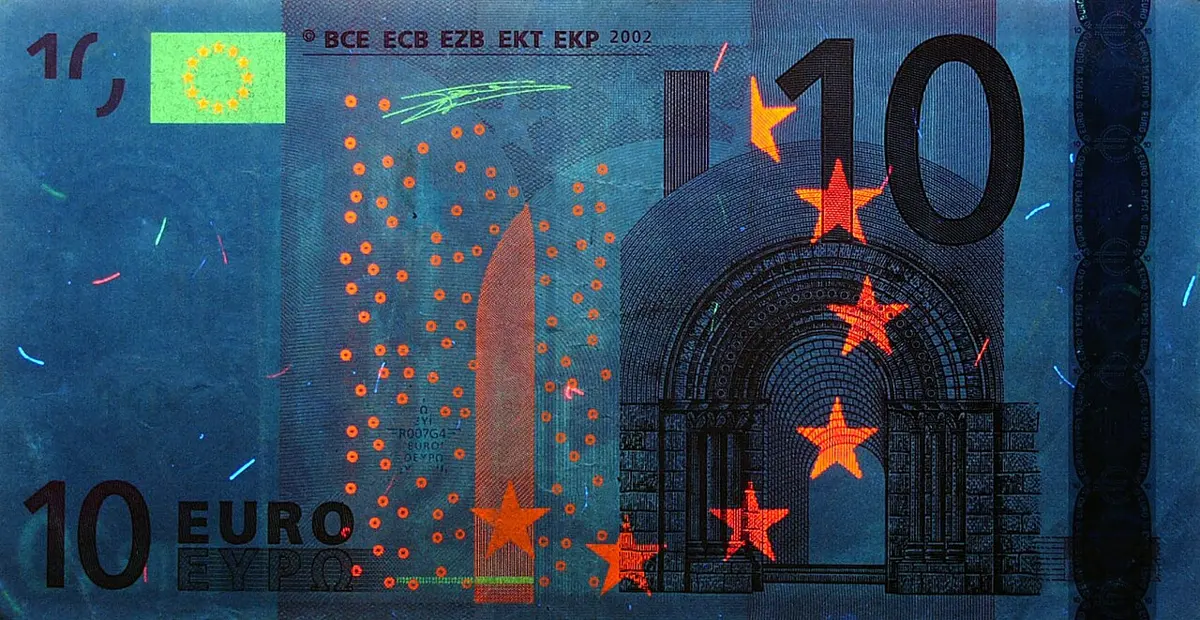
Shine an ultraviolet lamp on a euro banknote, and stars and dots that were invisible a moment ago glow orange-red. The same red light came out of every color television of the last century, and comes out of the tube lights in many homes and offices. It is made by europium (say yoo-ROH-pee-um), a soft metal named after a continent.
Europium is the seventh lanthanide, after samarium. Like its neighbors it hides its differences deep inside the atom (fifteen near-twins), but it breaks the family pattern in two ways: it is the lightest and the most reactive of them.
The europium atom
A europium atom has 63 protons and 63 electrons. Natural europium is a mixture of two isotopes in almost equal amounts; the commoner, europium-153, has 90 neutrons: 63 + 90 = 153.
By shells its electrons are 2, 8, 18, 25, 8, 2. In subshells it ends 6s² 4f⁷ Grade 10: The Aufbau principle. The 4f subshell has seven boxes, and europium has exactly one electron in each: its 4f is half full. A half-full subshell is especially stable, and that explains most of what is odd about europium.
Its place and valency
- Period 6, the seventh lanthanide (f-block), between samarium (62) and gadolinium (64).
- Like the other lanthanides, it can lose three electrons to become Eu³⁺, with a valency of 3: europium oxide is Eu₂O₃ Grade 9: The criss-cross method.
- It also loses just its two 6s electrons and becomes Eu²⁺, with a valency of 2 Grade 9: Variable valency. Eu²⁺ keeps the half-full 4f⁷, so europium forms it more easily than any other lanthanide.
Why does europium form Eu²⁺ more easily than any other lanthanide?
Pick an answer to see why.
How europium was found and named
Samarium, found in 1879, was not pure: it hid two more elements. In the 1880s and 1890s chemists studying samarium kept seeing a few lines of light in its spectrum that belonged to nothing known (Why each element has its own lines).
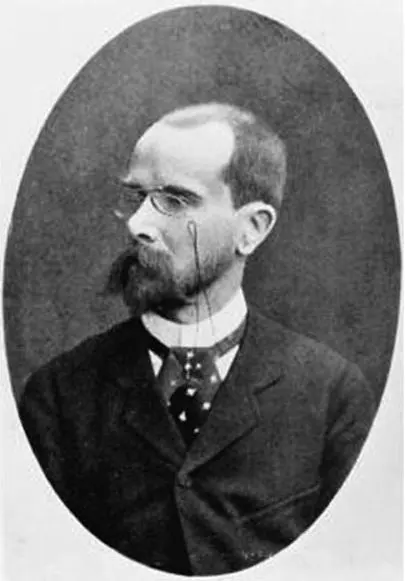
The French chemist Eugène-Anatole Demarçay, an expert in spectra, reported the new element in 1896. He then spent years dissolving and crystallizing a salt of samarium and magnesium again and again, each time checking the new lines grow stronger, until in 1901 he had it pure enough to be sure. He named it europium, after Europe. Its symbol is Eu.
Where europium is found
In the universe, europium is made in stars by catching neutrons (Catching neutrons).
In the Earth’s crust there are only about 2 grams in a tonne of rock. It is mined with the other rare earths, from bastnäsite and monazite (where the rare earths come from), and separated from them using its knack for forming Eu²⁺, which behaves differently from all the 3+ ions around it. In 2025 europium oxide cost about 27 US dollars a kilogram (USGS, 2026).
In Nepal and in your body. Nepal mines no rare earths. Your body has no use for europium.
What europium is like and how it reacts
- A soft, silvery metal, about as soft as lead.
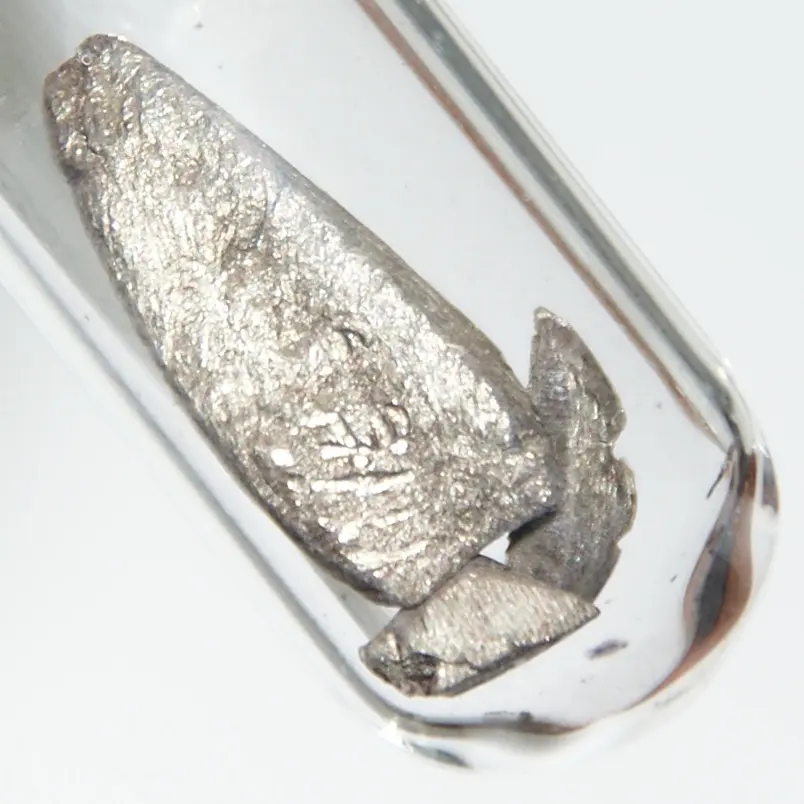
- The most reactive lanthanide. A fresh surface tarnishes quickly, and a piece of the metal can catch fire in air at about 150–180 °C. So europium is stored under oil or in sealed glass, like the pieces in the photo above.
- With water, it reacts much like calcium, giving europium hydroxide and hydrogen Grade 9: Very reactive metals and water:
2Eu + 6H₂O → 2Eu(OH)₃ + 3H₂ - The lightest lanthanide. Its density, 5.24 g/cm³, is far below its neighbors’. In a metal, every atom gives some electrons to the shared “sea” of free electrons that holds the metal together Grade 9: Properties of metals. Most lanthanides give three each; europium, holding on to its half-full 4f, gives only two. With less glue between them, its atoms sit farther apart, so the metal is lighter and melts lower, at 822 °C. Ytterbium (70), whose 4f is completely full, does the same.
Why europium glows red
Light is given out when an electron in an atom drops from a higher energy level to a lower one. In Eu³⁺, the electrons that jump are the 4f ones, deep inside the ion, shielded by the electrons around them. So their jumps are always nearly the same size, wherever the ion is, and the light comes out at nearly one exact color: a pure, deep red, strongest at about 612 nm.
Ultraviolet rays, which we can’t see, carry more energy than any visible light Grade 9: Ultraviolet rays. A europium compound soaks up UV and gives the energy back as red light. A substance that does this, glowing in one color when another kind of light falls on it, is called a phosphor.
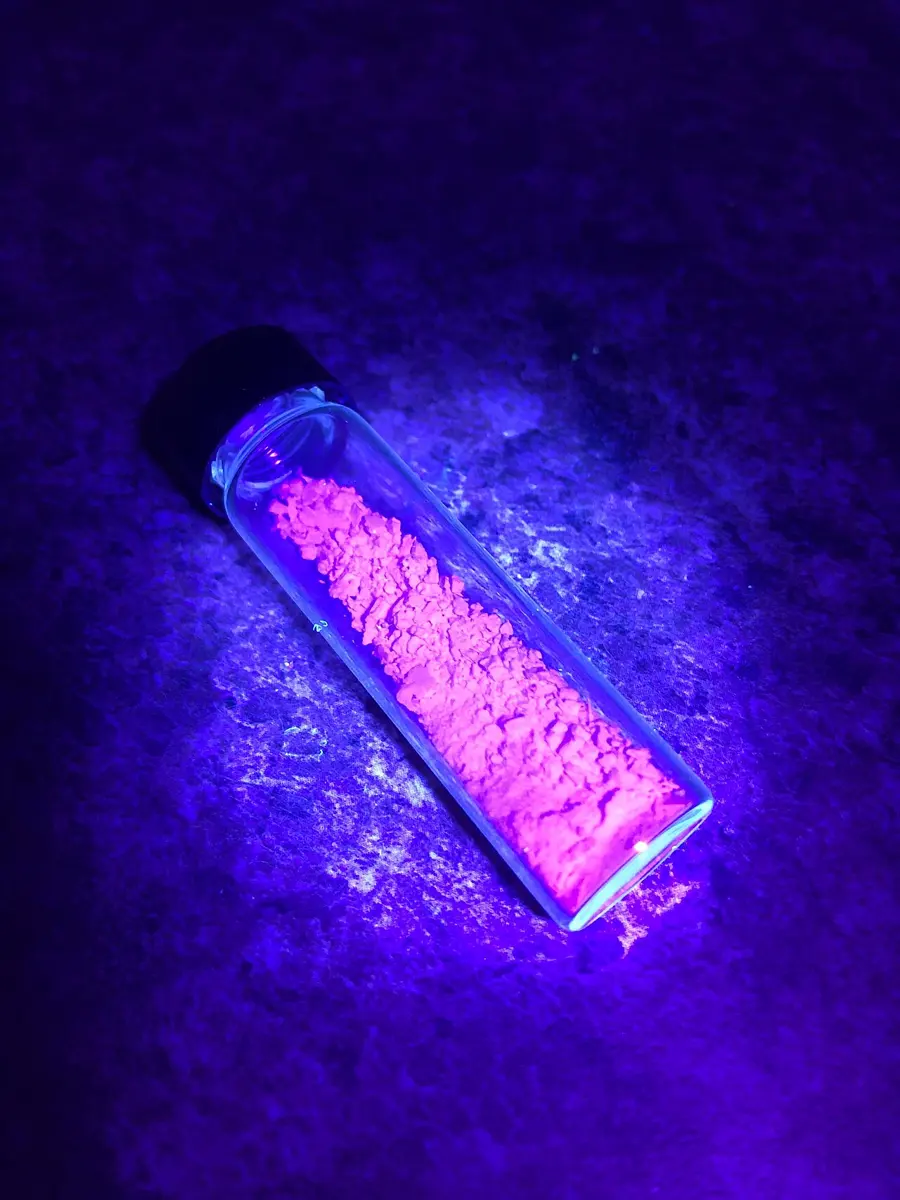
- Color television. The old picture tubes made every color from tiny dots of red, green and blue phosphor. In 1964 a phosphor of yttrium with a little europium was found to give a strong, pure red, and from then on europium gave the red of color TVs and computer screens.
- Tube lights. The inside of a tube light is coated with a phosphor powder that turns the UV from the mercury gas into visible light. In the brighter, better kinds, the powder is a mixture of three: red from Eu³⁺, blue from Eu²⁺, and green from terbium.
- Glow in the dark. Glow-in-the-dark stickers and exit signs often hold strontium aluminate with a little europium, which soaks up light by day and gives it out slowly for hours (strontium).
The red in banknotes
To check a euro note, a shopkeeper can hold it under a UV lamp: stars, dots and fibers in the paper light up. Scientists who measured the light of the orange-red marks found the color pattern of europium. The exact recipe of the ink is a secret, which is the point: a forger with an ordinary printer can copy the picture but not the glow.
Isotopes of europium
Natural europium is 47.8% europium-151 and 52.2% europium-153, both stable for all practical purposes. That is why its atomic mass, 151.96, is almost exactly halfway between 151 and 153 Grade 9: Atomic mass.
Both isotopes soak up neutrons very well, so europium has been used in control rods, which catch neutrons to slow the chain reaction in a nuclear reactor Grade 9: Nuclear fission.
Europium and your health
Europium has no known job in the body and is of low toxicity. The danger is the metal itself: its fine powder can catch fire in air.
In your science books
- Grade 9: ultraviolet rays and tube lights, variable valency, the criss-cross method, atomic mass, nuclear fission and the properties of metals.
- Grade 10: the Aufbau principle and the lanthanides.
- Going further: why each element has its own lines, packets of light and where europium is made.
More to explore
- Its neighbors: samarium before it, gadolinium after it, terbium, its partner in tube lights, and lanthanum, with the story of the whole row. The other lanthanides with pages: cerium, praseodymium, neodymium and promethium.
- Light from LEDs: the blue LED.
- Play: find europium in Guess the Element, the Periodic Table Jigsaw and Higher or Lower.
- Read more: europium at the Royal Society of Chemistry and at PubChem.