
- Atomic number
- 113
- Atomic mass
- 286.18
- Shells
- 2, 8, 18, 32, 32, 18, 3
- Configuration
- 1s² 2s² 2p⁶ 3s² 3p⁶ 4s² 3d¹⁰ 4p⁶ 5s² 4d¹⁰ 5p⁶ 6s² 4f¹⁴ 5d¹⁰ 6p⁶ 7s² 5f¹⁴ 6d¹⁰ 7p¹ (predicted)
- In the table
- period 7, group 13 (IIIA), p-block
- Kind
- Other metal
- Valency
- Not measured; expected 1 (Nh⁺), and perhaps 3
- State at 25 °C
- expected to be a solid
- Melts · boils
- not known · not known
- Known since
- 2004
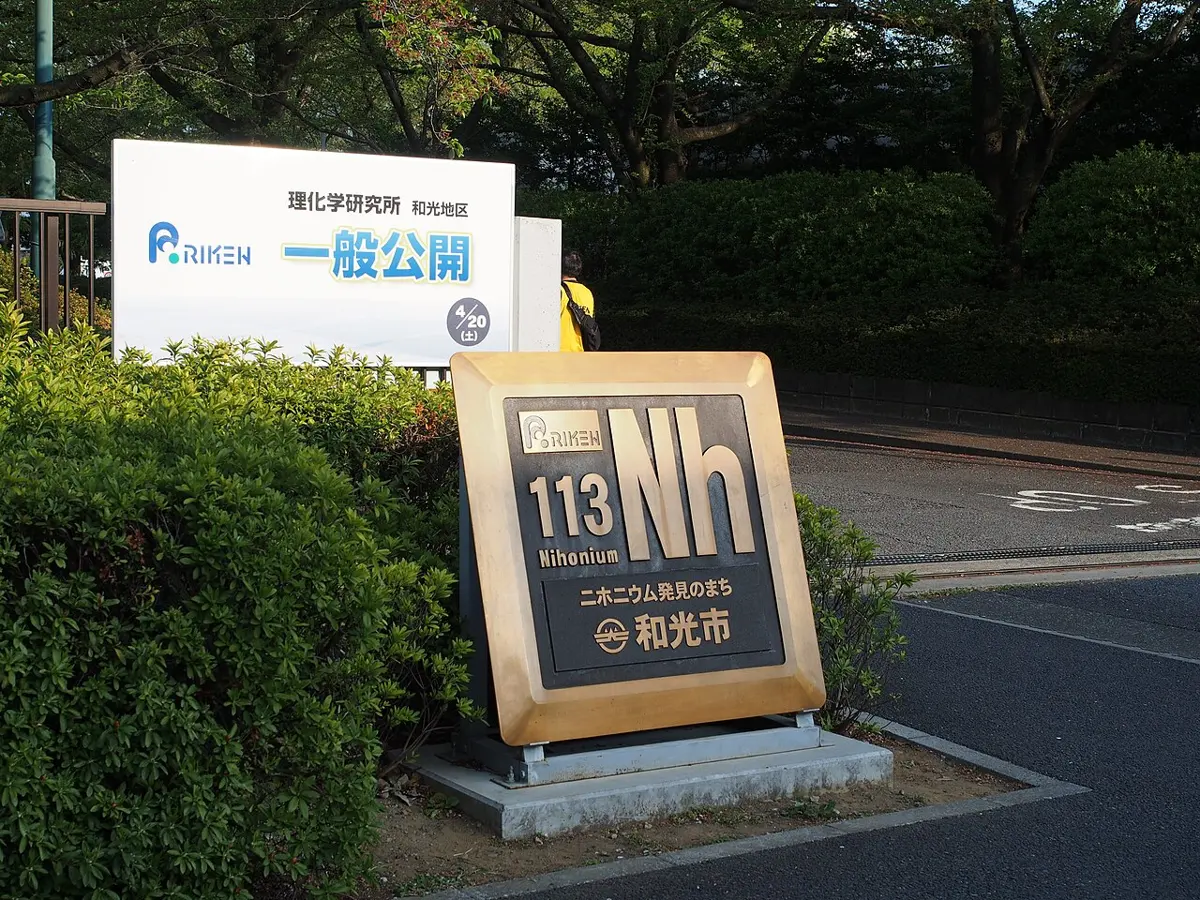
Until 2015, no element had ever been discovered in Asia. Then, on the last day of 2015, a letter arrived at RIKEN, Japan’s national research institute in Wakō, near Tokyo: element 113 was theirs. It was the first element ever discovered in Asia, and the team named it after their country: nihonium.
The nihonium atom
A nihonium atom has 113 protons (atomic number 113) and 113 electrons. Its longest-lasting known kind, nihonium-286, has 286 − 113 = 173 neutrons.
After copernicium, every d subshell is full, so the next electron goes into a new subshell, 7p Grade 10: The Aufbau principle:
… 7s² 5f¹⁴ 6d¹⁰ 7p¹
The shells are 2, 8, 18, 32, 32, 18, 3: three electrons in the outermost shell. That puts nihonium back among the p-block elements, in group 13 (the old group IIIA), under boron, aluminium, gallium, indium and thallium Grade 10: Features of the modern periodic table.
Nihonium is in group 13, with aluminium. How many electrons does a nihonium atom have in its outermost shell?
Pick an answer to see why.
Aluminium gives away all three and forms Al³⁺. Lower down the group, the s electrons are held more and more tightly, so thallium usually gives away only its one p electron, as Tl⁺. Nihonium is expected to go further in the same direction: valency 1.
Three atoms in nine years
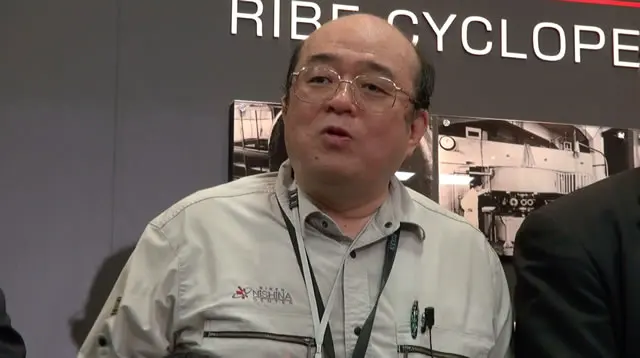
The team, led by Kosuke Morita at the RIKEN Nishina Center, began in September 2003. They fired zinc-70 nuclei (30 protons), moving at about a tenth of the speed of light, at a thin layer of bismuth-209 (83 protons): 30 + 83 = 113. They knew they would succeed very rarely. They chose this reaction because each new atom would decay, by alpha particles, into nuclei that were already known, and known daughters are the strongest proof of a new element.
The first atom came on 23 July 2004, the second on 2 April 2005. Both decayed four times and then ended when dubnium-262 split in two. The judges of IUPAC and IUPAP said that was not yet enough. For over seven years the team kept firing and saw nothing. “I was not prepared to give up,” Morita said later. Then, on 12 August 2012, came the third atom. This time the chain went on: six alpha decays, through bohrium-266, dubnium-262 and lawrencium-258, all well known, to mendelevium-254.
Meanwhile, a team from Dubna in Russia and Livermore in the USA had also seen element 113, from 2003, as the decay product of element 115. But their chains ended in nuclei no one had seen before, so they were harder to check. On 31 December 2015, IUPAC gave RIKEN the credit.
Named after Japan
The team chose nihonium, symbol Nh, from Nihon (日本), one of the two ways to say “Japan” in Japanese; it means “the land of the rising sun”. IUPAC approved it in November 2016.
The name also remembers an old disappointment. In 1908, the Japanese chemist Masataka Ogawa announced a new element, which he called nipponium (Np), from Nippon, the other way to say Japan. No one could confirm it, and the name was dropped; its symbol Np later went to neptunium. Long afterwards, his samples and notes showed that he had really found element 75, rhenium, years before it was officially discovered in 1925. A name once used for a failed claim cannot be used again, so 113 became nihonium, not nipponium.
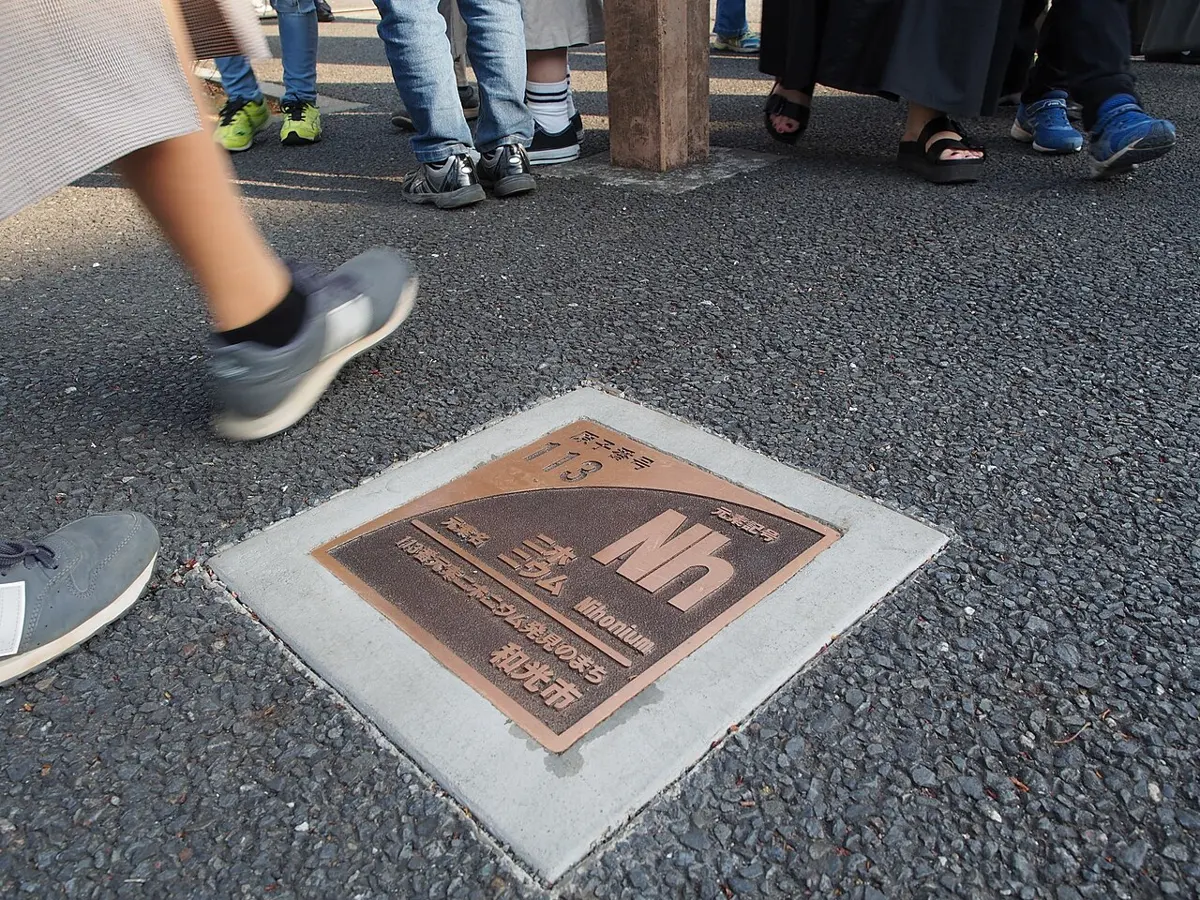
Today the road from Wakō station to RIKEN is called Nihonium Street, with a plate for every element set into the pavement.
What has been measured, and what is only predicted
Nihonium is now made more often as the decay product of element 115, moscovium. Its longest-lasting known kind, nihonium-286, has a half-life of about 10 seconds (measurements range from 8 to 12).
What has been measured: how its nuclei decay and how long they last, and, since 2024, a first piece of chemistry. At the GSI laboratory in Germany, single atoms of nihonium were blown over surfaces of quartz (silicon dioxide) and gold. They stuck less firmly than thallium does, but more firmly than copernicium and flerovium, its neighbors, whose specially stable arrangements of electrons make them hold back.
What is only predicted: that it is a solid, heavy metal, denser than thallium (about 16 to 18 g/cm³, against thallium’s 11.8), melting at a few hundred degrees, and less reactive than thallium.
In your science books
- Grade 9: the structure of an atom and radioactive elements.
- Grade 10: features of the modern periodic table, the Aufbau principle and valency.
- Going further: alpha decay and half-life.
More to explore
- Its neighbors: thallium, above it in group 13, copernicium before it and flerovium after it; rhenium, Ogawa’s “nipponium”.
- Play: find nihonium in Guess the Element and the Periodic Table Jigsaw.
- Read more: nihonium at the Royal Society of Chemistry and at PubChem.