
- Atomic number
- 20
- Atomic mass
- 40.08
- Shells
- 2, 8, 8, 2
- Configuration
- 1s² 2s² 2p⁶ 3s² 3p⁶ 4s²
- In the table
- period 4, group 2 (IIA), s-block
- Kind
- Alkaline earth metal
- Valency
- 2 (Ca²⁺)
- State at 25 °C
- solid
- Melts · boils
- 842 °C · 1,484 °C
- Density
- 1.5 × as heavy as water
- Known since
- 1808
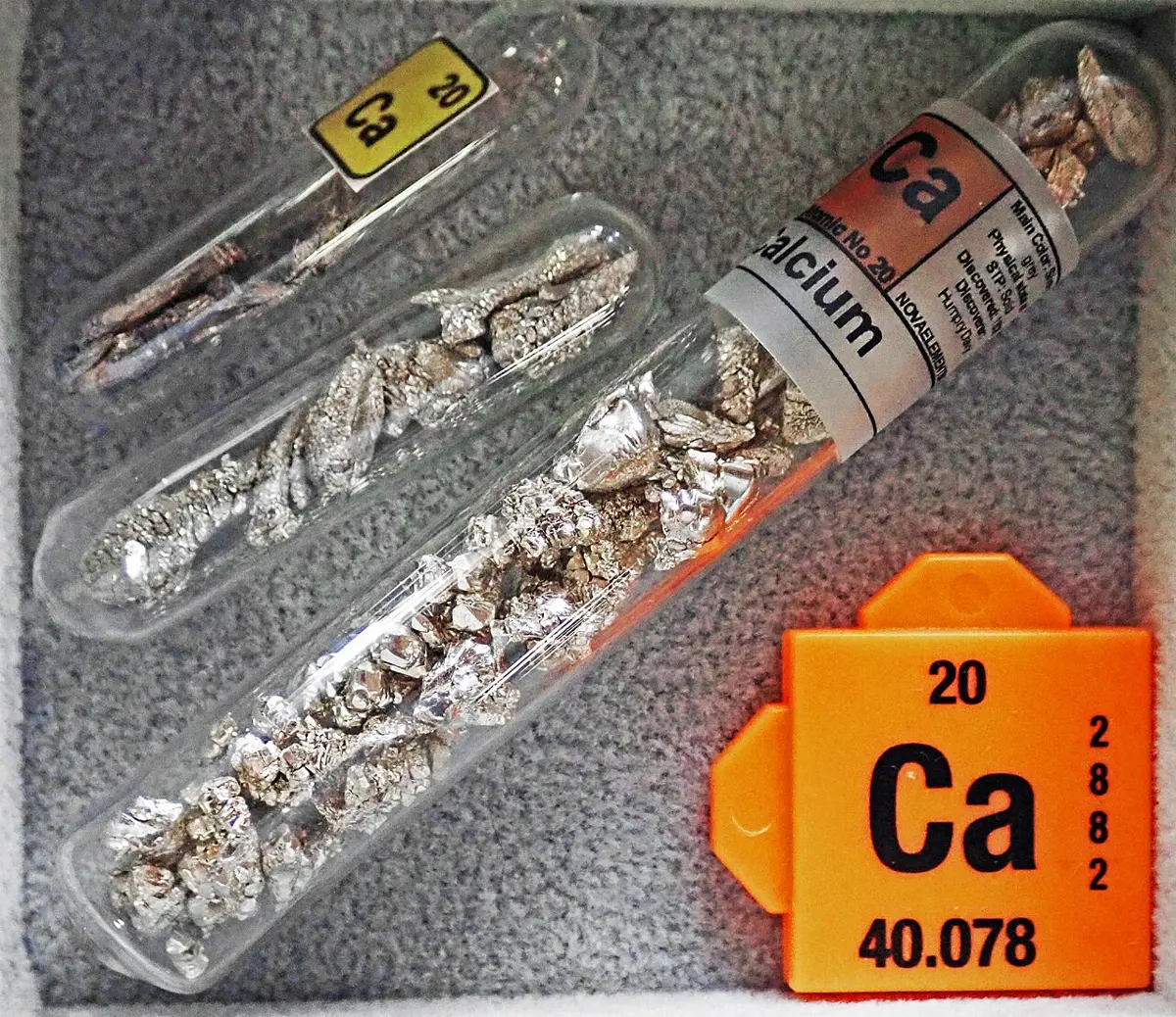
Your bones and teeth, an eggshell, a snail’s shell, the white chalk on a blackboard, the marble of a temple, the cement in a new house, the limestone at the very top of Sagarmatha: all of them are built around one element, calcium.
You have about a kilogram of it in your body, more than any other metal. Yet you have probably never seen calcium itself: a soft, silvery metal that fizzes in water. Here is its story.
The calcium atom
A calcium atom has 20 protons, so its atomic number is 20, and 20 electrons. Most calcium atoms also have 20 neutrons, so their mass number is 20 + 20 = 40.
By the 2n² rule the electrons fill the K and L shells (2 and 8). The M shell then takes 8, and the last 2 go into the N shell: 2, 8, 8, 2 Grade 8: Bohr and Bury’s rule. In subshells, like potassium before it, calcium fills 4s before 3d Grade 10: The Aufbau principle:
1s² 2s² 2p⁶ 3s² 3p⁶ 4s²
Calcium gives away its two outer electrons. What is left, 2, 8, 8, has a full outer shell like argon’s. So calcium forms the calcium ion, Ca²⁺, with two positive charges, and its valency is 2 Grade 8: Valency.
How many electrons does a calcium ion, Ca²⁺, have?
Pick an answer to see why.
Because calcium makes Ca²⁺ ions, its compounds have formulas you can work out with the criss-cross method Grade 9: The criss-cross method: with chloride (Cl⁻) it makes CaCl₂, with oxide (O²⁻) CaO, with carbonate (CO₃²⁻) CaCO₃, with hydroxide (OH⁻) Ca(OH)₂ Grade 9: Formation of calcium chloride.
Its place in the periodic table
- Period 4, because its electrons are in four shells.
- Group 2 (IIA), because it has two outer electrons.
- s-block, because they are in the 4s subshell.
Calcium is an alkaline earth metal, with beryllium, magnesium, strontium, barium and radium. Old chemists called lime (calcium oxide) and magnesia “earths”, because fire could not change them, and they make water alkaline; hence the name Grade 10: Alkaline earth metals. Calcium is less reactive than potassium, its neighbor in group 1: it has two electrons to lose, held by one more proton.
How calcium was found and named
People have used calcium’s compounds for thousands of years. They burned limestone to make lime for plaster, mortar and whitewash. The Romans built with lime mortar and concrete; the Egyptians plastered with gypsum. But no one could get the metal out of lime: Antoine Lavoisier listed it as an “earth” in 1789, though he suspected it hid a new element.
In 1808 the English chemist Humphry Davy, who had just used electricity to free potassium and sodium, tried the same with lime. Damp lime alone did not work. So he mixed lime with mercury oxide and passed a current through it. The calcium that formed dissolved in the mercury as an amalgam (the Swedish chemist Jöns Jacob Berzelius had done the same). Davy heated it until the mercury boiled away, and was left with a little calcium. The name comes from the Latin calx, lime, and gives the symbol Ca.
Nepali has its own word for lime: चुन, from Sanskrit चूर्ण (powder). Limestone is चुनढुङ्गो. The element is written क्याल्सियम.
Where calcium is found
In the universe. Calcium atoms were made inside big stars and in the explosions that ended them (Getting the atoms out). Two of the darkest lines in sunlight’s spectrum, which Joseph von Fraunhofer labeled H and K, are calcium’s (The barcode in sunlight).
In the Earth’s crust. About 4% of the crust is calcium: it is the fifth most common element there, after oxygen, silicon, aluminium and iron. It is never found as the metal. Its main minerals:
- calcium carbonate, CaCO₃: limestone, marble (limestone changed by heat and pressure) and chalk. Most limestone was made from the shells and skeletons of sea creatures, piled up on old sea floors;
- gypsum, calcium sulphate (CaSO₄·2H₂O);
- fluorite, calcium fluoride (CaF₂), and apatite, a calcium phosphate.
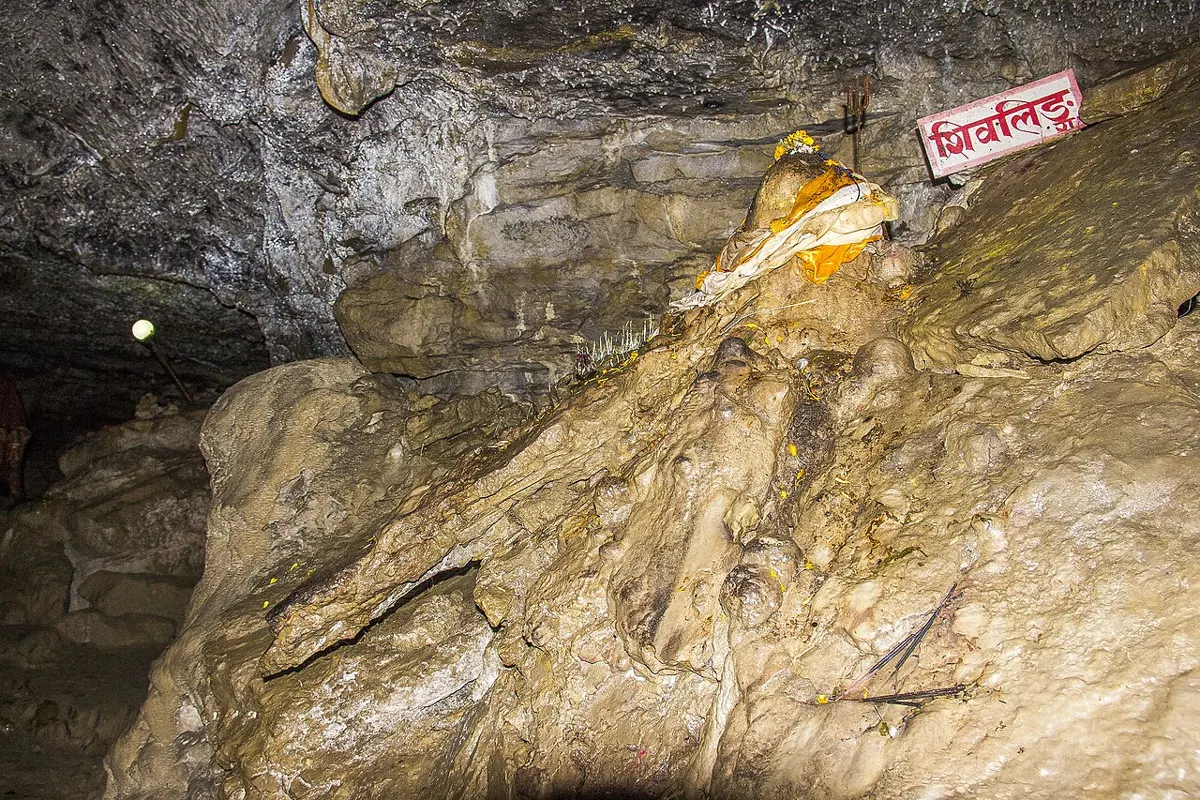
In Nepal. Limestone and dolomite are found in many of Nepal’s hills Grade 8: Minerals in Nepal. The summit of Sagarmatha itself is limestone, made on the floor of an ancient sea and full of the remains of sea animals; India’s push into Asia has lifted it nearly 9 km (Why is Everest still rising?). Rainwater slowly dissolves limestone, carving caves such as Mahendra Gufa near Pokhara.
In the sea. Seawater holds about 0.4 g of calcium per liter. Corals, shellfish and tiny floating algae take it out to build their shells and skeletons, which become the limestone of the future.
In your body: about 1 kilogram in an adult, 99% of it in bones and teeth.
What calcium is like
- A silvery-white metal, harder than sodium and potassium but still soft enough to cut with a strong knife. In air it soon goes dull gray under a coat of oxide and nitride.
- Light: its density is 1.54 g/cm³, a little more than half that of aluminium.
- Melts at 842 °C and boils at 1,484 °C, much higher than potassium, because each atom gives two electrons to the metal’s sea of free electrons, which holds the atoms together more strongly.
- A good conductor of electricity, like all metals.
Calcium metal itself has few uses: it is too reactive. Almost all the calcium we use is in its compounds.
How calcium reacts
With water. Calcium reacts steadily with cold water Grade 9: Metals and water. Unlike sodium and potassium it sinks, and bubbles of hydrogen stream up from it. The water turns milky, because the calcium hydroxide formed does not all dissolve, and turns red litmus blue:
Ca + 2H₂O → Ca(OH)₂ + H₂
With oxygen. Heated, calcium burns with a bright red flame, leaving white calcium oxide:
2Ca + O₂ → 2CaO
With acids it fizzes, giving hydrogen and a calcium salt:
Ca + 2HCl → CaCl₂ + H₂
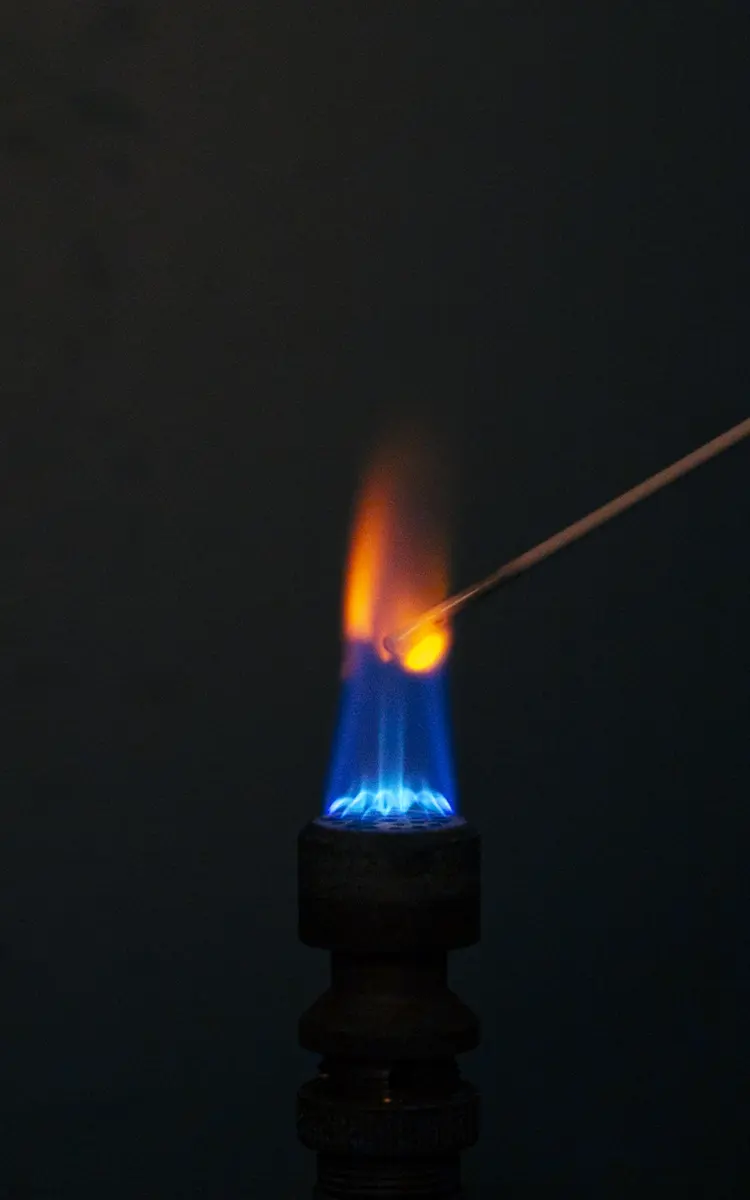
Its flame color. Calcium compounds color a flame brick-red (orange-red).
A small piece of calcium is dropped into water. What do you see?
Pick an answer to see why.
Limestone, lime and slaked lime
The most important calcium chemistry is a cycle that people have used for thousands of years.
- Burn limestone. Heated in a kiln to about 900 °C, calcium carbonate breaks down: carbon dioxide is driven off, leaving quicklime, calcium oxide Grade 10: Calcination.
CaCO₃ → CaO + CO₂ - Add water. Quicklime takes up water so eagerly that it hisses, swells and gets hot enough to boil the water: this is slaking, and it makes slaked lime, calcium hydroxide. This is the चुन eaten in पान and spread on walls as whitewash.
CaO + H₂O → Ca(OH)₂ - Leave it in the air. Slaked lime slowly takes in carbon dioxide from the air and turns back into calcium carbonate, hard as stone. This is how lime mortar and plaster set, and why a whitewashed wall becomes hard and white.
Ca(OH)₂ + CO₂ → CaCO₃ + H₂O
The third step is also the famous test for carbon dioxide. A clear solution of slaked lime in water, lime water, turns milky when carbon dioxide bubbles through it, because tiny grains of calcium carbonate form. Keep bubbling, and it clears again: the carbonate turns into calcium hydrogencarbonate, which dissolves Grade 10: Tests for carbon dioxide.
Rangoli’s father whitewashes the house with slaked lime. After a few days the walls are hard and bright white. What has happened?
Pick an answer to see why.
Calcium and hard water
Rainwater carries a little carbon dioxide, which makes it a weak acid. Trickling through limestone, it slowly dissolves some, as calcium hydrogencarbonate, Ca(HCO₃)₂ (Water that dissolves rock). Water carrying calcium and magnesium salts is hard water: soap won’t lather in it, and makes a gray scum instead Grade 8: Hard water.
Boil hard water, and the hydrogencarbonate breaks down again into calcium carbonate: the white scale inside kettles and pressure cookers Grade 8: Temporary hardness. In a cave, the same thing happens drop by drop as water drips from the roof and gives off its carbon dioxide: over thousands of years the calcium carbonate left behind grows into stalactites hanging down and stalagmites growing up (Stalactites and stalagmites).
Calcium in daily life and in Nepal
Cement. Limestone, heated with clay to about 1,450 °C in a long turning kiln, makes clinker, hard gray lumps that are ground with a little gypsum into cement. Mixed with sand, gravel and water, cement sets into concrete, the most used building material in the world. In 2025 the world made about 3.8 billion tonnes of cement, nearly half of it in China (USGS, 2026). Making it gives off about 7% of all the carbon dioxide people release, much of it from the limestone itself (CaCO₃ → CaO + CO₂).
Nepal’s cement factories are built near its limestone hills: the government’s Hetauda and Udayapur factories, and many private ones. Since about 2019 they have made almost all the cement the country uses.
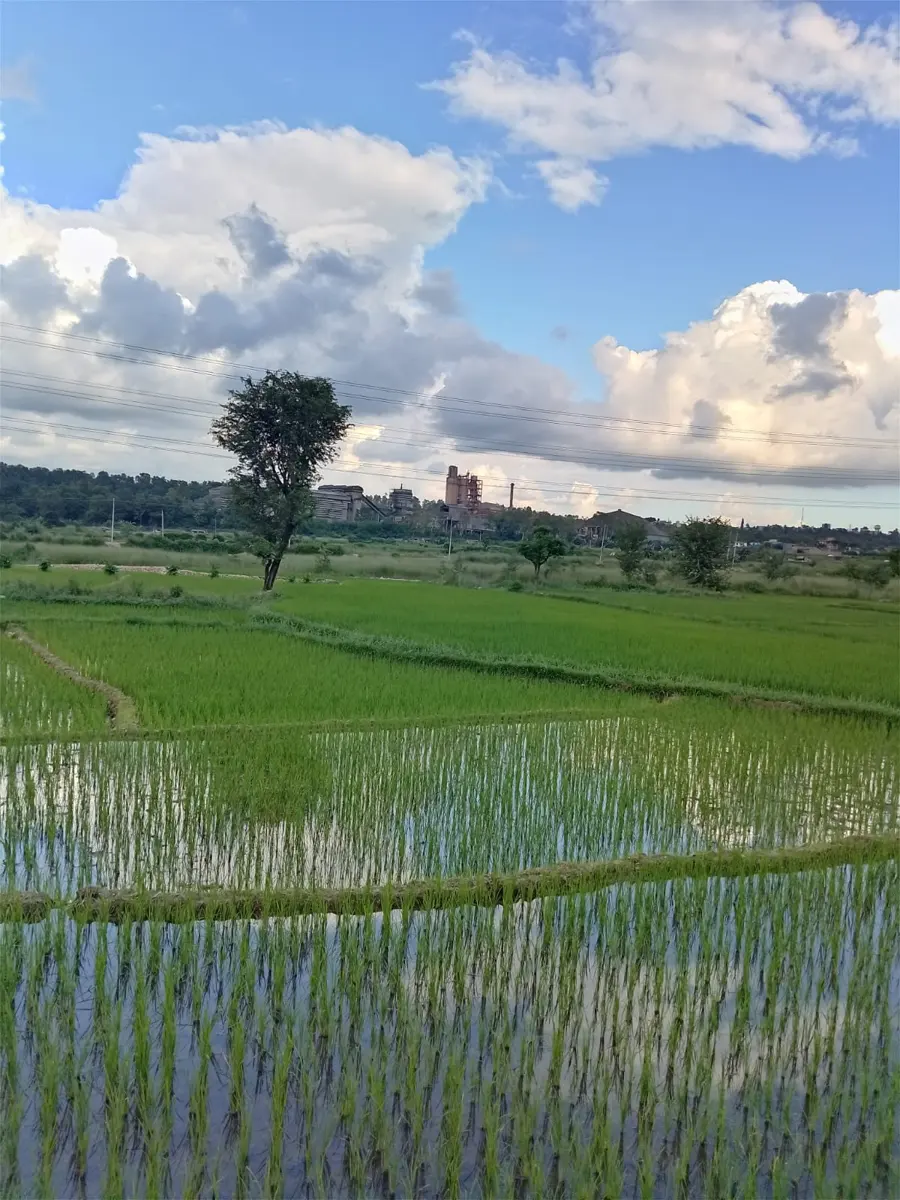
Farming. Many hill soils are too acidic for crops. Spreading agricultural lime (powdered limestone or slaked lime) neutralizes the acid, and supplies calcium, a nutrient plants need Grade 9: Necessary nutrients for plants.
More calcium compounds you meet:
- Plaster of Paris, made by heating gypsum, sets hard when mixed with water: for setting broken bones and making molds and statues.
- Bleaching powder, which contains calcium hypochlorite, disinfects drinking water and wells.
- Calcium carbide (CaC₂) gives off acetylene gas with water. It is sometimes misused to ripen mangoes and bananas, which Nepal’s food rules forbid Grade 10: Chemicals that ripen fruit.
- Antacid tablets for heartburn are often calcium carbonate, which neutralizes stomach acid.
Calcium and your health
About 99% of your kilogram of calcium is in your bones and teeth, as a hard calcium phosphate mineral called hydroxyapatite, woven through with tough protein fibers Grade 9: Hard connective tissue. Bone is alive: it is broken down and rebuilt all the time, and it is also the body’s calcium store.
The other 1% is just as important. Calcium ions in the blood and cells make muscles contract (including the heart), help nerves pass messages on, and help blood clot. The body keeps the calcium in the blood very steady: when it falls, the parathyroid glands release a hormone that takes calcium from the bones Grade 9: Parathyroid glands.
How much you need. Teenagers need the most, about 1,300 mg a day from ages 9 to 18, while their bones grow fastest; adults about 1,000 mg (US National Institutes of Health). A glass of milk (250 mL) gives about 300 mg. Good sources: milk, curd and cheese, small fish eaten with their bones (such as dried sidra), green leafy vegetables such as mustard greens, sesame (तिल), soybeans and tofu, and beans. To use calcium the body also needs vitamin D, which your skin makes in sunlight.
Too little, over years, leaves bones thin and weak. In children short of vitamin D or calcium, bones stay soft and bend (rickets). In older people, especially women after about 50, bones lose calcium and break easily (osteoporosis). The calcium you store as a teenager is a bank for the rest of your life, so exercise and a good diet now really matter.
Too much from tablets can cause kidney stones; from food it is very rare.
Isotopes of calcium
Natural calcium has six isotopes; about 97% is calcium-40, with 20 protons and 20 neutrons, so its atomic mass is 40.08, very close to 40. Some calcium-40 on Earth was made by the slow decay of radioactive potassium-40, the element just before it in the table.
Surprising facts and records
- The fifth element of the crust, and the most common metal in your body.
- Space bones. Astronauts living for months in weightlessness lose roughly 1% of the bone in their hips and legs each month, because bones that carry no weight are not rebuilt. They exercise for about two hours a day to slow it.
- Shells into mountains. The white cliffs of Dover in England are chalk, made of the shells of microscopic algae that lived in a warm sea some 70 to 100 million years ago.
In your science books
- Grade 8: the first 20 elements, the 2n² rule, hardness of water, acids and carbonates and minerals in Nepal.
- Grade 9: calcium chloride’s bond, metals and water, metals the body needs, bone and the parathyroid glands.
- Grade 10: the Aufbau principle, alkaline earth metals, the lime water test, calcination and calcium carbide.
- Going further: caves and stalactites, limestone and the carbon cycle and Everest’s limestone summit.
More to explore
- Nobel Prizes with calcium in them: how nerve cells pass on messages (2013, calcium ions set off the release) and the jellyfish’s glowing protein (2008, the jellyfish’s light is switched on by calcium).
- Play: make calcium carbonate and calcium sulphate in Molecule Kitchen, or find calcium in Guess the Element and the Periodic Table Jigsaw.
- Read more: calcium at the Royal Society of Chemistry and at PubChem.