
- Atomic number
- 55
- Atomic mass
- 132.91
- Shells
- 2, 8, 18, 18, 8, 1
- Configuration
- 1s² 2s² 2p⁶ 3s² 3p⁶ 4s² 3d¹⁰ 4p⁶ 5s² 4d¹⁰ 5p⁶ 6s¹
- In the table
- period 6, group 1 (IA), s-block
- Kind
- Alkali metal
- Valency
- 1 (Cs⁺, as in CsCl and CsOH)
- State at 25 °C
- solid
- Melts · boils
- 28 °C · 671 °C
- Density
- 1.9 × as heavy as water
- Known since
- 1860
The clock on your phone is almost never wrong. It sets itself by the mobile network, and the network’s time comes, step by step, from atomic clocks. Nepal’s time is set 5 hours 45 minutes ahead of the world’s time, UTC, which is kept by comparing hundreds of atomic clocks in laboratories around the world. And what is a second? Since 1967 it has been defined by the atoms of one element: cesium.
Cesium is also the softest, most golden and most violently reactive of the everyday metals. It melts on a warm day, explodes in water and even reacts with ice. Here is its story.
The cesium atom
Every cesium atom has 55 protons, so cesium’s atomic number is 55, and a neutral atom has 55 electrons. Natural cesium has only one isotope, with 78 neutrons: mass number 55 + 78 = 133.
Its shells and subshells
By the 2n² rule Grade 8: Bohr and Bury’s rule, the K, L and M shells fill as 2, 8 and 18. The N shell can hold 32, but it reaches only 18 here, and the O shell 8, before the last electron starts a sixth shell, P: 2, 8, 18, 18, 8, 1.
In subshells Grade 10: The Aufbau principle, after krypton (element 36) come 5s, 4d and 5p, which make xenon (element 54). The next subshell in order of energy is 6s, lower than 4f and 5d, so the 55th electron goes there:
1s² 2s² 2p⁶ 3s² 3p⁶ 4s² 3d¹⁰ 4p⁶ 5s² 4d¹⁰ 5p⁶ 6s¹
Cesium is xenon plus one electron in a new shell, just as sodium is neon plus one, and potassium argon plus one.
How many shells hold electrons in a cesium atom, and how many electrons are in the outermost one?
Pick an answer to see why.
Its place in the periodic table
- Period 6, because its electrons are in six shells.
- Group 1, called IA in the older naming: lithium, sodium, potassium, rubidium, cesium and francium, the alkali metals.
- s-block, because its last electron goes into an s subshell.
Its one outer electron is very far from the nucleus, and shielded from it by 54 others, so it is held very loosely. It takes less energy to pull this electron off than to remove an electron from any other element. It becomes the ion Cs⁺, with the electrons of xenon Grade 9: Positively charged ions, so its valency is 1, as in cesium chloride, CsCl. Cesium is the most electropositive of the elements you can hold Grade 10: Electropositivity.
How cesium was found and named
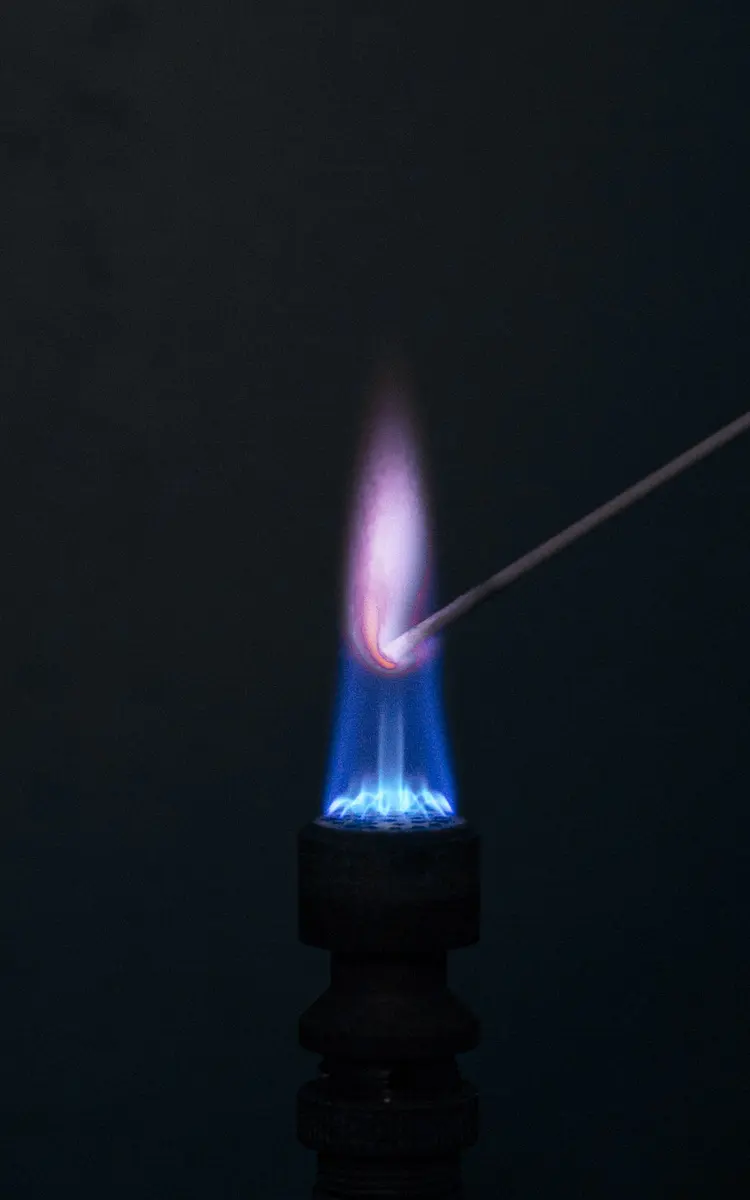
In 1859, at Heidelberg in Germany, the chemist Robert Bunsen and the physicist Gustav Kirchhoff built the first spectroscope: a prism that spreads the light of a flame into its colors. Each element heated in a flame gives its own pattern of bright lines, like a barcode (Why each element has its own lines).
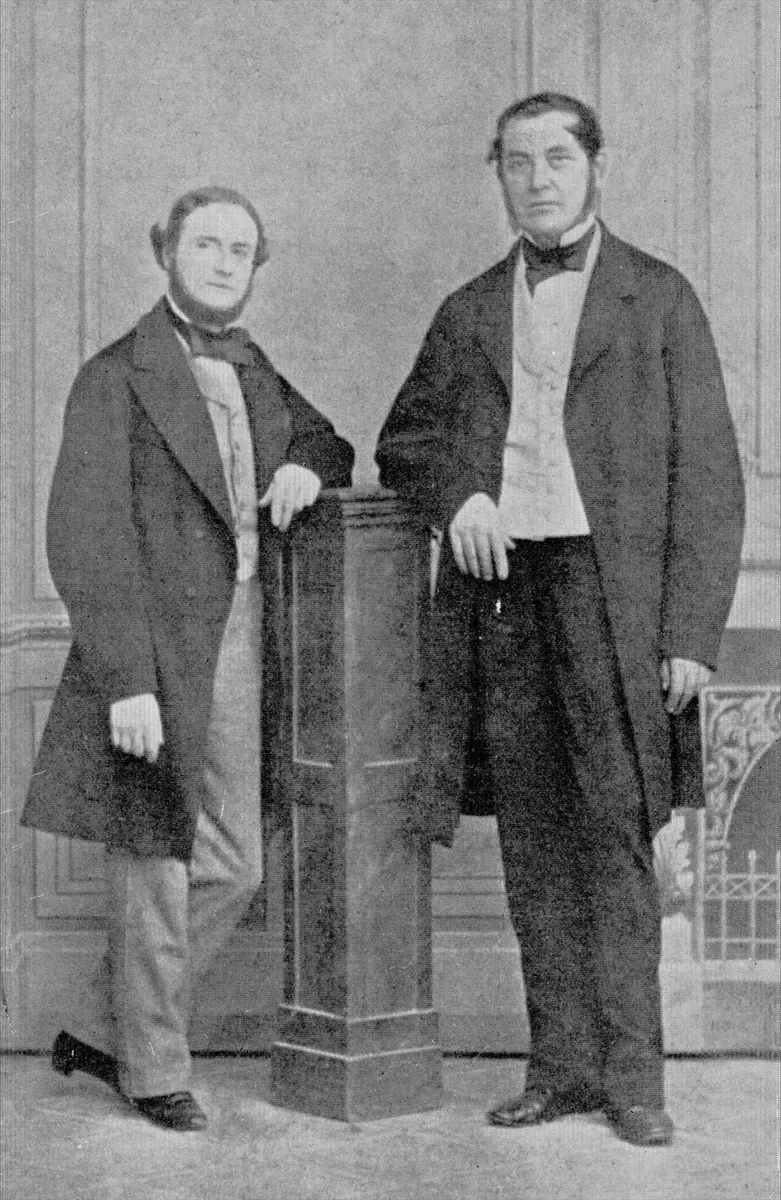
In 1860 they looked at the salts left after boiling away water from a mineral spring at Dürkheim. Among the familiar lines of sodium, potassium and lithium were two bright blue lines that belonged to no known element. They had found a new element, the first ever found with a spectroscope. They named it from the Latin caesius, the bluish-gray or sky-blue of those lines: hence the symbol Cs. To collect enough to study, they boiled down tens of thousands of liters of spring water, and got about 7 grams of cesium chloride. A year later the same method found rubidium.
Bunsen and Kirchhoff could not make the metal itself. That was done in 1882 by Carl Setterberg, a Swedish student in Bonn, by passing electricity through melted cesium cyanide. In Nepali cesium is simply सिजियम. (British books, and IUPAC, spell it caesium.)
Where cesium is found
In the universe. Cesium is heavier than iron, so stars cannot make it by fusion. It is made when nuclei catch neutrons, in old giant stars and when dead stars collide (Heavier than iron: catching neutrons).
In the Earth’s crust. There are about 3 grams of cesium in every tonne of rock, about thirty times less than rubidium. Its atom is so big that it fits badly into most minerals. So, as melted rock deep underground cools and crystallizes, cesium stays behind in the last, leftover liquid, and ends up in a few rare, coarse rocks called pegmatites, along with lithium. There it forms its one useful ore, pollucite, a cesium aluminium silicate.
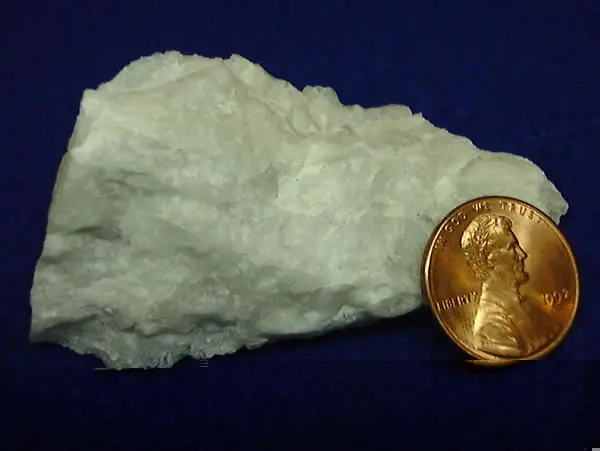
The richest deposit known is the Tanco mine at Bernic Lake in Manitoba, Canada; others are in Zimbabwe, Namibia, Australia and China. So little cesium is used, most uses needing only a few grams, that no country reports how much is mined (USGS, 2026).
In the sea and in you. Sea water holds about 0.3 micrograms of cesium in a liter. Your body treats cesium like potassium, so you hold a tiny trace of it, with no known use.
What cesium is like
- Golden. Pure cesium is a soft, shiny, pale gold metal. Almost every metal is silvery gray; copper, gold and cesium are the three that are not.
- Very soft, like the other alkali metals.
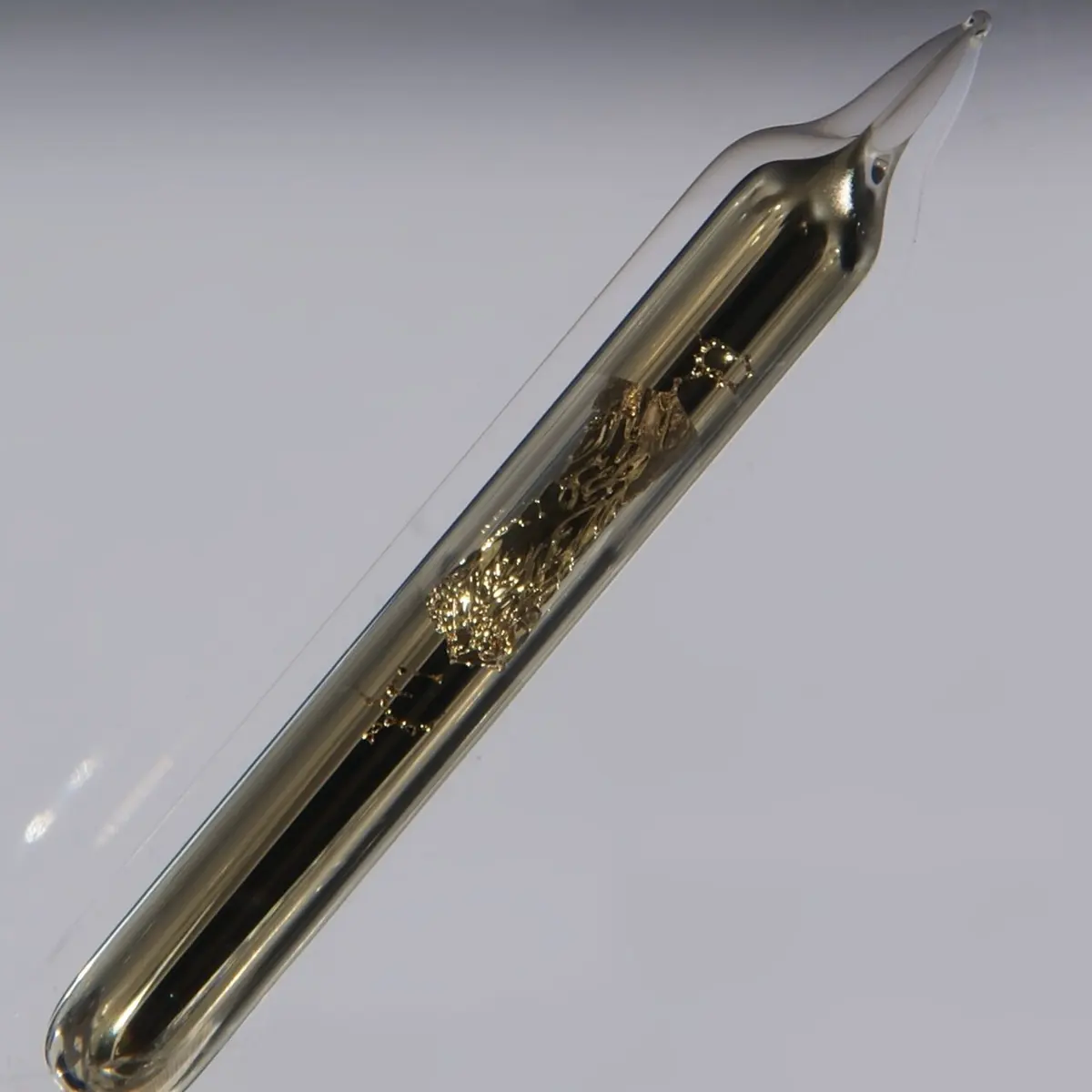
- Melts at 28.5 °C. On a warm day in Kathmandu, a sealed tube of cesium would be partly liquid, and it would melt in your hand (if it were safe to hold). Only mercury, among the stable metals, melts at a lower temperature; gallium melts at about 30 °C Grade 8: Position of metals.
- Density 1.9 g/cm³, nearly twice that of water.
- Extremely reactive, so it is kept in sealed glass with no air, or under oil.
Why does it melt so easily? A metal is held together by its free electrons Grade 9: What is inside a metal. Each cesium atom gives only one electron to the “sea”, and cesium’s atoms are the biggest of all, so that sea holds them together only weakly. Iron, with smaller atoms and more free electrons, melts at 1,538 °C.
How cesium reacts
Like all alkali metals, cesium reacts by losing its outer electron. Because that electron is held more loosely than in any other alkali metal you can get, cesium is the most reactive of them Grade 10: Chemical reactivity.
- Air. It catches fire by itself in air.
- Water. It reacts explosively, even with cold water, and with ice down to −116 °C. It gives cesium hydroxide, a very strong alkali, and hydrogen, which the heat sets alight Grade 9: Very reactive metals and water:
2Cs + 2H₂O → 2CsOH + H₂
Cesium hydroxide is so strongly alkaline that it eats into glass.
- Chlorine. It burns in chlorine to form cesium chloride, a white salt:
2Cs + Cl₂ → 2CsCl
A small piece of each alkali metal is dropped into water. Which reacts most violently?
Pick an answer to see why.
Cesium in daily life
The atomic clock
Every atom of cesium-133 can be flipped between two energy states by microwaves of one exact frequency. That frequency is the same for every cesium atom in the universe, and it never wears out or drifts, as a swinging pendulum or a vibrating quartz crystal does. An atomic clock keeps its microwaves tuned exactly to the cesium atoms, and counts the waves.
The first accurate cesium clock was built in 1955 by Louis Essen at the National Physical Laboratory in England. In 1967 the world agreed that one second is the time taken by exactly 9,192,631,770 of those microwave waves. Before that, the second was a fraction of a day, and the Earth’s spin is not quite steady.
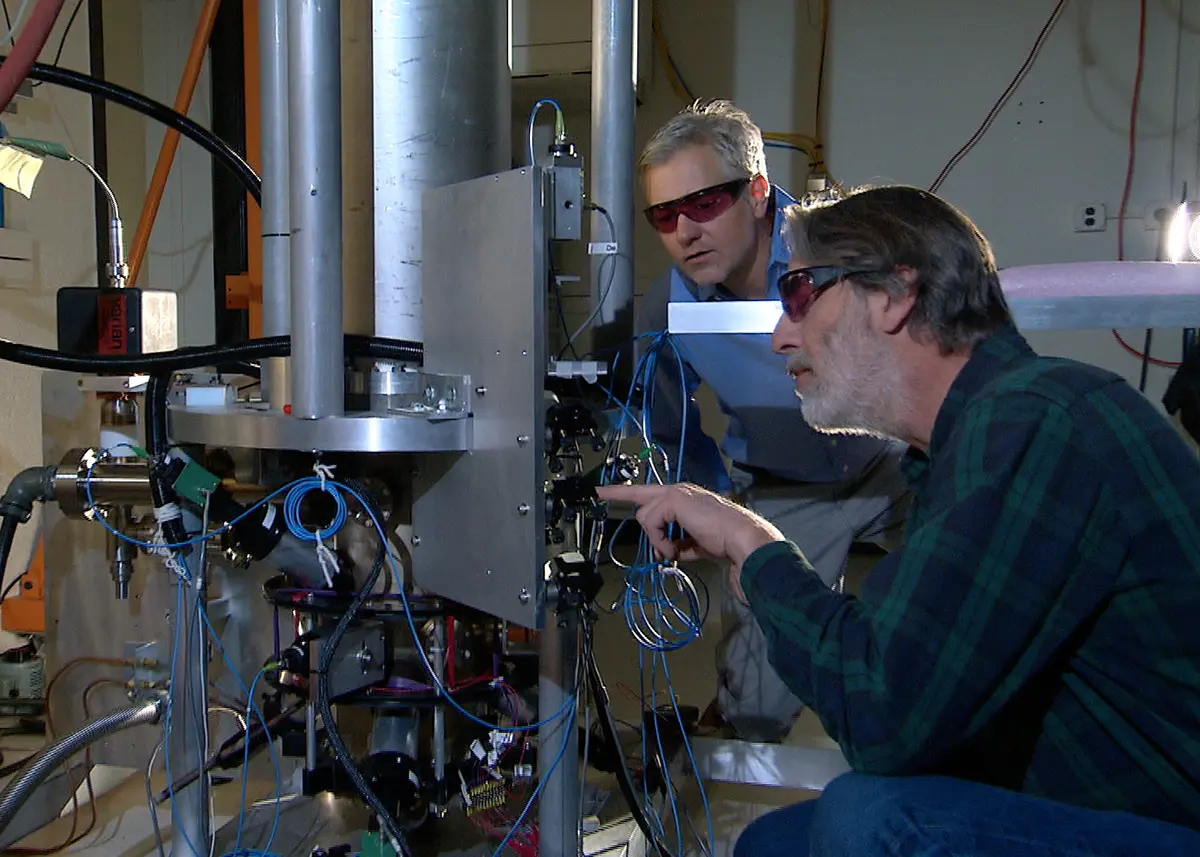
The best cesium clocks would take tens of millions of years to gain or lose a second. Cesium and rubidium clocks fly in navigation satellites, such as those of GPS Grade 9: GPS, and keep mobile phone networks and the internet in step.
Other uses
- Oil and gas wells. The largest use of cesium is in cesium formate, which dissolves in water to make a liquid up to 2.3 times as heavy as water. Pumped into a deep well while it is drilled, its weight holds back the gas and oil underground. It is expensive, so it is cleaned and reused; most of it is rented, not sold.
- Light into electricity. Light knocks electrons out of cesium more easily than out of almost any other metal (the photoelectric effect): even yellow and green light will do (Einstein’s packets of light). So cesium coats the surfaces of light detectors and photocells.
- X-ray images. Crystals of cesium iodide glow when X-rays hit them; panels of them turn X-rays into the digital images doctors look at.
- Factories. Cesium compounds help catalysts make sulphuric acid and some plastics.
Isotopes of cesium
Natural cesium has only one isotope, cesium-133. So every cesium atom has the same mass, and cesium’s atomic mass, 132.905, is not an average of a mixture: it is the mass of the cesium-133 atom itself Grade 9: Atomic mass.
Cesium-137
When uranium splits in a nuclear reactor or bomb Grade 9: Nuclear fission, one of the commonest pieces left over is cesium-137, which is radioactive, with a half-life of about 30 years (A clock inside the atom). It gives out a beta particle and becomes barium-137, which, within a few minutes, gives out a gamma ray and settles down (Gamma rays).
Cesium-137 was spread around the world by the nuclear bomb tests of the 1950s and 60s, and by the accidents at Chernobyl (1986) and Fukushima (2011). Because it lasts for decades and dissolves easily in water, it is, with strontium-90, the main source of radioactivity in the ground around Chernobyl. Its gamma rays are also useful: sealed sources of cesium-137 have been used to treat cancer, to kill germs in medical supplies, and in gauges that measure the thickness or density of materials in factories.
Cesium and your health
Ordinary cesium has no known use in the body, and its compounds, such as cesium chloride, are only mildly poisonous; there are no known health problems from the cesium in nature (USGS, 2026). The danger is in cesium metal and in radioactive cesium.
Your body treats cesium like potassium, its neighbor in group 1, so radioactive cesium spreads through the muscles and soft tissues instead of collecting in one place. It leaves slowly in urine and sweat: in an adult, most of it is gone in a few months.
Surprising facts and records
- Gold-colored. Cesium is one of only three metals that aren’t silvery, with copper and gold.
- Ice is enough. Cesium reacts with ice at −116 °C.
- Spotted before held. Cesium was found by its light alone, 22 years before anyone made the metal.
- A second, counted. Every second you live is, by definition, 9,192,631,770 ticks of the cesium atom.
In your science books
- Grade 8: the 2n² rule, metals in the periodic table and groups.
- Grade 9: ions, metals and water, nuclear fission and GPS.
- Grade 10: electronic configuration, electropositivity and reactivity down a group.
- Going further: what stars are made of (Bunsen, Kirchhoff and the spectroscope), the photoelectric effect, what happens when a nucleus decays and three things a photon can do (the gamma rays of cesium-137).
More to explore
- Nobel Prizes with cesium in them: atomic clocks (1989), cooling atoms with lasers (1997, which made the cesium fountain possible), the frequency comb (2005), the photoelectric effect (1921, and the cesium photocell) and crown ethers (1987, molecules that pull radioactive cesium out of nuclear waste).
- Elements next door: rubidium above it, barium beside it, and potassium, sodium and lithium, the rest of its family.
- Play: find cesium in Guess the Element and the Periodic Table Jigsaw.
- Read more: cesium at the Royal Society of Chemistry and at PubChem.