
- Atomic number
- 54
- Atomic mass
- 131.29
- Shells
- 2, 8, 18, 18, 8
- Configuration
- 1s² 2s² 2p⁶ 3s² 3p⁶ 4s² 3d¹⁰ 4p⁶ 5s² 4d¹⁰ 5p⁶
- In the table
- period 5, group 18 (0), p-block
- Kind
- Noble gas
- Valency
- 0 (but with fluorine and oxygen it forms compounds, valency 2, 4, 6 or 8)
- State at 25 °C
- gas
- Melts · boils
- −112 °C · −108 °C
- Density
- 4.6 × as heavy as air
- Known since
- 1898
For seventy years, every chemistry book said the same thing: the noble gases, helium, neon, argon, krypton and xenon, have full outer shells, so they never react. Then, on 23 March 1962, a young chemist in Canada mixed two gases in a glass tube and watched an orange-yellow solid appear. One of the gases was xenon.
Xenon is the rarest noble gas in the air, apart from radioactive radon. Yet you may have seen its light, in the blue-white headlights of some cars or the lamp of a cinema projector, and it has pushed spacecraft between the planets. Here is its story.
The xenon atom
A xenon atom has 54 protons, so xenon’s atomic number is 54, and 54 electrons. The commonest kind of xenon atom has 78 neutrons, so its mass number is 54 + 78 = 132.
By the 2n² rule the K, L and M shells can hold 2, 8 and 18 electrons, and the N shell up to 32 Grade 8: Bohr and Bury’s rule. Xenon’s 54 electrons are arranged 2, 8, 18, 18, 8: five shells, with eight in the outermost, the O shell.
Why does the N shell stop at 18 when it could hold 32? Because subshells fill in order of energy Grade 10: The Aufbau principle. After krypton (2, 8, 18, 8), the next electrons go into 5s, then the ten places of 4d (which bring the N shell up to 18), then 5p:
1s² 2s² 2p⁶ 3s² 3p⁶ 4s² 3d¹⁰ 4p⁶ 5s² 4d¹⁰ 5p⁶
The 4f subshell, which would fill the N shell further, comes only after 6s, in the elements of period 6. So xenon’s outer shell holds 5s² 5p⁶, eight electrons, an octet Grade 9: Octet and octet rule, and its usual valency is 0. Xenon gas is made of single atoms, Xe.
Its place in the periodic table
- Period 5, because its electrons are in five shells. It is the last element of the period, after iodine.
- Group 18, called group 0 in the older naming many books use.
- p-block, because its last electrons go into a p subshell.
Xenon is the fifth of the noble gases or inert gases: helium, neon, argon, krypton, xenon and radon Grade 8: Position of inert gases. Below it are radon, which is radioactive, and oganesson, made only a few atoms at a time in laboratories.
Xenon’s electrons are in the shells 2, 8, 18, 18, 8. In which period of the periodic table is it?
Pick an answer to see why.
How xenon was found and named
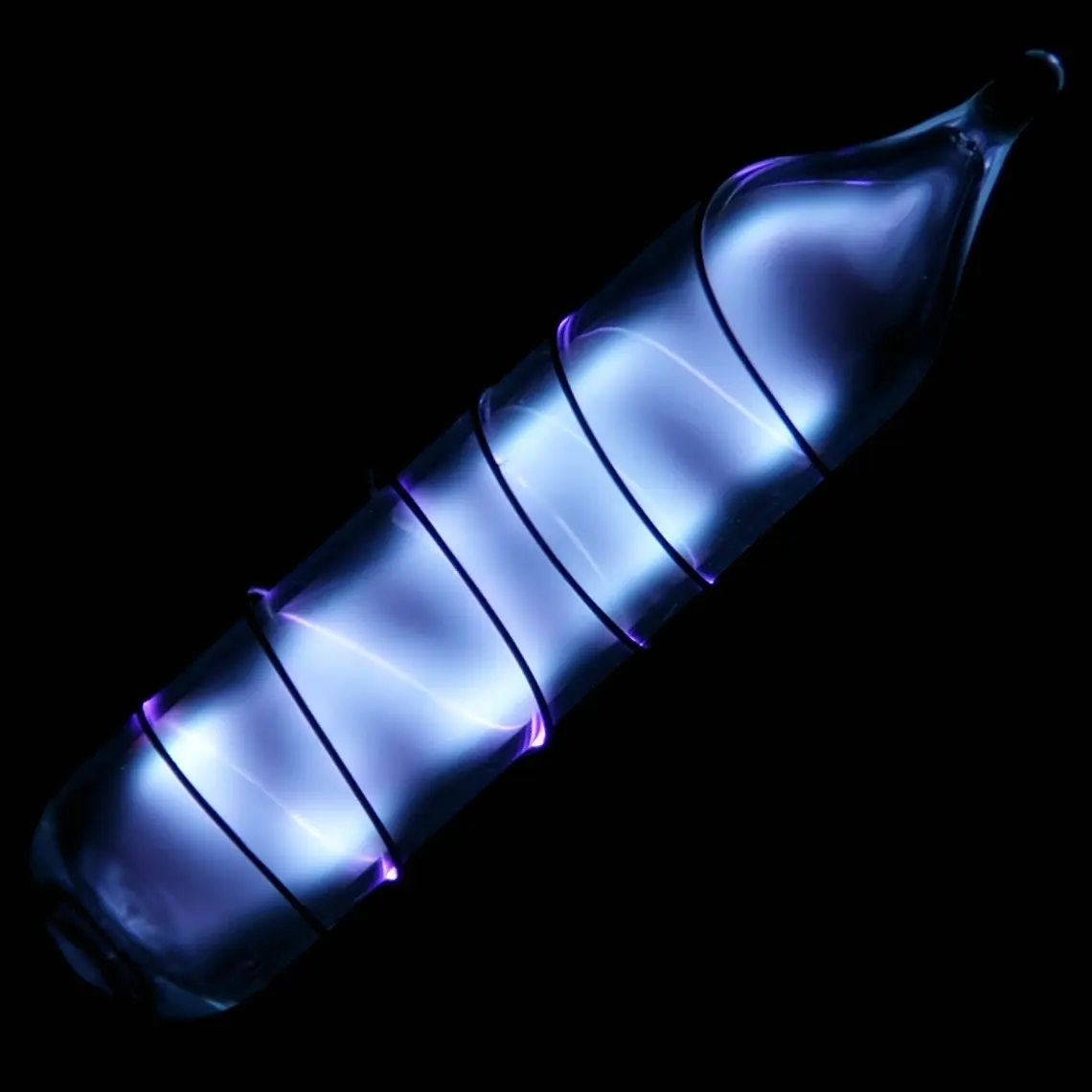
In the summer of 1898 the Scottish chemist William Ramsay and the young English chemist Morris Travers, in London, had already found argon (1894, with Lord Rayleigh) and, in May and June 1898, krypton and neon in liquid air. A rich industrialist, Ludwig Mond, gave them a new machine for making liquid air, and they used it to collect more krypton. By boiling it off again and again, they found a still heavier gas left at the end. On 12 July 1898, in a glass tube with electricity passing through it, it glowed a beautiful blue. It was another new element (Krypton).
The name. From the Greek xenos, stranger or guest: hence xenon, and the symbol Xe. Nepali books write it जेनन (some write जिनोन); it has no older Nepali name.
Where xenon is found
In the universe. Xenon is far heavier than iron, so it can’t be made by fusion in a star’s core. Its atoms were built up when lighter atoms caught neutrons, slowly inside giant stars and in a flash when stars exploded or dead stars collided (Heavier than iron).
In the air. Only about 1 part in 11 million of the air is xenon Grade 9: Gases around us. A room 4 m by 4 m by 3 m holds about 4 milliliters of it, less than a teaspoon. There is even less than scientists expect from the amounts of krypton and argon; where the “missing xenon” went, perhaps deep inside the Earth, is still a puzzle.
How it is collected. Factories cool air until it is liquid and separate its gases by their boiling points (fractional distillation). Xenon boils at −108 °C, far higher than nitrogen (−196 °C) and oxygen (−183 °C), so it stays behind in the liquid oxygen with krypton, and is separated from it by more distillation. It takes about 11 million liters of air to give one liter of xenon, so xenon is expensive, many times dearer than krypton.
What xenon is like
- A colorless gas with no smell or taste, made of single atoms.
- Very heavy for a gas. A liter weighs about 5.9 g at 0 °C, about 4.5 times as much as a liter of air (1.3 g).
- Liquid for a short range only: from −108 °C down to −112 °C, where it freezes. Liquid xenon is about three times as dense as water.
- It doesn’t burn and doesn’t help anything burn.
- It glows blue or lilac when electricity passes through it at low pressure; at high pressure, in a lamp, it gives a dazzling white light very close to sunlight.
Xenon’s atoms are the biggest of the stable noble gases, with the most electrons. Big atoms pull on each other more strongly, so xenon boils at a much higher temperature than the others (Molecules with no charged ends). Its outer electrons are also furthest from the nucleus, and that is the key to the next part of its story.
How xenon reacts
Bartlett’s experiment
In 1962 Neil Bartlett, a 29-year-old British chemist working at the University of British Columbia in Vancouver, Canada, had been studying platinum hexafluoride, PtF₆, a dark red substance that turns to vapor easily and is one of the most powerful oxidizing agents known: it pulls electrons away from other substances. He had found that it could even pull an electron off an oxygen molecule, O₂, making a solid salt, O₂⁺PtF₆⁻.
Then he looked up how much energy it takes to pull one electron off different particles. For an oxygen molecule it is 1,165 kJ/mol. For a xenon atom it is 1,170 kJ/mol: almost the same. If PtF₆ could take an electron from oxygen, it should be able to take one from xenon.
On 23 March 1962 he let red PtF₆ vapor meet colorless xenon gas. At once an orange-yellow solid formed. Xenon had reacted. It was the first compound of a noble gas ever made, and it overturned a rule every chemistry book had taught for seventy years.
Xenon’s compounds
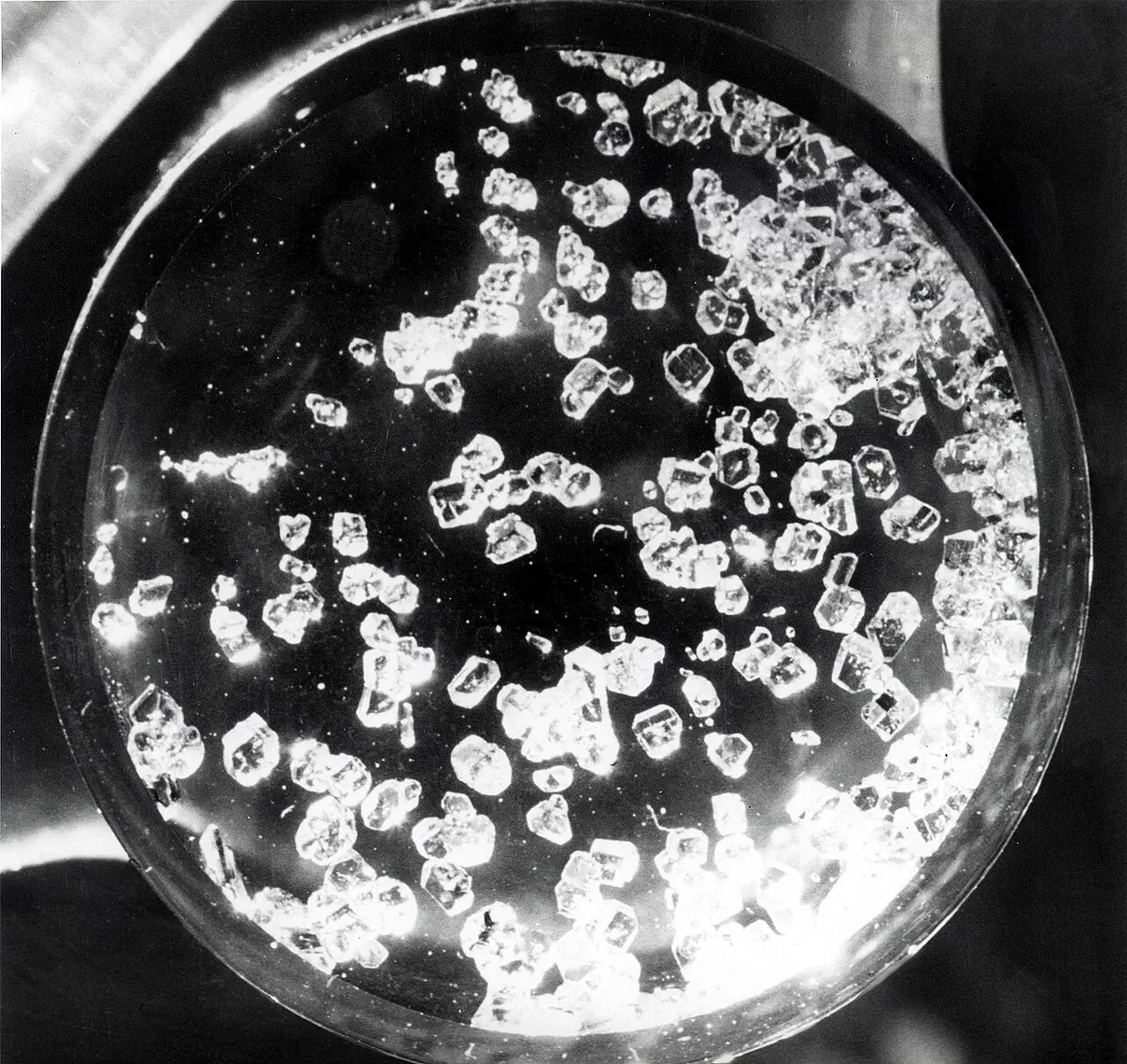
Within months, chemists at Argonne National Laboratory in the USA found that xenon reacts directly with fluorine when the two gases are heated together, making colorless crystals of xenon tetrafluoride:
Xe + 2F₂ → XeF₄
With a smaller share of fluorine it gives xenon difluoride, XeF₂ (even sunlight shining on the mixture is enough to make it), and with more fluorine xenon hexafluoride, XeF₆. From these, chemists have made more than a hundred xenon compounds, with fluorine and oxygen, in which xenon has a valency of 2, 4, 6 or 8. Some are useful: xenon difluoride is used to etch silicon in making tiny machines on chips, and to make a medicine against cancer. Others are dangerous: xenon trioxide, XeO₃, is a powerful explosive.
Why does xenon form compounds while neon and argon don’t?
Pick an answer to see why.
Xenon in daily life
Light
- Camera flashes. A thin glass tube of xenon, with an electrode at each end, gives a brilliant white flash lasting a tiny fraction of a second when a large current passes through it. Most cameras used one; phones today mostly use LEDs. Flashing xenon lamps, strobes, are also used in lighthouses, on aircraft and in factories.
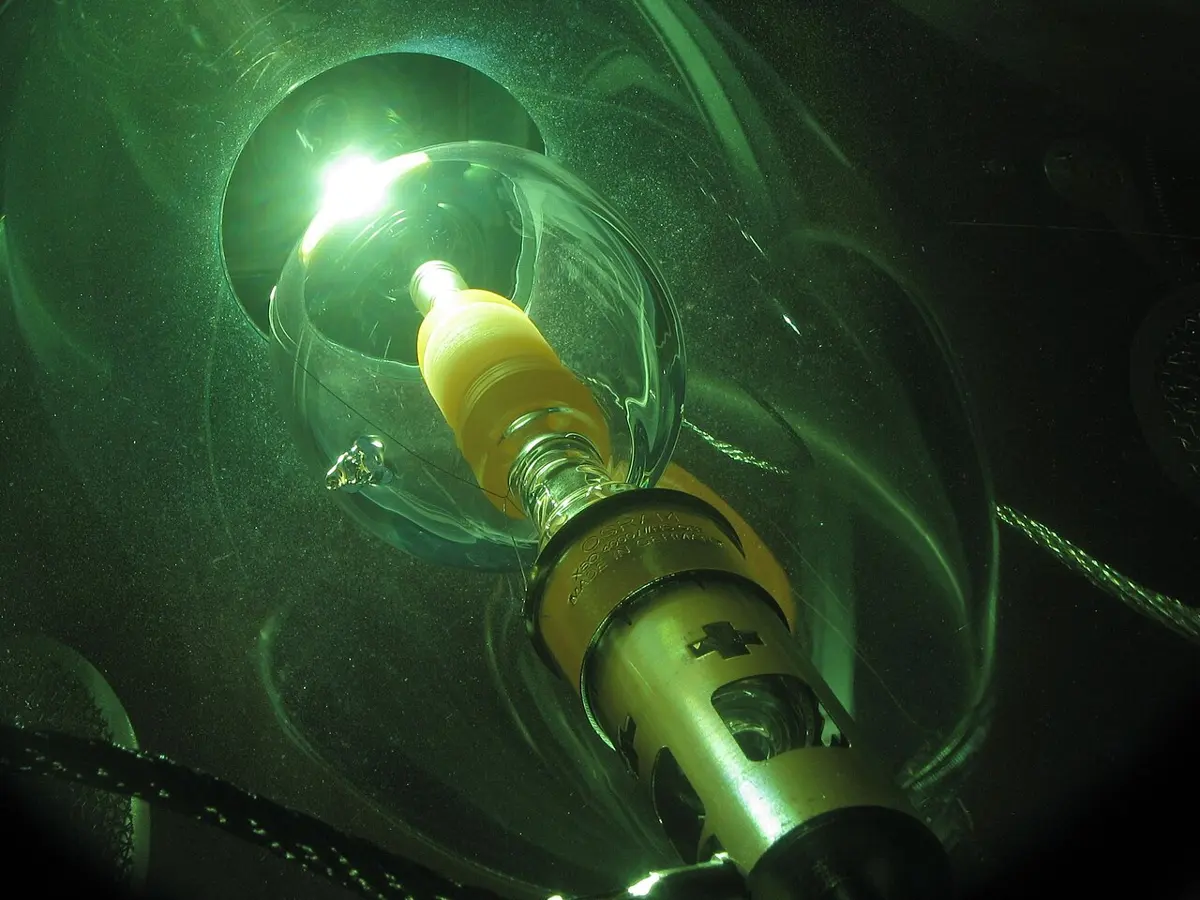
- Cinema projectors. A big xenon lamp has a short, very bright spark between two tungsten electrodes, inside a quartz bulb of xenon at high pressure. Its light is so close to sunlight that colors on the screen look true.
- Headlights. Some cars have “xenon” headlights: a small lamp of xenon and metal salts. The xenon lights up the moment it is switched on, giving the first blue-white light, and the metal salts then take over as the lamp warms up.
Driving spacecraft
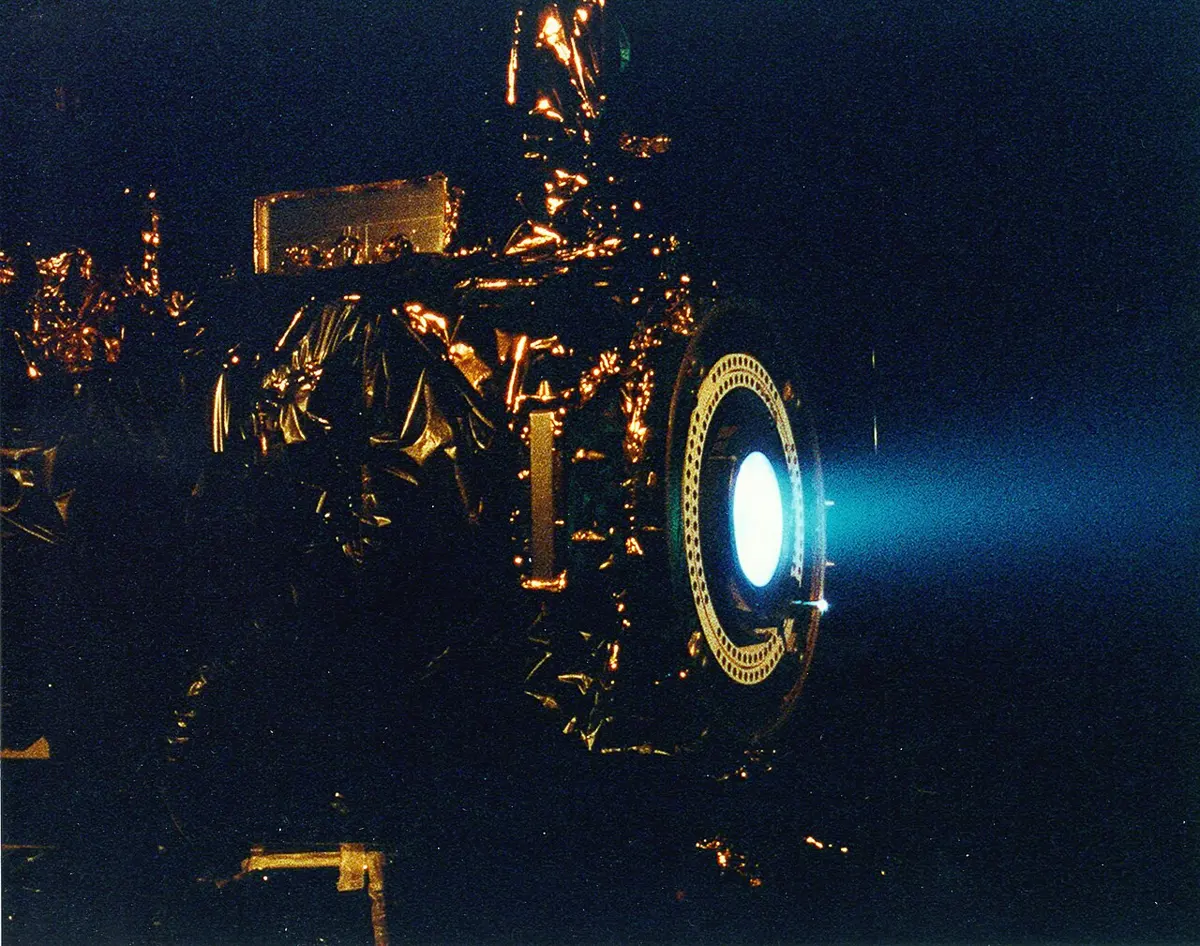
An ion engine works by knocking electrons off xenon atoms and throwing the charged atoms, ions, out of the back at tens of kilometers a second, using electricity from solar panels. Each ion pushes back on the engine as it leaves, and the spacecraft moves forward Grade 9: Newton’s third law.
Xenon suits it well: it is inert, so it harms nothing; it is heavy, so each ion gives a good push; and it is easy to ionize. The push is tiny, about the weight of a sheet of paper on your hand, but an ion engine can keep pushing for years on a small tank. NASA’s Deep Space 1 (1998) was the first spacecraft driven mainly by an ion engine, and its Dawn spacecraft used three to travel to the asteroid Vesta and then to the dwarf planet Ceres. Many satellites use small xenon thrusters to stay in place.
Medicine and science
- An anesthetic. Breathed in a strong mixture with oxygen, xenon puts people to sleep for operations, and they wake quickly, with few side effects. It was first used in surgery in 1951. It works well but costs far more than other anesthetics, so few hospitals use it.
- Lung scans. Patients breathe in a little radioactive xenon-133, or a specially prepared xenon-129, and a camera or an MRI scanner then shows how air moves through their lungs.
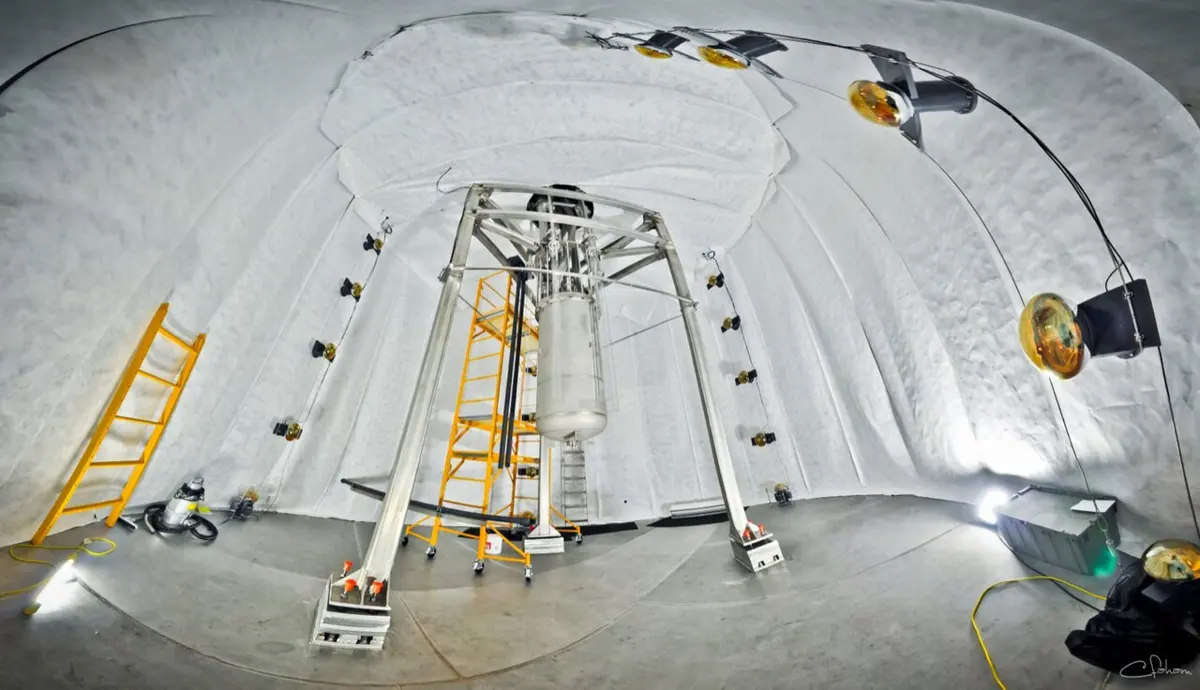
- Hunting dark matter. Scientists believe most of the matter in the universe is invisible dark matter. Some of the biggest experiments looking for it are tanks holding tonnes of liquid xenon, deep underground, watching for the tiny flash when a dark matter particle might hit a xenon nucleus. None has been seen yet.
Isotopes of xenon
Natural xenon is a mixture of nine isotopes, from xenon-124 to xenon-136, more than any element except tin. The commonest are xenon-132 (about 27%), xenon-129 (26%) and xenon-131 (21%), which is why xenon’s average atomic mass is 131.3 Grade 9: Atomic mass.
When uranium-235 splits in a nuclear reactor, many of the pieces are xenon atoms, or become xenon after beta decay (Fission). One of them, xenon-135, soaks up neutrons very strongly, so it can slow a reactor’s chain reaction; reactor operators must allow for it. Radioactive xenon from a secret nuclear test drifts on the wind and can be detected far away, which is how monitoring stations check that countries keep the treaty banning nuclear tests.
Xenon and your health
Xenon has no job in the body and is not poisonous. But it dissolves in blood and reaches the brain, and in large amounts it acts as an anesthetic. Like any gas, it can also push out the oxygen you need in a closed space. Being so heavy, it would collect near the floor.
Surprising facts and records
- The first letters written with atoms. In 1989 scientists at IBM in California used the tip of a special microscope to push 35 xenon atoms, one at a time, on a very cold nickel surface, until they spelled the company’s name: I B M. It was the first time anyone had placed single atoms exactly where they wanted.
- Xenon from the early solar system. Some meteorites hold extra xenon-129, made by the decay of an iodine isotope that no longer exists. It shows that the solar system formed soon after a nearby star exploded.
In your science books
- Grade 8: the 2n² rule, valency and inert gases (with its note on Bartlett).
- Grade 9: octet and octet rule, the gases of the air, atomic mass, nuclear fission and Newton’s third law.
- Grade 10: the Aufbau principle and non-metals and noble gases.
- Going further: where xenon is made, why bigger atoms boil higher, fission and why each element has its own lines.
More to explore
- The other noble gases: helium, neon, argon and krypton.
- See the bright lines of glowing gases with the Spectroscope at Science Playground (The Spectroscope).
- Play: find xenon in Guess the Element, the Periodic Table Jigsaw and Higher or Lower.
- Read more: xenon at the Royal Society of Chemistry and at PubChem.