
- Atomic number
- 84
- Atomic mass
- 208.98
- Shells
- 2, 8, 18, 32, 18, 6
- Configuration
- 1s² 2s² 2p⁶ 3s² 3p⁶ 4s² 3d¹⁰ 4p⁶ 5s² 4d¹⁰ 5p⁶ 6s² 4f¹⁴ 5d¹⁰ 6p⁴
- In the table
- period 6, group 16 (VIA), p-block
- Kind
- Metalloid
- Valency
- 2 and 4 (Po²⁺, Po⁴⁺); 2 in polonides (Po²⁻)
- State at 25 °C
- solid
- Melts · boils
- 254 °C · 962 °C
- Density
- 9.3 × as heavy as water
- Known since
- 1898
In July 1898, in a cold shed in Paris, Marie and Pierre Curie announced a new element. Nobody had seen it, and they had not yet even made a speck of it pure. They knew it was there only from its invisible rays, hundreds of times stronger than uranium’s. Marie named it after her homeland, Poland, which at that time had been divided up between Russia, Prussia and Austria and was missing from the map. It was the first element ever found by its radioactivity: polonium.
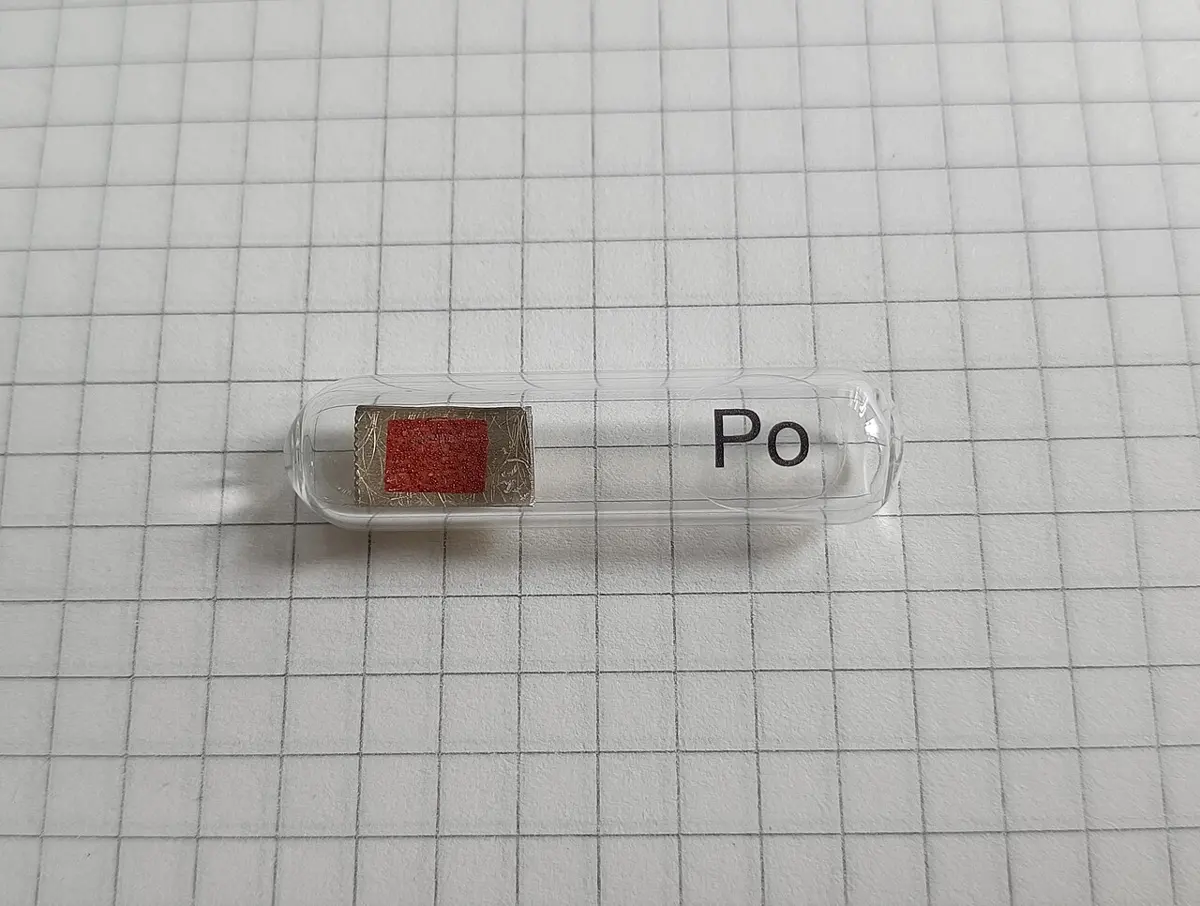
Polonium is so radioactive that a small piece of it is hot to the touch, and it is one of the most dangerous substances known if it gets inside the body. Yet it has kept moon rovers warm, cleaned dust from camera film, and helped discover the neutron.
The polonium atom
A polonium atom has 84 protons, so polonium’s atomic number is 84, and a neutral atom has 84 electrons. Every kind of polonium atom is radioactive. The one found in nature, polonium-210, has 126 neutrons: 84 + 126 = 210.
The electrons fill six shells: 2, 8, 18, 32, 18, 6 Grade 8: Bohr and Bury’s rule. In subshells Grade 10: The Aufbau principle, it ends:
… 6s² 4f¹⁴ 5d¹⁰ 6p⁴
Its place in the periodic table
- Period 6, because its electrons are in six shells.
- Group 16, called VIA in the older naming, because it has six outer electrons (6s² 6p⁴).
- p-block, because its last electrons go into a p subshell.
Polonium is at the bottom of the oxygen family: oxygen, sulphur, selenium, tellurium and polonium. Going down the group the elements become more like metals Grade 10: How properties change down groups. Oxygen and sulphur are non-metals; tellurium is a metalloid; polonium is so close to the line that some tables call it a metalloid Grade 10: Metalloids and others a metal, because it conducts electricity like a metal.
Like oxygen and sulphur, polonium can take two electrons from a very reactive metal, forming polonides such as sodium polonide, Na₂Po. But more often it behaves like a metal and gives electrons away: its common valencies are 2 and 4, as in polonium dioxide, PoO₂ Grade 9: Variable valency.
Which element is polonium most like in its chemistry?
Pick an answer to see why.
How polonium was found and named
In 1896 Henri Becquerel found that uranium gives out invisible rays. Marie Curie measured the rays of many ores, and found that pitchblende, the black ore of uranium, gave out more than its uranium could explain. Something far more radioactive was hidden in it.
With Pierre, she broke the ore down by chemical reactions and measured the rays of every part. One part followed the metal bismuth through every reaction, yet was hundreds of times more radioactive than uranium. Bismuth is not radioactive, so a new element was hiding with it. They announced it on 18 July 1898; in December they found a second one, radium. The whole story is in Radium: hunting elements by their rays, the Nobel Prize Marie won for them in 1911, and Radioactivity: rays from inside the atom, the one she shared with Pierre and Becquerel in 1903.
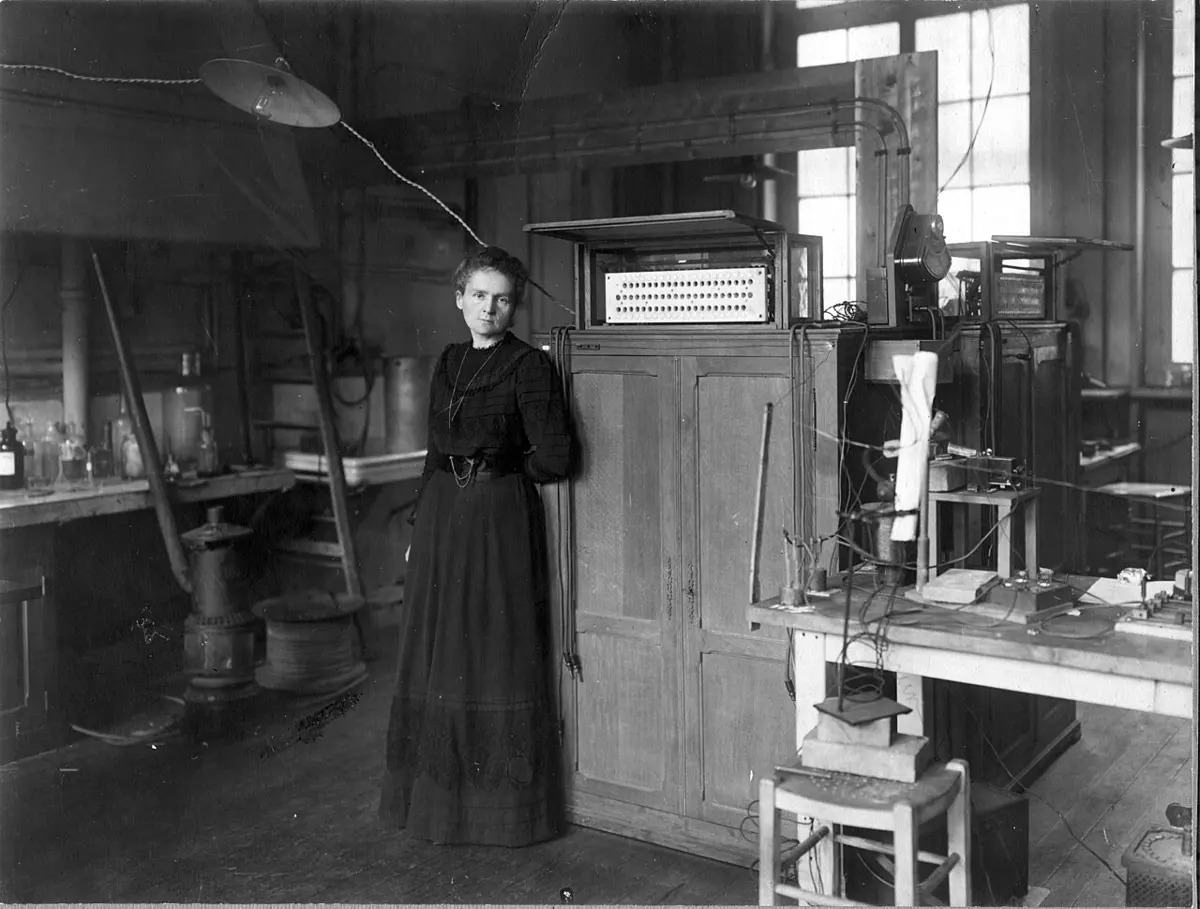
The name, from Polonia, the Latin for Poland, was a protest: a country could be taken off the map, but not out of the periodic table. The symbol is Po. Mendeleev’s periodic table had already left an empty space for it, below tellurium.
Where polonium is found
In the Earth. Polonium does not last: polonium-210 halves every 138 days. All of it on Earth is being made now, by the slow breakdown of uranium in rocks. Uranium-238 decays step by step until it becomes lead, and three of the steps are kinds of polonium (From uranium to lead). So uranium ores always hold a trace of polonium, about a tenth of a milligram in a tonne: that is why the Curies needed so much ore for so little.
Because radon, a gas, comes out of the ground everywhere and decays into polonium, a little polonium is in the air, the soil, water and food, and in everyone’s body (see radon).
Made by people. Getting polonium out of ore is hopeless, so it is made in nuclear reactors, from bismuth. A bismuth-209 nucleus catches a neutron, and the bismuth-210 it becomes turns into polonium-210 within days. Almost all of the world’s polonium is made this way, in Russia.
What polonium is like
- A silvery-gray metal that melts at 254 °C and evaporates easily for a metal.
- Its atoms stand in plain cubes. Polonium is the only element whose atoms, in its usual solid form, sit simply at the corners of cubes, one cube after another.
- It is hot. Each polonium-210 nucleus that breaks down throws out an alpha particle, 2 protons and 2 neutrons, at great speed (Alpha decay). The particles crash into the atoms around them and turn their energy into heat. One gram of polonium-210 gives out about 140 watts, more than a bright old light bulb, and heats itself to over 500 °C.
- It glows blue in the dark, as its rays make the air around it light up.
A gram of polonium-210 stays hot for months with no fuel. Where does the heat come from?
Pick an answer to see why.
Polonium at work
Its fierce alpha rays, which do not get far, have found a few careful uses:
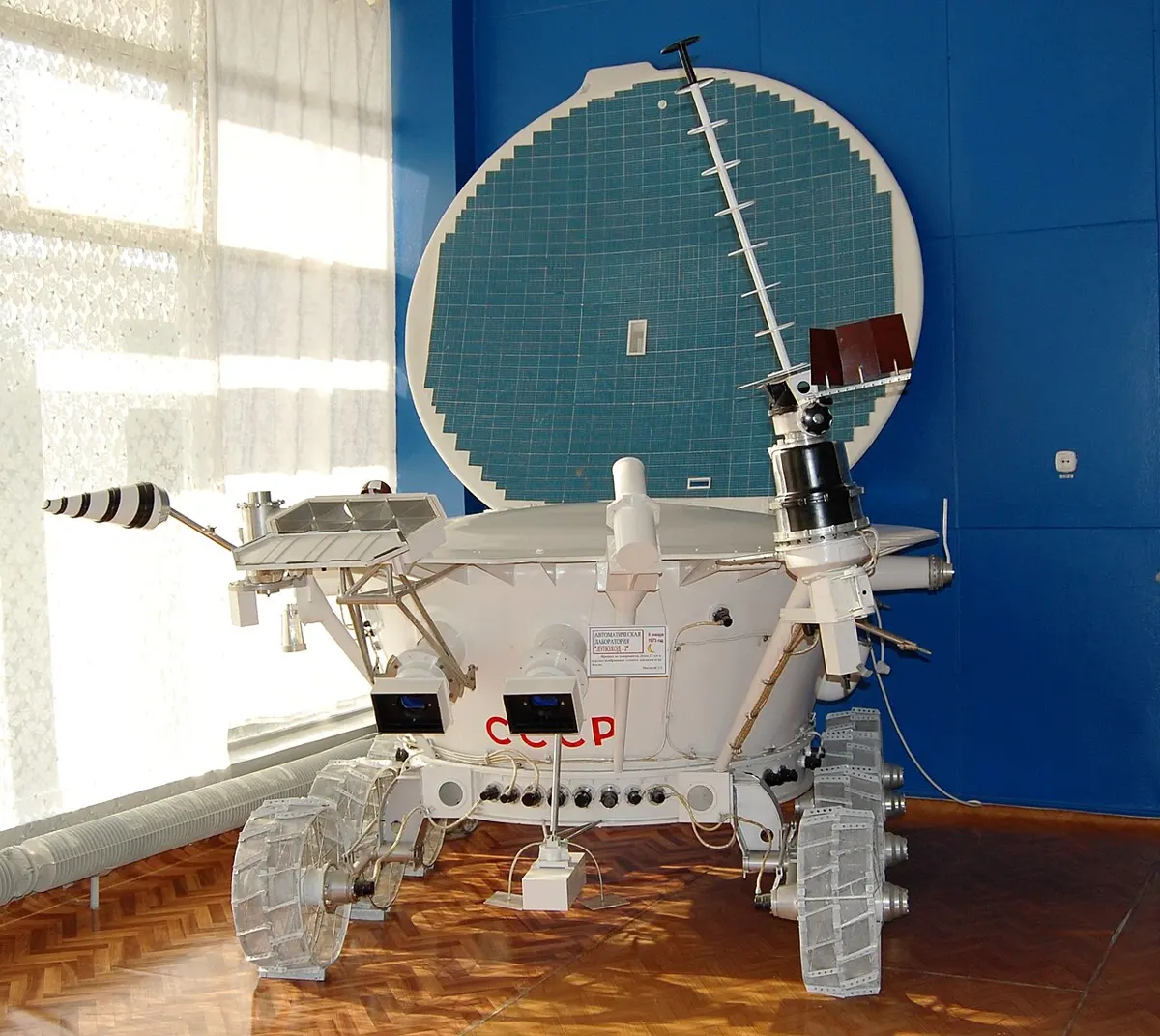
- Keeping things warm in space. The Soviet moon rovers Lunokhod 1 (1970) and Lunokhod 2 (1973) carried polonium-210 heaters, to keep their electronics from freezing through the two-week lunar night, when the temperature falls below −150 °C.
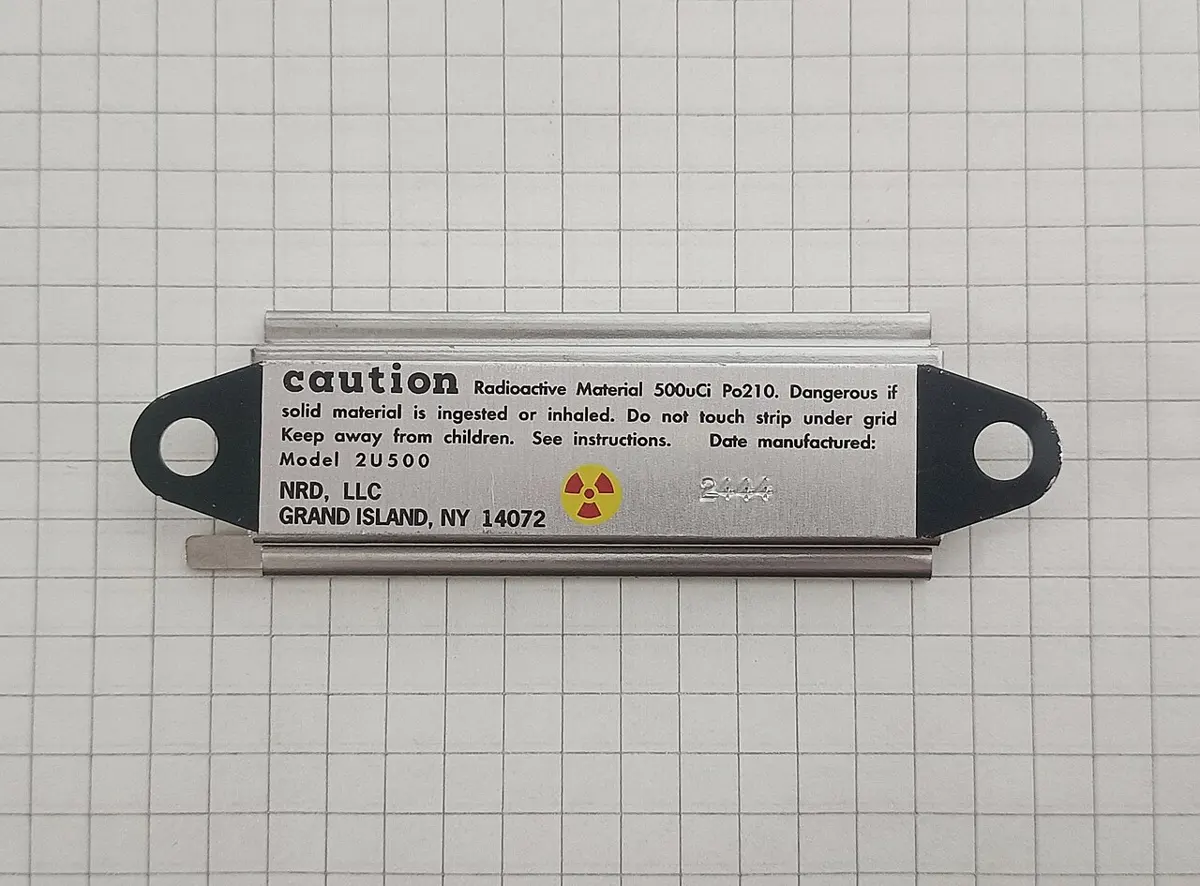
- Removing static electricity. Alpha particles knock electrons off the air molecules they pass, leaving the air able to carry away static charges. Brushes with a sealed strip of polonium were used to clean dust off photographic film, and machines rolling paper or plastic used polonium strips to stop sparks.
- A neutron source. Alpha particles from polonium, striking the light metal beryllium, knock neutrons out of it. In 1932 James Chadwick used exactly this to discover the neutron (The first radioactive atoms made by people).
Isotopes of polonium
There are more than 40 kinds of polonium atom, and all are radioactive Grade 9: Radioactive elements. Most last less than a second. The longest-lived, polonium-209, has a half-life of over a century, but it does not occur in nature. Polonium-210, the one in nature and the one people use, has a half-life of 138 days.
Polonium and your health
Polonium does nothing useful in the body, and it is one of the most dangerous substances known. Its danger depends on where it is:
- Outside the body, it is easy to shield. Alpha particles travel only about 4 cm in air and are stopped by a sheet of paper, or by the dead outer layer of your skin Grade 9: Radioactive emission. A sealed source is safe to work beside.
- Inside the body, if it is swallowed or breathed in, nothing stands in the way. Every alpha particle tears through the living cells around it, damaging them and the DNA inside them. Even an amount far too small to see can cause deadly radiation sickness.
The scientists who first worked with it paid a price: Marie Curie’s daughter Irène Joliot-Curie, who worked with polonium for years, died of leukemia, probably caused by her years of work with polonium and X-rays. In 2006 polonium became world news when a man in London died after being secretly poisoned with it, a crime that was traced through the tiny amounts of polonium left wherever it had been.
Polonium in tobacco smoke
The tobacco plant catches polonium-210 on its sticky leaves from the air, and takes it up from the soil and fertilizers. When tobacco is smoked, the polonium goes with the smoke deep into the lungs, where its alpha particles keep hitting the same small patches of cells. It is one of the many harmful substances in smoke that make smoking a cause of lung cancer.
Surprising facts and records
- The first element found by its rays. Before polonium, every element had been found by its chemistry or its light.
- Named for a country that wasn’t there. Poland became independent again in 1918, twenty years after its element.
- More alpha particles than radium. Weight for weight, polonium-210 gives out about 5,000 times as many alpha particles as radium.
In your science books
- Grade 8: the 2n² rule.
- Grade 9: variable valency and radioactive elements and their rays.
- Grade 10: electronic configuration, metalloids and properties down a group.
- Going further: alpha decay, beta decay and from uranium to lead.
More to explore
- Nobel Prizes: radioactivity: rays from inside the atom (1903), hunting elements by their rays (1911), Rutherford’s elements that transform (1908) and the first radioactive atoms made by people (1935, using polonium’s alpha particles).
- Its relatives: radium, found the same year, radon, which decays into it, bismuth, from which it is made, and tellurium, above it in group 16.
- Play: find polonium in Guess the Element and the Periodic Table Jigsaw.
- Read more: polonium at the Royal Society of Chemistry and at PubChem.