
- Atomic number
- 14
- Atomic mass
- 28.09
- Shells
- 2, 8, 4
- Configuration
- 1s² 2s² 2p⁶ 3s² 3p²
- In the table
- period 3, group 14 (IVA), p-block
- Kind
- Metalloid
- Valency
- 4
- State at 25 °C
- solid
- Melts · boils
- 1,414 °C · 3,265 °C
- Density
- 2.3 × as heavy as water
- Known since
- 1824
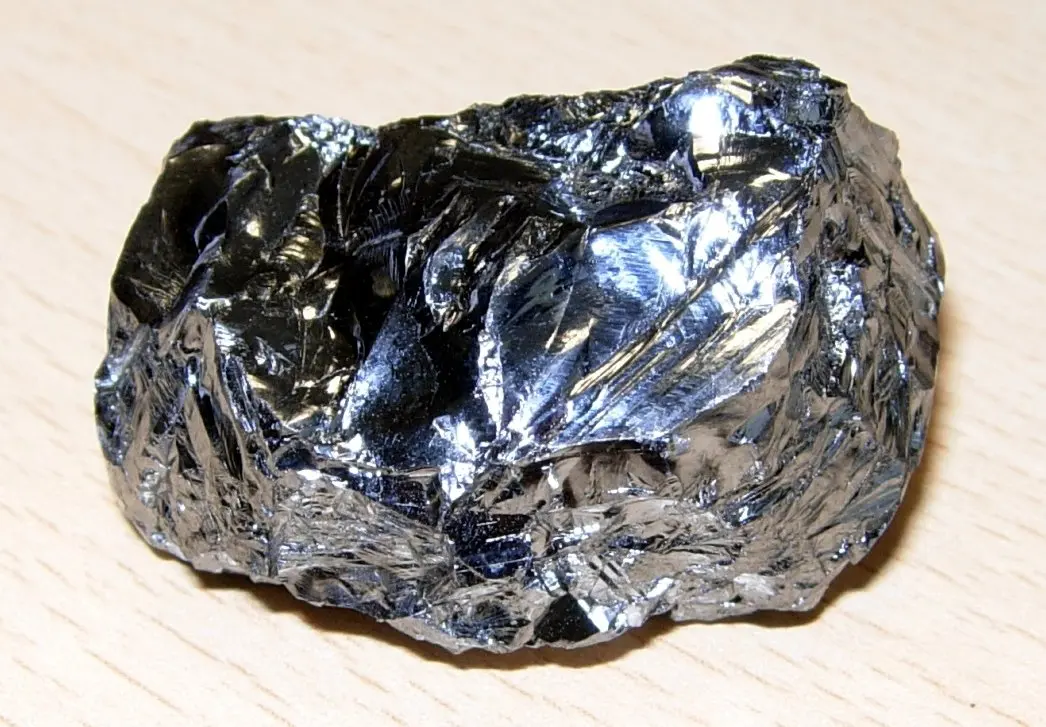
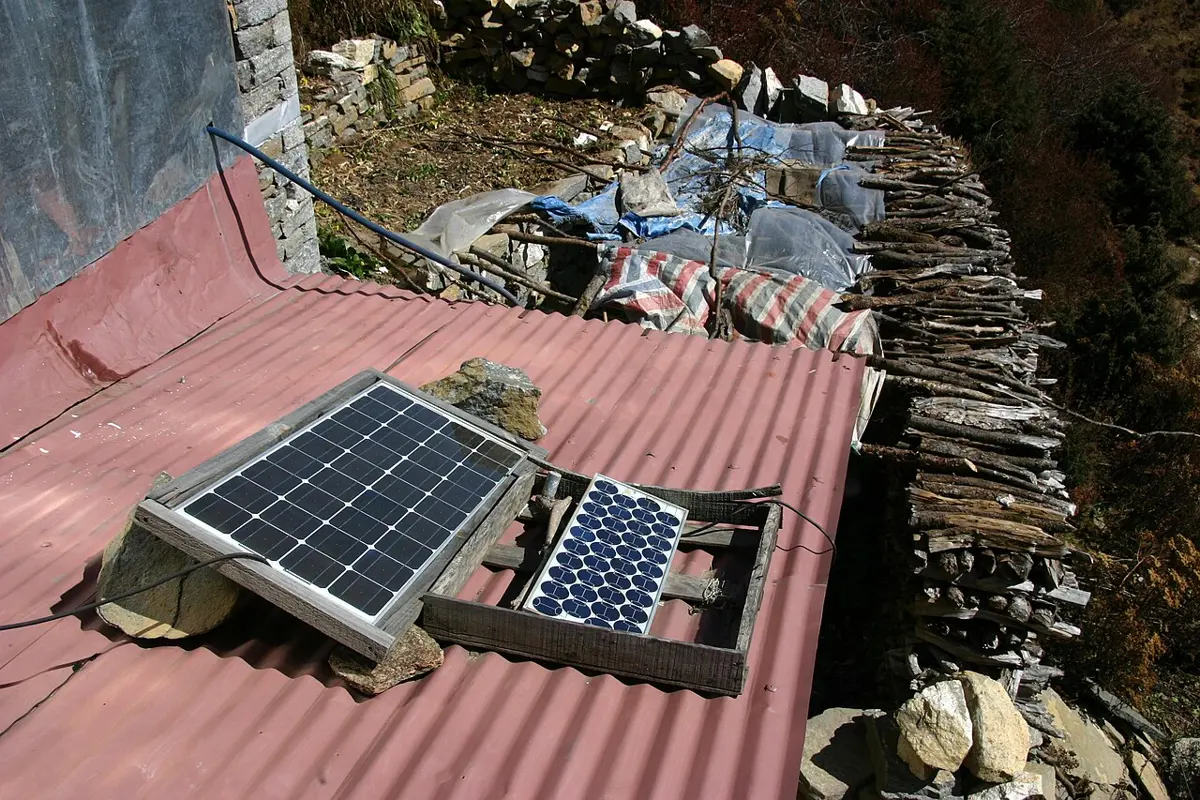
Pick up a handful of sand from the bank of the Trishuli or the Koshi. Most of the grains are quartz, and quartz is silicon joined to oxygen. So is the glass in your window, and most of the rock in the hills around you. Now look at your phone. Its brain is a chip of silicon smaller than a fingernail, and the solar panel on a roof in a village far from the power lines is made of silicon too.
The same element, cheap as sand and precious as a chip. Here is its story.
The silicon atom
Every silicon atom has 14 protons, so its atomic number is 14, and a neutral atom has 14 electrons. The commonest kind of silicon atom has 14 neutrons too, so its mass number is 28.
The electrons fill the K and L shells (2 and 8) and leave 4 for the M shell: 2, 8, 4 Grade 8: Bohr and Bury’s rule. In subshells that is 1s² 2s² 2p⁶ 3s² 3p² Grade 10: The Aufbau principle. The two 3p electrons go into separate p orbitals rather than pairing up in one.
Its place in the periodic table
- Period 3, because it has three shells.
- Group 14, called IVA in the older naming, because it has four valence electrons. Carbon is directly above it.
- p-block, because its last electrons go into a p subshell.
Four outer electrons is exactly half an octet. Losing four or gaining four would both take far too much energy, so silicon does neither: it shares its four electrons in four covalent bonds, just as carbon does Grade 9: Valency. Its valency is 4, as in silicon dioxide, SiO₂, and silicon carbide, SiC.
Silicon is a metalloid: it sits on the staircase between the metals and the non-metals and behaves partly like each Grade 10: Metalloids. Across period 3 the elements change from metals (sodium, magnesium, aluminium) through silicon to non-metals (phosphorus, sulphur, chlorine, argon). Down group 14 they change from carbon, a non-metal, through silicon and germanium to tin and lead, which are metals.
Silicon has four valence electrons. What does it usually do with them?
Pick an answer to see why.
How silicon was found and named
People have used silicon’s compounds since the Stone Age. Flint (चकमक), a hard form of silica, was chipped into the first knives and axes, and was struck against iron to make sparks for lighting fires. Thousands of years ago people in Egypt and Mesopotamia learned to melt sand into glass.
But silica holds on to its oxygen very firmly, and getting the element out took a long time.
- 1808. Humphry Davy failed to split silica with electricity, but suggested a name, silicium, from Latin silex, flint.
- 1811. The French chemists Gay-Lussac and Thénard made some very impure silicon, without realizing it was a new element.
- 1817. The Scottish chemist Thomas Thomson changed the name to silicon, ending in -on like carbon and boron, because the element did not look like a metal.
- 1824. The Swedish chemist Jöns Jacob Berzelius made fairly pure silicon, as a brown powder, by heating a silicon compound with potassium, and showed what it was. He is usually given the credit for discovering it.
- 1854. The French chemist Henri Sainte-Claire Deville made shiny gray crystals of silicon, the form we know today.
The symbol is Si. Nepali has no old name for the element itself, which nobody saw before the 1800s, but it has words for its compounds: बालुवा (sand), काँच (glass), स्फटिक or बिल्लौर (clear quartz crystal), and सिलिका.
Where silicon is found
In the universe. Silicon is one of the ten most common elements in the universe. It is made in massive stars, from oxygen, late in their lives; in the very last stage before the star explodes, silicon itself is turned into iron (Cooking in stars).
In the Earth’s crust. Silicon makes up about 28% of the crust by mass, second only to oxygen. Together, oxygen and silicon are three-quarters of the rock under your feet. Silicon is never found free: about 90% of the crust is made of silicates, minerals of silicon, oxygen and metals, such as feldspar, mica and clay Grade 10: Minerals. The simplest is quartz, pure silicon dioxide, SiO₂ Grade 8: What a mineral is.
In Nepal. The Himalaya is made largely of silicate rock, and Nepal’s rivers carry its sand. Clear quartz crystals are found in districts such as Dailekh, Taplejung and Rasuwa Grade 8: Minerals in Nepal.
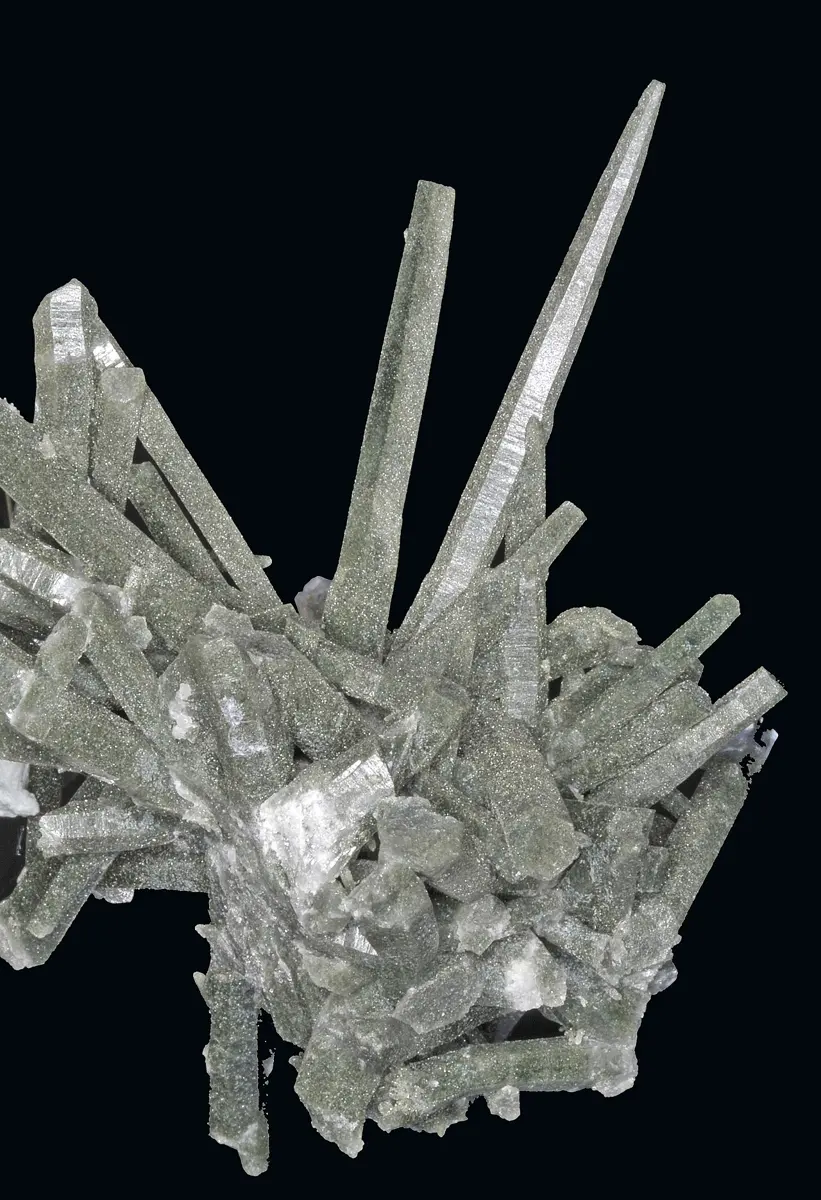
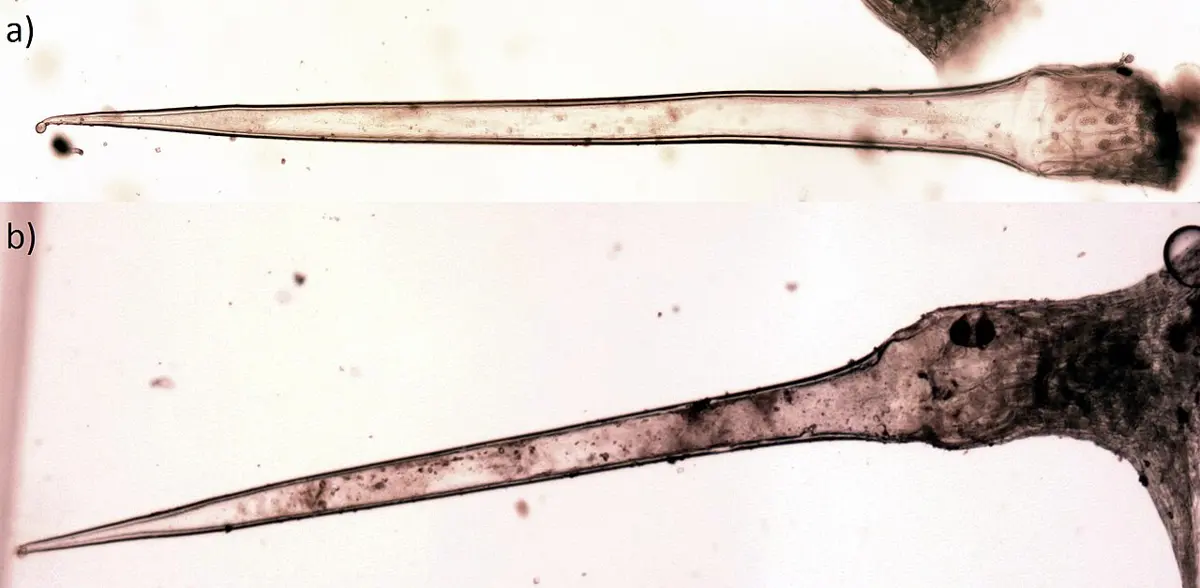
In living things. Many plants take up silica from the soil and build it into their stems and leaves to stiffen them: rice and other grasses, and bamboo, whose hollows sometimes hold white lumps made mostly of silica, sold as वंशलोचन for traditional medicine. The tips of the stinging hairs of the सिस्नो (nettle) are silica, as brittle as glass: they snap off in your skin and the hair injects its sting like a tiny needle. In the sea, tiny one-celled algae called diatoms build shells of glass. Your body holds only a trace.
What silicon is like
- Dark gray and shiny, with a bluish sheen, like a metal. But it is hard and brittle: hit it with a hammer and it shatters instead of flattening.
- Melts at 1,414 °C and boils at 3,265 °C.
- Light. Its density is 2.33 g/cm³, a little less than aluminium’s.
- A semiconductor. It conducts electricity, but far less than a metal and far more than a non-metal Grade 10: Metalloids.
- Expands when it freezes, as water does. Liquid silicon is denser than solid silicon.
Why these properties? In a crystal of silicon, each atom shares one electron with each of four neighbors, and each neighbor does the same. The whole crystal is one huge network of covalent bonds, built exactly like diamond (Networks of atoms: diamond and sand). Breaking it means breaking strong bonds, so silicon is hard and melts only when very hot. And because every outer electron is held in a bond, there is no “sea” of free electrons as in a metal Grade 9: What is inside a metal, so pure silicon conducts poorly.
But the electrons are held less tightly than in diamond. A little heat or light can knock one out of its bond, and then it is free to carry current. So, unlike a metal, silicon conducts better when it is hot or in light. That is the first secret of the solar cell.
A copper wire and a piece of pure silicon are both heated. What happens to how well they conduct electricity?
Pick an answer to see why.
Doping: the trick behind every chip
The real power of silicon comes from adding tiny, controlled amounts of other elements, a few atoms in a million or fewer. This is called doping.
- Add phosphorus, with five outer electrons. Four go into bonds with silicon neighbors; the fifth is left over and free to move. This is n-type silicon (n for the extra negative electrons).
- Add boron, with only three. One bond is an electron short. That gap, called a hole, can be filled by an electron from next door, which leaves a new hole behind, so the hole moves through the crystal like a positive charge. This is p-type silicon.
Where a layer of n-type silicon touches a layer of p-type, electricity can flow one way but not the other. Arranged in the right patterns, such layers make diodes, solar cells and transistors: tiny switches that turn a current on and off, millions of times a second, with no moving parts.
How silicon reacts
Silicon is not very reactive at room temperature, because a thin skin of silicon dioxide forms on it and protects it, as on aluminium. Acids do not attack it, except hydrofluoric acid, which also dissolves glass. Heated strongly in oxygen, it burns to silicon dioxide:
Si + O₂ → SiO₂
Silicon dioxide (silica) is the oxide of a non-metal, and like other non-metal oxides it is acidic. It reacts with basic oxides when they are melted together. In a blast furnace, lime takes away the sand in iron ore this way, as a glassy slag of calcium silicate Grade 10: Smelting:
CaO + SiO₂ → CaSiO₃
Heated with carbon in an electric furnace, sand gives silicon carbide, SiC, almost as hard as diamond: the grit on sandpaper and grinding wheels Grade 9: Reducing property of carbon.
Glass
Melt sand with soda (sodium carbonate) and limestone at about 1,500 °C, and let it cool: you get ordinary glass, a mixture of silicates. Glass is a strange solid. Its atoms are not lined up in a regular pattern as in a crystal: they are jumbled, as in a liquid that has stopped flowing. That is why glass does not have a sharp melting point but softens slowly, so a glass-blower can shape it. Adding other substances changes it: boron oxide makes heat-proof laboratory glass, lead oxide makes sparkling crystal glass, and a trace of cobalt makes it blue.
Which of these is a covalent network, like a crystal of silicon?
Pick an answer to see why.
From sand to chip
Silicon for steel and alloys. Quartz (very pure sand or quartz rock) is heated with carbon (coke and wood chips) to about 2,000 °C in an electric arc furnace. The carbon takes the oxygen away:
SiO₂ + 2C → Si + 2CO
This gives silicon about 98–99% pure. Most of it goes into alloys: a little silicon makes aluminium easy to cast (into engine parts, for example), and ferrosilicon, an alloy with iron, is used in making steel. In 2024 the world made about 10 million tonnes of silicon in all, nearly 80% of it in China (US Geological Survey). Nepal’s neighbor Bhutan makes ferrosilicon with its cheap hydropower.
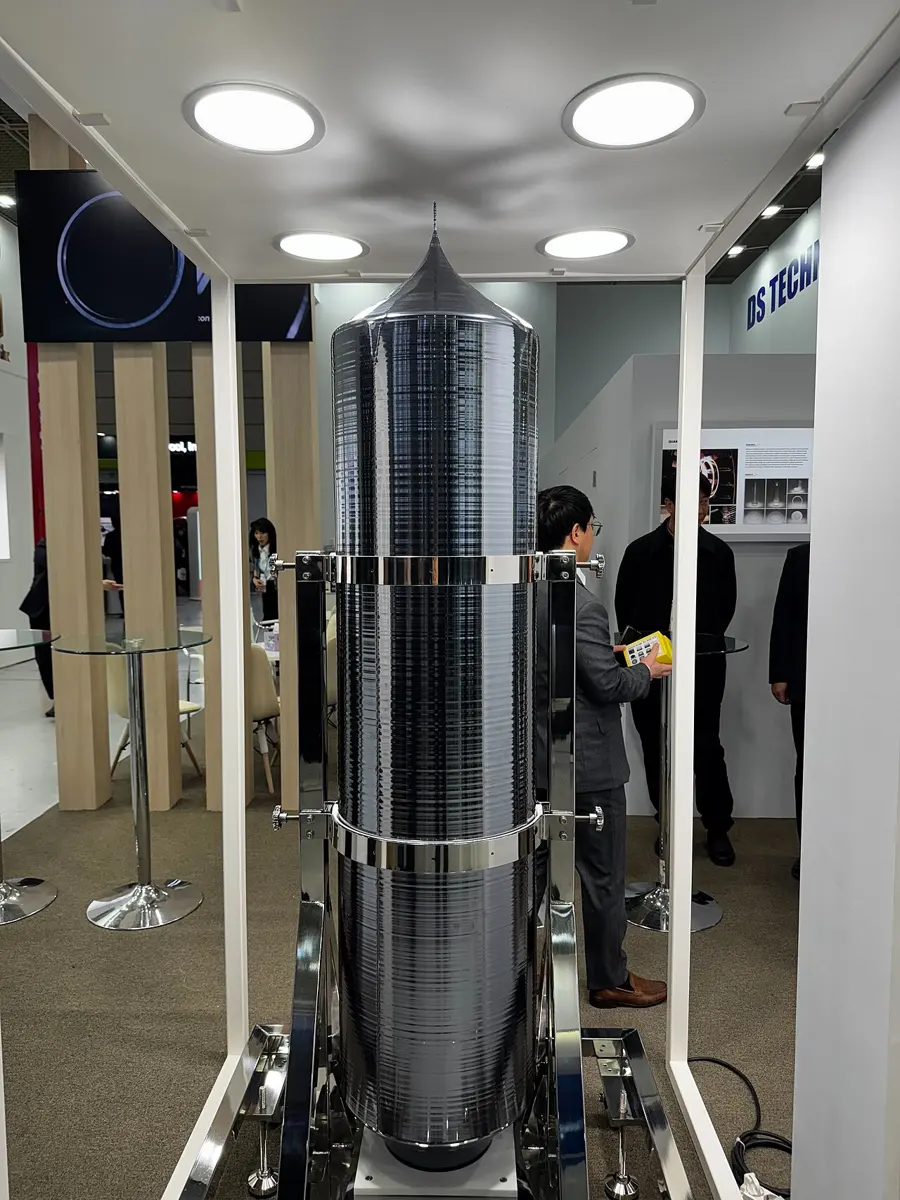
Silicon for chips. A chip needs silicon purer than almost anything else people make: 99.9999999% (“nine nines”), less than one stray atom in a billion. The silicon is turned into a liquid compound, trichlorosilane, which is distilled again and again and then turned back into silicon. The pure silicon is melted, and a single crystal is slowly pulled out of the melt on a rotating seed, growing into a long, perfect cylinder. This is sliced into thin discs, wafers, and the circuits are printed on them.
Silicon in daily life and in Nepal
- Building. Sand, gravel, bricks, cement and concrete are all silicates or silica. Nepal’s building boom is a silicon boom.
- Glass. Windows, bottles, bangles, spectacles, and the optical fibers that carry the internet, threads of very pure silica glass that guide light for kilometers.
- Electronics. Every phone, computer, TV and ATM runs on silicon chips. A modern phone’s main chip holds over ten billion transistors.
- Solar power. Almost all solar panels (over 95%) are made of silicon. Light knocks electrons free at a junction of n-type and p-type silicon, and they flow out as a current Grade 9: Solar electricity. In Nepal’s hills, solar panels light homes far from the grid, pump water and run streetlights.
- Silicones. Chains of silicon and oxygen atoms with carbon groups attached make silicones: rubbery sealants round windows and bathroom tiles, baking molds, phone cases and some lubricants.
- Drying. The little packets of silica gel in new shoes and bags soak up damp air.
Isotopes of silicon
Natural silicon is a mixture of three stable isotopes: about 92.2% silicon-28, 4.7% silicon-29 and 3.1% silicon-30 Grade 9: Atomic mass.
Silicon and your health
Silicon itself is not poisonous, and the silica in food and water passes through the body harmlessly. The danger is dust.
Surprising facts and records
- Silicon Valley, the area around San Francisco where many of the world’s computer companies began, is named after the silicon in their chips.
- The first transistor (1947) was made of germanium, silicon’s neighbor below it. Silicon took over from the 1950s and 1960s, because its oxide skin makes perfect insulating layers on a chip (The transistor).
- The Moon and the rocky planets are made mostly of silicate rock, just like the Earth’s crust and mantle.
In your science books
- Grade 8: atoms and symbols, the 2n² rule, periods, minerals and minerals in Nepal.
- Grade 9: valency, covalent bonds, metals, non-metals and metalloids, silicon carbide and solar electricity.
- Grade 10: electronic configuration, metalloids, silicate minerals and slag in smelting.
- Going further: networks of atoms: diamond and sand, four kinds of solid, photons in solar cells and where the atoms in your body came from.
More to explore
- Nobel Prizes with silicon in them: the transistor (1956), the chip (2000) and glass fibers and the electronic eye of every camera (2009).
- Play: make silicon dioxide in Molecule Kitchen, or find silicon in Guess the Element and the Periodic Table Jigsaw.
- Read more: silicon at the Royal Society of Chemistry and at PubChem.