
- Atomic number
- 28
- Atomic mass
- 58.69
- Shells
- 2, 8, 16, 2
- Configuration
- 1s² 2s² 2p⁶ 3s² 3p⁶ 4s² 3d⁸
- In the table
- period 4, group 10 (VIIIB), d-block
- Kind
- Transition metal
- Valency
- 2 (Ni²⁺, as in green nickel sulphate), sometimes 3
- State at 25 °C
- solid
- Melts · boils
- 1,455 °C · 2,913 °C
- Density
- 8.9 × as heavy as water
- Known since
- 1751
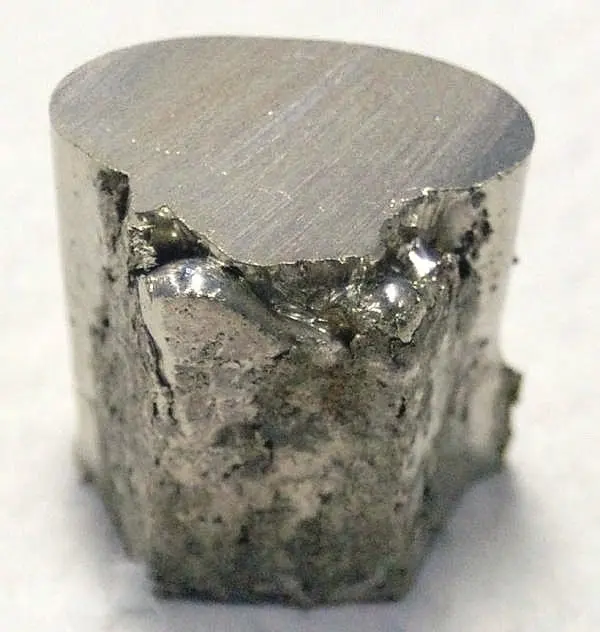
Pick up a steel spoon, a one-euro coin, or the rechargeable batteries in a torch, and there is a good chance you are holding nickel. It hides inside most stainless steel, it glows red-hot in heater coils as nichrome, and it sits under the shiny chrome on taps and bicycle bells.
It is also one of the few metals that fall from the sky: meteorites are made of iron and nickel. And deep beneath your feet, the Earth’s core is a ball of iron and nickel the size of the Moon and more. Here is nickel’s story.
The nickel atom
A nickel atom has 28 protons, so its atomic number is 28, and 28 electrons. Most nickel atoms have 30 neutrons, so their mass number is 28 + 30 = 58.
In shells, its electrons are 2, 8, 16, 2. As in iron, the M shell stops short of its 18: after argon’s 18 electrons, 4s fills first, and then 3d Grade 10: The Aufbau principle. Nickel has 8 electrons in 3d:
1s² 2s² 2p⁶ 3s² 3p⁶ 4s² 3d⁸
So the M shell holds 2 + 6 (3s, 3p) + 8 (3d) = 16, and the N shell holds the 2 in 4s.
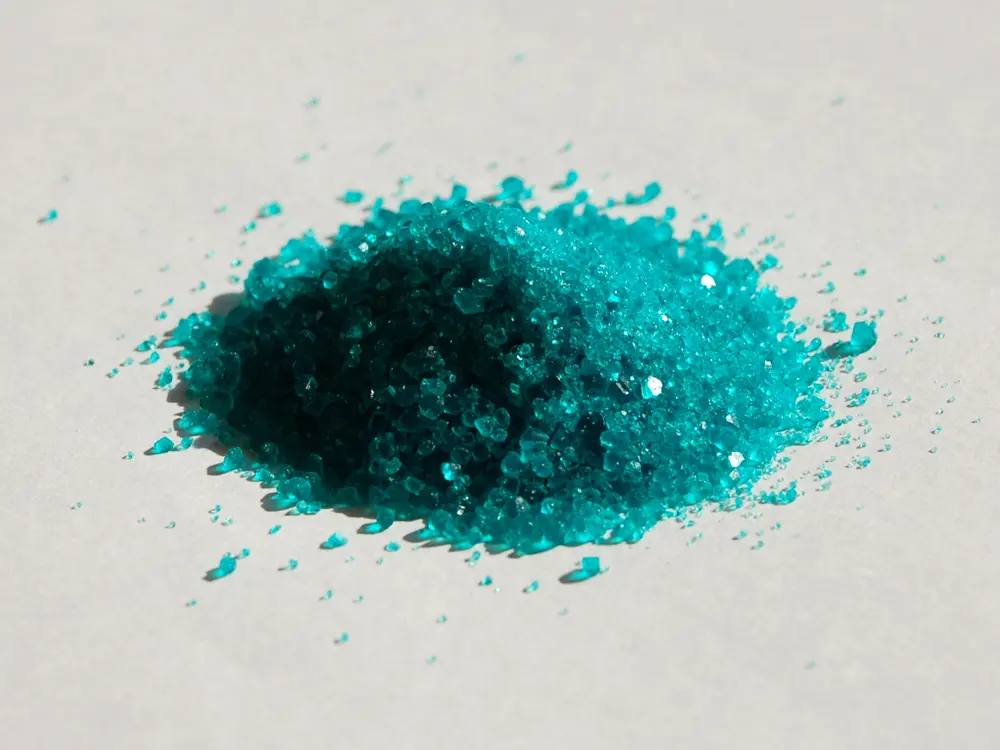
Valency. Nickel loses its two 4s electrons to become Ni²⁺ (valency 2), as in nickel sulphate (NiSO₄) and nickel chloride (NiCl₂), which are both green Grade 9: Variable valency. In rechargeable batteries it also shows valency 3.
How many electrons are in the outermost shell of a nickel atom?
Pick an answer to see why.
Its place in the periodic table
- Period 4, because its electrons are in four shells.
- Group 10, the last of the three columns that older tables put together as group VIIIB (iron, cobalt, nickel), between cobalt (27) and copper (29).
- d-block, because its last electrons go into a d subshell: nickel is a transition metal Grade 10: Metals.
Below nickel in group 10 are palladium and platinum, both precious metals and, like nickel, excellent catalysts (Joining carbon atoms with palladium).
Iron, cobalt and nickel sit side by side and are alike: hard, silvery-gray, and the only three elements that are strongly magnetic at room temperature Grade 8: Magnet.
How nickel was found and named
Iron from the sky. People used nickel long before they knew it. The iron of meteorites, which early peoples hammered into beads and blades, is an alloy of iron and nickel. Chinese metalworkers more than 2,000 years ago made a silvery copper alloy containing nickel, paktong or “white copper”.
The copper demon. In the Ore Mountains of Saxony, in Germany, miners found an ore that looked like copper ore. But however they heated it, they got no copper. They blamed a mischievous mountain spirit, Nickel, and called the ore Kupfernickel, “copper-demon”. Today it is called nickeline: it is nickel arsenide (NiAs), with no copper in it at all.
The metal. In 1751 the Swedish chemist Axel Fredrik Cronstedt heated nickeline from a Swedish mine, expecting copper. Instead he got a hard, white metal. He announced a new element and in 1754 named it after the demon: nickel, symbol Ni. Many chemists thought it was only a mixture of cobalt, iron and copper, until Torbern Bergman made it much purer in 1775 and showed it was a true element.
Where nickel is found
In the universe. Nickel was made in the hot cores of big stars, and in supernova explosions. In fact, as a star explodes, silicon burns into a radioactive nickel, nickel-56, which decays within months to cobalt-56 and then to iron-56. So most of the iron in the universe, including the iron in your blood, was nickel first (Why fusion stops at iron).
In the Earth’s core. When the young Earth was molten, heavy iron and nickel sank to the center Grade 8: How the Earth sorted itself. The Earth’s core is iron with some nickel: a solid inner core and a liquid outer core whose swirling makes the Earth’s magnetism Grade 8: Why the Earth is a magnet. Most of the Earth’s nickel is down there, far out of reach.
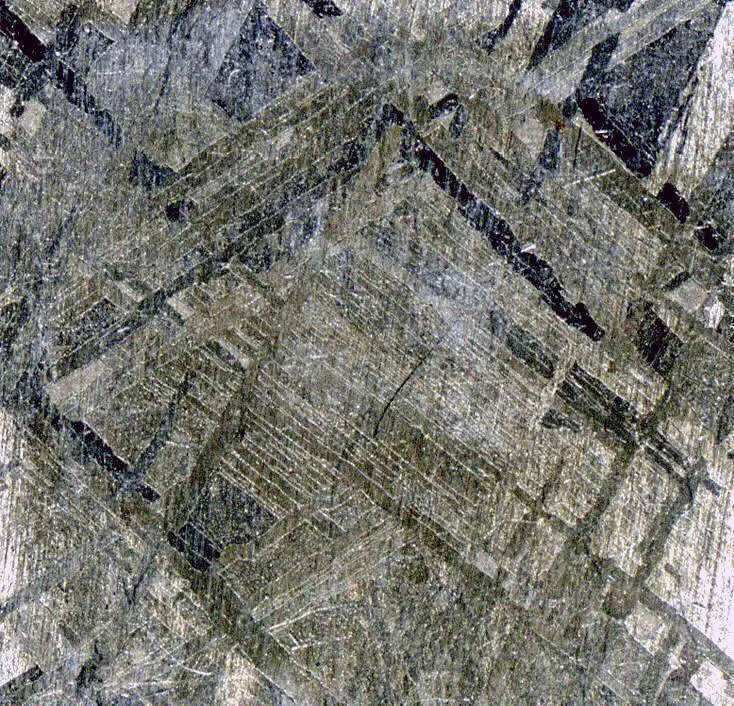
In meteorites. Iron meteorites are pieces of the cores of small planets that broke apart long ago. Cut, polished and etched with acid, many show a criss-cross pattern of two iron–nickel alloys, one richer in nickel than the other, which grew as the metal cooled very slowly inside its asteroid.
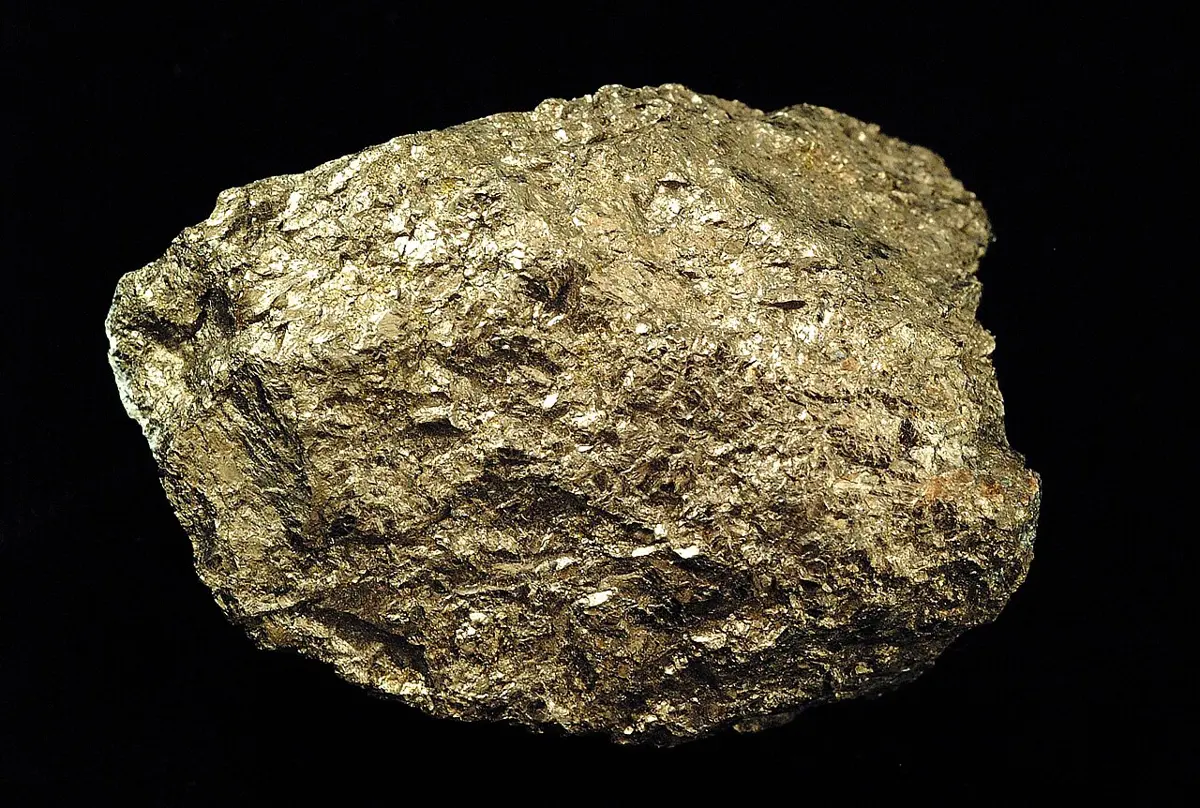
In the Earth’s crust. Nickel is mined from two kinds of ore: sulphide ores, mainly pentlandite, (Fe,Ni)₉S₈, and laterites, red soils formed when rocks rich in nickel weather in hot, wet climates. In 2025 the world mined about 3.9 million tonnes of nickel. Indonesia alone mined two-thirds of it, from laterites, followed by the Philippines, Russia, Canada, New Caledonia and China (USGS, 2026).
What nickel is like
- Color. Silvery-white with a faint golden tinge, and it takes a high polish.
- Hard, but malleable and ductile: it can be rolled into sheets and drawn into wire (Malleable, ductile).
- Heavy for its size: a density of 8.9 g/cm³, a little more than iron’s 7.9.
- Melts at 1,455 °C, and stays strong when hot.
- Magnetic. A magnet attracts nickel, but only below about 355 °C: heat it above that and it stops being magnetic, until it cools again.
- Resists corrosion. In air, a very thin layer of nickel oxide forms on its surface and protects it, so nickel stays bright for years.
How nickel reacts
Nickel is a little less reactive than iron but above hydrogen in the reactivity series. It reacts only slowly with dilute acids, giving a green solution and hydrogen Grade 9: Metals and dilute acids:
Ni + H₂SO₄ → NiSO₄ + H₂
Heated strongly in air, it forms green-black nickel oxide, NiO:
2Ni + O₂ → 2NiO
A more reactive metal pushes nickel out of its compounds Grade 10: Single displacement reaction. A strip of zinc in green nickel sulphate solution slowly gets coated with gray nickel:
Zn + NiSO₄ → ZnSO₄ + Ni
Which metal, dipped in nickel sulphate solution, will become coated with nickel?
Pick an answer to see why.
Nickel as a catalyst: from oil to vanaspati ghee
Finely powdered nickel is one of the most useful catalysts in industry. Liquid vegetable oils have carbon–carbon double bonds. Heated with hydrogen and a nickel catalyst, they take up hydrogen and turn into the solid fat of vanaspati ghee. This is called hydrogenation Grade 10: Hydrogenation. The simplest example is ethene becoming ethane:
C₂H₄ + H₂ → C₂H₆ (with nickel, heated)
The hydrogen molecules stick to the nickel’s surface, where their bond loosens, and the oil molecules pick them up there. The French chemist Paul Sabatier shared the 1912 Nobel Prize in Chemistry for discovering how well finely divided metals such as nickel do this.
How nickel is made pure
Nickel ore is concentrated, roasted and smelted much like copper ore Grade 10: Metallurgy, giving nickel that is about three-quarters pure, which is good enough for stainless steel. For pure nickel there is a clever trick, the Mond process.
In 1890 Ludwig Mond, a chemist in England, found that nickel joins with carbon monoxide gas at only about 50 °C to make a gas, nickel carbonyl, Ni(CO)₄. Almost no other metal does this so easily. Heated to over 200 °C, the gas breaks up again into nickel and carbon monoxide.
Mond founded a company to refine nickel this way, and versions of his process are still used. Nickel carbonyl, though, is one of the most poisonous gases known, so it is handled only in closed plant.
Nickel in daily life
Stainless steel. About two-thirds of all nickel goes into stainless steel Grade 8: Stainless steel. The commonest kind, “18/8”, is 18% chromium and 8% nickel. The chromium stops rust; the nickel makes the steel tough and easy to press into shapes such as sinks, pots and spoons. It also changes how the iron atoms are packed, and makes this steel non-magnetic: that is why a magnet doesn’t pick up some “steel” spoons Grade 8: Magnetic materials.
Nichrome. About 80% nickel and 20% chromium, nichrome is the wire of the heating elements in heaters, kettles, irons and rice cookers Grade 9: Heating effect. It has a high resistance and a high melting point, and doesn’t burn away when red-hot.
Plating. A thin coat of nickel, put on by electricity, protects steel and brass from corrosion, and lies under most chrome plating.
Coins. Nickel is hard-wearing and doesn’t tarnish easily. The American five-cent coin, called a “nickel”, is 75% copper and 25% nickel, and one- and two-euro coins use nickel alloys too.
Batteries. Nickel is in rechargeable nickel–cadmium and nickel–metal hydride batteries, and in the positive side of many lithium-ion batteries in phones and electric cars (The battery in your pocket).
Jet engines. The turbine blades of jet engines spin red-hot in the burning gases. They are made of nickel superalloys, which stay strong at temperatures that would make steel soft.
Isotopes of nickel
Natural nickel is a mixture of five stable isotopes. About 68% is nickel-58 and 26% nickel-60, with a little nickel-61, -62 and -64. Their average gives nickel’s atomic mass, 58.69 Grade 9: Atomic mass.
Nickel and your health
Some bacteria and plants need nickel: it is part of the enzyme urease, which breaks down urea, so nickel is counted among the plant micronutrients Grade 9: Nutrients for plants. Whether people need it is not known; our food (grains, beans and lentils, nuts, chocolate) gives us a little anyway.
The commonest problem with nickel is an allergy. Nickel is the most common cause of skin allergy in the world. In someone who is allergic, metal that touches the skin for a long time (earrings, a watch strap’s buckle, the metal button of jeans) causes an itchy red rash. Once you have the allergy, it lasts for life. It often starts with ear piercing with cheap jewelry.
Surprising facts and records
- The core is huge. The Earth’s core, mostly iron with some nickel, is about 7,000 km across: bigger than the planet Mars.
- A magnet that turns off. Hang a small piece of pure nickel from a magnet and heat it with a flame: above about 355 °C it drops off. When it cools, the magnet holds it again.
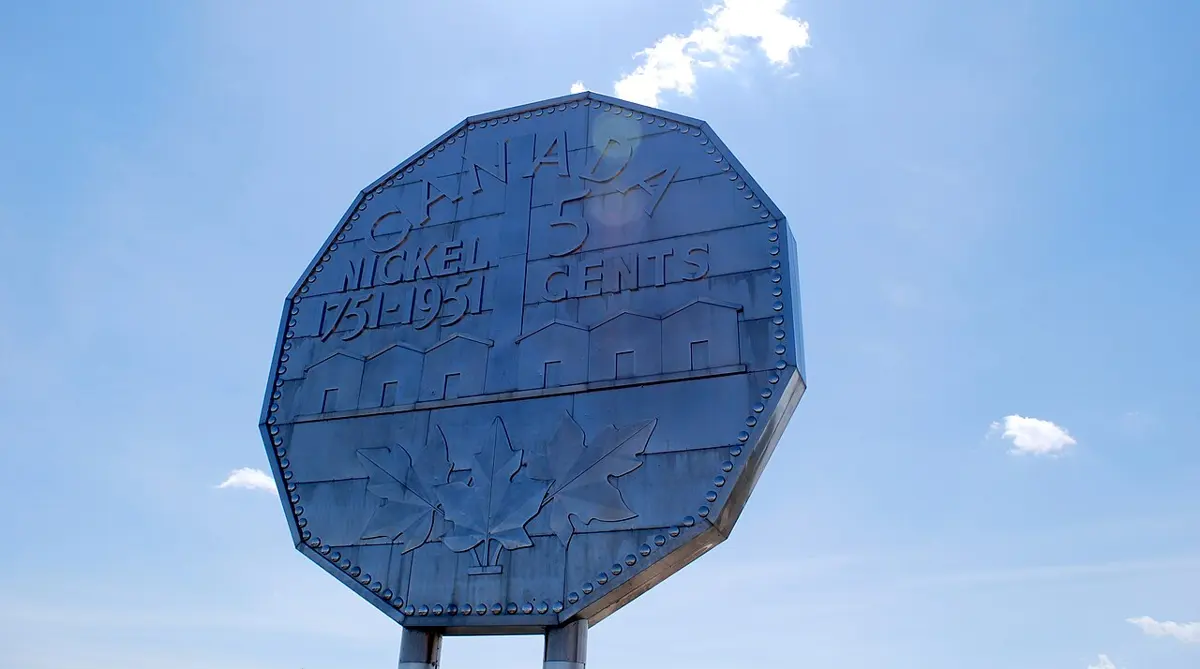
- Nickel coins you could test with a magnet. Canada’s five-cent coins were made of almost pure nickel from 1922 to 1981 (except in wartime), so they stuck to a magnet.
In your science books
- Grade 8: magnetic materials, why the Earth is a magnet and stainless steel.
- Grade 9: variable valency, metals and dilute acids, nichrome and the heating effect and plant micronutrients.
- Grade 10: electronic configuration, transition metals, metallurgy, single displacement and hydrogenation.
- Going further: why fusion stops at iron and binding energy.
More to explore
- Nobel Prizes with nickel in them: lithium-ion batteries (2019), palladium, nickel’s neighbor, as a catalyst (2010), atoms moved one by one on a nickel crystal (1986) and MOFs (2025, some of the first built on nickel ions).
- Play: find nickel in Guess the Element and the Periodic Table Jigsaw.
- Read more: nickel at the Royal Society of Chemistry and at PubChem.