
- Atomic number
- 98
- Atomic mass
- 251.08
- Shells
- 2, 8, 18, 32, 28, 8, 2
- Configuration
- 1s² 2s² 2p⁶ 3s² 3p⁶ 4s² 3d¹⁰ 4p⁶ 5s² 4d¹⁰ 5p⁶ 6s² 4f¹⁴ 5d¹⁰ 6p⁶ 7s² 5f¹⁰
- In the table
- period 7, group none (f-block), f-block
- Kind
- Actinide
- Valency
- 3 (Cf³⁺), and 2 or 4 in a few solids
- State at 25 °C
- solid
- Melts · boils
- 900 °C · not known
- Known since
- 1950
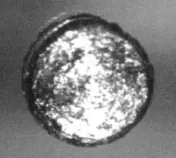
X-rays show a doctor your bones, because bones stop X-rays better than flesh. But what if you want to look for water hidden inside a metal airplane part, or for oil a kilometer under the ground? Then you need a different kind of ray: neutrons. The best small source of neutrons ever found is a speck of californium, element 98, and it is one of the very few elements beyond uranium that people use outside a laboratory.
The californium atom
A californium atom has 98 protons (atomic number 98) and 98 electrons. The kind that is useful, californium-252, has 252 − 98 = 154 neutrons. By shells, the electrons are 2, 8, 18, 32, 28, 8, 2, and in subshells Grade 10: The Aufbau principle:
… 6p⁶ 7s² 5f¹⁰
Californium is in period 7, the tenth of the actinides in the f-block Grade 10: Features of the modern periodic table, and a metal. In water it always forms Cf³⁺, giving away three electrons, like most actinides.
Californium-252 and californium-249 are both californium. What is different about them?
Pick an answer to see why.
How californium was made and named
In February 1950, Stanley Thompson, Kenneth Street Jr., Albert Ghiorso and Glenn Seaborg at the University of California in Berkeley fired alpha particles (2 protons and 2 neutrons) at a few millionths of a gram of curium-242. Collecting even that much curium had taken three years. A curium nucleus (96 protons) that captured an alpha particle had 98 protons. They made about 5,000 atoms of the new element, which lasted less than an hour, but that was enough to prove it was new.
The elements before it had been named to match the element above them in the table: americium like europium, curium like gadolinium, berkelium like terbium. Above element 98 is dysprosium, from the Greek for “hard to get at”. The team named it after their university and their state instead, californium, symbol Cf, and joked that a hundred years earlier, in the gold rush, people had found it hard to get to California.
Where californium comes from
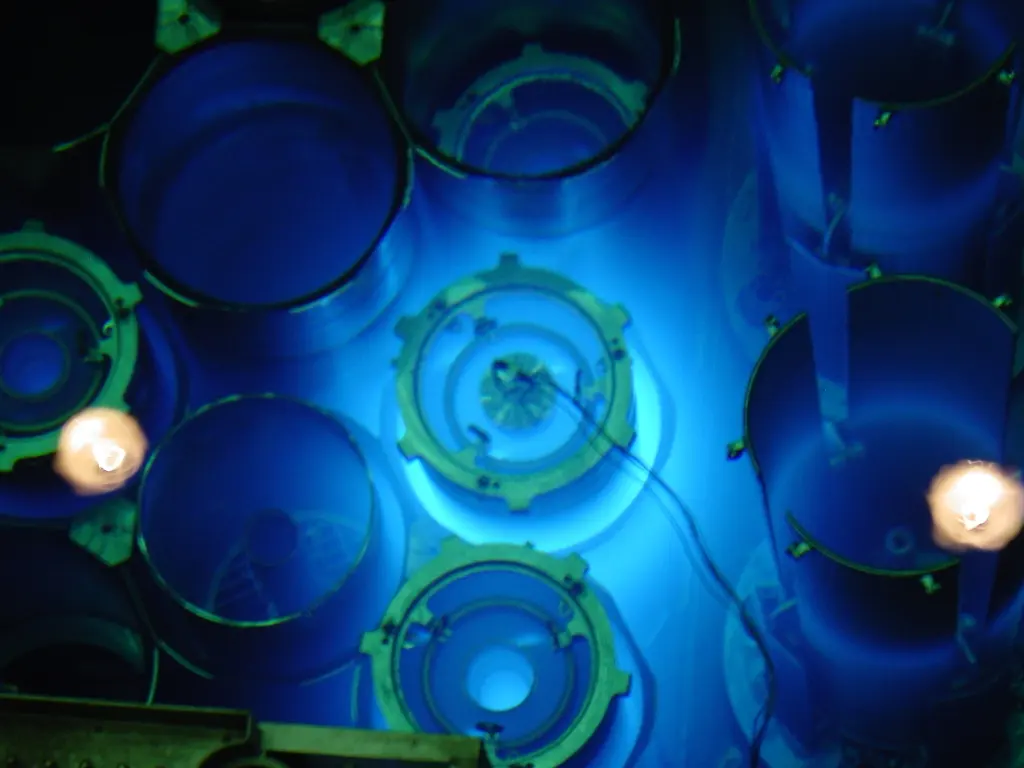
No californium is left from the Earth’s birth: its longest-lasting kind, californium-251, has a half-life of about 900 years. It is made in nuclear reactors, where plutonium, americium and curium nuclei catch neutron after neutron. Only two places make californium-252: the High Flux Isotope Reactor at Oak Ridge in the USA, which supplies the rest of the world outside Russia, and a reactor at Dimitrovgrad in Russia. Together they make well under a gram a year.
What californium is like
What has been measured:
- It is a soft, silvery metal that slowly tarnishes in air.
- It melts at about 900 °C.
- It is very dense: about 15.1 g/cm³, nearly twice as dense as iron. (The facts card has no density for it; this is the figure the Royal Society of Chemistry gives.)
Its boiling point has never been measured; tables that give one (about 1,470 °C) give an estimate.
Why californium gives out neutrons
Most californium-252 nuclei, about 97 in 100, decay the way many heavy nuclei do: they give out an alpha particle. Half of it is gone in about 2.6 years. But about 3 in 100 do something rare: the nucleus splits in two by itself. This is spontaneous fission Grade 9: nuclear fission. Each time, the two pieces fly apart and throw out about four neutrons.
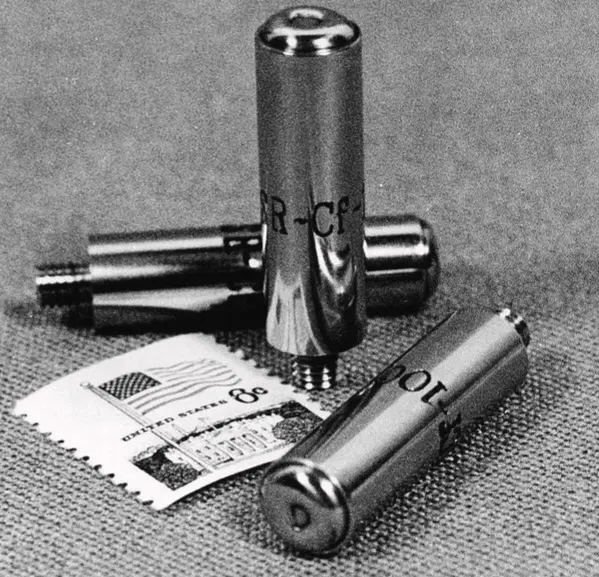
That makes californium-252 an amazing neutron source. One millionth of a gram gives out more than 2 million neutrons every second, with no reactor and no machine: just a sealed capsule a few centimeters long.
What californium is used for
Neutrons have no charge, so they pass through many materials that stop other rays. They go easily through most metals, but hydrogen, in water, oil and living things, slows and stops them. Each use of californium makes use of that.
- Starting nuclear reactors. A reactor’s chain reaction needs a few neutrons to get it going; a californium source is put in the core to start it.
- Finding oil and water underground. In a probe lowered down a well, as in Figure 3, the neutrons show which layers of rock hold water or oil.
- Finding gold and silver. Neutrons make a few atoms in a rock sample radioactive for a short time. The gamma rays those atoms give out have energies that belong to each element, so a geologist can tell on the spot how much gold or silver the rock holds.
- Checking welds and airplanes. A neutron picture of a metal part is like an X-ray picture, but the neutrons pass through the metal and are stopped by anything holding hydrogen. So it shows trapped water, corrosion and bad welds that an X-ray picture can miss.
- Treating some cancers. In a few hospitals, mostly in China, a tiny californium source is placed inside the body, right beside a tumor, for example in cancer of the cervix. Its neutrons kill cancer cells that resist other kinds of radiation.
- Making new elements. In 2006, scientists at Dubna, Russia, and Livermore, USA, announced that firing calcium (20 protons) at californium-249 (98 protons) had made element 118, now called oganesson.
Why is californium-252 used to find layers of oil and water deep underground?
Pick an answer to see why.
Californium and your health
The body has no use for californium. A californium-252 source is dangerous even from outside the body, because neutrons go deep into flesh; it is kept in thick shielding and handled with long tools. If californium gets inside the body, most of it settles in the bones and liver, where its radiation can stop the bones making red blood cells and can cause cancer.
In your science books
- Grade 9: radioactive elements, nuclear fission and shells and their energy.
- Grade 10: the actinides and the Aufbau principle.
- Going further: alpha decay, fission and what ionizing radiation does.
More to explore
- Nobel Prizes: Seaborg and McMillan’s prize (1951) for the elements beyond uranium.
- Its neighbors: berkelium, which turns into californium, einsteinium, the element after it, and dysprosium, the element above it.
- Play: find californium in Guess the Element and the Periodic Table Jigsaw.
- Read more: californium at the Royal Society of Chemistry and at PubChem.