
- Atomic number
- 58
- Atomic mass
- 140.12
- Shells
- 2, 8, 18, 19, 9, 2
- Configuration
- 1s² 2s² 2p⁶ 3s² 3p⁶ 4s² 3d¹⁰ 4p⁶ 5s² 4d¹⁰ 5p⁶ 6s² 4f¹ 5d¹
- In the table
- period 6, group none (f-block), f-block
- Kind
- Lanthanide
- Valency
- 3 and 4 (cerous Ce³⁺, ceric Ce⁴⁺)
- State at 25 °C
- solid
- Melts · boils
- 798 °C · 3,424 °C
- Density
- 6.8 × as heavy as water
- Known since
- 1803
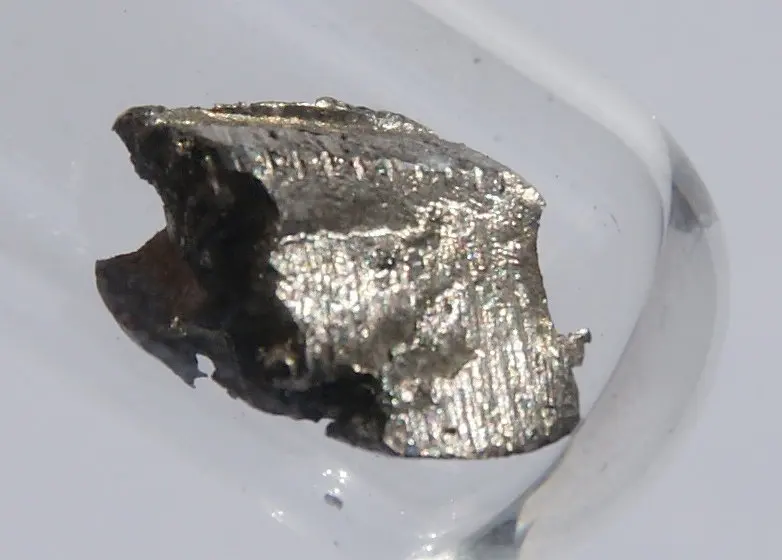
Flick the little wheel of a pocket lighter and a shower of sparks jumps out. The “flint” the wheel scrapes is not stone: it is a metal, an alloy made mostly of cerium (say SEER-ee-um) and iron. Cerium is soft enough to cut, yet its tiny shavings catch fire by themselves in air.
Cerium is the most common of the rare-earth elements, and the one that behaves most unlike its fourteen near-twins. It polishes the glass of lenses, cleans the exhaust of cars, and turns the blue light of an LED white. Here is its story.
The cerium atom
A cerium atom has 58 protons and 58 electrons. Most cerium atoms (88%) have 82 neutrons, so their mass number is 58 + 82 = 140.
By shells, its electrons are 2, 8, 18, 19, 9, 2. Compare lanthanum, one element before it: 2, 8, 18, 18, 9, 2. Cerium’s extra electron has gone into the N shell, the fourth one, deep inside the atom.
In subshells Grade 10: The Aufbau principle, that electron is the first in 4f. Cerium keeps lanthanum’s 5d electron as well:
1s² 2s² 2p⁶ 3s² 3p⁶ 4s² 3d¹⁰ 4p⁶ 5s² 4d¹⁰ 5p⁶ 6s² 4f¹ 5d¹
The 4f, 5d and 6s electrons have almost the same energy, so cerium has four electrons it can give away fairly easily, not three.
Which shell does cerium’s 4f electron belong to?
Pick an answer to see why.
Its place in the periodic table
- Period 6, because it has six shells, between lanthanum (57) and praseodymium (59).
- The second lanthanide, in the f-block, the separate row below the main table Grade 10: Features of the modern periodic table. Why the lanthanides are so alike is explained on the lanthanum page (fifteen near-twins).
Its two valencies
Every lanthanide forms an ion with a charge of 3+. Cerium does too: losing its 6s and 5d electrons gives Ce³⁺, the cerous ion, valency 3. But cerium can also lose its single 4f electron, to give Ce⁴⁺, the ceric ion, valency 4. Ce⁴⁺ has the same electrons as the noble gas xenon, a stable arrangement. Cerium is the only lanthanide whose 4+ ion lasts in water, so it is the lanthanide with a true variable valency Grade 9: Variable valency.
The two ions look different: cerous salts are white or colorless, ceric salts yellow to orange-red.
| Cerous (cerium(III)) | Ceric (cerium(IV)) | |
|---|---|---|
| Ion | Ce³⁺ | Ce⁴⁺ |
| Oxide | Ce₂O₃ | CeO₂ |
| Chloride or sulphate | CeCl₃ | Ce(SO₄)₂ |
| Color of salts | white, colorless | yellow, orange |
Cerium burns in air to give ceric oxide. What is its formula?
Pick an answer to see why.
How cerium was found and named
- 1751. In the Bastnäs mine in Sweden, the mineralogist Axel Cronstedt found an unusually heavy rock. Later it was called cerite.
- 1803. Jöns Jacob Berzelius, then a young Swedish chemist, and the mineralogist Wilhelm Hisinger showed that cerite held a new earth (a metal oxide). In the same year Martin Heinrich Klaproth, in Germany, found it on his own.
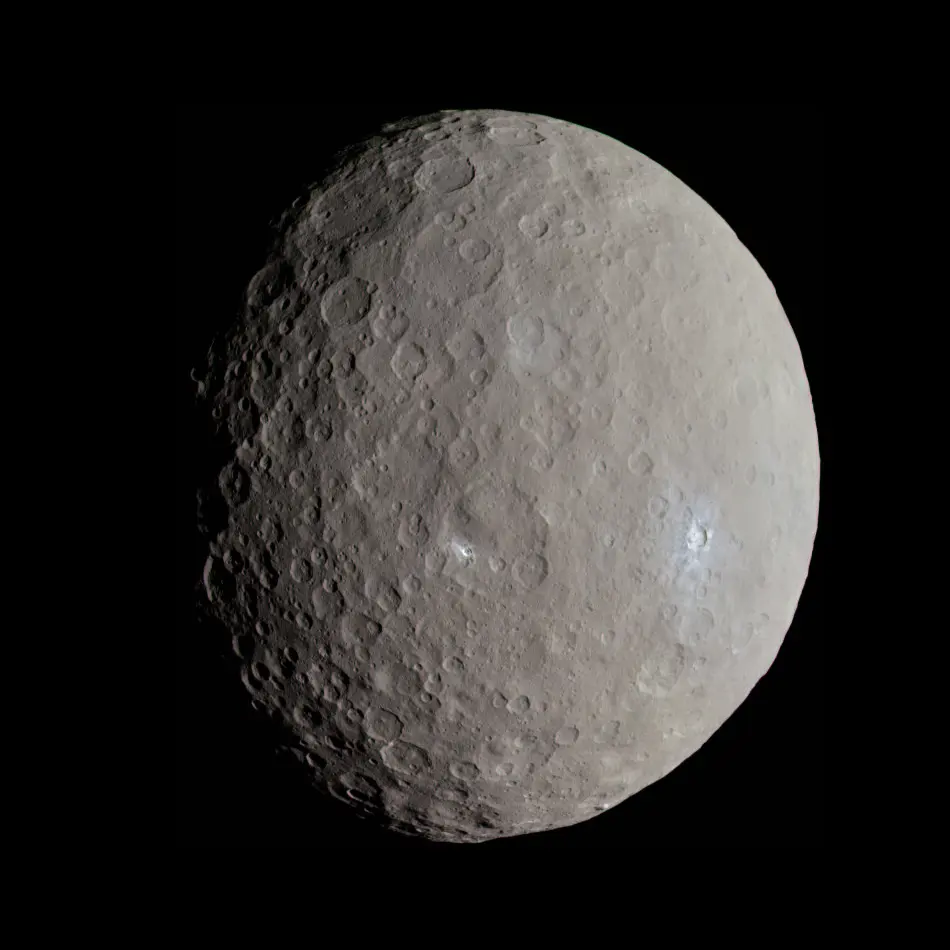
- Berzelius and Hisinger named their earth ceria, after Ceres, the first asteroid ever seen, found in 1801. Ceres was named after the Roman goddess of farming and grain. The symbol is Ce.
- 1875. William Hillebrand and Thomas Norton, in the USA, made the metal at last, by passing an electric current through molten cerium chloride.
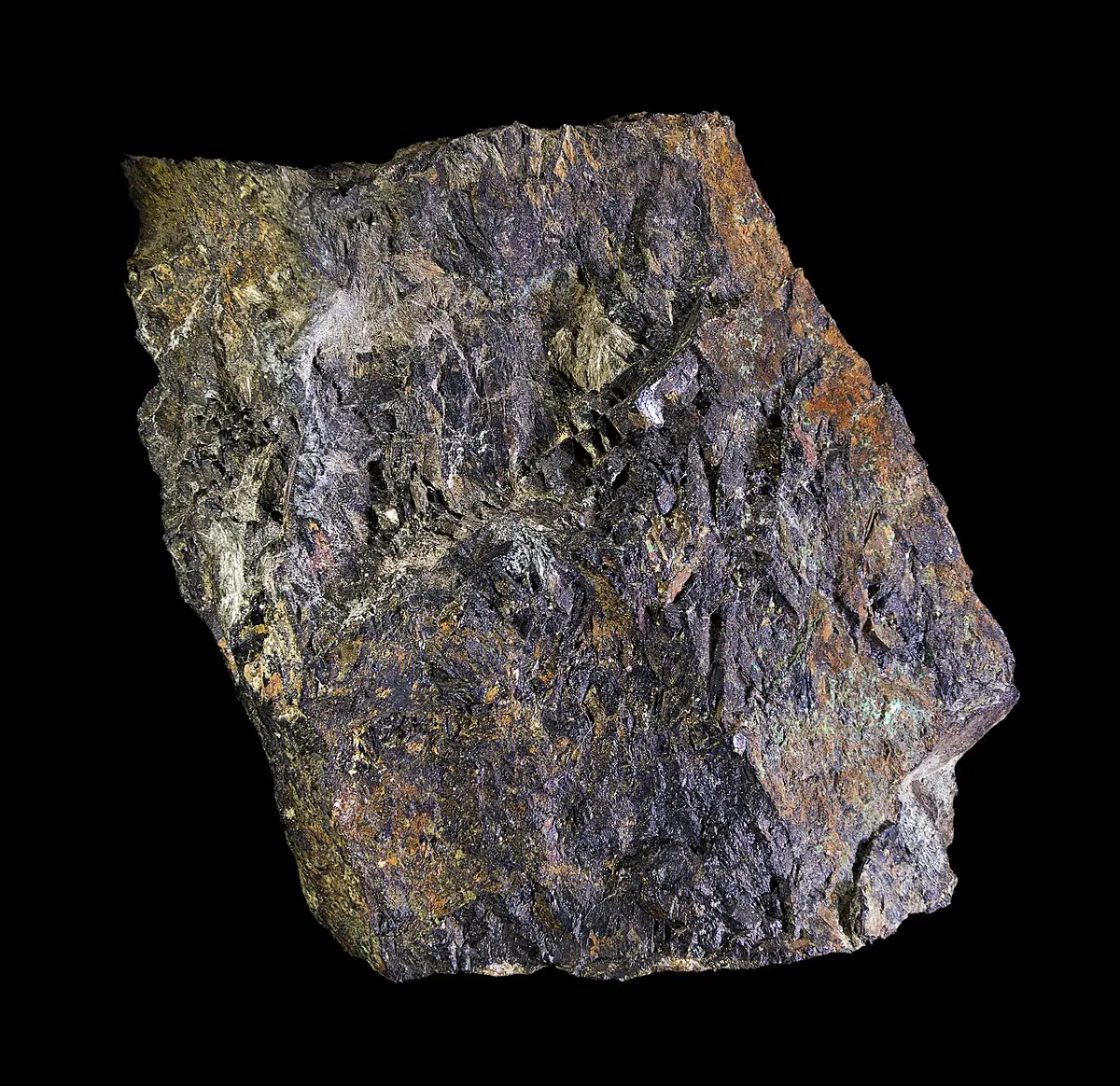
The ceria of 1803 was far from pure: in 1839–41 Mosander found lanthanum and didymium hiding in it (see lanthanum’s story). Cerium was the first lanthanide to be found, but its oxide only became pure once the others had been taken out.
Where cerium is found
In the universe, like lanthanum, it is made when atoms catch neutrons in stars, mostly slowly in old giant stars (Slowly, in giant stars).
In the Earth’s crust there are about 66 grams of cerium in every tonne of rock: about as much as copper, and far more than lead or tin. It is the most common rare earth by far. It is mined, together with the others, from bastnäsite and monazite, in which it is about half of all the rare earths (China mines about 70% of the world’s rare earths: see lanthanum).
Cerium is also the easiest rare earth to separate, thanks to its second valency. When the ore is roasted in air, cerium becomes CeO₂, while the others become oxides like La₂O₃. The other oxides dissolve in dilute acid; CeO₂ does not, and is left behind.
In Nepal and in your body. Nepal mines no rare earths, and your body has no use for cerium.
What cerium is like and how it reacts
- An iron-gray, shiny, soft metal, which can be bent and hammered.
- Density 6.77 g/cm³.
- Reactive. It tarnishes quickly in moist air. Scratch pure cerium with a knife and the scraped-off bits may burst into flame: they are so small and so reactive that the heat of scraping lights them. When it burns, it gives ceric oxide:
Ce + O₂ → CeO₂ - With water, slowly when cold and fast when hot, it gives cerous hydroxide and hydrogen Grade 9: Very reactive metals and water:
2Ce + 6H₂O → 2Ce(OH)₃ + 3H₂ - With dilute acids, quickly, giving a salt and hydrogen.
Ce⁴⁺ ions pull electrons from other substances very strongly: they are a strong oxidizing agent, and chemists use ceric sulphate to measure how much of a substance there is in a solution.
Cerium in daily life
Sparks: the lighter flint
In 1903 Carl Auer von Welsbach, an Austrian chemist, patented ferrocerium: cerium with iron added to make it hard. Today’s lighter “flint” is ferrocerium made from mischmetal (German for “mixed metal”), the light rare earths together, about half cerium and a quarter lanthanum, because separating them would only cost more.
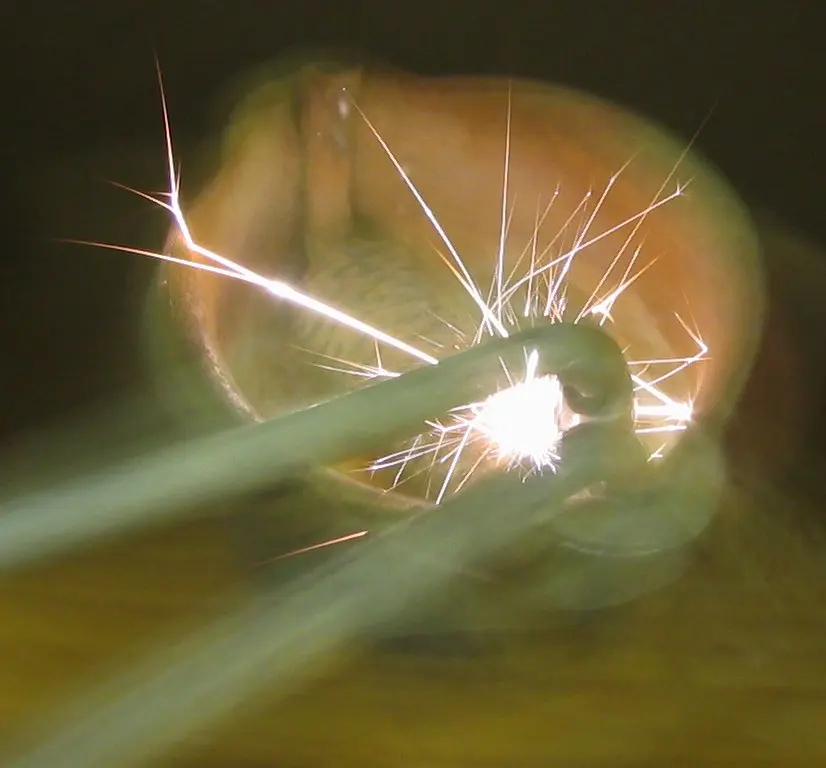
The same alloy, as a thick rod, is carried in survival kits as a fire starter, struck with a steel blade.
Light from a mantle
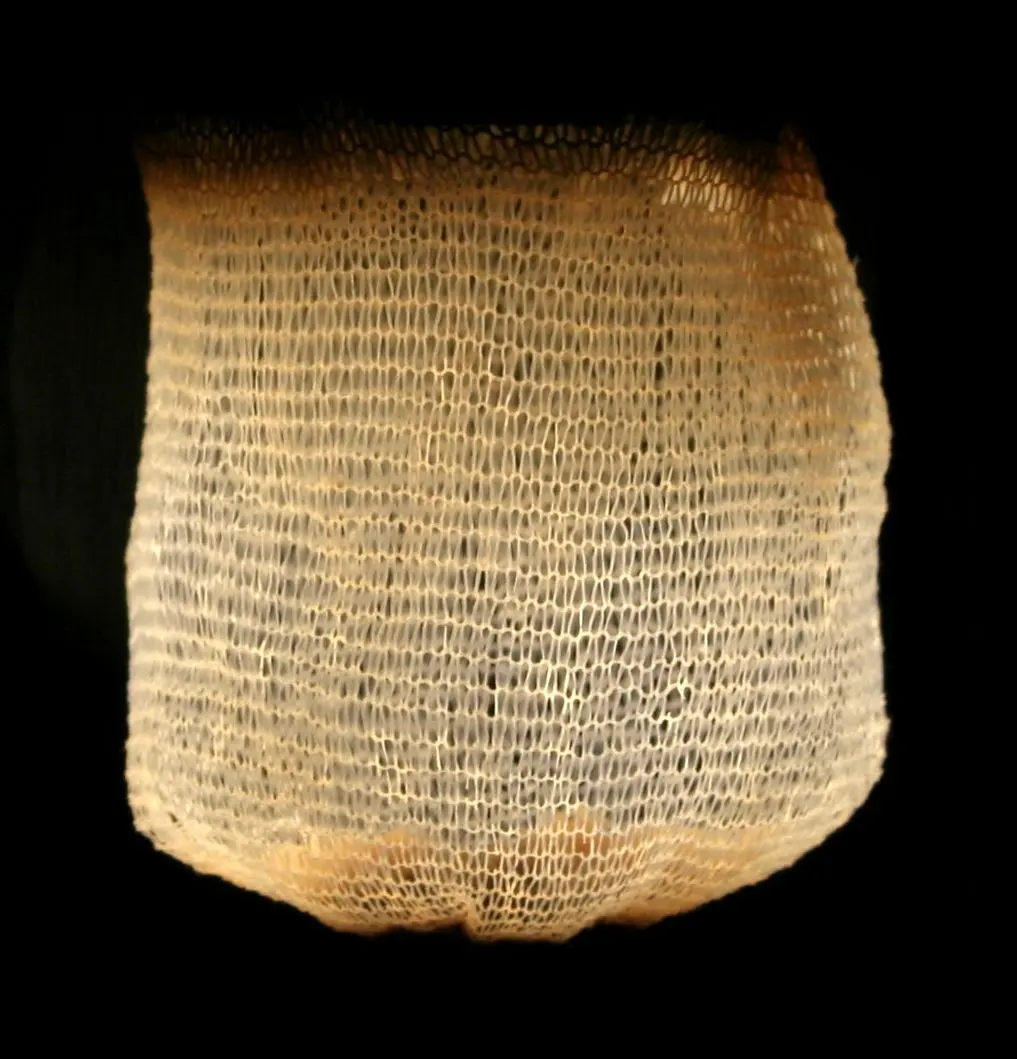
Auer von Welsbach also invented the gas mantle: a little bag of cloth soaked in metal salts, which burns away on first use and leaves a fragile net of oxides that glows white-hot in a flame. His first mantles of the mid-1880s, with lanthanum oxide in them, gave a greenish light and failed. About 1891 he found the mixture that worked: 99% thorium oxide and 1% cerium oxide, which glows a bright white. Mantles lit the streets of Europe until electric light took over, and still glow in pressure lanterns and camping lamps.
Polishing and coloring glass
Fine ceric oxide powder is the best polish for glass: it smooths lenses, mirrors and other glass much faster than the iron oxide polish used before. A little in molten glass also removes the green tint that iron impurities give, so the glass comes out clear. And cerium sulphide is a bright red pigment, used in plastics and paints in place of the poisonous cadmium reds.
Cleaner exhaust
In a car’s catalytic converter, platinum, palladium and rhodium turn poisonous carbon monoxide and nitrogen oxides into harmless gases (Catalyst; see platinum). Ceric oxide in the converter stores oxygen when the exhaust has spare oxygen, by staying as CeO₂, and gives it back when the exhaust is short of oxygen, by turning partly into Ce₂O₃. Cerium’s two valencies keep the converter working through every change of the engine. Ceric oxide in the walls of self-cleaning ovens similarly helps burn off food splashes.
White light from LEDs
The yellow powder over the blue chip of a white LED is yttrium aluminium garnet with a little cerium in it. The Ce³⁺ ions soak up some blue light and give out yellow; blue and yellow together look white (see yttrium and the blue LED Nobel Prize).
Isotopes of cerium
Natural cerium has four stable isotopes, so its atomic mass, 140.12, is an average Grade 9: Atomic mass.
Cerium and your health
Cerium has no known job in the human body (though some bacteria use it: see lanthanum), and it is only mildly poisonous.
In your science books
- Grade 9: variable valency, the criss-cross method, atomic mass and metals and water.
- Grade 10: the lanthanides, the Aufbau principle and catalysts.
- Going further: where cerium is made.
More to explore
- Nobel Prizes with cerium in their story: the blue LED (2014), whose white light needs cerium.
- Its neighbors: lanthanum before it (and the whole lanthanide row), praseodymium after it. Palladium is the other element named after an asteroid.
- Play: find cerium in Guess the Element, the Periodic Table Jigsaw and Higher or Lower.
- Read more: cerium at the Royal Society of Chemistry and at PubChem.