
- Atomic number
- 47
- Atomic mass
- 107.87
- Shells
- 2, 8, 18, 18, 1
- Configuration
- 1s² 2s² 2p⁶ 3s² 3p⁶ 4s² 3d¹⁰ 4p⁶ 5s¹ 4d¹⁰
- In the table
- period 5, group 11 (IB), d-block
- Kind
- Transition metal
- Valency
- 1 (Ag⁺)
- State at 25 °C
- solid
- Melts · boils
- 962 °C · 2,162 °C
- Density
- 10.5 × as heavy as water
- Known since
- ancient times
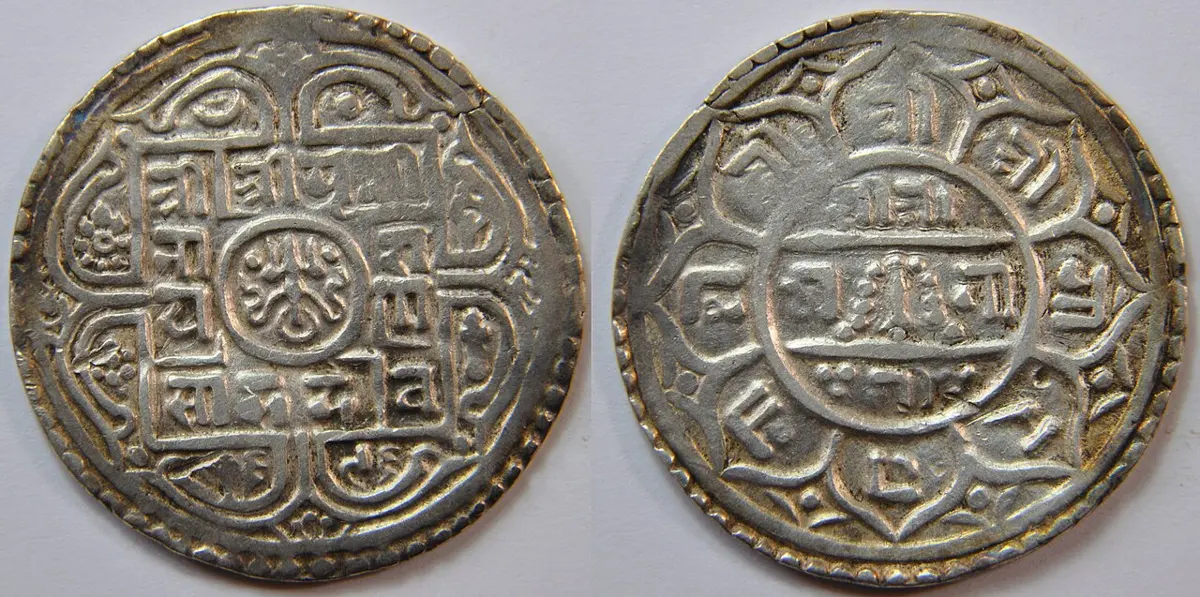
At a wedding or during Tihar, look at the jewelry: silver (चाँदी) anklets, bangles and chains, silver coins given as gifts, silver bowls for the puja. Silver has been one of the precious metals of Nepal for as long as there have been coins. Even the word rupee, रुपियाँ, comes from Sanskrit रूप्यक, a coin of silver.
Silver is also the metal of records: it conducts electricity and heat better than any other metal and reflects more light than any other. It made the first photographs and the first good mirrors, and today it is in every phone and every solar panel. Here is its story.
The silver atom
A silver atom has 47 protons, so silver’s atomic number is 47, and 47 electrons. Natural silver is a mixture of two kinds of atom, almost half and half: silver-107, with 60 neutrons, and silver-109, with 62.
By the 2n² rule Grade 8: Bohr and Bury’s rule, the shells hold 2, 8 and 18, then the N shell takes 18 (it could hold 32, but the next shell starts first), and one electron is left for the O shell: 2, 8, 18, 18, 1.
Its electronic configuration
In subshells, following the Aufbau order Grade 10: The Aufbau principle, 5s fills before 4d, so you would expect silver to end in 5s² 4d⁹. But the real atom is:
1s² 2s² 2p⁶ 3s² 3p⁶ 4s² 3d¹⁰ 4p⁶ 5s¹ 4d¹⁰
Just like copper above it, silver moves one electron from 5s into 4d, because a completely full d subshell is especially stable.
How many electrons are in the outermost shell of a silver atom?
Pick an answer to see why.
Its place in the periodic table
- Period 5, because its electrons are in five shells. It sits between palladium (46) and cadmium (48).
- Group 11, called IB in the older naming. Copper is above it and gold below: the three coinage metals, all soft, shiny, excellent conductors and unreactive enough to be found as the pure metal.
- d-block, so silver is a transition metal Grade 10: Metals.
Silver loses its single 5s electron to become the silver ion, Ag⁺. Unlike copper and gold, silver has just one usual valency, 1 Grade 9: Variable valency: silver nitrate is AgNO₃, silver chloride AgCl, silver oxide Ag₂O.
How silver was found and named
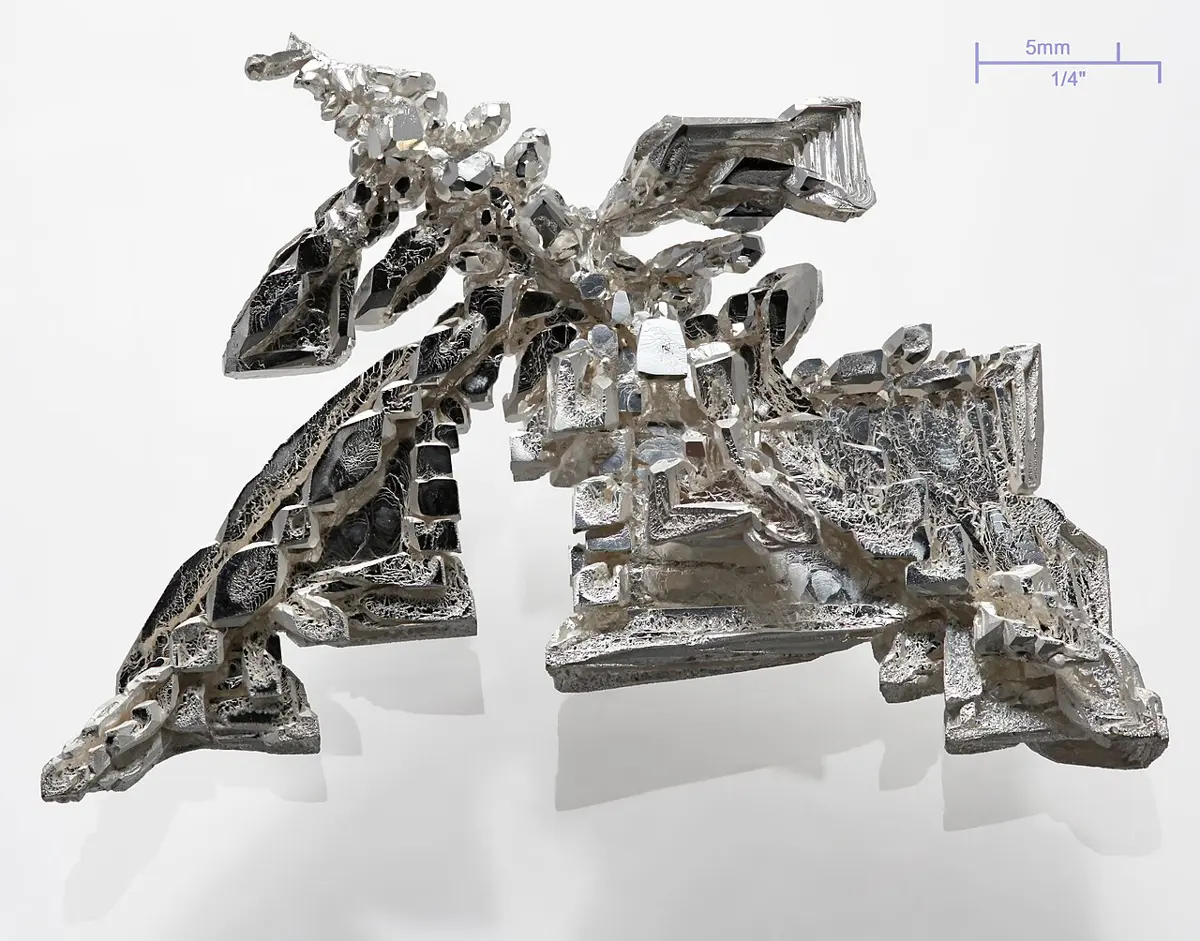
Silver is sometimes found as the pure metal, native silver, in wires and branching crystals. But most of it is hidden in the ores of lead, so people first had to learn to separate the two. Heaps of waste from ancient mines in Turkey and Greece show that silver was being mined by about 3000 BCE.
The trick was cupellation. Silver-bearing lead was melted in a shallow dish of bone ash, and air was blown over it. Lead, more reactive, turned into lead oxide, which soaked into the dish or was blown away; silver, which doesn’t react with air, was left behind as a bright bead.
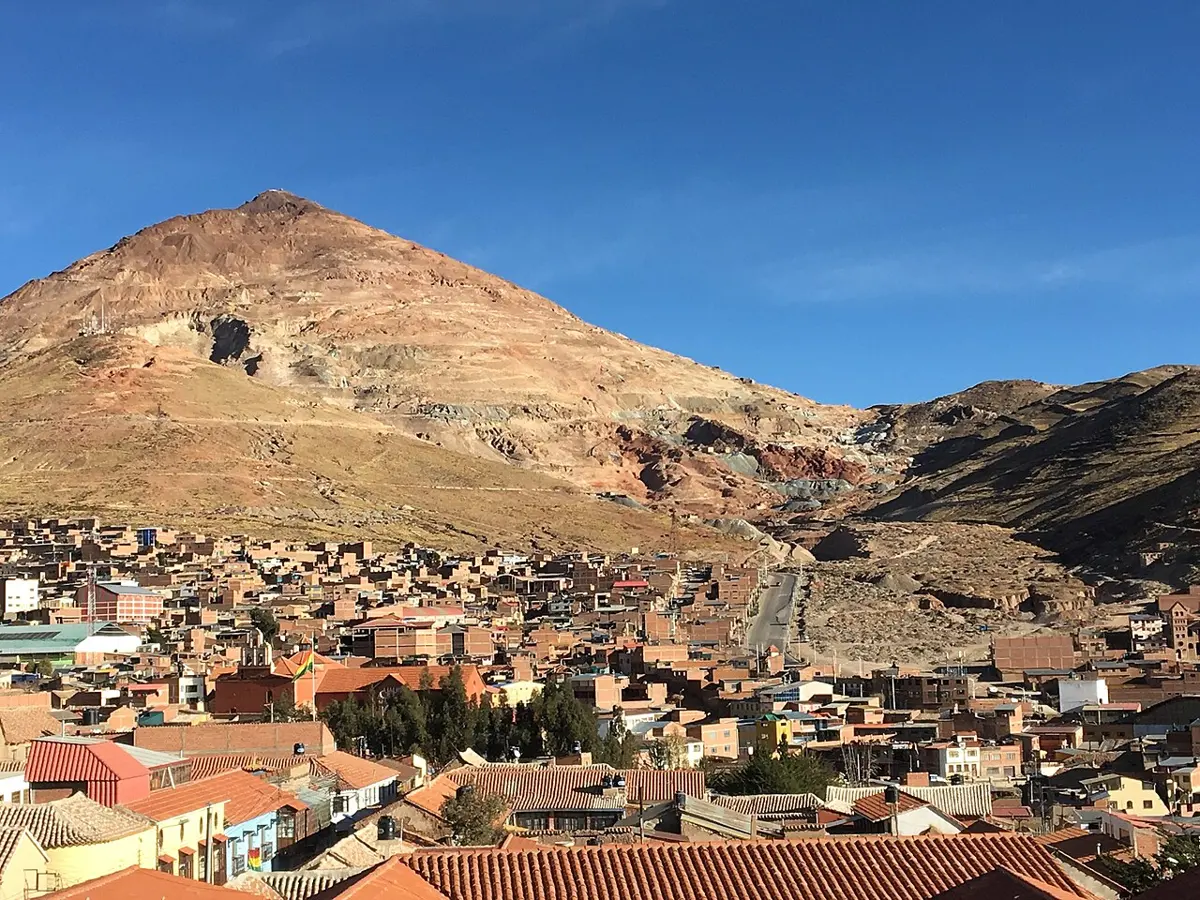
Silver made empires rich. The mines of Laurion paid for the navy of ancient Athens. In 1545 the Spanish found Cerro Rico, the “rich hill”, at Potosí in Bolivia, and for two centuries its silver was carried all over the world, much of it to China, where silver had become the money.
The name. The English “silver” comes from an old Germanic word; nobody knows where that came from. The symbol Ag is from the Latin argentum, from an old word meaning shining white; Argentina is named after it, “the land of silver”. Nepali चाँदी comes from Sanskrit चन्द्र, the Moon, silver being the white, moon-colored metal. Nepali also has the Sanskrit रजत (white, silver), as in a रजत जयन्ती, a silver jubilee, and a silver medal, a रजत पदक.
Where silver is found
In the universe. Silver is heavier than iron, so stars could not make it by ordinary burning. It was built when atoms caught neutrons, in giant stars and in collisions of dead stars (Heavier than iron).
In the Earth’s crust. Silver is rare: less than a tenth of a gram in a tonne of ordinary rock. Its ores are argentite (silver glance, Ag₂S) and horn silver (AgCl) Grade 10: Ores of silver, but most silver today comes as a by-product of mining lead, zinc, copper and gold. In 2024 the world mined about 25,000 tonnes of silver, a quarter of it in Mexico; China and Peru came next.
In Nepal. There are no silver mines; Nepal buys its silver, and its silversmiths work it into jewelry, puja vessels and statues.
In your body. None that it needs: silver has no job in any living thing.
What silver is like
- Color and shine. Brilliant white. Polished silver reflects about 95% of the light that falls on it, more than any other metal, which is why silver makes the best mirrors.
- Soft, malleable and ductile, second only to gold Grade 9: Malleable. Pure silver is too soft for everyday things, so jewelry and spoons are made of sterling silver, 92.5% silver and 7.5% copper, which is harder.
- The best conductor of electricity of all metals, a little better than copper Grade 9: Metals are good conductors of electricity, and the best conductor of heat: a silver spoon in hot tea quickly burns your fingers.
- Melts at 962 °C, and is heavy: its density is 10.5 g/cm³.
Silver gives one free electron per atom to the “sea” of electrons, like copper, and its atoms let them pass with the least hindrance of any metal. Silver isn’t used for house wiring only because it costs about a hundred times as much as copper.
How silver reacts
Silver is near the bottom of the reactivity series, below hydrogen and copper Grade 9: The reactivity series:
… Fe > Pb > (H) > Cu > Hg > Ag > Au
So silver does not react with water, with oxygen in the air, or with dilute hydrochloric or sulphuric acid. It dissolves in nitric acid, which is how silver nitrate (AgNO₃) is made.
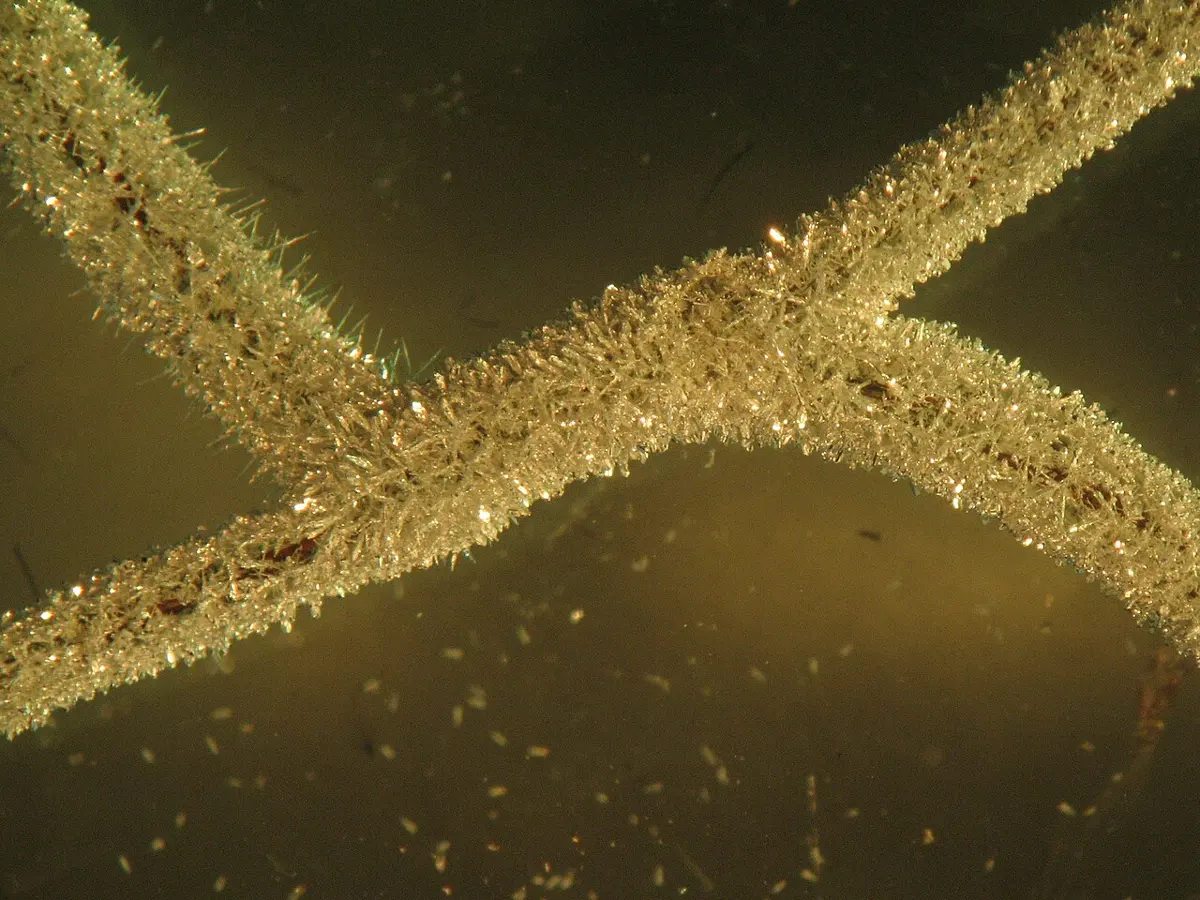
Copper pushes silver out. Hang a copper wire in silver nitrate solution, and glittering crystals of silver grow on the wire while the solution turns blue with copper nitrate (Displacement reactions, Single displacement):
Cu + 2AgNO₃ → Cu(NO₃)₂ + 2Ag
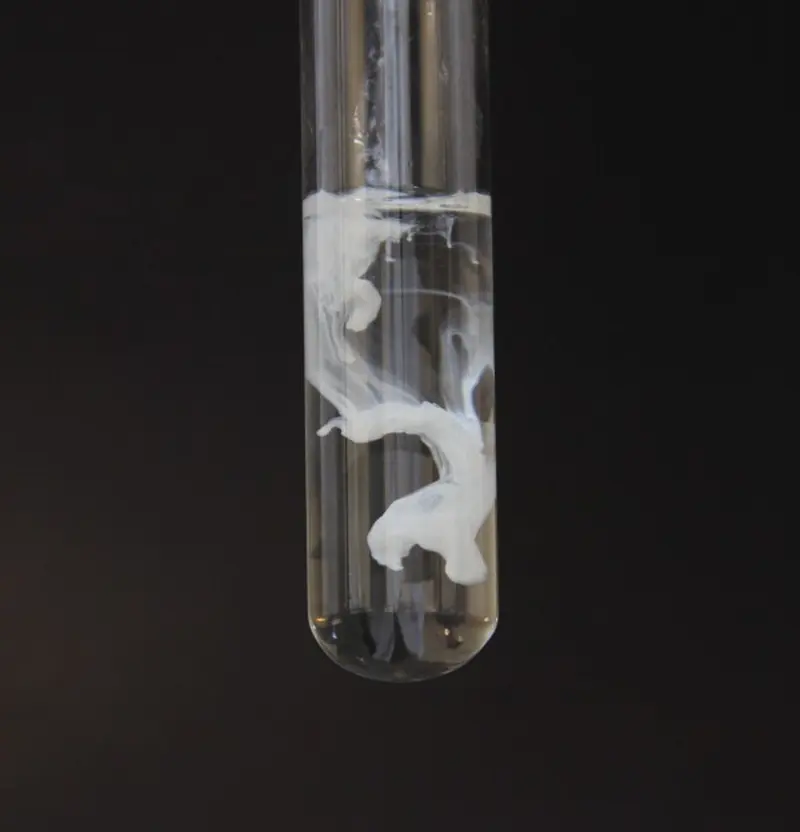
The test for chlorides. Add silver nitrate to anything containing chloride ions, such as salt water or tap water with chlorine, and a white precipitate of silver chloride appears Grade 10: Double displacement:
NaCl + AgNO₃ → AgCl↓ + NaNO₃
Leave the silver chloride in sunlight and it slowly turns gray, then purple-black, as light breaks it into tiny grains of silver. That is the reaction behind photography (below).
Why silver turns black
Silver doesn’t react with oxygen, yet old silver goes yellow, then brown, then black. The culprit is sulphur. Tiny traces of hydrogen sulphide in the air, from eggs, onions, rubber bands, burning fuel and drains, react with the silver to form a thin black layer of silver sulphide:
4Ag + 2H₂S + O₂ → 2Ag₂S + 2H₂O
This is called tarnishing. A spoon used for boiled eggs tarnishes fastest, because egg yolk is rich in sulphur.
A silver spoon left in a bowl of egg turns black. What is the black layer?
Pick an answer to see why.
Silver in daily life
Industry uses most of it. In 2024 more than half of all the silver used went into industry: the contacts of switches and keyboards, the circuits of phones and computers, solder, and above all solar panels. The thin silvery lines on the face of every solar cell, on the rooftops of Nepal too, are printed silver paste that collects the current. About a sixth of all silver now goes into solar cells.
Jewelry, coins and puja. Silver anklets (पाउजु, कल्ली), bangles (बाला) and coins are given at festivals and weddings across Nepal, and Newar silversmiths have made silver vessels and ornaments for centuries.
Mirrors. In 1835 the German chemist Justus von Liebig found how to coat glass with a thin, even layer of silver from silver nitrate solution, the first good modern mirrors. Before that, mirrors were glass backed with a mixture of tin and poisonous mercury. Many mirrors and telescope mirrors are still silvered, and the inner walls of a thermos flask are silvered to reflect heat back Grade 8: The thermos flask.
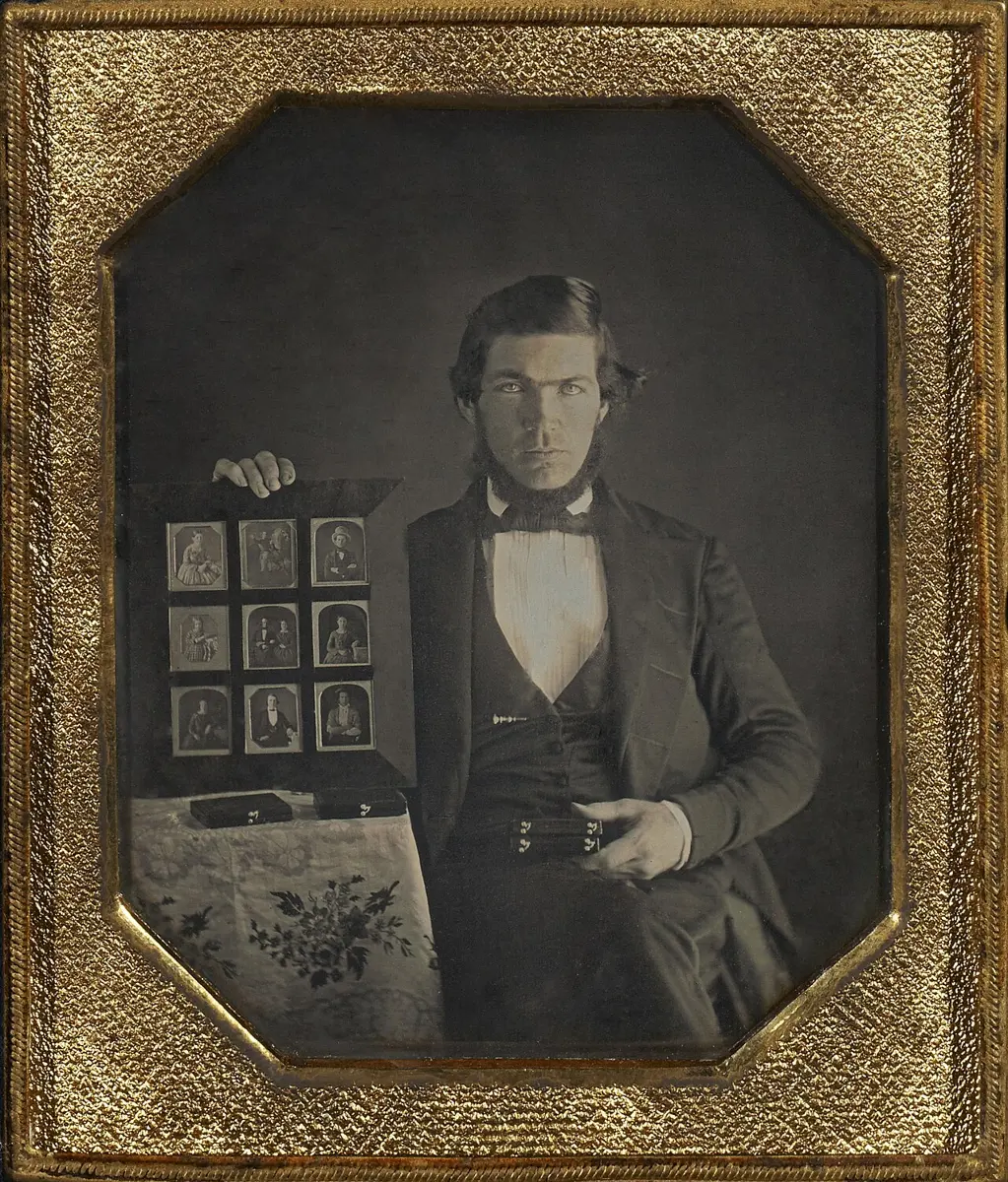
Photography. Silver salts change when light falls on them. The first practical photographs, made by Louis Daguerre in 1839, were images on silver-coated copper plates, and for 150 years every camera film and X-ray film used grains of silver bromide: light turned some of them into tiny dark specks of silver, and those specks made the picture Grade 10: Light speeds up reactions.
Killing germs. Silver ions kill many bacteria, so silver is used in some wound dressings, water filters and hospital equipment.
Isotopes of silver
Natural silver is almost half and half silver-107 and silver-109, neither of them radioactive. That is why its atomic mass, 107.87, is close to 108, halfway between them Grade 9: Atomic mass.
Silver and your health
Your body doesn’t need any silver, and metallic silver is harmless: the thin edible silver leaf on some sweets passes through you. But swallowing silver compounds for a long time, for example “colloidal silver” sold as a cure, can turn the skin permanently blue-gray, a condition called argyria. There is no good evidence that drinking silver cures anything.
Surprising facts and records
- Three records in one. Silver is the best conductor of electricity, the best conductor of heat, and the best reflector of visible light among all metals.
- A silver Olympic gold. An Olympic gold medal is mostly silver: at least 92.5% silver, with at least 6 grams of gold on the outside.
- Silver clouds. In dry places, planes spray tiny crystals of silver iodide into clouds: water freezes on them as on ice, which can help a little more rain or snow to fall.
In your science books
- Grade 8: the 2n² rule, displacement reactions (copper and silver nitrate), the thermos flask and minerals.
- Grade 9: valency, properties of metals, the reactivity series, atomic mass and poisonous mushrooms.
- Grade 10: electronic configuration, ores of silver, electro-refining, single and double displacement and light and reactions.
- Going further: where the atoms in your body came from.
More to explore
- Nobel Prizes with silver in them: the laser (1964, the first laser’s ruby rod had silvered ends), quantum dots (2023, glassmakers colored glass with silver long before anyone knew why) and the germ behind stomach ulcers (2005, found with a silver stain).
- Play: find silver in Guess the Element, Higher or Lower and the Periodic Table Jigsaw.
- Read more: silver at the Royal Society of Chemistry and at PubChem.