
At a wedding in Nepal, the bride wears gold: a tilhari, earrings, bangles. Gold is weighed in tola, 11.66 g each, and one tola holds about 36 thousand billion billion gold atoms. Not one of them was made on the Earth. Nor was the iron in your blood, the calcium in your bones, the oxygen in every breath or the hydrogen in every glass of water. All of them are older than the Earth, older than the Sun.
So where were they made? Grade 9 gave you the short answer: in stars, and scattered when the stars died (Death of a star and Nova, supernova, and what is left). This topic is the long answer: which elements came from where, how far each kind of star gets, why fusion stops at iron, how gold was made without it, and how we know.
What you are made of
About 98 % of your mass is just six elements. Here they are for a grown-up of 70 kg, with a few of the rarer ones you can’t live without.
| Element | Mass in a 70 kg body | Share of the mass | Where it is |
|---|---|---|---|
| oxygen | 45 kg | 64 % | water, and every kind of molecule in you |
| carbon | 13 kg | 19 % | proteins, fats, sugars, DNA |
| hydrogen | 7 kg | 10 % | water, and every kind of molecule in you |
| nitrogen | 1.8 kg | 2.6 % | proteins, DNA |
| calcium | 1.0 kg | 1.4 % | bones and teeth |
| phosphorus | 0.78 kg | 1.1 % | bones, DNA, ATP |
| potassium, sulphur, sodium, chlorine, magnesium | about 0.5 kg together | 0.7 % | salts in your blood and cells; proteins |
| iron | about 4 g | 0.006 % | hemoglobin in your blood |
| iodine | about 0.02 g | 0.00003 % | your thyroid gland |
(From the usual table for an adult; the shares vary from person to person, mostly with how much fat, muscle and bone there is.)
Oxygen is the heaviest share, because you are more than half water, and water is mostly oxygen by mass. But count atoms instead of kilograms, and the order changes.
Where did your atoms come from last? From your food, water and air. The carbon in you was in dal and rice a few weeks or months ago, and before that in the carbon dioxide of the air (Food becomes you); atoms go round and round between air, plants, animals and soil (Following the atoms). Many of them have been through countless living things. But they all go round inside the Earth system, and almost none is being made (radioactive decay in the rocks makes a little helium, argon and lead, nothing you are built from): the Earth formed 4.6 billion years ago with all of them already in it, from the same cloud of gas and dust as the Sun. So the real question is where that cloud got its elements.
Which element has the most atoms in your body?
Pick an answer to see why.
A clue in the numbers
Before asking how elements are made, look at how much of each there is. Astronomers have measured the elements in the Sun’s light, as you saw in What Are Stars Made Of?, and chemists have measured them in the oldest meteorites, rocks that have hardly changed since the Solar System formed. The two agree, and give the make-up of the cloud the Sun and the Earth were born from.
The graph has a shape, and any explanation of where elements come from has to explain it:
- a.Hydrogen and helium are far ahead of everything else. Count atoms, and 99.9 % of all the atoms in the Solar System are hydrogen or helium.
- b.Lithium, beryllium and boron come next in the table but are a hundred thousand to ten million times rarer than their neighbors: a deep dip.
- c.From carbon to iron the amounts fall slowly, with a peak at iron.
- d.Past iron they drop steeply: the heavy elements are tens of thousands to millions of times rarer than iron. There are about 5 million iron atoms in the Solar System for every gold atom.
- e.All along, the line zig-zags: elements with an even atomic number are more common than their odd neighbors.
Hydrogen and helium: the first minutes
In How Do We Know the Universe Is Expanding? you saw how the hot early universe made its elements: in the first few minutes, nearly all the neutrons joined protons to make helium-4, and the leftover protons stayed as hydrogen. About three-quarters hydrogen and a quarter helium by mass, a little deuterium, and a trace of lithium. That explains part a. of the graph.
So the hydrogen in you was made 13.8 billion years ago, in the first minutes of the universe. Stars don’t make hydrogen; they only use it up. Every hydrogen atom in the water you drink is older than every star.
Why didn’t the Big Bang go on to make carbon and oxygen too? Two reasons:
- There is no stable nucleus with 5 or with 8 nucleons. Helium-4 plus a proton would make 5; helium-4 plus helium-4 would make 8, beryllium-8, which falls apart into two helium nuclei again in about 10⁻¹⁶ s. The easy steps up from helium are missing.
- There was no time. By about 20 minutes the universe had cooled and thinned out too much for nuclei to meet and fuse at all.
Stars get round both problems: they are hot and dense for millions or billions of years.
Where did the hydrogen atoms in your body’s water come from?
Pick an answer to see why.
Cooking in stars: up to iron
Helium into carbon
You know the first step from Grade 9 and from How Long Will the Sun Shine?: a star spends most of its life fusing hydrogen into helium in its core. When the hydrogen there runs out, the core shrinks and heats up. At about 100 million K something new can happen.
Two helium nuclei crash together and make beryllium-8. It falls apart again in 10⁻¹⁶ s, but the core is so hot and crowded that, just occasionally, a third helium nucleus hits it in that moment. Then the three stick as carbon-12:
This is the triple-alpha process (a helium nucleus is an alpha particle). Some of the carbon catches one more helium nucleus and becomes oxygen-16. A star like the Sun ends its life with a core of carbon and oxygen.
Each fuel needs a hotter core
Why does helium need 100 million K, when hydrogen fuses at about 15 million K in the Sun? Because nuclei are positive, and repel each other. To fuse, two nuclei must rush at each other fast enough to get close before the repulsion turns them back, and the bigger their charges, the harder that is. The electric force between two charges is in proportion to the product of the charges, as you may have seen in Why Is Gravity So Weak?:
| Fusing | Charges | Product of the charges |
|---|---|---|
| hydrogen + hydrogen | 1 and 1 | 1 |
| helium + helium | 2 and 2 | 4 |
| carbon + carbon | 6 and 6 | 36 |
| oxygen + oxygen | 8 and 8 | 64 |
So each new fuel needs a hotter core. A star much heavier than the Sun can squeeze and heat its core again and again: when one fuel runs out, the core shrinks, heats up, and the ash of the last stage becomes the fuel of the next. Each stage leaves its ash in the middle and goes on burning in a shell around it, so the core ends up in layers, like an onion.
Here are the stages of a star of 20 times the Sun’s mass, from a computer model of such a star by Alexander Heger, Stan Woosley and colleagues (2003):
| Fuel | Main products | Temperature at the center | How long it lasts |
|---|---|---|---|
| hydrogen | helium | 37 million K | 8.1 million years |
| helium | carbon, oxygen | 190 million K | 1.2 million years |
| carbon | neon, magnesium (and sodium) | 870 million K | about 1,000 years |
| neon | oxygen, magnesium | 1.6 billion K | about 7 months |
| oxygen | silicon, sulphur | 2.0 billion K | about 1.3 years |
| silicon | iron, nickel | 3.3 billion K | about 11 days |
Two things make the later stages so short. First, every fuel after hydrogen gives out far less energy per kilogram: hydrogen into helium turns 0.71 % of the fuel’s mass into energy, helium into carbon 0.065 %, and each later stage only 0.01 to 0.03 %. Second, at billions of kelvin the core makes huge numbers of neutrinos, ghostly particles that fly straight out through the whole star and carry energy away. The hotter the core, the more it loses this way, so it must burn its fuel faster and faster to hold the star up.
In the 20-Sun star, carbon burning lasts about 1,000 years, but hydrogen burning 8 million years. Which is not a reason for the difference?
Pick an answer to see why.
How far a star gets depends on its mass
Only a heavy star can squeeze its core hot enough for every stage. Roughly (the boundaries depend on details, such as how fast the star spins and how much mass it loses):
| Mass at birth | Fuels it burns | What it gives back to space | What is left |
|---|---|---|---|
| less than about half the Sun’s | hydrogen only | nothing yet: these stars live longer than the universe’s age so far | (one day, a helium white dwarf) |
| about half to 8 times the Sun’s | hydrogen, then helium | its outer layers, puffed off gently, rich in carbon and nitrogen | a white dwarf of carbon and oxygen |
| more than about 8 to 10 times the Sun’s | every stage, up to silicon into iron | most of the star, blown out in a supernova: oxygen, neon, magnesium, silicon, sulphur, calcium, some iron | a neutron star or a black hole |
You met these endings in Grade 9 Grade 9: Nova, supernova, and what is left; now you know what each one has made.
A star of 3 times the Sun’s mass reaches the end of its life. Which of these elements has its core made?
Pick an answer to see why.
Why fusion stops at iron
The last stage turns silicon into iron and nickel, and there it stops. You saw why in Why both splitting and joining give out energy: iron and nickel are at the peak of the curve of binding energy per nucleon, the most tightly held nuclei of all. Fusing light nuclei moves up the curve and gives out energy; fusing iron into anything heavier would move down it and take in energy.
So a core of iron is a dead end. With no fuel left, nothing holds it up against its own weight. In less than a second it collapses into a neutron star, and the outer layers are blasted away in a supernova. That explains the iron peak in the graph: iron is where fusion in stars ends up.
Why can’t a star get energy by fusing iron into heavier elements?
Pick an answer to see why.
Getting the atoms out
Elements made in a star’s core are no use to a new planet unless they get out. They leave in four ways.
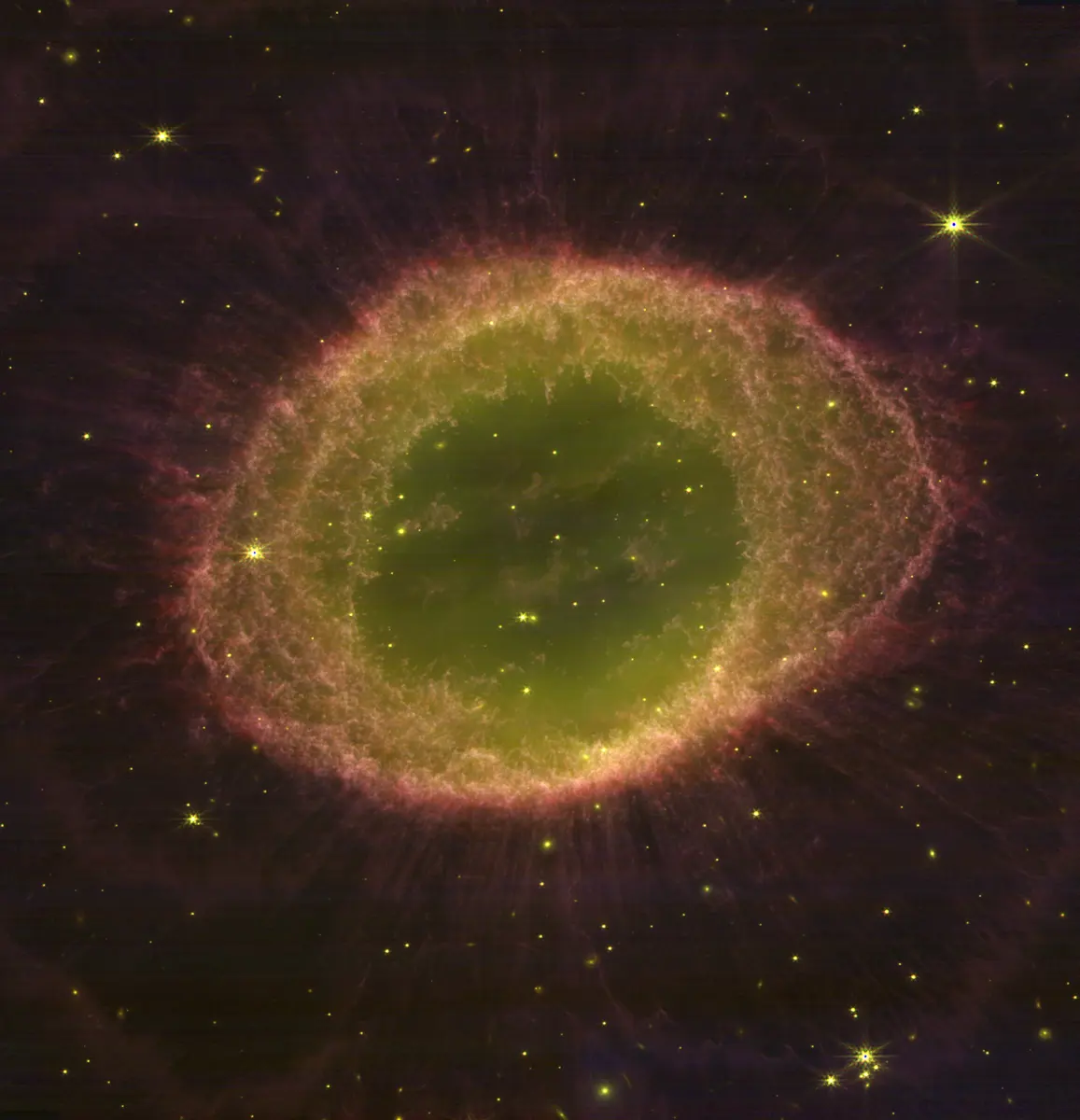
Gently, from giants. A star of up to about 8 Suns swells into a giant at the end of its life Grade 9: Death of a star. In its last stages, stirring inside it carries carbon and nitrogen up to its surface, and a strong wind blows its outer layers away, finally as a glowing planetary nebula. Most of the carbon and nitrogen in you came out this way.
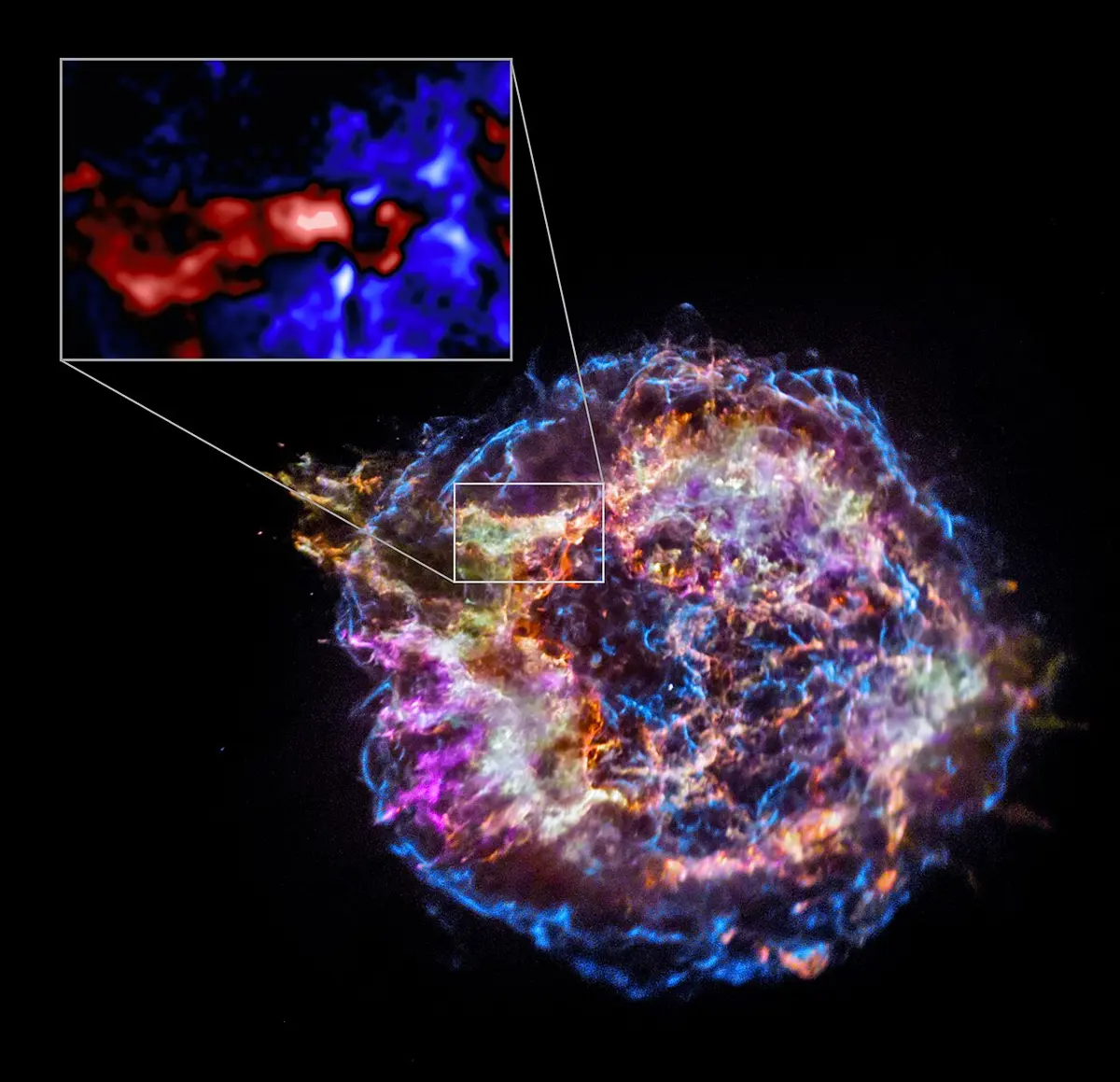
In a blast, from massive stars. A supernova throws out most of the star at thousands of kilometers per second, with the layers of its onion: oxygen, neon, magnesium, silicon, sulphur, calcium. All the oxygen in your body came from stars that exploded like this.
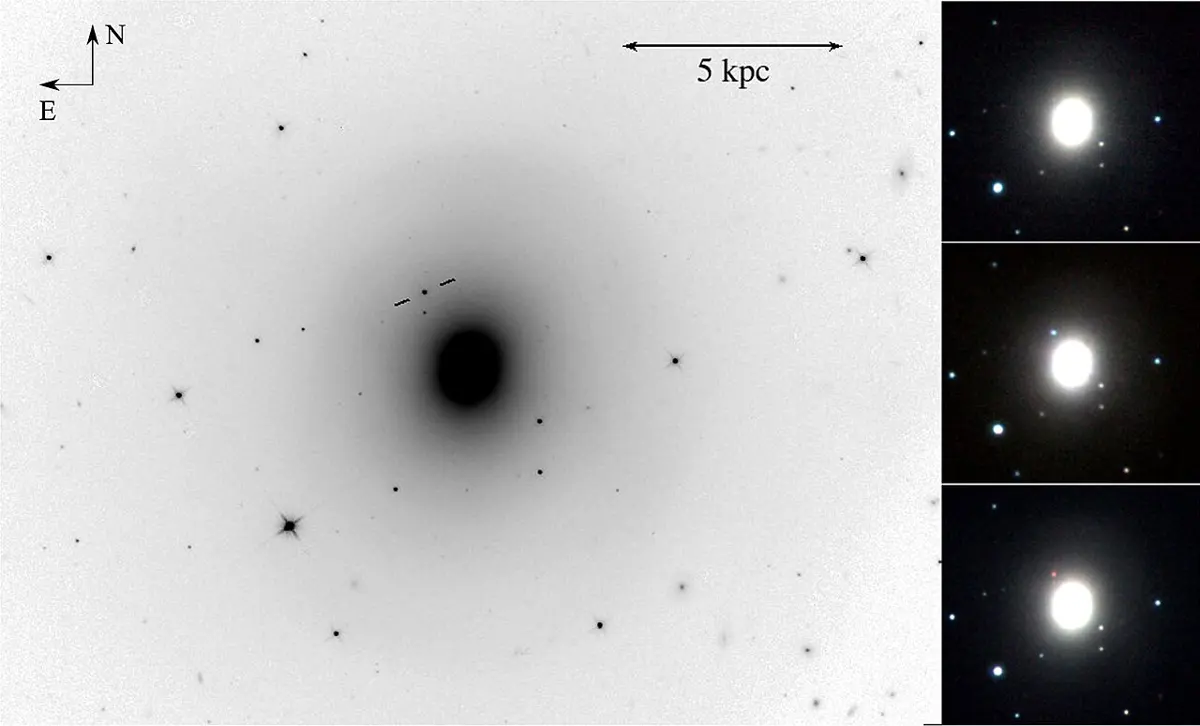
From exploding white dwarfs. A white dwarf on its own just cools. But many stars come in pairs, and a white dwarf can gain mass from its partner, or merge with another white dwarf. Grade 9 told you that a white dwarf can’t be heavier than about 1.4 Suns Grade 9: The limits in solar masses. A carbon-and-oxygen white dwarf pushed close to that limit catches fire all at once and blows itself completely apart: a different kind of supernova. Its carbon and oxygen are burned in a second into silicon, calcium and especially iron and nickel. About two-thirds of the iron in your blood was made this way.
By cosmic rays. Space is crossed by cosmic rays: nuclei flying at nearly the speed of light, mostly protons. When one hits a carbon, nitrogen or oxygen nucleus in the thin gas between the stars, it can chip pieces off. Some of the pieces are lithium, beryllium and boron. Stars don’t make beryllium and boron at all, and they destroy all three in their hot insides, because they fuse at only a few million kelvin (some giant stars do make a little lithium near their surface and blow it out). That explains the deep dip in the graph: almost all the beryllium and boron in the universe was made by cosmic rays, slowly, a nucleus at a time.
Heavier than iron: catching neutrons
If fusion stops at iron, how are gold, iodine, silver, lead and uranium made? Not by fusion at all.
A neutron has no charge, so a nucleus doesn’t repel it. Even iron, or anything else, can catch a passing neutron easily. Each neutron caught makes the nucleus one mass number heavier, the same element. Catch one too many and the nucleus becomes unstable. Then, sooner or later, it beta decays (Beta decay): a neutron in it turns into a proton, and the atomic number goes up by one. It has become the next element. Catching neutrons and beta decaying, over and over, a nucleus climbs the whole periodic table.
There are two ways for this to happen, at very different speeds.
Slowly, in giant stars
In an old giant star of one to a few times the Sun’s mass, near the end of its life, nuclear reactions in the layers round its core give off a gentle stream of neutrons. A nucleus there catches one only every few years or decades. So when it becomes unstable, it nearly always decays before the next neutron arrives, and it climbs the table one step at a time, through the stable nuclei, just as you probably did in the widget. This is the slow neutron-capture process, or s-process. It makes about half of the heavy atoms past iron, among them most of the barium and strontium and about half the lead, and the stars’ winds carry them out into space. The s-process ends at lead and bismuth: past them, the next nuclei fall apart again.
In a flash, when dead stars collide
The other half of the heavy elements, including nearly all the gold, platinum, iodine and uranium, need a flood of neutrons so dense that a nucleus catches one every thousandth of a second or so, dozens to hundreds of them within about a second, so fast that nuclei swell with neutrons long before they can decay. Only when the flood stops do they beta decay, many times in a row, back towards stable nuclei. This is the rapid neutron-capture process, or r-process.
That needs one of the most neutron-rich places in the universe. Grade 9 told you that a neutron star is a ball of neutrons only about 20 km across Grade 9: Nova, supernova, and what is left. Two neutron stars orbiting each other slowly spiral together, and when they finally collide, some of their neutron-rich matter is flung out into space, and the r-process happens in it.
Why can a nucleus catch a neutron much more easily than it can fuse with a proton or a helium nucleus?
Pick an answer to see why.
A periodic table of where elements were made
Put all of this together, element by element, and you get a periodic table of origins. The American astronomer Jennifer Johnson made one from the measured amounts and the latest models, in 2017; it was published in her review in the journal Science in 2019, and it has been reprinted around the world since.
Now add it up for your own body. Combine the table of what you are made of with Johnson’s table of where each element came from:
So about three-quarters of your mass was made in massive stars that exploded, mostly as oxygen; about a sixth in dying giant stars, mostly as carbon and nitrogen; and a tenth, your hydrogen, in the Big Bang. But by number of atoms, nearly two-thirds of you is from the Big Bang: 13.8 billion years old. The iodine in your thyroid, about 0.02 g, came mostly from colliding neutron stars.

Questions
Which element in your body was not made inside a star?
Pick an answer to see why.
A massive star’s core has just run out of silicon. What happens next?
Pick an answer to see why.
Explain why the Big Bang made hardly any elements heavier than helium, but stars made them.
Answer
In the Big Bang, protons and neutrons could fuse only between about 3 and 20 minutes after the start: before that it was too hot for nuclei to survive, and after it the universe had cooled and spread out too much for nuclei to meet. In that time almost all the neutrons went into helium-4. Going further was blocked, because there is no stable nucleus with 5 or 8 nucleons: helium plus a proton, or helium plus helium, falls apart at once. Stars stay hot and dense for millions or billions of years. In a star’s core, at about 100 million K, there is time and crowding enough for a third helium nucleus to hit beryllium-8 in the moment it exists, making carbon (the triple-alpha process); from carbon, further fusion builds heavier elements.
Use the table of the 20-Sun star to describe how the temperature at the center, and the length of each stage, change as the star moves to heavier fuels. Explain both changes.
Answer
The temperature rises at every stage: from 37 million K for hydrogen to 190 million K for helium, 870 million K for carbon and 3.3 billion K for silicon. Heavier nuclei have bigger charges and repel each other more strongly (the product of the charges goes from 1 for hydrogen to 64 for oxygen), so they must move faster, at a higher temperature, to get close enough to fuse.
The stages get shorter: 8.1 million years for hydrogen, 1.2 million for helium, about 1,000 years for carbon, and 11 days for silicon (oxygen, at about 1.3 years, lasts a little longer than neon, but both are short). Every fuel after hydrogen gives out far less energy per kilogram (0.71 % of the mass for hydrogen into helium, 0.065 % for helium into carbon, 0.01 to 0.03 % for the later stages), and from carbon burning on, the hot core loses more and more energy as neutrinos, so it has to burn its fuel faster and faster.
In a star’s helium-burning core, a carbon-12 nucleus can catch a helium-4 nucleus and become oxygen-16, and an oxygen-16 nucleus can catch another and become neon-20. The masses are: carbon-12, 12.000000 u; helium-4, 4.002603 u; oxygen-16, 15.994915 u; neon-20, 19.992440 u. (i) Find the energy given out when carbon-12 and helium-4 fuse into oxygen-16. (ii) Find the energy given out when oxygen-16 and helium-4 fuse into neon-20. Use 1 u = 931.5 MeV.
Answer
- i.Mass lost = 12.000000 + 4.002603 − 15.994915 = 0.007688 u. Energy = 0.007688 × 931.5 = 7.16 MeV.
- ii.Mass lost = 15.994915 + 4.002603 − 19.992440 = 0.005078 u. Energy = 0.005078 × 931.5 = 4.73 MeV.
Both give out energy: they move up towards the peak of the binding-energy curve.
The iodine in iodized salt is iodine-127 (53 protons). Starting from iron-56 (26 protons, 30 neutrons), how many neutrons must be caught and how many beta decays must happen to make it? By Johnson’s table, which process made most of it, and where? Describe how that process differs from the other one.
Answer
Neutrons caught: 127 − 56 = 71. Beta decays: 53 − 26 = 27 (check: 30 + 71 − 27 = 74 neutrons, and 53 + 74 = 127 ✓).
By Johnson’s table, 95 % of the iodine came from the r-process, in merging neutron stars. In the r-process, neutrons arrive so fast that a nucleus catches dozens to hundreds of them within about a second, so nuclei swell with neutrons far beyond the stable ones before they can decay; when the flood stops, they beta decay many times in a row until they reach a stable nucleus. In the s-process, in old giant stars, a nucleus catches a neutron only every few decades, so it decays as soon as it becomes unstable, and climbs through the stable nuclei one step at a time.
Technetium has no stable isotope; its longest-lived kind has a half-life of about 4 million years. Explain why finding technetium in the spectra of giant stars that are billions of years old shows that stars are making elements now.
Answer
Every 4 million years, half of any technetium decays. A star billions of years old has lived for hundreds of half-lives, and after even 100 half-lives only (½)¹⁰⁰ ≈ 10⁻³⁰ of the original would be left: none at all. So the technetium seen in the star’s outer layers can’t have been there since the star formed. It must have been made inside the star within the last few million years and carried up to the surface, where its lines are seen. Since it was made by catching neutrons, it shows that the s-process is happening in such stars today.
A younger student asks you: “Where did the calcium in my bones come from?” Write a short answer, in order, that follows a calcium atom from where it was made to your bones.
Answer
A good answer has these steps, in order:
- The calcium was made by fusion in a star: either in the oxygen and silicon layers of a massive star just before it exploded as a supernova, or in a white dwarf that blew itself apart (Johnson’s table gives about half from each).
- The explosion threw the calcium out into space, where it mixed with the gas and dust between the stars.
- About 4.6 billion years ago, a cloud of that gas and dust collapsed to form the Sun and its planets, so the calcium became part of the rocks of the Earth.
- Over billions of years, the rocks weathered, and the calcium dissolved into soil and water.
- Plants took it up from the soil, and animals ate the plants. You got it from your food: milk, dal, green vegetables.
- Your body built it into your bones. One day, it will go back into the soil.
In the graph of the Solar System’s elements (Figure 32.1), lithium, beryllium and boron are hundreds of thousands to millions of times rarer than carbon, though they are lighter. Explain this, using where Johnson’s table says they come from.
Answer
Lithium, beryllium and boron fuse easily at fairly low temperatures, a few million kelvin, so a star destroys them rather than making them; and the Big Bang made only a trace of lithium and none of the other two. Almost all the beryllium and boron, and some of the lithium, were made by cosmic rays: fast nuclei that hit carbon, nitrogen and oxygen nuclei in space and chip pieces off. That happens one nucleus at a time, slowly, so very little has been made. (Johnson’s table gives most of the lithium to dying low-mass stars, which make a little in their outer layers.)
Where to go next
- How Long Will the Sun Shine? The Sun’s own life: how long its hydrogen lasts, and how it will end as a white dwarf of carbon and oxygen.
- How Do We Know the Universe Is Expanding? The evidence for the Big Bang, including the helium it made in its first minutes.
- How Old Is the Earth? Uranium made in colliding neutron stars decays at a steady rate, and that is how the Earth’s age was measured.