
Water channels and salt gates
Nobel Prize in Chemistry, 2003: Peter Agre and Roderick MacKinnon

Peter Agre
born 1949 in Northfield, Minnesota, USA
A doctor who studied blood. He found the water channel by accident, while looking for something else.
Photo: Nobel Media, CC BY 3.0
Roderick MacKinnon
born 1956 in Burlington, Massachusetts, USA
He worked as a doctor first and began research at about 30, then taught himself a new way of seeing molecules to answer one question.
Photo: PotassiumChannel, CC BY-SA 3.0
Drink a big glass of water on a hot day in Terai. Within minutes the water has left your stomach and intestines, gone into your blood, and reached cells all over your body. An hour later your kidneys may be sending some of it out again. All that time, the water is passing through the walls of cells.
The walls of cells are made of a fatty layer, and water does not pass easily through fat. So how does it get through so fast? And how do the salts in your body, which carry the signals in every nerve, get through? In 2003 the Nobel Prize in Chemistry went to two Americans who found the answers: Peter Agre, who discovered the water channels, and Roderick MacKinnon, who showed, atom by atom, how a salt channel works.
The problem: a wall that has to let things through
Every cell is wrapped in a thin covering, the cell membrane Grade 8: The covering of the cell. It is made of two layers of fat-like molecules, about four millionths of a millimeter thick in all. It keeps the inside of the cell in and the outside out.
But a cell must also let things through: water, food, waste, and ions. An ion is an atom that has lost or gained electrons, so it carries an electric charge Grade 9: Ion. When table salt dissolves, it splits into sodium ions (Na⁺) and chloride ions (Cl⁻). Your body also uses potassium ions (K⁺) and calcium ions (Ca²⁺).
Charged ions cannot pass through the fatty middle of the membrane at all, and water passes through it only slowly. Yet red blood cells and kidney cells let water in and out very fast. By the 1950s scientists were sure there must be tiny pores, holes, that let water through but not ions. They had found that mercury compounds slowed the water down, as if they blocked the holes. But for more than thirty years nobody could find the pore itself.
Osmosis: water moves on its own
Water moves through a membrane by osmosis. If the water on one side has more salt or sugar dissolved in it, water moves towards that side, as if to dilute it. This is why salt draws water out of vegetables when you make achar Grade 10: Natural food preservatives, and why a raisin left in plain water swells up. A cell in pure water swells as water rushes in, and a cell in very salty water shrinks.
A red blood cell is put into pure water. What happens?
Pick an answer to see why.
Why it was hard
Both problems were about proteins: large molecules, made of long chains of building blocks, that do most of the work in a cell. The channels had to be proteins sitting across the membrane. But:
- Finding them. A membrane holds hundreds of different proteins. Which one was the water pore?
- Seeing them. To know how a channel picks what to let through, you have to see where its atoms are. The usual way is X-ray crystallography: grow a crystal of the protein, shine X-rays through it, and work out the positions of the atoms from the pattern the X-rays make. Proteins that sit in fatty membranes are greasy and floppy, and they almost never form good crystals.
What they did, step by step
Agre: the protein nobody had seen
Peter Agre was a doctor and a blood scientist at Johns Hopkins University in Baltimore. He was not looking for water channels at all.
- Mid-1980s, an accident. He was studying the Rh blood group protein of red blood cells, the “positive” or “negative” in a blood group such as B+ Grade 10: Blood group. His samples kept containing a smaller protein that nobody had noticed before, because it did not show up with the usual stains. At first he thought it was a broken piece of the Rh protein, or dirt.
- A lot of it. It turned out to be a new protein, and a very common one: about 200,000 copies in every red blood cell. He found it in the kidneys too. Its shape suggested a channel, but a channel for what? He asked a dozen experts. None knew.
- A clue. His old teacher, John Parker, pointed out that red blood cells and kidney tubes are both very leaky to water. Perhaps the protein was the long-lost water pore.
- 1992, the frog eggs. To test it, his team used the eggs of an African frog. These eggs hardly let water in, and they survive even in pond water. Into some eggs they injected the instructions (RNA) for making the protein; others got only water. Three days later all the eggs looked the same. Then they put them in pure water. The eggs without the protein stayed as they were. The eggs with the protein swelled and burst within a few minutes, “like popcorn,” Agre said.
- The proof. Small bubbles of membrane with the protein added let water through very fast; without it, slowly. Mercury stopped the water, just as it did in red blood cells. Agre named the protein aquaporin, “water pore.”
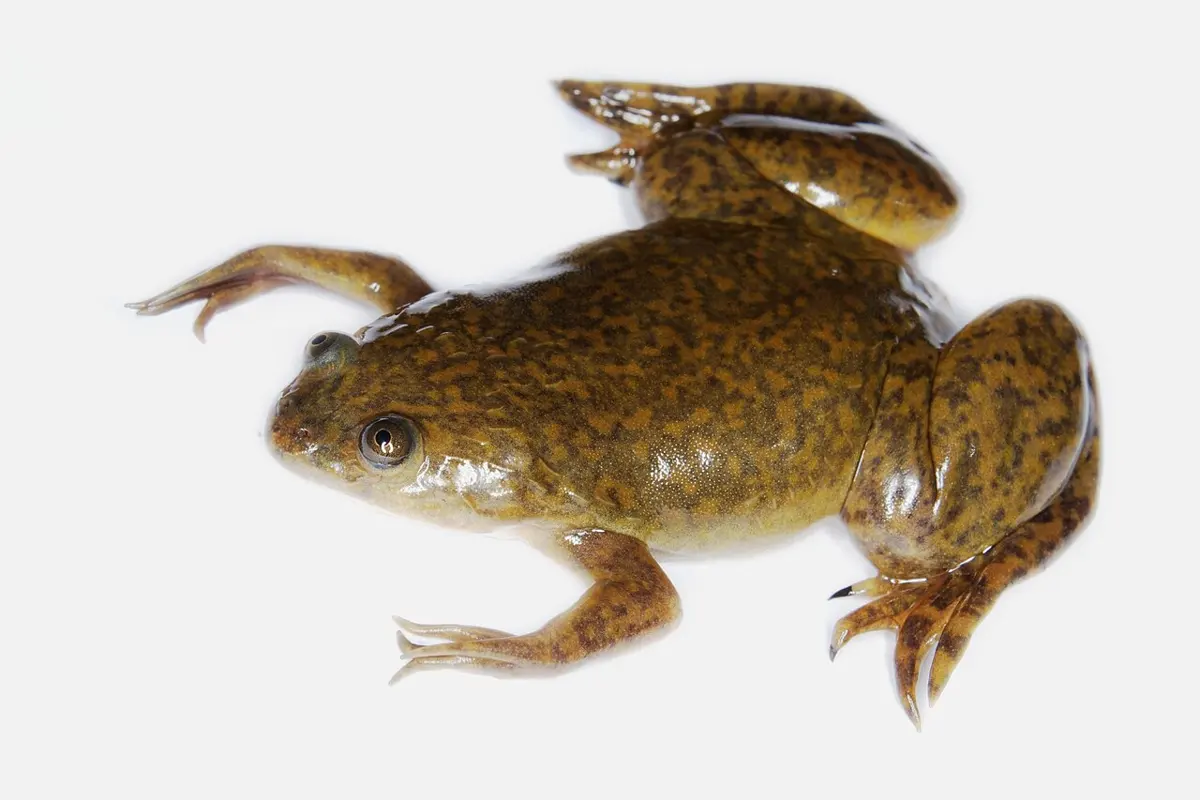
Why did Agre use frog eggs for his test?
Pick an answer to see why.
How the water channel picks water
By 2000, Agre and other teams had seen the shape of aquaporin in detail. (Sources give 1999 or 2000; the most detailed pictures came in 2000.)
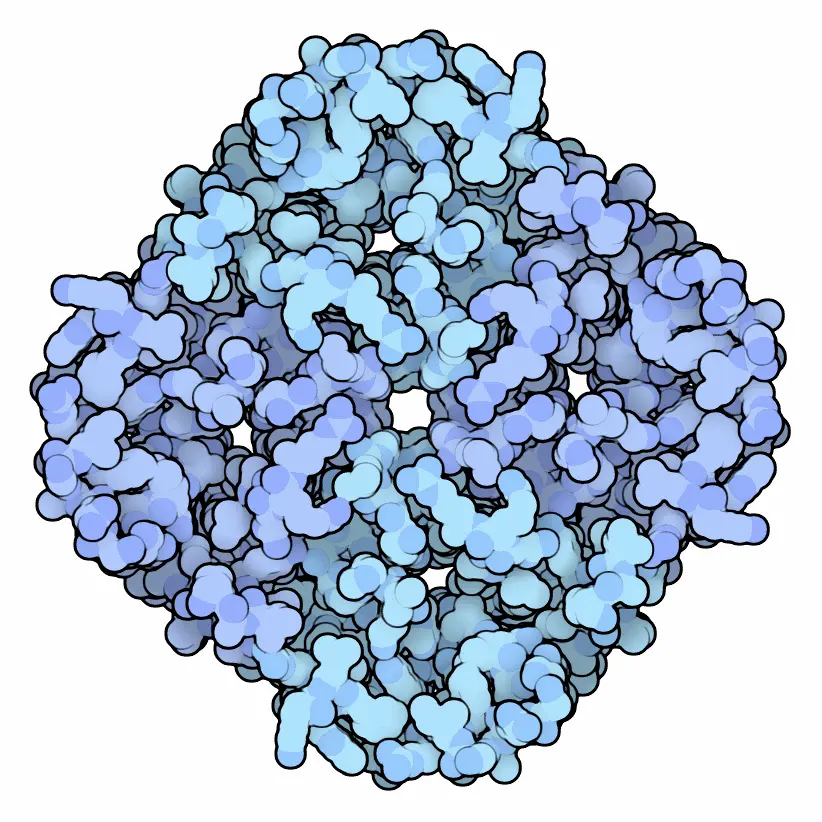
- Each aquaporin has a pore so narrow that water molecules must pass through in single file, one behind another.
- About 3 billion water molecules pass through one pore every second.
- Halfway along, the pore has a positive charge. Positive ions, such as the H⁺ of acids (which in water travels as H₃O⁺), are pushed back. This matters: the cell keeps different amounts of H⁺ on its two sides and uses the difference to store energy, so it must not leak.
MacKinnon: seeing the potassium gate
Salt channels, called ion channels, were already famous. In the 1950s Alan Hodgkin and Andrew Huxley had shown that every nerve signal is a wave of sodium and potassium ions flowing in and out through the membrane of a nerve cell (they won the Nobel Prize in Physiology or Medicine in 1963) Grade 9: Neuron or nerve cell. Channels had to open and shut, and each kind had to let in only its own ion.
The biggest puzzle was the potassium channel. It lets potassium ions through but stops sodium ions. Yet a sodium ion is smaller than a potassium ion. How can a door let the big one in and keep the small one out?
- 1982–1986. Roderick MacKinnon trained as a doctor and worked in a hospital. Then he went back to research. “My scientific career in effect began at the age of 30,” he said later.
- Learning to see. He became sure that the answer needed a picture of the channel, atom by atom. Many thought such a crystal could never be made. He learned X-ray crystallography himself, and in 1996 moved to Rockefeller University in New York.
- A bacterium’s channel. Human channels were too hard to crystallize, so he used a potassium channel from a soil bacterium, Streptomyces lividans. It is very similar to ours; it is even blocked by the same scorpion poisons.
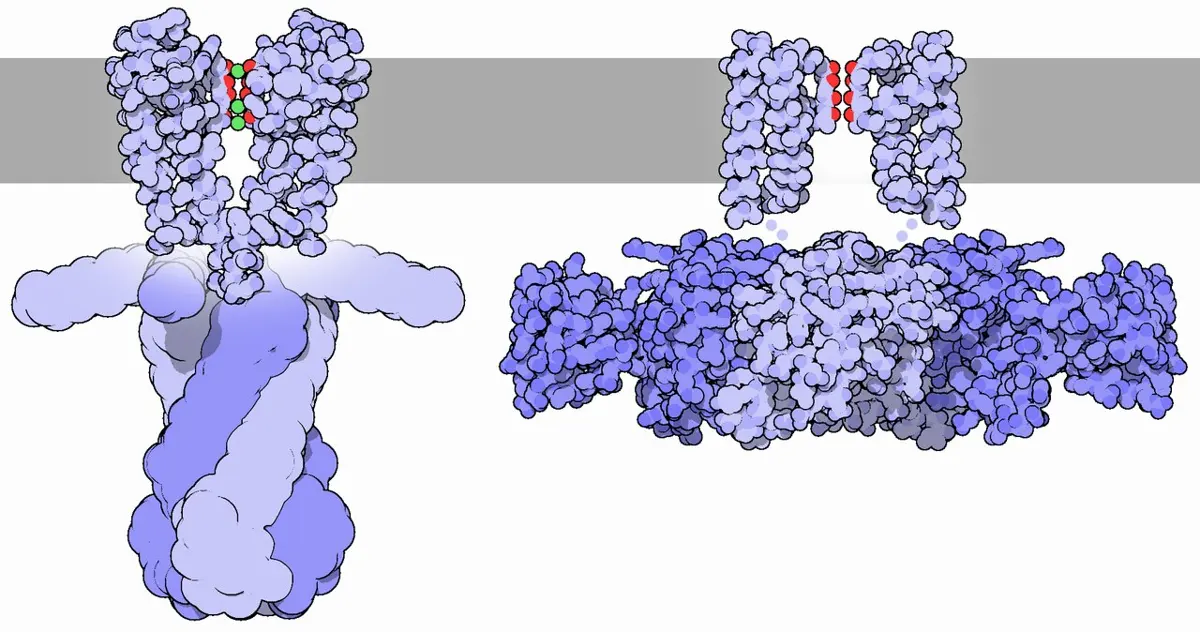
- April 1998, the picture. His team published the first atom-by-atom picture of an ion channel. You could even see the potassium ions lined up inside it.
How the potassium filter works
In water, each potassium ion is surrounded by water molecules. The oxygen atoms of the water face the ion, at a particular distance. To enter the channel, the ion must leave its water behind, and that normally costs energy.
The narrowest part of the channel, the filter, is lined with oxygen atoms of the protein itself. They sit at exactly the same distance from a potassium ion as the water’s oxygen atoms did. So a potassium ion swaps its water for the protein’s oxygen atoms at no cost, and slides through. Up to about 100 million ions can pass through one channel in a second.
A sodium ion is too small to touch all of the filter’s oxygen atoms at once. It is much happier keeping its water, so it stays outside. The filter picks potassium over sodium by size, but not the way a sieve does.
MacKinnon also showed how channels open and close. At the bottom of the channel is a gate. A part of the protein, a sensor, opens it in answer to a signal: a change in the voltage across the membrane, or a chemical such as calcium.
In your life today
- Your kidneys. Every day your kidneys filter about 170–180 liters of fluid out of your blood, yet you pass only one or two liters of urine. Water channels take most of the water back: one kind (AQP1) about 70%, and another (AQP2) about 10%, controlled by a hormone. When you are thirsty, this hormone, ADH, sends more AQP2 channels to the kidney’s walls, and your urine becomes dark (Water, breath and heartbeat). People who lack the hormone, or whose AQP2 channels don’t work, can pass 10–15 liters of urine a day.
- Every thought and heartbeat. Each nerve signal and each heartbeat is ions flowing through channels. Faulty channels cause some heart rhythm problems and some kinds of epilepsy.
- At the dentist. The injection that numbs your tooth (lidocaine) works by blocking the sodium channels of the nerves, so pain signals can’t travel.
- Plants. Plants have many aquaporins too, especially in their roots. They help a plant take up water and keep its stems firm.
What came next
- A whole family. Humans have 13 kinds of aquaporin, in the kidneys, eyes, brain, skin and elsewhere. One in the lens of the eye, when faulty, causes cataracts in babies.
- New medicines. Many medicines act on ion channels: for the heart, for epilepsy, for pain. Pictures of channels, atom by atom, help design new ones.
- Cleaner water. Engineers are testing water filters with aquaporins built into them, to take salt out of sea water using less energy.
- An open question. MacKinnon’s team went on to study channels that open when the membrane is stretched, which let us feel touch and hear. How exactly such a channel feels a push is still being worked out.
In your science books
- Grade 8: the cell membrane, the covering of the cell.
- Grade 9: ions and the nerve cell.
- Grade 10: blood groups, red blood cells and salt as a preservative (osmosis).
- Going Further: messages along nerves and how your kidneys keep your water steady.
Learn more
- The Nobel Prize’s own explanation: Channels in cell membranes (nobelprize.org).
- The laureates’ Nobel lectures: Agre and MacKinnon.
The official reason
The prize was given “for the discovery of water channels.”
The prize was given “for structural and mechanistic studies of ion channels.”