
- Atomic number
- 49
- Atomic mass
- 114.82
- Shells
- 2, 8, 18, 18, 3
- Configuration
- 1s² 2s² 2p⁶ 3s² 3p⁶ 4s² 3d¹⁰ 4p⁶ 5s² 4d¹⁰ 5p¹
- In the table
- period 5, group 13 (IIIA), p-block
- Kind
- Other metal
- Valency
- 3 (In³⁺); sometimes 1 (In⁺)
- State at 25 °C
- solid
- Melts · boils
- 157 °C · 2,072 °C
- Density
- 7.3 × as heavy as water
- Known since
- 1863
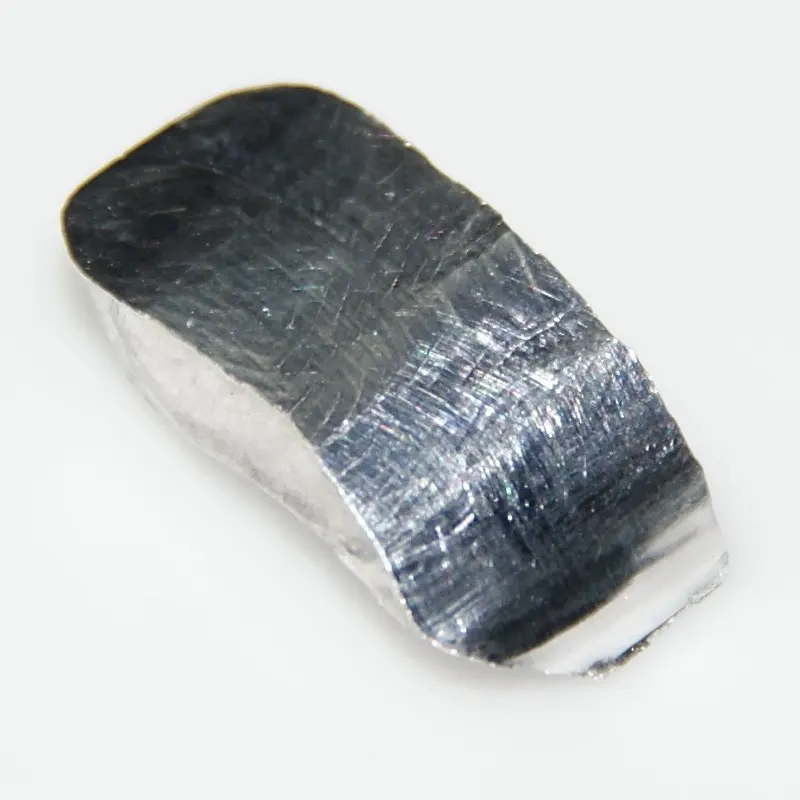
Touch the screen of a phone and it knows exactly where your finger is. Yet the screen looks like plain glass: there are no wires to be seen. The wires are there, but they are made of something you can see through: a coating of indium tin oxide, only a ten-thousandth of a millimeter thick.
Indium is a rare, silvery metal, so soft you can scratch it with a fingernail, that sticks to glass and squeaks when you bend it. A hundred years ago the whole world had only about a gram of it; today it is in almost every phone in Nepal. Here is its story.
The indium atom
Every indium atom has 49 protons, so indium’s atomic number is 49, and a neutral atom has 49 electrons. Most indium atoms (about 96 in 100) have 66 neutrons, so their mass number is 49 + 66 = 115.
By the 2n² rule Grade 8: Bohr and Bury’s rule, the K, L and M shells take 2, 8 and 18 electrons. The N shell takes 18 more before a fifth shell, O, starts, and the last 3 go there: 2, 8, 18, 18, 3.
In subshells Grade 10: The Aufbau principle, indium fills 5s and 4d, then puts its last electron in 5p:
1s² 2s² 2p⁶ 3s² 3p⁶ 4s² 3d¹⁰ 4p⁶ 5s² 4d¹⁰ 5p¹
Its place in the periodic table
- Period 5, because its electrons are in five shells.
- Group 13, called IIIA in the older naming, because it has 3 outer electrons (5s² 5p¹). Above it are boron, aluminium and gallium; below it is thallium.
- p-block, because its last electron goes into a p subshell.
Like aluminium, indium gives up its three outer electrons to form In³⁺ ions, so its usual valency is 3 Grade 9: Valency: indium oxide is In₂O₃ and indium chloride InCl₃. Indium can also lose just its one 5p electron to form In⁺, so it has variable valency Grade 9: Variable valency. Going down a group, the elements become more metallic Grade 10: Electropositivity, and indium, low in group 13, is a soft metal, a post-transition metal.
Indium is in the same group as aluminium. What is the formula of indium oxide?
Pick an answer to see why.
How indium was found and named
In 1863, at the mining school in Freiberg, Germany, the chemist Ferdinand Reich was testing zinc blende from the local mines. He hoped to find thallium, an element discovered two years before by the bright green line in its light. A spectroscope spreads an element’s glowing light into its colors, and every element gives its own pattern of sharp colored lines, like a fingerprint (Why each element has its own lines).
But Reich had a problem: he was color-blind. So he asked his assistant, Hieronymus Theodor Richter, to look. Richter saw no green line. He saw a brilliant indigo-blue line that belonged to no known element. They named the new metal indium, after indigo, symbol In. The word indigo comes from Latin indicum, “from India”, because the blue dye came to Europe from India.
Within a few years Richter had made enough of the metal to show a bar of it. Then the two men quarreled, because Richter began to call himself the discoverer.
Where indium is found
In the universe. Indium was built in old, swollen giant stars, where atoms catch neutrons one at a time over thousands of years and slowly grow heavier (Heavier than iron).
In the Earth’s crust. Indium is one of the rarer metals: about 0.05 grams in every tonne of rock, about as rare as silver. It almost never forms minerals of its own. Instead, a little of it hides in the ores of other metals, above all in zinc blende (ZnS), the ore in which Reich found it. So, like cadmium, indium is collected as a by-product when zinc is refined. In 2024 the world refined only about 1,100 tonnes of new indium, about 70% of it in China, followed by South Korea and Japan. Japan and South Korea also recover a lot of indium by recycling the scraps left over from making screens.
In Nepal. Nepal produces no indium. But it is in the screen of nearly every phone, television and laptop in the country.
In your body. None that matters: indium does no job in any living thing.
What indium is like
- Silvery and shiny, and it stays shiny in air.
- Very soft: softer than lead. It can be cut with a knife, scratched with a fingernail, and it leaves a gray line on paper like a pencil.
- It cries. Bend a bar of pure indium and it gives a faint, high-pitched squeak, as tin does, made by its crystals sliding over one another.
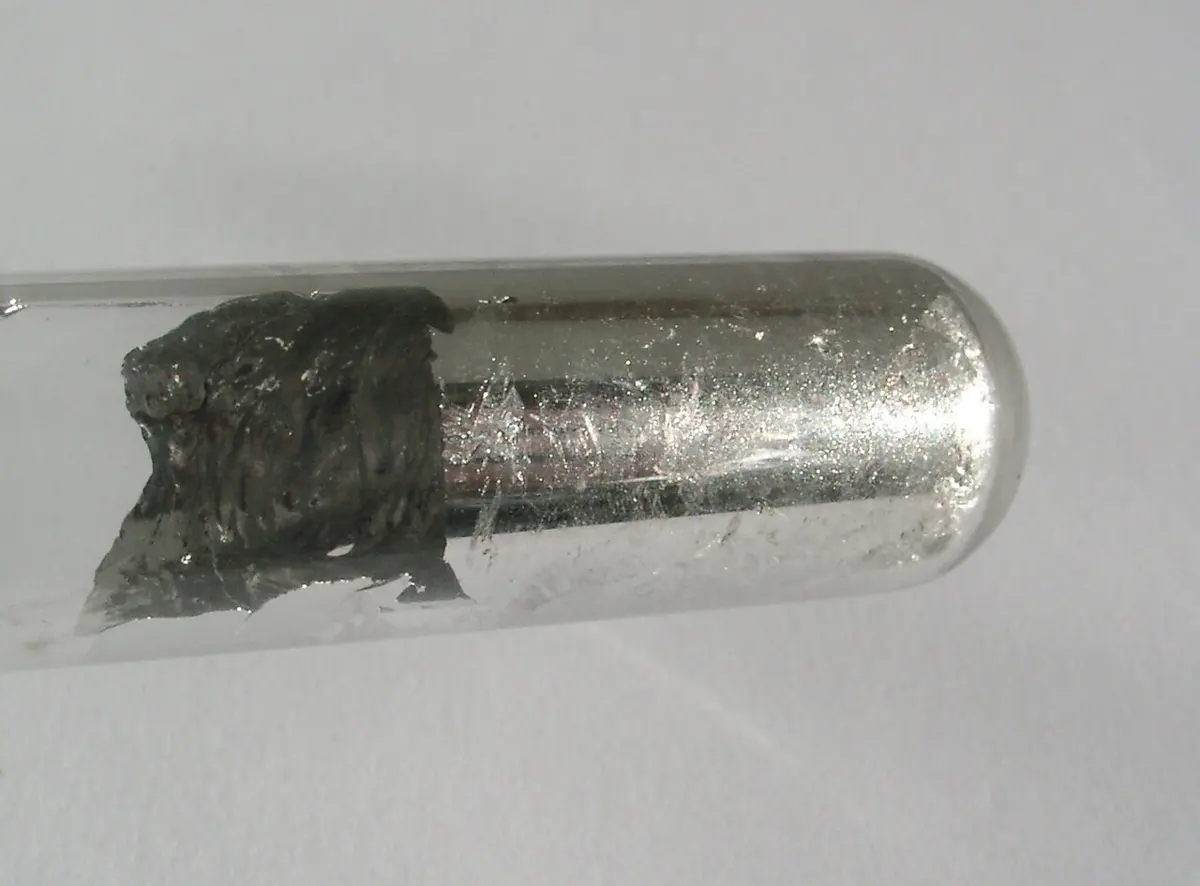
- It sticks to glass. Melted indium spreads over clean glass and clings to it, so it is used to make tight seals in very cold and vacuum equipment.
- Melts at 157 °C, hardly hotter than a kitchen oven, but boils at 2,072 °C. It stays liquid over a range of more than 1,900 °C.
- Density 7.31 g/cm³, a little less than iron.
How indium reacts
Indium is fairly unreactive, a little like tin. It does not react with water, and it keeps its shine in air at room temperature.
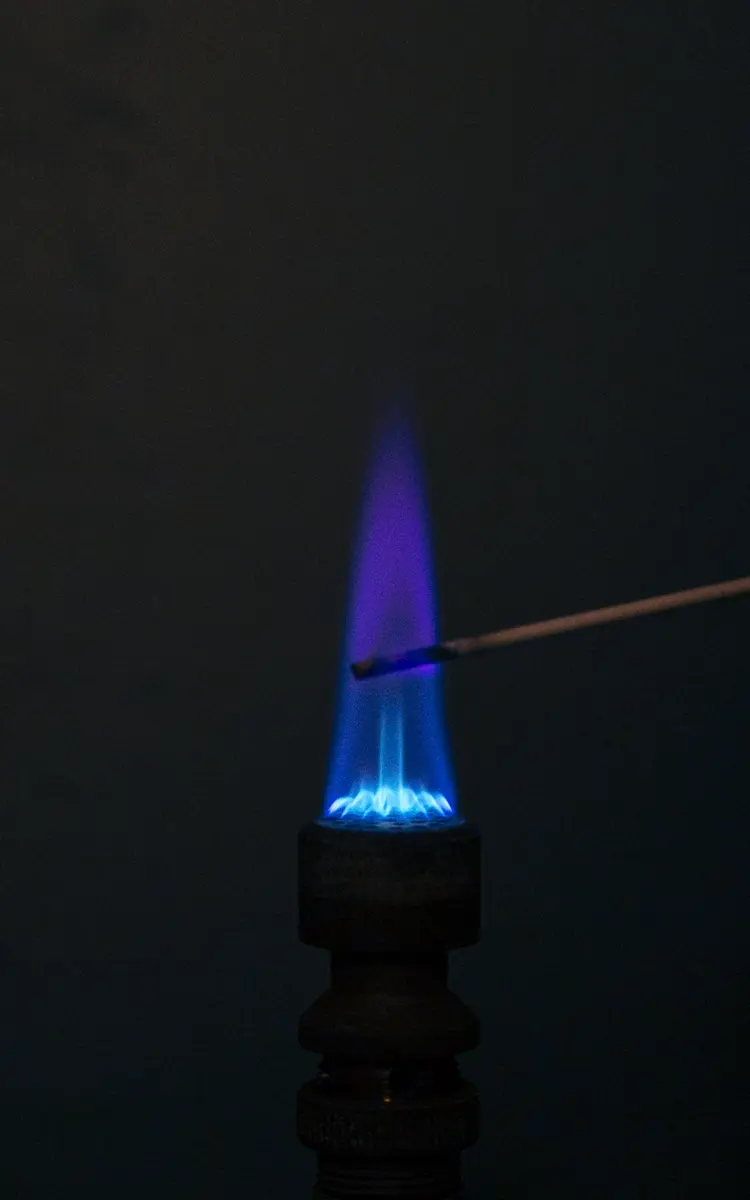
Heated in air, it burns with a violet flame to indium oxide Grade 9: Metals react with oxygen:
4In + 3O₂ → 2In₂O₃
With dilute acids, it dissolves and gives off hydrogen, like zinc and iron Grade 9: Metals and dilute acids:
2In + 6HCl → 2InCl₃ + 3H₂
How many molecules of hydrogen are given off when two atoms of indium react with hydrochloric acid?
Pick an answer to see why.
Indium tin oxide: wires you can see through
Metals conduct electricity because their outer electrons move freely Grade 9: Metals are good conductors of electricity. The same free electrons soak up and reflect light, which is why metals are shiny and you cannot see through them. Glass lets light through but does not conduct. A screen needs both at once.
Indium tin oxide (ITO) is indium oxide with about a tenth of tin oxide mixed in. Each tin atom adds a spare electron that can move, so the solid conducts electricity. Yet the electrons are few enough, and the oxide clear enough, that a thin layer lets visible light through. Laid on glass as a film about a ten-thousandth of a millimeter thick, it makes an electrode you can look straight through. More than half of all the indium used goes into ITO.
How a touch screen finds your finger
Most phones have a capacitive touch screen. Under the cover glass lie two sets of very thin ITO strips, one running across the screen and one running up and down, separated by a thin layer that does not conduct. Wherever a strip crosses a strip, the pair stores a tiny electric charge. Your finger also conducts electricity (your body is mostly salty water), so when it comes close to a crossing, it draws away some of the electric field there. A chip checks every crossing many times a second, finds where the charge has changed, and works out where you touched.

That is why a touch screen does not work through thick gloves, but works with a special pen whose tip conducts. ITO also carries the current in the screens of televisions and laptops, and in many solar panels, where light must get in and electricity out.
Indium in daily life
Blue and white LEDs. The blue LED, which won the Nobel Prize in Physics in 2014, is made of indium gallium nitride. Adding a little indium to gallium nitride made its light bluer and much brighter. Every white LED bulb in Nepali homes starts with such a blue LED, coated to turn part of its light yellow (Gallium).
The internet’s light. Indium phosphide (InP) makes the tiny lasers and light detectors that send and receive the flashes of infrared light carrying data along optical fibers, the cables of the internet.
Low-melting metals. Indium lowers the melting point of alloys. Solders with indium join delicate electronics, and some alloys of indium with gallium and tin are liquid at room temperature, used in place of mercury in some thermometers.
Control rods. The control rods of many nuclear reactors are 80% silver, 15% indium and 5% cadmium, three metals whose nuclei all catch neutrons (Cadmium).
Medicine. A radioactive isotope, indium-111 (half-life 2.8 days), is attached to a patient’s own white blood cells, which are put back into the blood. The cells gather where there is an infection, and a camera that sees the indium’s gamma rays shows the doctor where it is.
Isotopes of indium
Natural indium is a mixture of two isotopes Grade 9: Atomic mass: about 4.3% indium-113 (64 neutrons) and 95.7% indium-115 (66 neutrons).
The surprise is that the common one, indium-115, is radioactive. It gives out beta particles (Beta decay), but so slowly that its half-life is about 440 million million years, some 30,000 times the age of the universe. A piece of indium is far too weakly radioactive to harm anyone. Indium is one of the very few elements whose commonest natural atoms are radioactive.
Indium and your health
Your body has no use for indium, and you take in almost none: what is swallowed is hardly absorbed. Indium in a phone or a solder joint is harmless to touch.
The danger is dust. Workers who breathed fine dust of indium tin oxide for years, while grinding and polishing it in factories, have developed a serious lung disease. Factories that make or recycle ITO now control the dust.
Surprising facts and records
- A gram in the world. Until 1924, the world’s whole supply of separated indium was about one gram. Its first big use came in the Second World War, coating the bearings of aircraft engines.
- Bite it. Indium is so soft that a person can leave tooth marks in it.
- A new blue. In 2009, chemists in the USA mixing indium, yttrium and manganese oxides by chance made YInMn blue, the first new blue pigment found in about 200 years.
- Cold and super. Cooled to within 3.4 degrees of absolute zero (about −270 °C), indium becomes a superconductor, carrying electricity with no resistance at all Grade 9: Resistance.
In your science books
- Grade 8: the 2n² rule and groups and periods.
- Grade 9: valency, atomic mass, metals as conductors and resistance.
- Grade 10: electronic configuration and how properties change down a group.
- Going further: why each element has its own lines, beta decay and where the atoms in your body came from.
More to explore
- Nobel Prizes with indium in them: blue LEDs (2014, indium gallium nitride).
- Neighbors: gallium above it, cadmium and tin beside it, and zinc, whose ore it hides in.
- Play: find indium in Guess the Element and the Periodic Table Jigsaw.
- Read more: indium at the Royal Society of Chemistry and at PubChem.