
- Atomic number
- 68
- Atomic mass
- 167.26
- Shells
- 2, 8, 18, 30, 8, 2
- Configuration
- 1s² 2s² 2p⁶ 3s² 3p⁶ 4s² 3d¹⁰ 4p⁶ 5s² 4d¹⁰ 5p⁶ 6s² 4f¹²
- In the table
- period 6, group none (f-block), f-block
- Kind
- Lanthanide
- Valency
- 3 (Er³⁺)
- State at 25 °C
- solid
- Melts · boils
- 1,529 °C · 2,868 °C
- Density
- 9.1 × as heavy as water
- Known since
- 1843
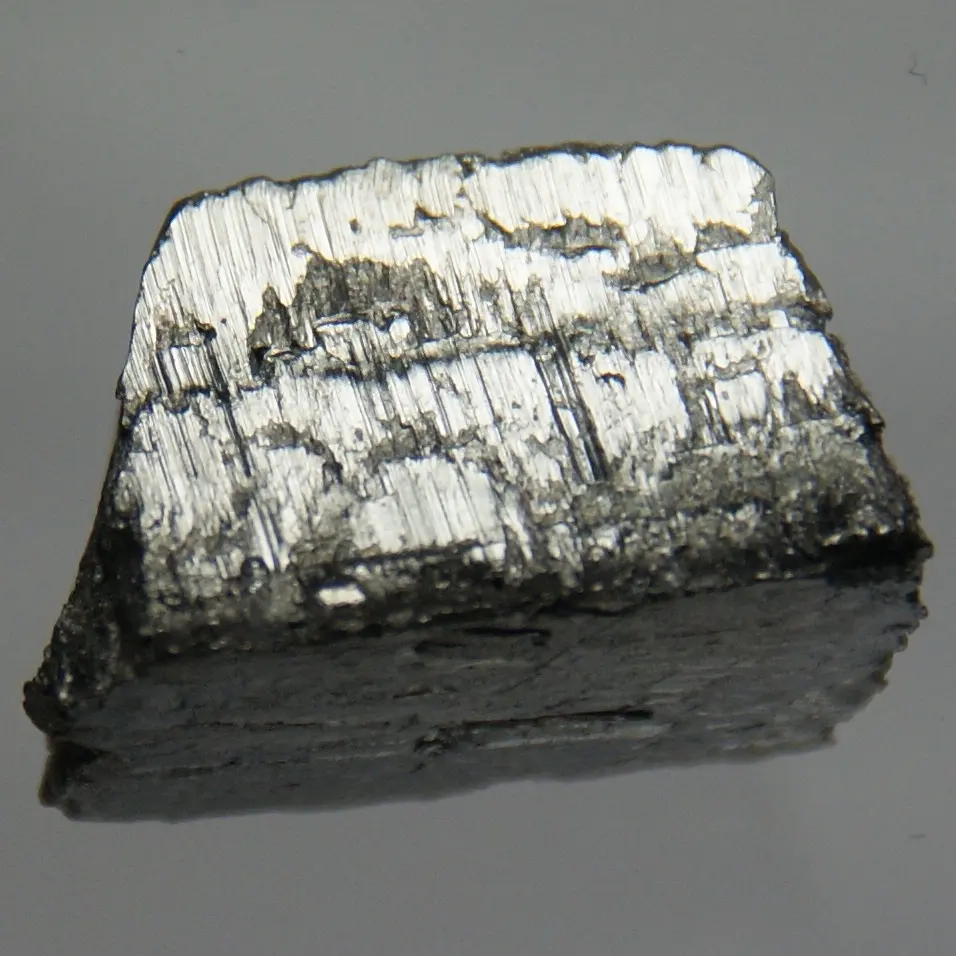
When you watch a video in Nepal, the data often comes from a computer in another country, thousands of kilometers away. For much of the way it travels as flashes of invisible light along hair-thin glass fibers, many of them laid across the bottom of the sea. Light fades as it goes, so along the way it is made strong again, many times, by a short length of glass fiber with a little erbium (say UR-bee-um) in it. Erbium is the twelfth lanthanide, a soft silvery metal whose compounds are pink.
The erbium atom
An erbium atom has 68 protons and 68 electrons. Natural erbium is a mixture of six isotopes. The commonest, erbium-166 (about a third), has 98 neutrons: 68 + 98 = 166. The atomic mass, 167.26, is the average of the mixture Grade 9: Atomic mass.
By shells its electrons are 2, 8, 18, 30, 8, 2. In subshells it ends 6s² 4f¹² Grade 10: The Aufbau principle.
Its place and valency
- Period 6, the twelfth lanthanide (f-block), between holmium (67) and thulium (69) (fifteen near-twins).
- It loses three electrons and becomes Er³⁺, with a valency of 3: erbium chloride is ErCl₃ and erbium oxide Er₂O₃.
How many electrons does an Er³⁺ ion have?
Pick an answer to see why.
How erbium was found and named
In 1794 the Finnish chemist Johan Gadolin found a new earth, yttria, in a black mineral from the quarry at Ytterby, near Stockholm in Sweden (yttrium’s story). In 1843 the Swedish chemist Carl Gustaf Mosander showed that yttria was a mixture. Besides yttria itself, he separated two new oxides and named them, after the village, erbia and terbia. The symbol of erbium is Er.
The two were so alike that chemists soon mixed up their names. The rose-pink oxide we call erbia today is the one Mosander had called terbia, and his yellowish “erbia” is today’s terbia (terbium’s story).
And erbia was not pure either. It turned out to hide five more elements, one inside another, each found by chemists who split it a little further:
Fairly pure erbium oxide was made only in 1905, and the metal in 1934, when the German chemists Wilhelm Klemm and Heinrich Bommer heated purified erbium chloride with potassium.
Where erbium is found
In the universe, erbium is made in stars by catching neutrons (Catching neutrons).
In the Earth’s crust there are about 3 grams in a tonne of rock. It is mined with the other rare earths from minerals such as xenotime and monazite, and from clays in southern China, which supplies most of it. In 2025 erbium oxide cost about 46 US dollars a kilogram (USGS, 2026).
In Nepal and in your body. Nepal mines no rare earths. Your body has no use for erbium.
What erbium is like and how it reacts
- A soft, silvery metal that can be hammered into shape Grade 9: Properties of metals.
- In air it keeps its shine when dry and tarnishes slowly in moist air. Heated, it burns to the pink oxide: 4Er + 3O₂ → 2Er₂O₃.
- With water, slowly when cold and fairly quickly when hot, giving erbium hydroxide and hydrogen Grade 9: Very reactive metals and water:
2Er + 6H₂O → 2Er(OH)₃ + 3H₂ - With dilute acids, readily, giving hydrogen and a rose-pink solution of Er³⁺.
Why erbium is pink
Almost every compound of erbium is pink: the oxide, the chloride, the sulphate. The color comes from the Er³⁺ ion itself. Its 4f electrons can take in light, but only light of a few exact energies, so the ion absorbs a few narrow bands of color from white light, mostly in the green. White light with some green taken out looks pink. The 4f electrons lie deep inside the ion, shielded by the electrons outside them, so whatever the ion is joined to hardly changes those bands, and every erbium compound is much the same pink.
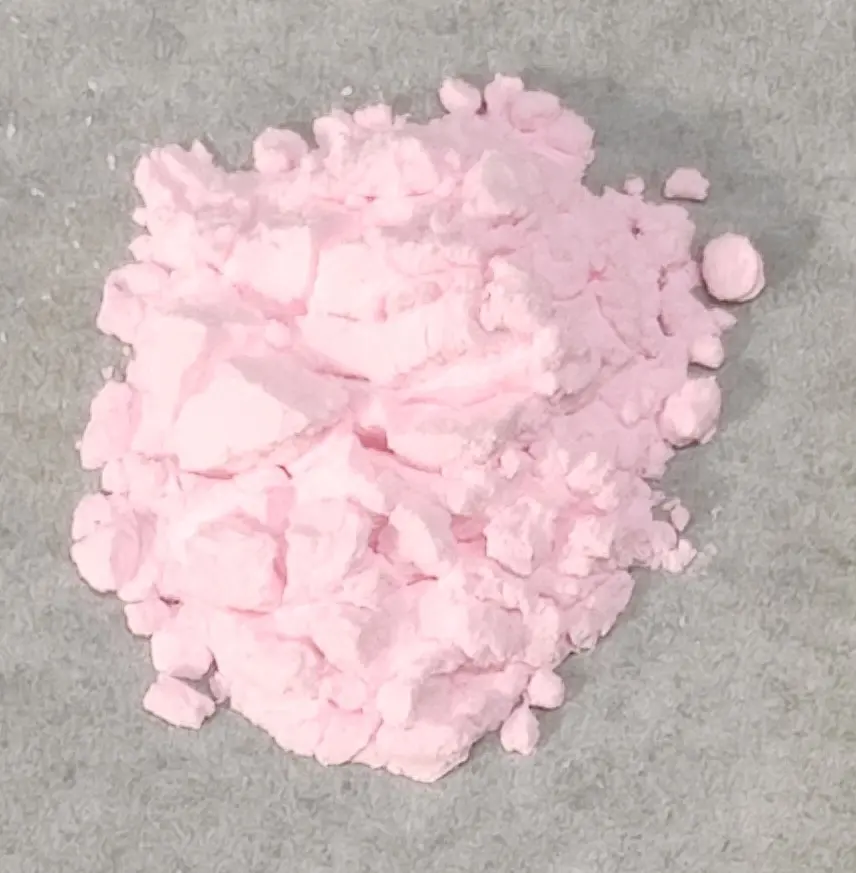
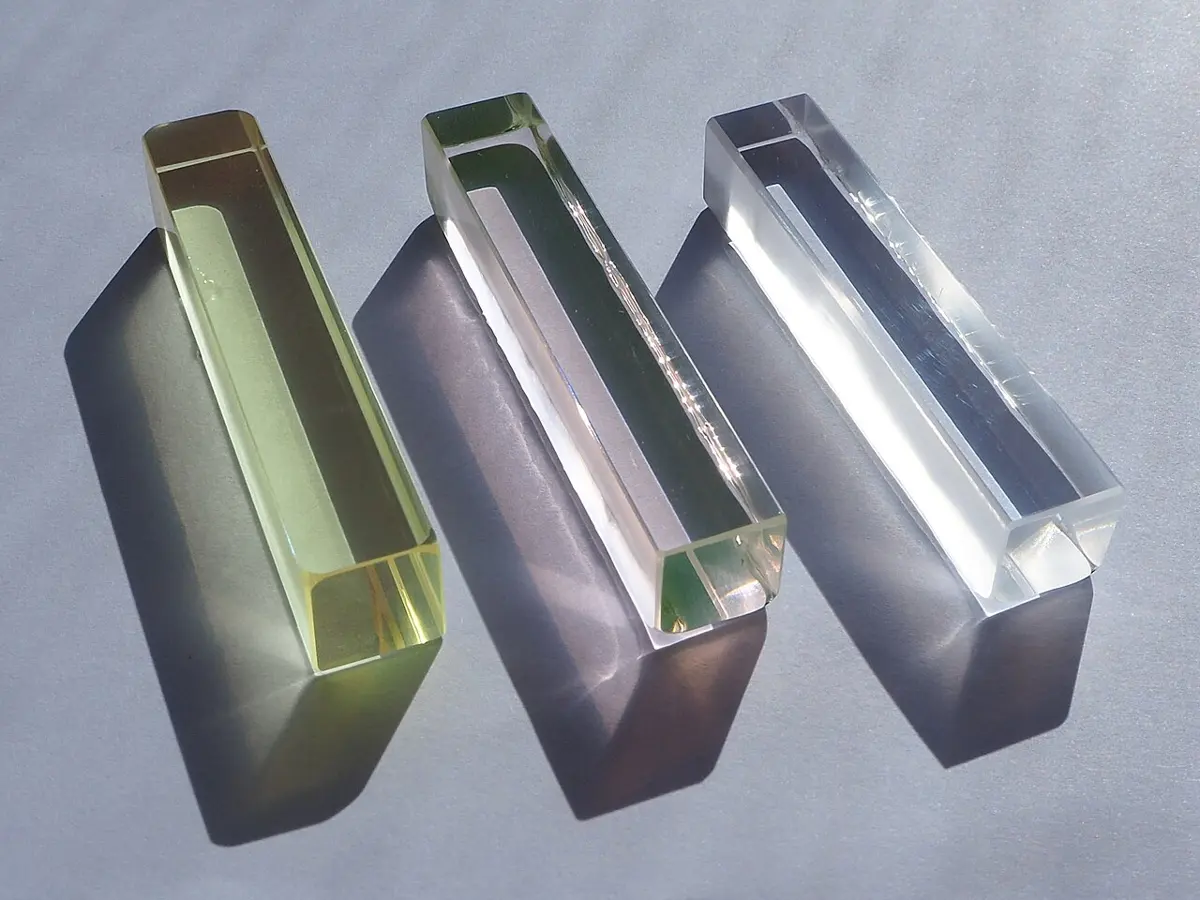
So erbium oxide is used to color glass and cubic zirconia pink, in some sunglasses and cheap jewelry. Glass with erbium also soaks up infrared light, so it is used in some safety glasses for welders and metal workers.
Erbium chloride, erbium sulphate and erbium oxide are all pink. What does this tell you?
Pick an answer to see why.
Erbium and the internet
Most of the internet’s long-distance traffic goes as flashes of infrared light along optical fibers, thin threads of very pure glass that keep the light inside by total internal reflection Grade 10: Optical fibers in telecommunication. A flash means 1 and no flash means 0 Grade 10: Binary numbers.
Even the purest glass is not perfectly clear. In good modern fiber, a few percent of the light is lost in every kilometer, so after some tens of kilometers the flashes are too faint to read. The light used is at a wavelength of about 1,550 nm, in the infrared, because glass fiber loses the least light there.
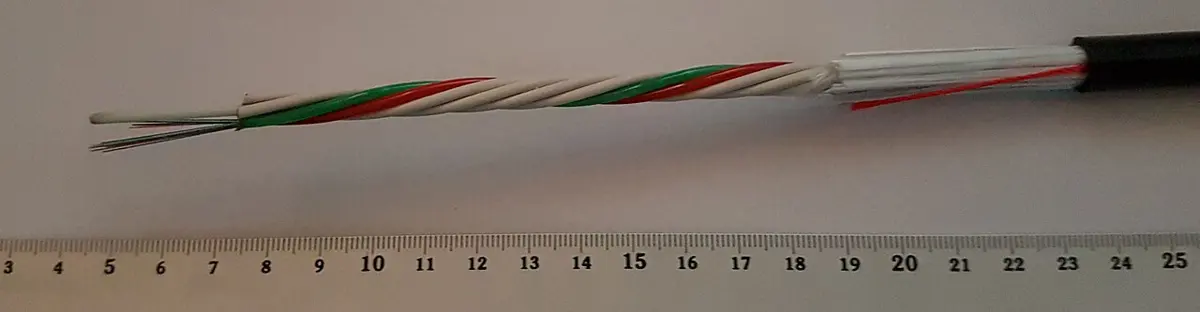
Before 1987, the faint light had to be turned into an electric signal at each stop, made strong in an electronic circuit and turned back into light. Then two teams, one at the University of Southampton in Britain and one at Bell Labs in the USA, showed a simpler way: the erbium-doped fiber amplifier. A short length of fiber has a little erbium in its core. A small pump laser shines extra light into it, at 980 nm, which lifts the Er³⁺ ions to a higher energy. When a flash of the signal passes, it makes the excited ions give up their energy as more light of exactly the same color, going the same way, in step with it. The flash comes out much stronger, still as light, with no electronics in between.
By luck, the wavelength that erbium amplifies, around 1,550 nm, is just where glass fiber loses least light. And one amplifier boosts many signals of slightly different colors at once. Undersea cables have an amplifier every 50 to 150 kilometers or so, sitting on the sea floor, and the long cables on land use them too. Without erbium, the internet could not carry anything like as much as it does.
Other uses
- Lasers for teeth and skin. A crystal of yttrium aluminium garnet with erbium makes the Er:YAG laser, whose infrared light, at 2,940 nm, is soaked up by water even more strongly than the holmium laser’s. Its energy stays in a very thin layer, so dentists use it to remove decay from teeth and skin doctors to smooth the surface of the skin (yttrium’s lasers).
- Easier metal. A little erbium makes vanadium softer and easier to shape.
Erbium and your health
Erbium has no known job in the body and is of low toxicity. As a fine powder the metal can catch fire.
In your science books
- Grade 9: atomic mass, the properties of metals and the internet.
- Grade 10: the Aufbau principle, the lanthanides, total internal reflection, optical fibers and binary numbers.
- Going further: where erbium is made.
More to explore
- Its neighbors: holmium before it, one of the elements hiding in erbia, and dysprosium, another; terbium, whose name it swapped; yttrium, with the story of Ytterby, and lanthanum, with the story of the whole row.
- Play: find erbium in Guess the Element, the Periodic Table Jigsaw and Higher or Lower.
- Read more: erbium at the Royal Society of Chemistry and at PubChem.