
- Atomic number
- 62
- Atomic mass
- 150.36
- Shells
- 2, 8, 18, 24, 8, 2
- Configuration
- 1s² 2s² 2p⁶ 3s² 3p⁶ 4s² 3d¹⁰ 4p⁶ 5s² 4d¹⁰ 5p⁶ 6s² 4f⁶
- In the table
- period 6, group none (f-block), f-block
- Kind
- Lanthanide
- Valency
- 3, sometimes 2 (Sm³⁺, Sm²⁺)
- State at 25 °C
- solid
- Melts · boils
- 1,074 °C · 1,794 °C
- Density
- 7.5 × as heavy as water
- Known since
- 1879
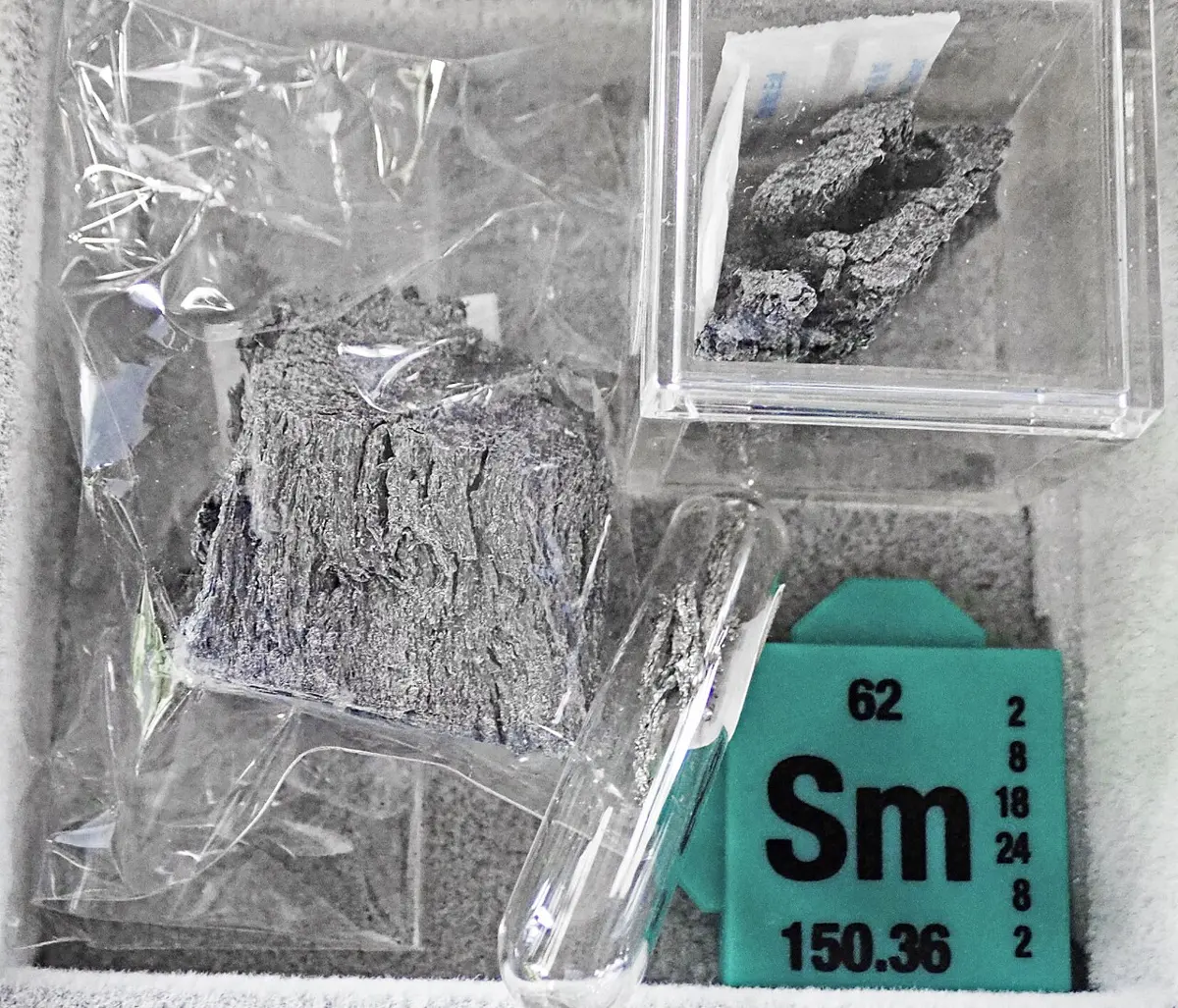
Some magnets have to work in places too hot for a neodymium magnet: in aircraft and missiles, beside motors that run hot, in the tubes that make the microwaves for radar. For these, engineers use magnets of samarium (say sa-MAIR-ee-um) and cobalt. And geologists use samarium for something quite different: its atoms tick, very slowly, like a clock, and they have dated the oldest rocks of the Earth and the Moon.
Samarium is the sixth lanthanide, two places after neodymium. It is also the first element whose name honors a person, even if only through a rock.
The samarium atom
A samarium atom has 62 protons and 62 electrons. Natural samarium is a mixture of seven isotopes; the commonest, about 27% of the atoms, is samarium-152, with 90 neutrons: 62 + 90 = 152.
By shells its electrons are 2, 8, 18, 24, 8, 2. In subshells it ends 6s² 4f⁶ Grade 10: The Aufbau principle: six of the seven 4f boxes have one electron each.
Its place and valency
- Period 6, the sixth lanthanide (f-block), after promethium (61). How its row works: fifteen near-twins.
- Usually it loses three electrons to become Sm³⁺, so its valency is 3: samarium oxide is Sm₂O₃, the chloride SmCl₃ Grade 9: The criss-cross method.
- Unlike most lanthanides, it can also lose just its two 6s electrons and form Sm²⁺, with a valency of 2 Grade 9: Variable valency. Sm²⁺ is so eager to give away another electron that chemists use its compounds to push electrons onto other molecules.
Samarium oxide is Sm₂O₃. What is the valency of samarium in it?
Pick an answer to see why.
How samarium was found and named
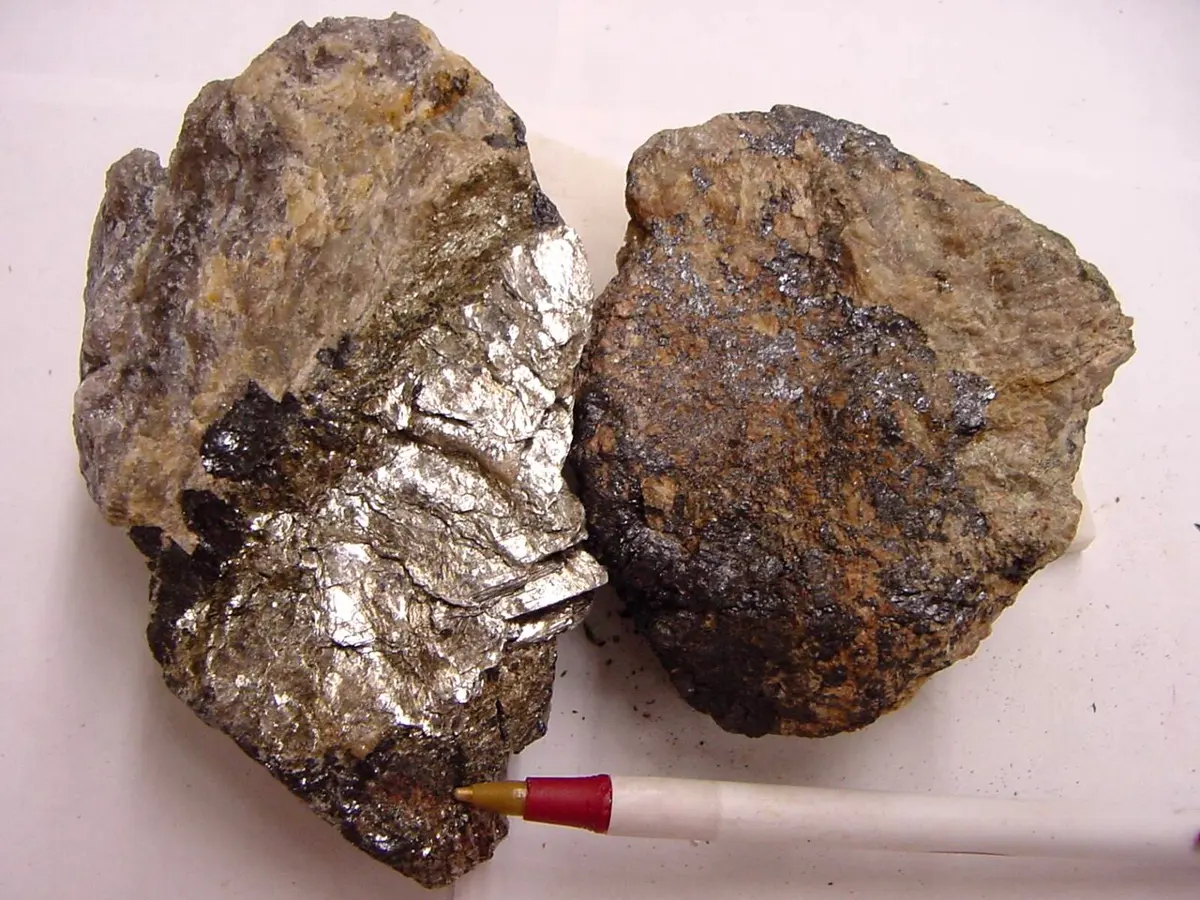
Samarskite is a heavy, black mineral first found in the Ural Mountains of Russia. It was named after Vasili Samarsky-Bykhovets, a Russian army colonel and mining official.
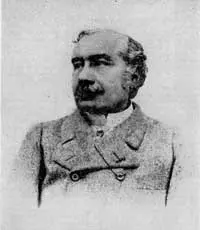
In 1879, in Paris, Paul-Émile Lecoq de Boisbaudran took didymium (the “twin” earth that was soon to be split into praseodymium and neodymium) out of samarskite. He added ammonia to a solution of it and saw the precipitate come down in two stages. The first part soaked up light in sharp lines of its own: a new element. He named it samarium, after the mineral, and so, indirectly, after the colonel. The symbol is Sm. (The Swiss chemist Marc Delafontaine had announced a “decipium” from samarskite a year before; it turned out to be a mixture that held samarium.)
Samarium itself was not pure either: gadolinium was found in it in 1886 and europium in 1901.
Where samarium is found
In the universe, it is made in stars by catching neutrons (Catching neutrons).
In the Earth’s crust there are about 7 grams in a tonne of rock, mined with the other rare earths from monazite (up to about 3% samarium) and bastnäsite (where the rare earths come from). Samarium oxide is cheap: in 2025 about 3 US dollars a kilogram, against 73 for neodymium oxide (USGS, 2026). Almost all of it is separated in China, and in April 2025 China began to limit its export, with that of several other rare earths, because samarium magnets are needed for aircraft and weapons (USGS, 2026).
In Nepal and in your body. Nepal mines no rare earths. Your body has no use for samarium.
What samarium is like and how it reacts
- A silvery metal, about as hard and dense as zinc (density 7.52 g/cm³). It slowly dulls in air, as a layer of oxide forms.
- It boils at a low temperature for a lanthanide, below 2,000 °C (lanthanum boils at about 3,460 °C). Factories use this to make it pure: they heat its oxide with lanthanum metal, and the samarium boils off.
- With water, slowly when cold and quickly when hot Grade 9: Very reactive metals and water:
2Sm + 6H₂O → 2Sm(OH)₃ + 3H₂ - With dilute acids, readily, giving pale yellow-green solutions of Sm³⁺ Grade 9: Metals and dilute acids:
2Sm + 3H₂SO₄ → Sm₂(SO₄)₃ + 3H₂
Samarium–cobalt magnets
Before neodymium magnets came along in the 1980s, the strongest magnets in the world were made of samarium and cobalt, first in the 1960s: SmCo₅ (one samarium atom to five cobalt atoms) and later Sm₂Co₁₇. They made small headphones and the first personal cassette players possible.
Neodymium magnets are stronger, so why are samarium–cobalt magnets still made? Because of heat. A magnet loses its magnetism when heated Grade 8: Demagnetization by heating, and cobalt stays magnetic to a higher temperature than any other element. Samarium–cobalt magnets keep working at about 250–350 °C, where an ordinary neodymium magnet (safe to about 80 °C) would long have weakened. They also hardly rust, so they need no coating.
So samarium–cobalt magnets are used where it is hot or where a magnet must not drift: in aircraft and missiles, in small motors, in the tubes that make microwaves for radar, in some high-quality guitar pick-ups. They cost more, and are brittle: they chip and crack easily.
A motor must work inside an engine at 200 °C. Which magnet should the engineer choose?
Pick an answer to see why.
A clock in the rocks
One of samarium’s natural isotopes, samarium-147 (15% of samarium), is radioactive. It gives out an alpha particle, 2 protons and 2 neutrons Grade 9: Radioactive emission, and becomes neodymium-143. It does this very slowly: its half-life is about 106 billion years, nearly eight times the age of the universe.
When a rock crystallizes from molten magma, its minerals take in samarium and neodymium. From then on, the samarium-147 in each crystal slowly makes neodymium-143. The older the rock, the more extra neodymium-143 it has for its samarium. Geologists measure the two in several minerals of one rock, with a very sensitive balance for atoms (a mass spectrometer), and work out its age (A clock inside the atom).
Because the clock is so slow, it suits only very old things: the oldest rocks on Earth, rocks brought back from the Moon, and meteorites. And because samarium and neodymium are lanthanide near-twins, heating and squeezing rarely separate them, so the clock is hard to upset.
Samarium in the reactor and the hospital
- Catching neutrons. Samarium-149 absorbs neutrons very strongly, so samarium is used in some control rods of nuclear reactors, which soak up neutrons to slow the chain reaction Grade 9: Nuclear fission. Samarium-149 also builds up in the fuel itself as uranium splits, and reactor operators have to allow for it.
- Easing pain. A radioactive kind, samarium-153 (half-life about 46 hours), is joined to a molecule that bone takes up. Injected into people whose cancer has spread into their bones, it settles where the bone is being attacked and its beta rays ease the pain there.
- Glass and flints. Samarium oxide in glass soaks up infrared rays, and lighter flints contain about 1% samarium.
Samarium and your health
Samarium has no known job in the body and is of low toxicity: very little of it is absorbed from food. Like other rare-earth metals, its fine powder can catch fire.
In your science books
- Grade 8: demagnetization by heating.
- Grade 9: variable valency, the criss-cross method, radioactive emission, nuclear fission and metals and dilute acids.
- Grade 10: the Aufbau principle and the lanthanides.
- Going further: a clock inside the atom, alpha decay and where samarium is made.
More to explore
- Its neighbors: promethium before it, europium after it, neodymium, whose magnets beat it in strength, and lanthanum, with the story of the whole row.
- Its partner in magnets: cobalt.
- Play: find samarium in Guess the Element, the Periodic Table Jigsaw and Higher or Lower.
- Read more: samarium at the Royal Society of Chemistry and at PubChem.