
- Atomic number
- 53
- Atomic mass
- 126.9
- Shells
- 2, 8, 18, 18, 7
- Configuration
- 1s² 2s² 2p⁶ 3s² 3p⁶ 4s² 3d¹⁰ 4p⁶ 5s² 4d¹⁰ 5p⁵
- In the table
- period 5, group 17 (VIIA), p-block
- Kind
- Halogen
- Valency
- 1 (iodide, I⁻); also 5 and 7 with oxygen (iodate, IO₃⁻)
- State at 25 °C
- solid
- Melts · boils
- 114 °C · 184 °C
- Density
- 4.9 × as heavy as water
- Known since
- 1811
Look at a packet of salt in any shop in Nepal. Somewhere on it you will find the words iodized salt (आयोडिनयुक्त नुन) and a picture of two smiling children. The salt has a tiny amount of iodine added to it, less than a hundredth of a gram in a kilogram. That pinch has done more for the health of Nepal’s children than almost any medicine.
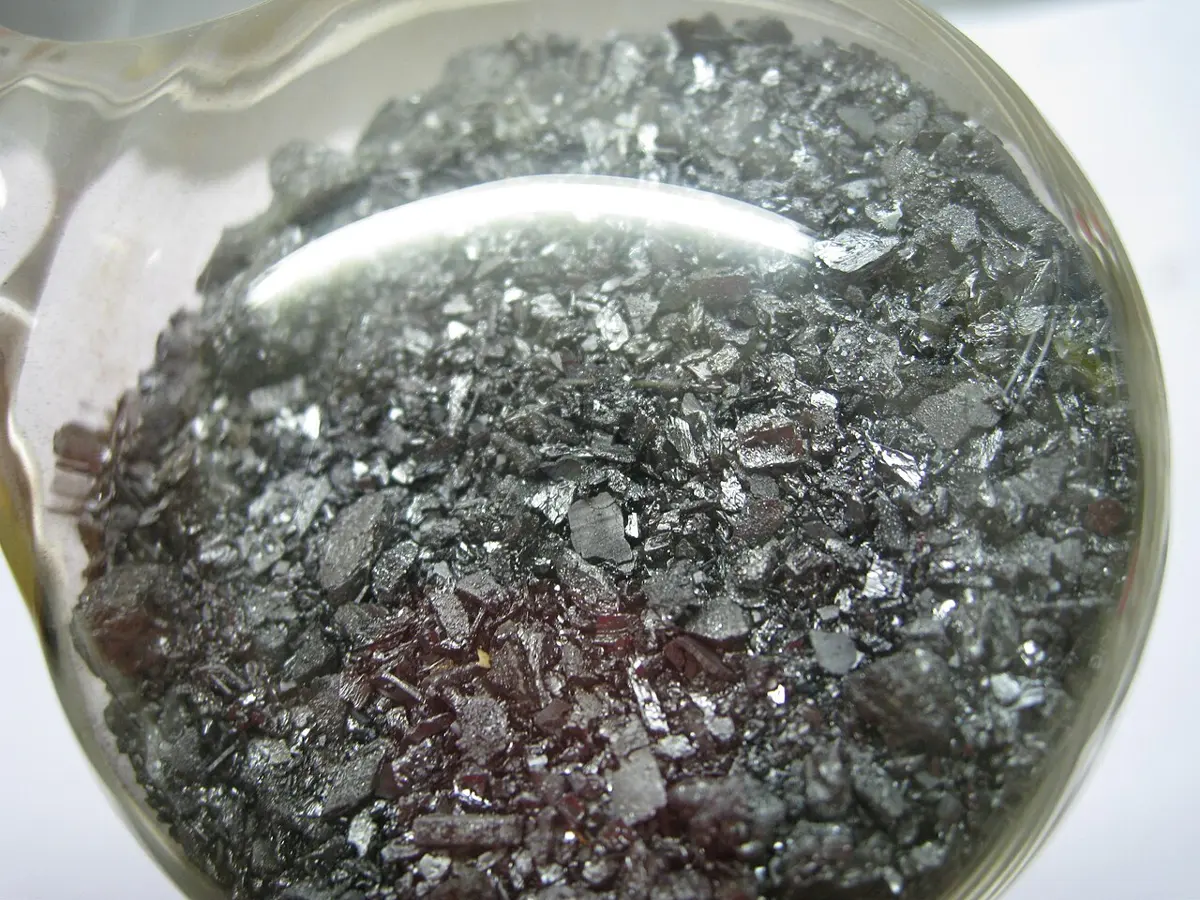
Iodine is also the brown liquid a nurse dabs on a cut, and the drop that turns a slice of potato blue-black in your science lab. On its own it is a shiny, almost black solid that, when warmed, gives off a beautiful violet vapor. Here is its story.
The iodine atom
Every iodine atom has 53 protons, so iodine’s atomic number is 53, and a neutral atom has 53 electrons. All natural iodine atoms have 74 neutrons, so their mass number is 53 + 74 = 127.
By the 2n² rule Grade 8: Bohr and Bury’s rule, the electrons fill the shells as 2, 8, 18, 18, 7. The O shell could hold far more, but an outermost shell never holds more than 8, and iodine’s has 7.
In subshells, following the Aufbau order Grade 10: The Aufbau principle:
1s² 2s² 2p⁶ 3s² 3p⁶ 4s² 3d¹⁰ 4p⁶ 5s² 4d¹⁰ 5p⁵
The outer shell is 5s² 5p⁵: seven electrons, one short of an octet Grade 9: Octet rule, the same pattern as fluorine (2s² 2p⁵) and chlorine (3s² 3p⁵).
Its place in the periodic table
- Period 5, because its electrons are in five shells. It sits between tellurium (52) and xenon (54).
- Group 17, called VIIA in the older naming, because it has 7 outer electrons.
- p-block, because its last electron goes into a p subshell. It is a non-metal Grade 10: Non-metals.
Group 17 is the halogens, the “salt-makers”: fluorine, chlorine, bromine and iodine (and the rare, radioactive astatine below it). Like the others, iodine takes one electron from a metal to become the iodide ion, I⁻, with a valency of 1, as in potassium iodide, KI Grade 9: Ions. Or two iodine atoms share a pair of electrons Grade 9: Covalent bond, which is why iodine is made of I₂ molecules. With oxygen it can also show a valency of 5, as in potassium iodate, KIO₃, one of the compounds added to salt.
Iodine is at the bottom of the common halogens, so its atom is the biggest, its outer electrons are the farthest from the nucleus, and its pull on an extra electron is the weakest. That makes iodine the least reactive of the four Grade 10: Chemical reactivity.
Which of these halogens is the least reactive?
Pick an answer to see why.
How iodine was found and named
In the early 1800s France was at war, and its army needed gunpowder, which is made with saltpeter (potassium nitrate). In Paris, Bernard Courtois made saltpeter using the ash of burnt seaweed, which is rich in potassium compounds.
One day in 1811, Courtois added strong sulphuric acid to the leftover seaweed liquid. A cloud of beautiful violet vapor rose up, and where it touched the cold metal of his vessels it formed dark, shiny crystals. Courtois guessed he had found a new substance and gave samples to other chemists. In 1813 the French chemist Joseph Gay-Lussac and the English chemist Humphry Davy, who was visiting Paris, both showed it was a new element, a cousin of chlorine.
Gay-Lussac named it iode, from the Greek iodes, violet, after the color of its vapor: hence “iodine” and the symbol I. In Nepali it is आयोडिन, a borrowed name; there is no older Nepali word.
Where iodine is found
In the universe. Iodine is heavier than iron, so it was not made by ordinary burning in stars. It was built up by atoms catching neutrons, mostly in the violent explosions and collisions of dying stars (Heavier than iron).
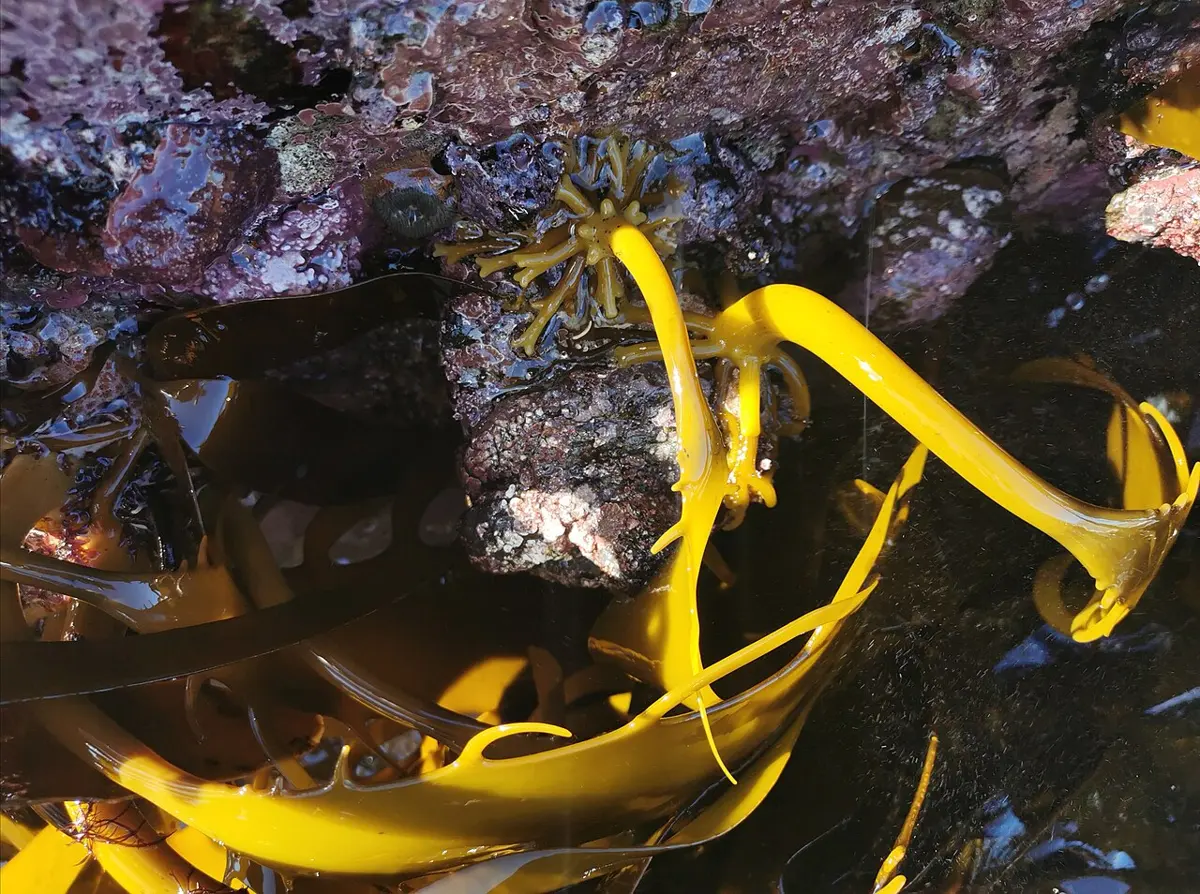
In the sea. Iodine is a rare element. Seawater holds only about 0.05 milligrams in a liter (some sources say 0.06), as iodide and iodate. Yet some living things gather it: brown seaweeds such as kelp gather many thousands of times more iodine than the water around them. That is why Courtois found it in seaweed ash, and why seafood is rich in iodine.
On land. Today most iodine comes from two places: the dry nitrate deserts of Chile, where iodate minerals lie with the nitrate, and salty underground water (brine) pumped up with natural gas and oil in Japan and the United States. In 2025 the world produced about 33,000 tonnes, not counting the United States, which keeps its figure secret; Chile made about 23,000 tonnes and Japan 9,000 tonnes (USGS, 2026).
In Nepal. In mountain lands the soil has very little iodine. Over thousands of years, glaciers scraped away old soil and heavy monsoon rain washed iodine out, carrying it down to the sea. So crops, milk and water in the Himalaya, like those in the Alps and the Andes, are low in iodine. Nepal has no iodine of its own.
In your body. An adult holds about 15 to 20 milligrams of iodine, most of it in a small gland in the neck, the thyroid.
What iodine is like
- A gray-black solid with a metallic shine, unusual for a non-metal Grade 9: Metals and non-metals compared. It forms flat, brittle crystals and does not conduct electricity.
- Heavy: its density is 4.9 g/cm³, about five times that of water.
- Melts at 114 °C and boils at 184 °C. But warm it gently in an open dish and it turns straight from a solid into a violet vapor, without seeming to melt: this is sublimation. When the vapor meets something cold, it turns straight back into crystals.
- It has a sharp smell, like a hospital.
- Hardly dissolves in water (about 0.3 g in a liter), giving a pale yellow-brown solution. It dissolves well in alcohol and in a solution of potassium iodide, giving a brown liquid, and in oils and petrol, giving a violet one.
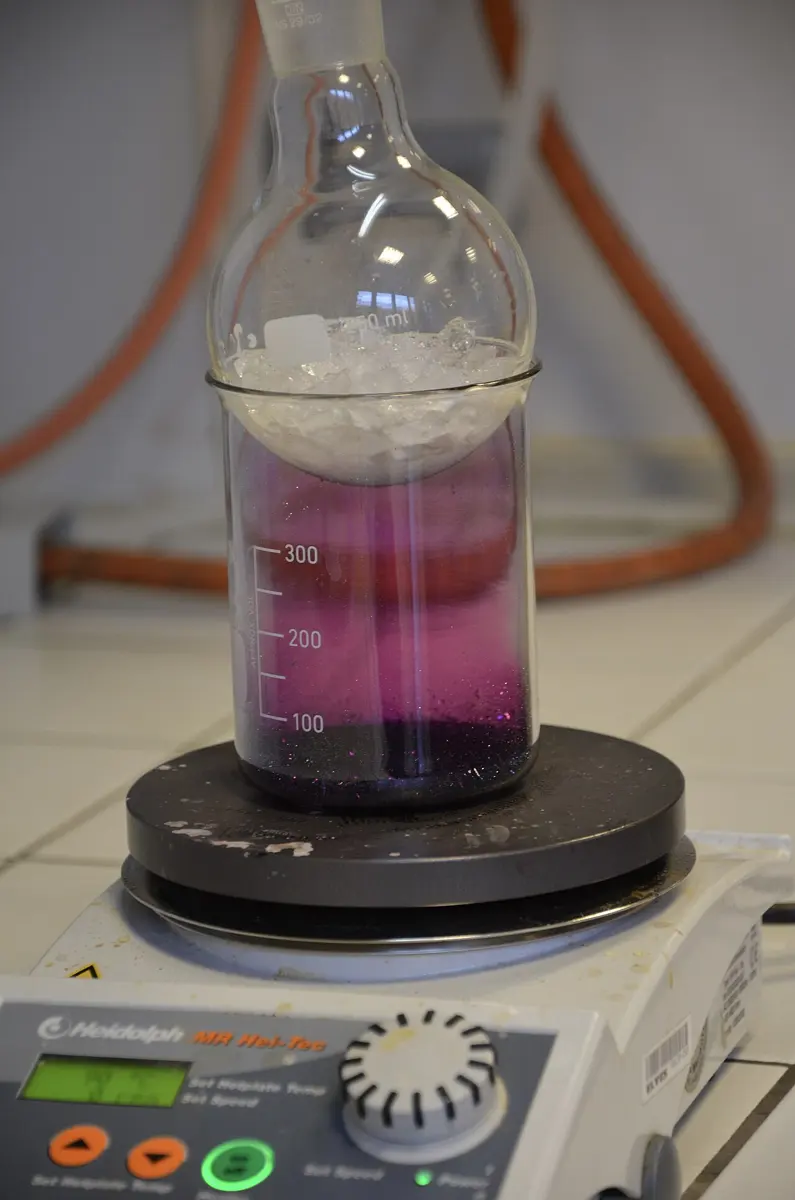
Why does a solid change so easily into a gas? Inside the crystal, the I₂ molecules are held to each other only by weak forces between molecules, much weaker than the bond inside each molecule. A little heat is enough to free the molecules from the crystal, so plenty of vapor forms well below the melting point. Heated quickly in a closed tube, iodine does melt into a dark liquid, at 114 °C.
How iodine reacts
Iodine is the least reactive common halogen, but it still reacts.
With metals, it makes iodides. Warm iodine with iron filings and they join to make iron iodide; mix powdered aluminium and iodine, add one drop of water, and after a moment the mixture bursts into flames with clouds of violet vapor (a teacher’s demonstration, never one to try):
2Al + 3I₂ → 2AlI₃
Displaced by other halogens. A more reactive halogen pushes a less reactive one out of its compounds Grade 10: Single displacement. Add chlorine water or bromine water to colorless potassium iodide solution and it turns brown with freed iodine:
Cl₂ + 2KI → 2KCl + I₂
Br₂ + 2KI → 2KBr + I₂
Iodine can’t do the same to chlorides or bromides, because it is less reactive than both.
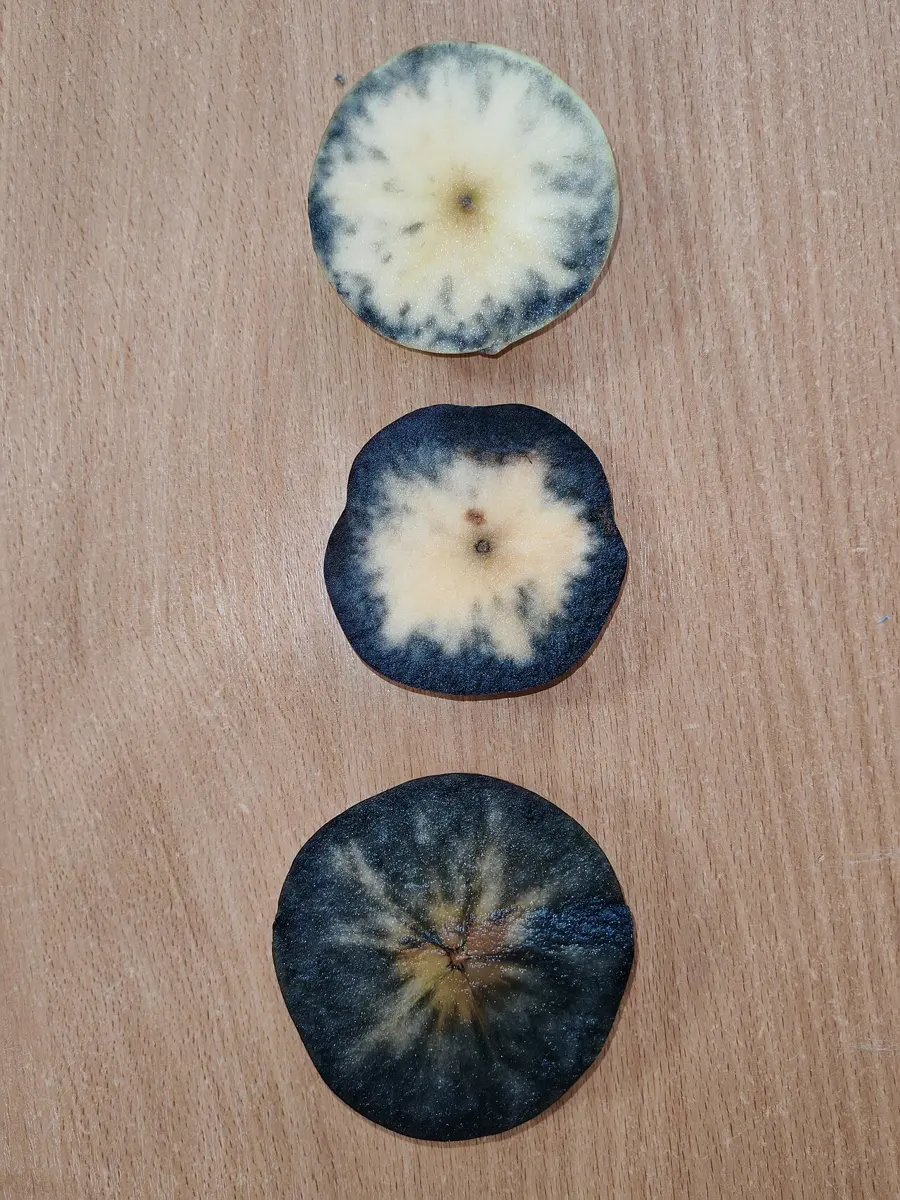
With starch: blue-black. A drop of iodine solution on starch turns a deep blue-black. The long, coiled starch molecule wraps around a row of iodine particles, and that complex soaks up most colors of light. This is the test for starch, the one you use to show that a leaf has made starch in sunlight or that saliva breaks starch down (Taking food apart).
A few drops of iodine solution are added to four foods. Which one stays brown?
Pick an answer to see why.
Iodine and your health
The thyroid
The thyroid gland in your neck, shaped like a butterfly on the windpipe, makes the hormone thyroxine Grade 9: Thyroid gland. Each thyroxine molecule carries four iodine atoms, about two-thirds of its mass. Thyroxine sets how fast your body’s cells burn food (the metabolism) and is needed for a baby’s brain and body to grow normally.
With too little iodine, the thyroid can’t make enough thyroxine. It grows bigger, trying harder, and the neck swells into a goiter (गलगाँड). Worse, a baby whose mother lacks iodine in pregnancy can be born with lifelong damage to the brain and to hearing. The World Health Organization calls a lack of iodine the world’s most common cause of brain damage that could be prevented.
Iodized salt in Nepal
Not long ago, goiter was very common in Nepal’s hills and mountains. In some villages, most adults had a swollen neck. The cure was simple: since everyone eats salt, add iodine to the salt.
- 1922: Switzerland, another mountain country with goiter, became one of the first to iodize its salt.
- 1973: Nepal began bringing in iodized salt from India and set up its first program against iodine deficiency.
- 1998: the Iodized Salt Act was passed to make iodizing all salt for eating compulsory. Nepal’s food standard says salt must hold at least 50 mg of iodine per kilogram when it is made and 30 mg when it is sold. Packets of salt with enough iodine carry the two-children logo.
- 2016: a national survey found 97% of homes using iodized salt. Goiter is now rare.
How much is needed? About 0.15 mg (150 micrograms) a day for adults and teenagers, less for young children and more, about 0.25 mg, in pregnancy (WHO). Seafood, seaweed, milk and eggs have iodine; in Nepal most comes from salt.
Too much is not good either. The 2016 survey found that many people in Nepal now get more iodine than they need, because salt often holds more iodine than the standard and people eat a lot of salt. Health experts have suggested lowering the amount added. The answer is not to stop using iodized salt but to eat less salt, which is better for your blood pressure too.
Iodine in daily life
- Killing germs. Iodine kills bacteria, viruses and fungi. Povidone-iodine, a brown solution, is used to clean skin before operations and on cuts and wounds in hospitals and health posts across Nepal. Iodine tablets are used by trekkers to make stream water safe to drink.
- X-rays. The largest use of iodine today is in contrast media: liquids with iodine in them, injected into a vein before an X-ray or CT scan. Iodine’s big atoms block X-rays, so blood vessels and organs show up clearly.
- Screens. The thin filters that make the picture in many LCD screens, of computers, TVs and calculators, are made of plastic soaked in iodine.
- Farming. Iodine is added to animal feed, because cows, goats and chickens need it too.
- Making rain. Fine smoke of silver iodide is sprayed into clouds to help ice crystals form, in cloud seeding: silver iodide crystals are shaped almost exactly like ice crystals.
- Photography. The first photographs, made by Louis Daguerre in 1839, used silver plates made sensitive to light with iodine vapor.
Isotopes of iodine
Natural iodine has only one stable isotope, iodine-127. Every iodine atom in your salt has 53 protons and 74 neutrons. That is why iodine’s atomic mass, 126.90, is so close to a whole number Grade 9: Atomic mass: there is no mixture to average.
Doctors also use a radioactive isotope, iodine-131, made in nuclear reactors, with a half-life of about 8 days. Since the thyroid gathers iodine, a patient who swallows a capsule of iodine-131 carries the radiation straight to the thyroid. A small dose shows how the gland is working; a bigger one destroys an overactive gland or thyroid cancer, while the rest of the body gets little radiation. It has been used this way since the 1940s.
Iodine-131 is also one of the dangers after a nuclear accident, such as Chernobyl in 1986. Children who drank milk with iodine-131 in it got thyroid cancer in the years after. That is why people near an accident are given potassium iodide tablets: they fill the thyroid with ordinary iodine, so it has no room left for the radioactive kind Grade 9: Radioactive elements.
Why does radioactive iodine-131 go mostly to the thyroid gland?
Pick an answer to see why.
Surprising facts and records
- The heaviest element you need. Of all the elements your body must have, iodine, element 53, has the highest atomic number.
- A shiny non-metal. Iodine and graphite are the two famous non-metals with a metallic luster.
- Seaweed for goiter. Long before iodine was discovered, doctors in ancient China treated goiter with burnt seaweed and sea sponge. It worked, and now we know why.
In your science books
- Grade 8: non-metals in the periodic table, groups and the 2n² rule.
- Grade 9: the thyroid gland, the octet rule, ions, covalent bonds, radioactive elements and metals and non-metals compared.
- Grade 10: Mendeleev’s iodine and tellurium, the Aufbau principle, reactivity down a group and single displacement.
- Going further: the starch test on your dal bhat and where heavy atoms were made.
More to explore
- Nobel Prizes with iodine in them: filming atoms during a reaction (1999, the first molecule filmed breaking apart had an iodine atom), joining carbon atoms with palladium (2010, an iodine or bromine “handle” marks where carbon atoms join) and plastic that conducts (2000, iodine vapor made the plastic conduct).
- The other halogens: fluorine, chlorine and bromine.
- Play: find iodine in Guess the Element and the Periodic Table Jigsaw.
- Read more: iodine at the Royal Society of Chemistry and at PubChem.