
Look around you: a steel plate, a glass of water, the salt on your rice, the air, your own hand. Millions of different substances, and yet they are all built from just 118 elements, the way thousands of Nepali words are built from a few dozen letters. Gold, silver and copper are metal elements; sulphur and iodine are non-metal elements. Scientists are still trying to make new ones in laboratories.
How can so few elements make so many things? Because their atoms join. In this unit you will look inside an atom, see why some atoms are happy alone while others grab, give away or share electrons, learn to write the formula of a compound without memorizing it, and finish inside the nucleus, where the energy of the Sun comes from.
Introduction to an atom
An element is a pure substance that can’t be broken down into other substances with different properties. Iron is an element: however you break it, crush it or melt it, you only ever get iron. An element is made of a huge number of atoms of one kind.
An atom is the smallest particle of an element that can take part in a chemical reaction.
- All the atoms of one element are alike, and they are different from the atoms of every other element. Every atom in a gold ring is a gold atom; a silver atom is different from it, and a copper atom is different again.
- Most atoms readily react with the atoms of other elements. A few, the atoms of the inert gases (helium, neon, argon and their family), hardly react at all.
- A compound is made of the atoms of two or more elements joined together: water is hydrogen and oxygen, common salt is sodium and chlorine.
Which of these is the smallest particle of an element that can take part in a chemical reaction?
Pick an answer to see why.
Structure of an atom
Atoms are tiny. The average diameter of an atom is about 10⁻¹⁰ m, one ten-billionth of a meter. Line up ten million atoms and the row would be just 1 mm long.
An atom is made of three even smaller particles, the subatomic particles: protons, neutrons and electrons.
- Protons and neutrons are packed together in a tiny center called the nucleus.
- Electrons move around the nucleus at high speed in fixed paths called orbits or shells.
| Particle | Where it is | Charge | Mass (in amu) |
|---|---|---|---|
| proton (p⁺) | in the nucleus | +1 (positive) | 1 |
| neutron (n⁰) | in the nucleus | 0 (neutral) | 1 |
| electron (e⁻) | in the shells, around the nucleus | −1 (negative) | about 1/1840 |
An atom has as many electrons as protons, so their charges cancel and the whole atom is electrically neutral.
- The number of protons in an atom is its atomic number. It decides which element the atom is: every atom with 6 protons is carbon, every atom with 8 is oxygen.
- The number of protons plus neutrons is its mass number.
Shells and their energy
The electrons can’t be just anywhere. In 1913 the Danish scientist Niels Bohr showed that electrons move only in certain shells, each with a fixed energy. The shells are named K, L, M, N… going outwards (or numbered n = 1, 2, 3, 4…). The K shell, nearest the nucleus, has the lowest energy.
Each shell holds at most 2n² electrons, where n is the shell’s number:
| Shell | n | Most electrons, 2n² |
|---|---|---|
| K | 1 | 2 × 1² = 2 |
| L | 2 | 2 × 2² = 8 |
| M | 3 | 2 × 3² = 18 |
| N | 4 | 2 × 4² = 32 |
Electrons fill the shells from the inside out, K first. There is one more rule for the first 20 elements: the outermost shell never holds more than 8 electrons. That is why potassium (19 electrons) is 2, 8, 8, 1 and not 2, 8, 9: its 19th electron starts the N shell even though the M shell could hold 18. Writing the electrons shell by shell like this is called the atom’s electronic configuration.
Bohr’s shells are the picture you will use to count electrons, and they work well for that. But no one has ever seen an electron going round a track. Since 1926 scientists have known that an electron has no fixed path at all: we can only say where it is likely to be found. So its place is pictured as an electron cloud, thick where the electron is often found and thin where it rarely is. Each shell is, roughly, a cloud at its own distance from the nucleus.
Duplet and duplet rule
Helium has only 2 electrons, and both are in its one and only shell, the K shell. The K shell holds at most 2 (2 × 1² = 2), so helium’s shell is full.
Having two electrons in the K shell, when it is the only shell, is called the duplet state. It is a very stable state. Because of it, helium doesn’t take part in any chemical reaction, and it is found in nature as free, single atoms.
Hydrogen (1 electron), lithium (2, 1) and beryllium (2, 2) are close to helium. In reactions they lose, gain or share electrons so that their outer shell ends up as a duplet, like helium’s: hydrogen by sharing (or by losing its electron), lithium by losing 1 and beryllium by losing 2. The tendency of these atoms to get two electrons in the K shell is called the duplet rule.
Octet and octet rule
Neon (2, 8), argon (2, 8, 8), krypton, xenon and radon, the other members of the inert gas group (group 18 of the modern periodic table), all have 8 electrons in their outermost shell. This state is called the octet state (octa means eight).
Atoms in the octet state, like those in the duplet state, are stable: they don’t take part in chemical reactions under ordinary conditions, and they are found as single atoms, as gases. That is why these elements are called inert gases (or noble gases).
Every other atom has fewer than 8 electrons in its outermost shell. These atoms react: they lose, gain or share electrons until their outermost shell holds 8, like an inert gas. This tendency is the octet rule.
Why does neon not take part in chemical reactions?
Pick an answer to see why.
Valence shell and valence electron
Sodium has 11 electrons, but only the 1 electron in its outermost shell, the M shell, takes part in its chemical reactions. The inner shells are full and stay as they are.
- The outermost shell of an atom is its valence shell. For sodium and chlorine it is the M shell.
- The electrons in the valence shell are the valence electrons. Sodium has 1 valence electron; chlorine has 7.
Valency
In a reaction, an atom loses, gains or shares some of its valence electrons. The number of electrons an atom loses, gains or shares when it forms a compound decides how many other atoms it can join with. The combining capacity of an atom with other atoms is called its valency.
- An atom with 1, 2 or 3 valence electrons usually loses them; its valency is 1, 2 or 3.
- An atom with 5, 6 or 7 valence electrons usually gains 3, 2 or 1; its valency is 8 minus the number of valence electrons.
- An atom with 4 valence electrons (carbon, silicon) shares them; its valency is 4.
- Inert gases have valency 0.
Here are the first 20 elements:
| Element | Symbol | Atomic number | K | L | M | N | Valency |
|---|---|---|---|---|---|---|---|
| hydrogen | H | 1 | 1 | 1 | |||
| helium | He | 2 | 2 | 0 | |||
| lithium | Li | 3 | 2 | 1 | 1 | ||
| beryllium | Be | 4 | 2 | 2 | 2 | ||
| boron | B | 5 | 2 | 3 | 3 | ||
| carbon | C | 6 | 2 | 4 | 4 | ||
| nitrogen | N | 7 | 2 | 5 | 3 | ||
| oxygen | O | 8 | 2 | 6 | 2 | ||
| fluorine | F | 9 | 2 | 7 | 1 | ||
| neon | Ne | 10 | 2 | 8 | 0 | ||
| sodium | Na | 11 | 2 | 8 | 1 | 1 | |
| magnesium | Mg | 12 | 2 | 8 | 2 | 2 | |
| aluminium | Al | 13 | 2 | 8 | 3 | 3 | |
| silicon | Si | 14 | 2 | 8 | 4 | 4 | |
| phosphorus | P | 15 | 2 | 8 | 5 | 3, 5 | |
| sulphur | S | 16 | 2 | 8 | 6 | 2, 6 | |
| chlorine | Cl | 17 | 2 | 8 | 7 | 1 | |
| argon | Ar | 18 | 2 | 8 | 8 | 0 | |
| potassium | K | 19 | 2 | 8 | 8 | 1 | 1 |
| calcium | Ca | 20 | 2 | 8 | 8 | 2 | 2 |
Phosphorus and sulphur have two valencies: in some compounds they share all their valence electrons (5 or 6), in others only enough to complete an octet (3 or 2).
Which atom has valency 3?
Pick an answer to see why.
Reactivity and valency
Among the metals of one row of the periodic table, the one with fewer electrons to lose usually reacts more vigorously. Sodium (valency 1) needs to lose only one electron, and it reacts violently with cold water; magnesium (valency 2) must lose two, and it reacts only slowly with cold water. (This is a rough guide for metals, not a law: fluorine, with valency 1, is the most reactive non-metal of all, while nitrogen, with valency 3, hardly reacts. Grade 10 explains reactivity more fully, in How properties change across periods and down groups.)
Variable valency
Some elements have more than one valency, depending on the compound they form. When only the valence electrons take part, the valency is the lower one; when an electron from the shell inside also takes part, the valency is higher.
| Element | Valencies | Examples |
|---|---|---|
| iron (Fe) | 2 and 3 | FeO, ferrous oxide; Fe₂O₃, ferric oxide (rust) |
| copper (Cu) | 1 and 2 | Cu₂O, cuprous oxide (red); CuO, cupric oxide (black) |
| gold (Au) | 1 and 3 | AuCl, aurous chloride; AuCl₃, auric chloride |
| mercury (Hg) | 1 and 2 | Hg₂Cl₂, mercurous chloride; HgCl₂, mercuric chloride |
The ending tells you which: -ous for the lower valency, -ic for the higher. Silver has just one usual valency, 1.
Ion
An atom has equal numbers of protons (+) and electrons (−), so it has no overall charge. When an atom, or a group of atoms, loses or gains electrons from its valence shell, the numbers no longer match, and it becomes charged. A charged atom or group of atoms is called an ion.
The charge is written at the top right of the symbol: Na⁺, K⁺, Cu⁺, Mg²⁺, Ca²⁺, Zn²⁺, Al³⁺, Cl⁻, O²⁻, N³⁻. The number of charges on an ion is equal to its valency. (Some books write Mg²⁺ as Mg⁺⁺ and O²⁻ as O⁻⁻; they mean the same.)
Positively charged ions (cations)
When an atom loses one or more electrons from its valence shell, it has more protons than electrons, so it becomes positively charged. An ion formed by losing electrons is a positive ion or cation. Metals form cations.
| Valency 1 | Valency 2 | Valency 3 |
|---|---|---|
| hydrogen, H⁺ | magnesium, Mg²⁺ | aluminium, Al³⁺ |
| lithium, Li⁺ | calcium, Ca²⁺ | ferric (iron(III)), Fe³⁺ |
| sodium, Na⁺ | beryllium, Be²⁺ | auric (gold(III)), Au³⁺ |
| potassium, K⁺ | zinc, Zn²⁺ | |
| silver, Ag⁺ | manganese, Mn²⁺ | |
| cuprous (copper(I)), Cu⁺ | cupric (copper(II)), Cu²⁺ | |
| mercurous (mercury(I)), Hg⁺ (really a pair, Hg₂²⁺) | mercuric (mercury(II)), Hg²⁺ | |
| aurous (gold(I)), Au⁺ | ferrous (iron(II)), Fe²⁺ | |
| ammonium, NH₄⁺ |
Boron also has valency 3, but it shares its electrons instead of forming B³⁺ ions.
Negatively charged ions (anions)
When an atom gains electrons from other atoms, it has more electrons than protons, so it becomes negatively charged. An ion formed by gaining electrons is a negative ion or anion. Non-metals form anions.
| Valency 1 | Valency 2 | Valency 3 |
|---|---|---|
| fluoride, F⁻ | oxide, O²⁻ | nitride, N³⁻ |
| chloride, Cl⁻ | sulphide, S²⁻ | phosphate, PO₄³⁻ |
| bromide, Br⁻ | sulphate, SO₄²⁻ | |
| iodide, I⁻ | carbonate, CO₃²⁻ | |
| nitrate, NO₃⁻ | ||
| hydroxide, OH⁻ | ||
| bicarbonate, HCO₃⁻ | ||
| bisulphate, HSO₄⁻ | ||
| chlorate, ClO₃⁻ | ||
| nitrite, NO₂⁻ |
Some ions, like NH₄⁺, OH⁻, NO₃⁻, SO₄²⁻, CO₃²⁻ and PO₄³⁻, are groups of atoms that stay together and carry a charge as one unit. Such a group is called a radical (or a polyatomic ion). The names of anions made from one atom end in -ide: chloride, oxide, sulphide.
An atom has 12 protons and 10 electrons. What is it?
Pick an answer to see why.
Chemical bond
The atoms of a compound are held together by a force called a chemical bond. In table salt, for example, sodium and chlorine are held together by chemical bonds.
Why do atoms bond at all? Apart from the inert gases (He, Ne, Ar, Kr, Xe and Rn), no atom has a duplet or an octet in its outermost shell: its outer shell is incomplete. Atoms take part in chemical reactions, forming bonds, to get a duplet or octet.
Not every compound has the same kind of bond. There are several kinds; in this unit you will study the two most important, the electrovalent (ionic) bond and the covalent bond.
Electrovalent bond
Metal atoms usually have 1, 2 or 3 electrons in their valence shell. The easiest way for them to reach an octet (or a duplet) is to lose those electrons.
Non-metal atoms usually have 5, 6 or 7 valence electrons. The easiest way for them to reach an octet is to gain 3, 2 or 1 electrons.
So when a metal meets a non-metal, the metal gives its valence electrons to the non-metal. The metal becomes a positive ion and the non-metal a negative ion. Opposite charges attract each other strongly (like the north and south poles of two magnets), and this electrostatic attraction holds the ions together.
The bond formed by the transfer of electrons from the valence shell of a metal atom to the valence shell of a non-metal atom is called an electrovalent bond or ionic bond. A compound held together by electrovalent bonds is an electrovalent compound (or ionic compound): sodium chloride (NaCl), magnesium oxide (MgO) and calcium chloride (CaCl₂) are examples.
a. Formation of sodium chloride (NaCl)
Sodium is 2, 8, 1: it has 1 valence electron. Chlorine is 2, 8, 7: it has 7. Sodium gives its one valence electron to chlorine.
Now Na⁺ is 2, 8 and Cl⁻ is 2, 8, 8: both have an octet. The opposite charges attract, and an electrovalent bond holds them together:
b. Formation of magnesium oxide (MgO)
Magnesium (a metal) is 2, 8, 2; oxygen (a non-metal) is 2, 6. Magnesium loses its 2 valence electrons, and an oxygen atom takes both:
Mg²⁺ (2, 8) and O²⁻ (2, 8) both have an octet, and they attract each other:
c. Formation of calcium chloride (CaCl₂)
Calcium is 2, 8, 8, 2: it has 2 valence electrons to lose. But a chlorine atom needs only 1. So two chlorine atoms are needed: calcium gives one electron to each.
One Ca²⁺ ion and two Cl⁻ ions attract each other, and calcium chloride is formed:
Magnesium chloride (MgCl₂) forms in exactly the same way: magnesium (2, 8, 2) gives one electron to each of two chlorine atoms.
In forming an ionic bond, what happens to the electrons?
Pick an answer to see why.
Characteristics of electrovalent compounds
- a.They are formed between a metal and a non-metal.
- b.Most of them dissolve in water, and when they dissolve, they separate into positive and negative ions. That is why salt water conducts electricity. (A few, like calcium carbonate, the stuff of marble, hardly dissolve.)
- c.They have high melting and boiling points, because the attraction between millions of oppositely charged ions in a crystal is very strong. Common salt melts at 801 °C.
- d.They are usually hard, brittle crystalline solids at room temperature.
- e.They conduct electricity when melted or dissolved in water (the ions can move), but not as solids.
Covalent bond
Non-metals (except hydrogen) have 5, 6 or 7 electrons in their valence shell, so each wants to gain 3, 2 or 1 electrons. When two non-metal atoms meet, neither will give its electrons away: both want more. So they share.
Each atom puts one or more of its electrons into a shared pair, which belongs to both atoms at once. Counting the shared electrons for each atom, both get a duplet or an octet.
A bond formed between two atoms of non-metals (the same or different elements) by sharing pairs of electrons, each atom giving equally to each pair, is called a covalent bond. A compound with covalent bonds is a covalent compound: water (H₂O), hydrogen chloride (HCl), methane (CH₄) and ammonia (NH₃) are examples.
A covalent bond is drawn as a line between the atoms: one line for each shared pair. Atoms can share one pair (a single bond, H–H), two pairs (a double bond, O=O) or three pairs (a triple bond, N≡N).
Formation of hydrogen chloride (HCl)
A hydrogen atom has 1 electron in its K shell; chlorine has 7 in its valence shell. Each puts one electron into a shared pair. Now hydrogen counts 2 (a duplet) and chlorine 8 (an octet). This makes a molecule of hydrogen chloride, a covalent compound.
Formation of a water molecule (H₂O)
A water molecule has one oxygen atom and two hydrogen atoms.
| Atom | K | L |
|---|---|---|
| hydrogen | 1 | |
| oxygen | 2 | 6 |
Oxygen has 6 valence electrons and needs 2 more; each hydrogen needs 1 more. So oxygen shares one pair with each of two hydrogen atoms. Oxygen now counts 8 (an octet) and each hydrogen 2 (a duplet). Water is a covalent compound: H–O–H.
Formation of methane (CH₄)
Carbon has 4 valence electrons; each hydrogen atom has 1. One carbon atom shares one pair with each of four hydrogen atoms: four shared pairs. Carbon gets an octet and each hydrogen a duplet. Methane, the main gas in biogas, is a covalent compound.
Formation of ammonia (NH₃)
Nitrogen has 5 valence electrons and needs 3 more. It shares one pair with each of three hydrogen atoms. Nitrogen gets an octet (3 shared pairs plus its own lone pair), and each hydrogen a duplet.
Double and triple bonds
Two oxygen atoms (6 valence electrons each) each need 2 more: they share two pairs, a double bond. Two nitrogen atoms (5 each) each need 3: they share three pairs, a triple bond.
How many pairs of electrons are shared in a molecule of ammonia?
Pick an answer to see why.
Characteristics of covalent compounds
- a.They are formed when two or more non-metals combine.
- b.Most of them don’t dissolve in water (wax, oil, petrol). Some do, like sugar and alcohol.
- c.They don’t split into ions, so most of them don’t conduct electricity.
- d.They have low melting and boiling points: many are gases or liquids at room temperature (methane, ammonia, water), or soft solids that melt easily (wax).
Molecular formula
The smallest particle of a substance that can exist on its own is a molecule. A molecule is made of two or more atoms joined together. A molecule of water (H₂O) is two hydrogen atoms and one oxygen atom; a molecule of hydrogen (H₂) is two hydrogen atoms; a molecule of oxygen (O₂) is two oxygen atoms.
Just as an element has a symbol, a molecule is written as a group of symbols. The group of symbols that shows the atoms in one molecule of a substance is its molecular formula.
| No. | Substance | Molecular formula |
|---|---|---|
| 1 | hydrochloric acid | HCl |
| 2 | sulphuric acid | H₂SO₄ |
| 3 | sodium hydroxide | NaOH |
| 4 | magnesium hydroxide | Mg(OH)₂ |
| 5 | ammonia | NH₃ |
| 6 | sodium chloride | NaCl |
| 7 | magnesium carbonate | MgCO₃ |
| 8 | magnesium chloride | MgCl₂ |
| 9 | water | H₂O |
| 10 | calcium carbonate | CaCO₃ |
| 11 | carbon dioxide | CO₂ |
| 12 | potassium nitrate | KNO₃ |
| 13 | sodium bicarbonate | NaHCO₃ |
| 14 | potassium sulphate | K₂SO₄ |
| 15 | ammonium phosphate | (NH₄)₃PO₄ |
Writing a molecular formula: the criss-cross method
You don’t have to memorize formulae. If you know the valencies, the criss-cross method gives the formula:
- Write the name of the compound.
- Write the symbols of its elements or radicals under the name, the positive one (usually the metal) first.
- Write the valency of each just above its symbol.
- Cross the valencies over: each valency goes to the bottom right of the other symbol.
- Simplify: if both numbers can be divided by the same number, divide them; don’t write a 1; and if a radical (a group like SO₄ or NO₃) has a number 2 or more, put it in brackets.
Here are more, worked the same way:
| Compound | Symbols | Valencies | Crossed over | Formula |
|---|---|---|---|---|
| sodium chloride | Na, Cl | 1, 1 | Na₁Cl₁ | NaCl |
| calcium chloride | Ca, Cl | 2, 1 | Ca₁Cl₂ | CaCl₂ |
| aluminium chloride | Al, Cl | 3, 1 | Al₁Cl₃ | AlCl₃ |
| carbon tetrachloride | C, Cl | 4, 1 | C₁Cl₄ | CCl₄ |
| boron oxide | B, O | 3, 2 | B₂O₃ | B₂O₃ |
| ammonium sulphate | NH₄, SO₄ | 1, 2 | (NH₄)₂(SO₄)₁ | (NH₄)₂SO₄ |
| calcium sulphate | Ca, SO₄ | 2, 2 | Ca₂(SO₄)₂ → divide by 2 | CaSO₄ |
| aluminium nitrate | Al, NO₃ | 3, 1 | Al₁(NO₃)₃ | Al(NO₃)₃ |
| calcium bicarbonate | Ca, HCO₃ | 2, 1 | Ca₁(HCO₃)₂ | Ca(HCO₃)₂ |
What is the molecular formula of magnesium bicarbonate?
Pick an answer to see why.
What a molecular formula tells you
- The elements in the molecule (their names and symbols).
- The valency of each element or radical (by crossing back).
- The number of atoms of each element in one molecule. H₂SO₄ has 2 hydrogen, 1 sulphur and 4 oxygen atoms, 7 atoms in all.
Atomic weight and molecular weight
Atomic mass
Almost all the mass of an atom is in its nucleus, in its protons and neutrons; electrons are so light that we can leave them out. Atomic and molecular masses are measured in atomic mass units (amu); a proton and a neutron each have a mass of about 1 amu. So, for one atom,
- An oxygen atom has 8 protons and 8 neutrons: atomic mass = 8 + 8 = 16 amu.
- A sodium atom has 11 protons and 12 neutrons: atomic mass = 11 + 12 = 23 amu.
For calculations, use these atomic masses:
| H | C | N | O | Na | Mg | Al | P | S | Cl | K | Ca |
|---|---|---|---|---|---|---|---|---|---|---|---|
| 1 | 12 | 14 | 16 | 23 | 24 | 27 | 31 | 32 | 35.5 | 39 | 40 |
Molecular mass
The sum of the atomic masses of all the atoms in a molecule is its molecular mass (or molecular weight).
Nuclear stability
The nucleus is packed with protons, all positively charged, and like charges repel. What stops a nucleus from flying apart? A very strong, very short-range force, the nuclear force, which pulls protons and neutrons together. Neutrons add this pull without adding any repulsion, so they act like glue.
Whether a nucleus is stable (stays as it is for ever) depends on its balance of neutrons and protons:
- Light nuclei are stable with about as many neutrons as protons: a neutron-to-proton ratio of about 1. Carbon-12 has 6 and 6, oxygen-16 has 8 and 8.
- Heavier nuclei have more protons pushing each other apart, so they need more neutrons to hold together: iron-56 has 26 protons and 30 neutrons; lead-208 has 82 protons and 126 neutrons, a ratio of about 1.5.
- A nucleus with too many or too few neutrons for its protons is unstable.
- Beyond bismuth (83 protons), no number of neutrons is enough: every such nucleus is unstable.
So the larger the atomic number, the harder it is for a nucleus to be stable. An unstable nucleus sooner or later changes towards a stable one, and as it does, it throws out energetic radiation. This is radioactivity.
Radioactive elements and radioactive emission
Unstable nuclei, mostly those with a high atomic number, give out powerful rays to become more stable. Elements whose nuclei do this are called radioactive elements: uranium, plutonium, thorium, radium and radon are examples. Most have an atomic number above 83. The giving out of these rays is radioactive emission (radioactivity).
There are three kinds of radiation:
| Radiation | What it is | Charge | How far it gets |
|---|---|---|---|
| alpha (α) | a helium nucleus: 2 protons and 2 neutrons | +2 | a few cm of air; stopped by a sheet of paper or by skin |
| beta (β) | a fast electron, made in the nucleus | −1 | a meter or so of air; stopped by a few mm of aluminium |
| gamma (γ) | an electromagnetic ray, like very energetic X-rays | none | passes through the body; reduced only by thick lead or concrete |
The radiation from radioactive elements is harmful: it damages the cells of the body and their DNA, causing burns, sickness and cancer. Radioactive materials are handled from behind shields, and their containers carry the warning sign ☢.
Which of these is not a radioactive element?
Pick an answer to see why.
Nuclear fission
The splitting of a heavy, unstable nucleus into two smaller nuclei is called nuclear fission. It happens when a nucleus of uranium-235 or plutonium-239 is hit by a neutron. The nucleus absorbs the neutron, wobbles and splits into two middle-sized nuclei, such as barium and krypton, and throws out 2 or 3 new neutrons and a huge amount of energy:
(In this way of writing, the top number is the mass number and the bottom number the atomic number. Check: 235 + 1 = 141 + 92 + 3, and 92 = 56 + 36.)
Where does the energy come from? Weigh everything after the split, and it is very slightly lighter than the uranium and neutron before it. That lost mass (m) has turned into energy (E), by Einstein’s famous E = mc², where c is the speed of light (3 × 10⁸ m/s). Because c² is enormous, a tiny loss of mass gives a vast amount of energy. The energy comes out mostly as the speed of the flying fragments (which becomes heat) and as gamma rays.
The new neutrons can split more uranium nuclei, which give more neutrons, which split more nuclei: a chain reaction. In a nuclear power station it is controlled, so that each fission causes just one more; in an atom bomb it is not.
Nuclear fusion
Joining light nuclei, such as hydrogen, to make a heavier nucleus, such as helium, is called nuclear fusion. Nuclei are all positive and repel each other, so they fuse only when they crash together at tremendous speed: that needs a temperature of millions of degrees and a huge pressure. Those conditions exist in the core of the Sun and the other stars, which also have plenty of hydrogen. There, in several steps, four hydrogen nuclei join to make one helium nucleus, and an enormous amount of energy is released:
(The two ⁰₊₁e particles are positrons, particles like electrons but positively charged. Check: mass numbers 4 = 4 + 0, charges 4 = 2 + 2.)
Atomic energy or nuclear energy
The energy released from the nucleus is called atomic energy or nuclear energy.
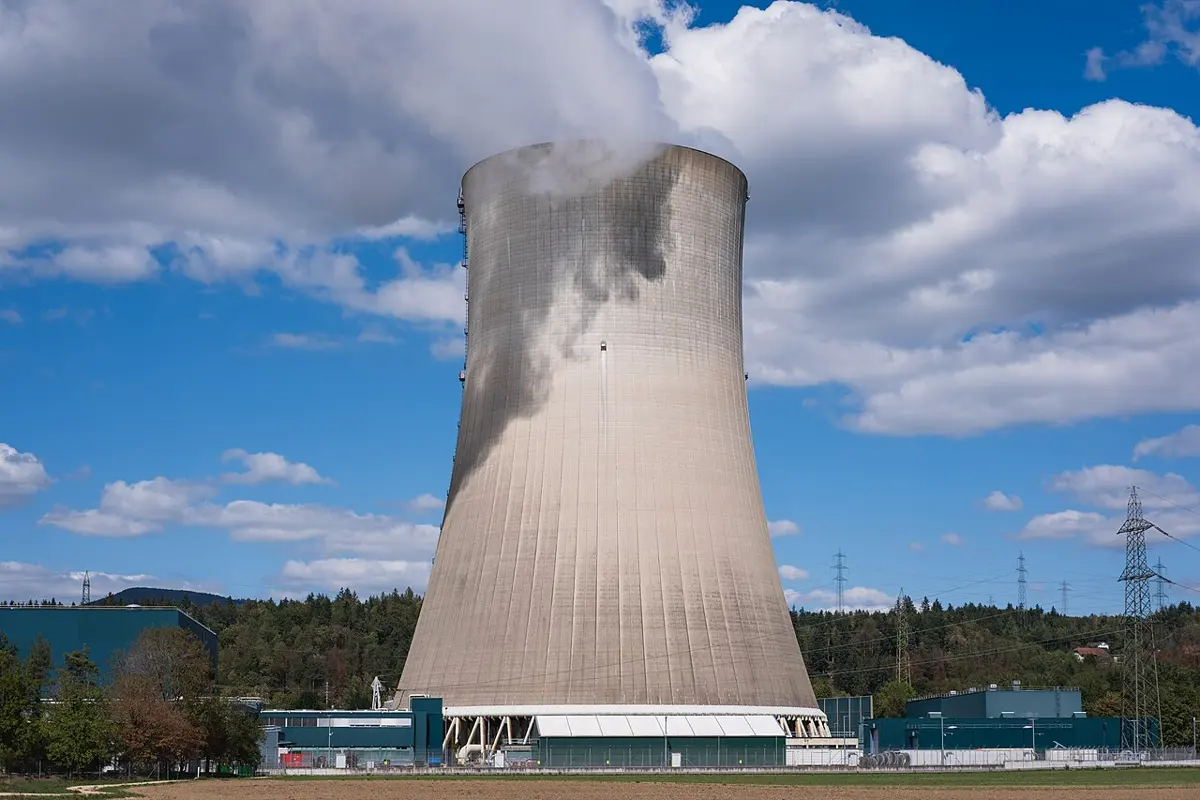
Electricity from fission. In a nuclear power plant, controlled fission happens in a strong steel vessel called a nuclear reactor. The heat boils water into steam; the steam turns a turbine, and the turbine turns a generator that makes electricity, just as in a coal power plant, but without burning anything. About 30 countries make electricity this way; altogether it gives about a tenth of the world’s electricity (as of 2024), and about two-thirds of France’s.
Electricity from fusion? Not yet. Fusion needs temperatures of more than 100 million °C on Earth, hotter than the Sun’s core, and no material can hold anything that hot: in most designs the gas is held away from the walls by magnetic fields. In December 2022 a laboratory in the USA, for a fraction of a second, got more energy out of a fusion reaction than its lasers put in. A huge experimental reactor, ITER, is being built in France. A fusion power station is still years away (as of 2026).
Other uses of radiation. The radiation from radioactive substances is used to:
- treat cancer (radiotherapy), by aiming radiation at a tumor to kill its cells; in Nepal, at hospitals such as the B.P. Koirala Memorial Cancer Hospital in Bharatpur;
- sterilize (kill all germs on) syringes, bandages and surgical instruments, and keep some foods from spoiling;
- find the age of old objects (carbon-14 dating), check welds and pipes for cracks, and much more.
Dangers. Nuclear energy has a dark side too:
- Nuclear weapons. The atom bombs dropped on Hiroshima and Nagasaki in Japan in August 1945 killed more than 100,000 people, many of them later, from radiation.
- Accidents and leaks. At Chernobyl (in Ukraine) in 1986 and at Fukushima (Japan) in 2011, reactors failed and released radiation; thousands of people had to leave their homes for good.
- Waste. Used fuel stays dangerously radioactive for thousands of years, and must be stored safely all that time.
Project work
Exercise
1. Tick the correct answer
(i) What is the smallest particle of an element that can take part in a chemical reaction?
Pick an answer to see why.
(ii) What is the average diameter of an atom?
Pick an answer to see why.
(iii) Which of the following is a radioactive element?
Pick an answer to see why.
(iv) Which of the following compounds has a covalent bond?
Pick an answer to see why.
(v) Which of the following atoms has valency 3?
Pick an answer to see why.
(vi) What is the molecular formula of magnesium bicarbonate?
Pick an answer to see why.
2. Fill in the blanks
The electrons in an atom move in shells (orbits) with fixed energy. The scientist who found this was …
Answer
Niels Bohr (1913).
The formation of smaller nuclei by splitting an unstable nucleus with a high atomic number is called …
Answer
nuclear fission.
To reach an octet, the number of electrons a calcium atom loses from its valence shell is …
Answer
2 (calcium is 2, 8, 8, 2; it becomes Ca²⁺, 2, 8, 8).
In a molecule of ammonia, a … bond is formed.
Answer
covalent (three single covalent bonds between nitrogen and hydrogen).
The molecular formula of calcium chloride is …
Answer
CaCl₂ (Ca valency 2, Cl valency 1, crossed over).
The molecular mass of sodium bicarbonate is …
Answer
84 amu. NaHCO₃ = 23 + 1 + 12 + 3 × 16 = 23 + 1 + 12 + 48 = 84.
3. Write the differences between
Duplet and octet
Answer
| Duplet | Octet |
|---|---|
| 2 electrons in the outermost shell | 8 electrons in the outermost shell |
| only in the K shell, when it is the atom’s only shell | in the L, M or any later shell, when it is the outermost |
| e.g. helium (2); also H⁻, Li⁺, Be²⁺ | e.g. neon (2, 8), argon (2, 8, 8); also Na⁺, Cl⁻ |
| hydrogen, lithium and beryllium react to reach it | most other atoms react to reach it |
Electrovalent bond and covalent bond
Answer
| Electrovalent (ionic) bond | Covalent bond |
|---|---|
| formed by the transfer of electrons from one atom to another | formed by the sharing of pairs of electrons |
| usually between a metal and a non-metal | between non-metals |
| makes positive and negative ions, held by electrostatic attraction | makes molecules; no ions are formed |
| its compounds have high melting and boiling points | its compounds usually have low melting and boiling points |
| its compounds usually dissolve in water, and conduct electricity when melted or dissolved | its compounds usually don’t dissolve in water, and don’t conduct electricity |
| e.g. NaCl, MgO, CaCl₂ | e.g. H₂O, HCl, CH₄, NH₃ |
4. Give reasons
Atomic energy has both boons and banes.
Answer
It is a boon (a blessing) because a little nuclear fuel makes a huge amount of electricity without smoke or carbon dioxide, and the radiation from radioactive substances is used to treat cancer, sterilize medical instruments and preserve food. It is a bane (a curse) because it can be used to make nuclear weapons that kill on a massive scale (Hiroshima and Nagasaki, 1945), accidents at power plants can release radiation (Chernobyl 1986, Fukushima 2011), the radiation causes sickness and cancer, and the waste stays dangerous for thousands of years. So it helps or harms depending on how it is used.
He and Ne do not take part in chemical reactions.
Answer
Helium has 2 electrons in its K shell, its only shell (a duplet), and neon has 8 in its outermost L shell (2, 8, an octet). Their outermost shells are full and stable, so they have no tendency to lose, gain or share electrons. That is why they don’t react, and are found in nature as single atoms.
Methane is a covalent compound.
Answer
Methane (CH₄) is formed from carbon and hydrogen, both non-metals. Carbon (2, 4) has 4 valence electrons and each hydrogen 1; instead of transferring electrons, carbon shares one pair with each of four hydrogen atoms. Carbon gets an octet and each hydrogen a duplet. Bonds formed by sharing electrons are covalent, so methane is a covalent compound.
5. Answer the following questions
What is an atom?
Answer
An atom is the smallest particle of an element that can take part in a chemical reaction. It is made of a tiny, positively charged nucleus, containing protons and neutrons, with electrons moving around it in shells. An atom has equal numbers of protons and electrons, so it is electrically neutral. Its diameter is about 10⁻¹⁰ m.
What do you understand by subatomic particles?
Answer
The particles smaller than an atom that atoms are made of are subatomic particles. There are three: protons (charge +1, mass 1 amu, in the nucleus), neutrons (no charge, mass 1 amu, in the nucleus) and electrons (charge −1, mass about 1/1840 amu, moving in shells around the nucleus). The number of protons is the atomic number of the element.
Explain atomic models.
Answer
An atomic model is a picture or object that shows how an atom is built. Scientists’ models changed as they learned more:
- Dalton (1808): atoms are tiny solid balls that can’t be divided.
- Thomson (1904), after discovering the electron: a ball of positive charge with electrons stuck in it, like seeds in a fruit.
- Rutherford (1911), from the gold foil experiment: a tiny, dense, positive nucleus at the center, with electrons moving around it, and the atom mostly empty space.
- Bohr (1913): electrons move around the nucleus only in fixed shells (K, L, M, N…), each with a fixed energy; a shell holds at most 2n² electrons.
In class (Activity 14.1), we make models of the Bohr kind: a ball of clay for the nucleus, wire rings for shells and beads for electrons. A model of sodium, for example, has 11 protons and 12 neutrons in the nucleus and 2, 8 and 1 electrons on three rings. Such models help us see the electronic configuration, the valence electrons and how bonds form.
What is radioactive emission? Write its types.
Answer
The giving out of energetic radiation by the unstable nuclei of radioactive elements (such as uranium, thorium and radium), as they change towards a more stable state, is called radioactive emission. It is of three types:
- alpha (α) rays: helium nuclei, positively charged, stopped by paper;
- beta (β) rays: fast electrons, negatively charged, stopped by a few mm of aluminium;
- gamma (γ) rays: electromagnetic rays with no charge, very penetrating, stopped only by thick lead or concrete.
Write about nuclear fusion and nuclear fission in short.
Answer
Nuclear fission is the splitting of a heavy, unstable nucleus into two lighter nuclei. When a uranium-235 nucleus is hit by a neutron, it splits into barium and krypton nuclei, gives out 3 neutrons, and releases a huge amount of energy from the mass that is lost:
U-235 + n → Ba-141 + Kr-92 + 3n + energy.
The neutrons can cause a chain reaction. It is used in nuclear power plants (and atom bombs).
Nuclear fusion is the joining of light nuclei to form a heavier nucleus. In the Sun and stars, at millions of degrees and enormous pressure, four hydrogen nuclei join to form a helium nucleus, releasing an enormous amount of energy:
It is the source of the energy of the Sun and stars.
What are the octet and duplet states? Give an example of each.
Answer
The duplet state is the stable state of an atom with 2 electrons in its K shell when that is its only shell. Example: helium (2). The octet state is the stable state of an atom with 8 electrons in its outermost shell. Examples: neon (2, 8) and argon (2, 8, 8). Atoms in these states don’t react; other atoms lose, gain or share electrons to reach them.
What is a chemical bond?
Answer
The force that holds the atoms (or ions) of a compound together is called a chemical bond. It forms when atoms lose, gain or share electrons to get a duplet or an octet. The two main kinds are the electrovalent (ionic) bond, formed by transfer of electrons, as in NaCl, and the covalent bond, formed by sharing of electrons, as in H₂O.
Explain the formation of an electrovalent bond and a covalent bond, with one example of each.
Answer
Electrovalent bond: sodium chloride. Sodium (2, 8, 1) loses its 1 valence electron and becomes Na⁺ (2, 8); chlorine (2, 8, 7) gains that electron and becomes Cl⁻ (2, 8, 8). Both ions have an octet. The positive and negative ions attract each other, and this electrostatic attraction is the electrovalent bond: Na⁺ + Cl⁻ → NaCl. (Draw Figure 14.7.)
Covalent bond: hydrogen chloride. Hydrogen (1) and chlorine (2, 8, 7) both need one more electron, so neither can give one away. Each puts one electron into a shared pair. Hydrogen then has a duplet and chlorine an octet, and the shared pair holds them together: H–Cl. (Draw Figure 14.11.)
Explain the formation of molecules of ammonia, sodium chloride and magnesium chloride, with figures.
Answer
Ammonia (NH₃): nitrogen (2, 5) needs 3 electrons; each hydrogen (1) needs 1. Nitrogen shares one pair of electrons with each of three hydrogen atoms: three covalent bonds. N gets an octet (with its one lone pair), each H a duplet. (Draw Figure 14.14.)
Sodium chloride (NaCl): sodium (2, 8, 1) gives its one valence electron to chlorine (2, 8, 7): Na − e⁻ → Na⁺ and Cl + e⁻ → Cl⁻. The ions, both with an octet, attract: an ionic bond. (Draw Figure 14.7.)
Magnesium chloride (MgCl₂): magnesium (2, 8, 2) has 2 valence electrons, but a chlorine atom (2, 8, 7) takes only one. So magnesium gives one electron to each of two chlorine atoms: Mg − 2e⁻ → Mg²⁺ and 2Cl + 2e⁻ → 2Cl⁻. One Mg²⁺ (2, 8) and two Cl⁻ (2, 8, 8) attract each other: Mg²⁺ + 2Cl⁻ → MgCl₂. (Draw it like Figure 14.9, with magnesium’s three shells in place of calcium’s four.)
Define valency.
Answer
The combining capacity of an atom with other atoms is its valency. It is the number of electrons an atom loses, gains or shares to reach a duplet or octet. For example, sodium (2, 8, 1) loses 1 electron: valency 1; oxygen (2, 6) gains 2: valency 2; carbon (2, 4) shares 4: valency 4.
What is an ion? How are positive and negative ions formed? Give examples.
Answer
An ion is an atom or group of atoms that carries an electric charge because it has lost or gained electrons.
A positive ion (cation) forms when an atom loses electrons from its valence shell, leaving more protons than electrons. Metals do this. Example: Na − e⁻ → Na⁺ (11 protons, 10 electrons); Mg − 2e⁻ → Mg²⁺.
A negative ion (anion) forms when an atom gains electrons, so that it has more electrons than protons. Non-metals do this. Example: Cl + e⁻ → Cl⁻ (17 protons, 18 electrons); O + 2e⁻ → O²⁻.
How do we write molecular formulae? Explain with examples.
Answer
We use the criss-cross method:
- Write the name of the compound, e.g. aluminium oxide.
- Write the symbols below it: Al, O.
- Write the valencies above the symbols: Al 3, O 2.
- Cross the valencies over and write them at the bottom right of the other symbol: Al₂O₃.
- Simplify: divide by any common factor, don’t write 1, and put a radical in brackets if it has a number 2 or more.
More examples: calcium chloride, Ca (2) and Cl (1) → CaCl₂; calcium sulphate, Ca (2) and SO₄ (2) → Ca₂(SO₄)₂ → CaSO₄; aluminium nitrate, Al (3) and NO₃ (1) → Al(NO₃)₃.
What is molecular mass? Calculate the molecular mass of (i) sodium chloride, (ii) calcium carbonate, (iii) ammonia, (iv) carbon dioxide, (v) magnesium sulphate.
Answer
The sum of the atomic masses of all the atoms in a molecule is its molecular mass. (Na = 23, Cl = 35.5, Ca = 40, C = 12, O = 16, N = 14, H = 1, Mg = 24, S = 32)
- i.NaCl = 23 + 35.5 = 58.5 amu
- ii.CaCO₃ = 40 + 12 + 3 × 16 = 40 + 12 + 48 = 100 amu
- iii.NH₃ = 14 + 3 × 1 = 17 amu
- iv.CO₂ = 12 + 2 × 16 = 44 amu
- v.MgSO₄ = 24 + 32 + 4 × 16 = 24 + 32 + 64 = 120 amu
Practice every question in the book, and keep track of the ones you miss →