
- Atomic number
- 27
- Atomic mass
- 58.93
- Shells
- 2, 8, 15, 2
- Configuration
- 1s² 2s² 2p⁶ 3s² 3p⁶ 4s² 3d⁷
- In the table
- period 4, group 9 (VIIIB), d-block
- Kind
- Transition metal
- Valency
- 2 and 3 (cobaltous Co²⁺, cobaltic Co³⁺)
- State at 25 °C
- solid
- Melts · boils
- 1,495 °C · 2,927 °C
- Density
- 8.9 × as heavy as water
- Known since
- 1735
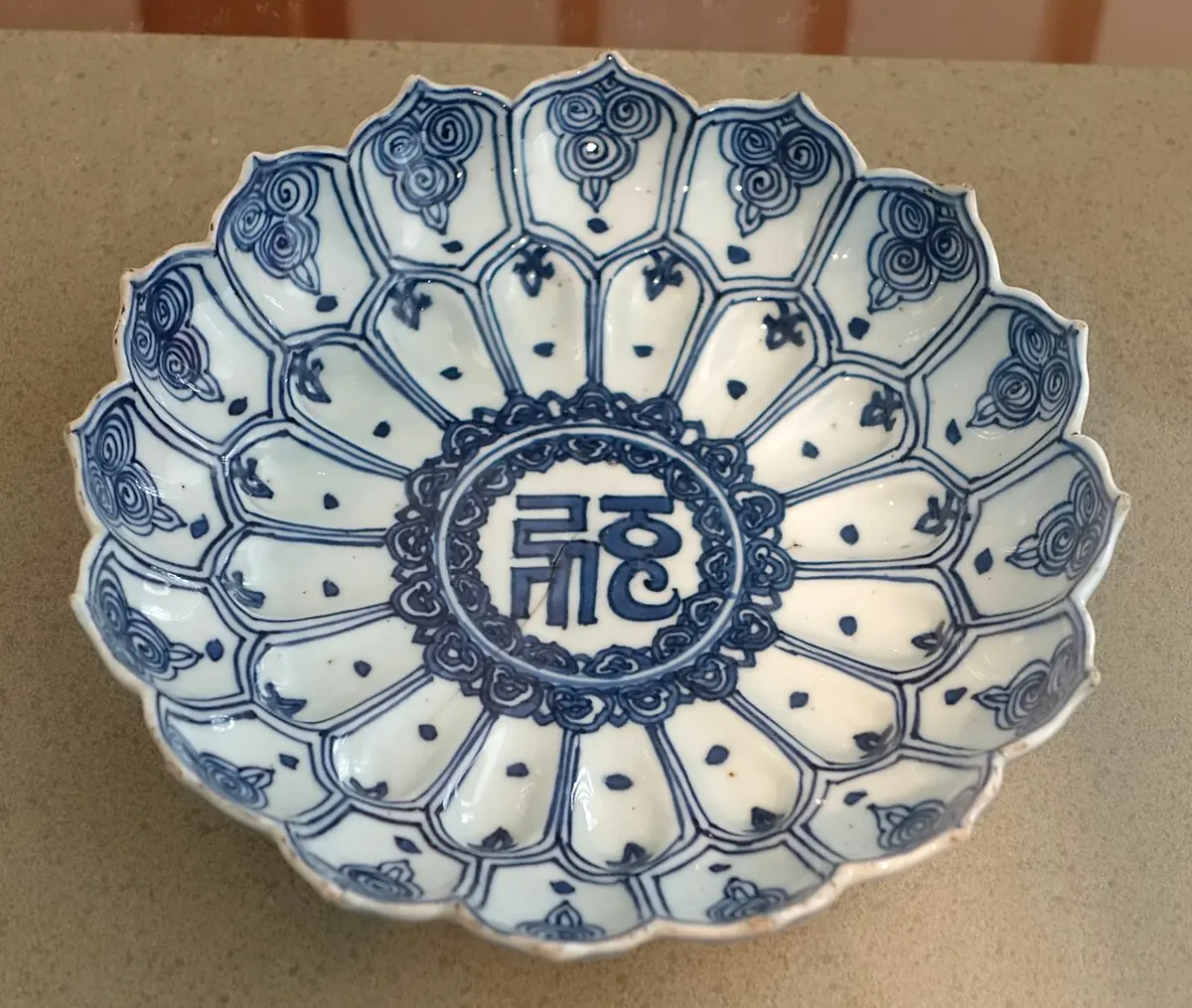
The phone in your pocket almost certainly has a few grams of cobalt in it, inside its battery. So do laptops, and many electric scooters and cars. The deep blue of old glass bottles and of China’s famous blue-and-white porcelain is cobalt too. And a tiny amount of it is inside you, at the heart of vitamin B12, without which your blood and nerves would fail.
Cobalt is also one of only three metals that a magnet picks up, with iron and nickel. Here is its story, from its atom to the goblins that gave it its name.
The cobalt atom
Every cobalt atom has 27 protons in its nucleus, so cobalt’s atomic number is 27. A neutral atom also has 27 electrons. All natural cobalt atoms have 32 neutrons, so their mass number is 27 + 32 = 59.
You might expect the 2n² rule Grade 8: Bohr and Bury’s rule to fill the M shell with 18 electrons before any go into the N shell. It doesn’t. After argon (2, 8, 8), the next two electrons go into the fourth shell, as in potassium and calcium, and only then does the third shell carry on filling. So cobalt’s shells are 2, 8, 15, 2: a third shell that is not yet full, and two electrons outside it.
Its electronic configuration
In Grade 10 you write electrons in subshells Grade 10: The Aufbau principle. The 4s subshell is filled before 3d, so the order explains the shells:
1s² 2s² 2p⁶ 3s² 3p⁶ 4s² 3d⁷
The M shell holds 3s² 3p⁶ 3d⁷, which is 2 + 6 + 7 = 15 electrons; the N shell holds 4s², which is 2. Unlike its neighbors chromium and copper, cobalt follows the filling order with no exception.
Which is the correct arrangement of electrons in shells for a cobalt atom (27 electrons)?
Pick an answer to see why.
Its place in the periodic table
- Period 4, because its electrons are in four shells.
- Group 9, in the middle of the three columns called VIIIB in the older naming. It sits between iron (26) and nickel (28).
- d-block, because its last electrons go into the 3d subshell. So cobalt is a transition metal Grade 10: Metals.
Below cobalt in group 9 are rhodium and iridium, two rare, very unreactive metals. But cobalt is more like its neighbors in the same row, iron and nickel: all three are hard, silvery, and magnetic.
In compounds, cobalt loses its two 4s electrons to become Co²⁺ (valency 2, cobaltous), or one more from 3d to become Co³⁺ (valency 3, cobaltic) Grade 9: Variable valency. In simple salts such as cobalt chloride (CoCl₂), it is Co²⁺.
How cobalt was found and named
Cobalt’s color was used for thousands of years before anyone knew it was a metal.
- About 3,400 years ago, glassmakers in Egypt colored glass a deep blue with a cobalt mineral. Cobalt-blue glass was found in the tomb of Tutankhamun.
- From the 1300s, potters in China painted their white porcelain with a cobalt ore before firing it: the famous blue-and-white ware, sold as far as Africa and Europe.
- About 1735, the Swedish chemist Georg Brandt showed that the blue came from a new metal, not from bismuth, as people had thought. He published his work in 1739. Other chemists argued for years that his “metal” was only a mixture of iron and arsenic, until it was accepted.
Cobalt is often called the first metal discovered by a known person. Gold, copper, iron and the other old metals were all known before history was written down.
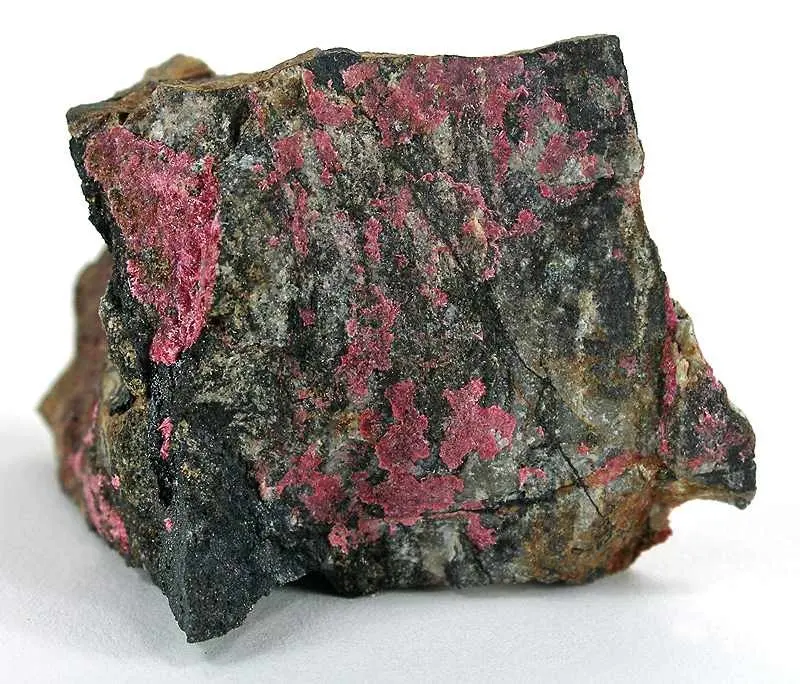
The name. In the silver mines of Germany, miners sometimes dug up an ore that looked like silver ore. When they smelted it, it gave no silver, only poisonous fumes of arsenic that made them ill. They blamed a mischievous goblin of the mines, the Kobold, and called the ore kobelt. From it came “cobalt” and the symbol Co. Nepali has no word of its own: it is कोबाल्ट.
Where cobalt is found
In the universe. Cobalt atoms were made in exploding stars, in the last moments of a massive star’s life, and scattered into space (Getting the atoms out). Cobalt is even part of how an exploding star shines for months afterwards: its radioactive nickel turns into radioactive cobalt, which turns into iron.
In the Earth’s crust. Cobalt is not rare, about 25 to 30 grams in every tonne of rock, but it is spread thinly. It is rarely mined for itself. Most comes as a by-product of mining copper or nickel, from the same ores. In 2024 the world mined about 290,000 tonnes of cobalt (USGS). About three quarters of it came from one country, the Democratic Republic of the Congo in central Africa, and the next largest share from Indonesia.
Much of the Congo’s cobalt is dug by hand, by people working without safety, and children among them. In 2014 UNICEF estimated that about 40,000 children worked in the mines of the southern Congo. Battery and phone makers now have to check where their cobalt comes from.
On the sea floor. Lumps of metal ore the size of potatoes, called nodules, lie on the deep ocean floor. They hold manganese, nickel and a lot of cobalt, but no one yet mines them.
In Nepal. Small amounts of cobalt ore occur in Nepal’s hills, and before 1951 Nepal even sold cobalt to India from small mines. Today none is mined.
In your body. An adult holds only about 1 milligram of cobalt, almost all of it in vitamin B12 (see below).
What cobalt is like
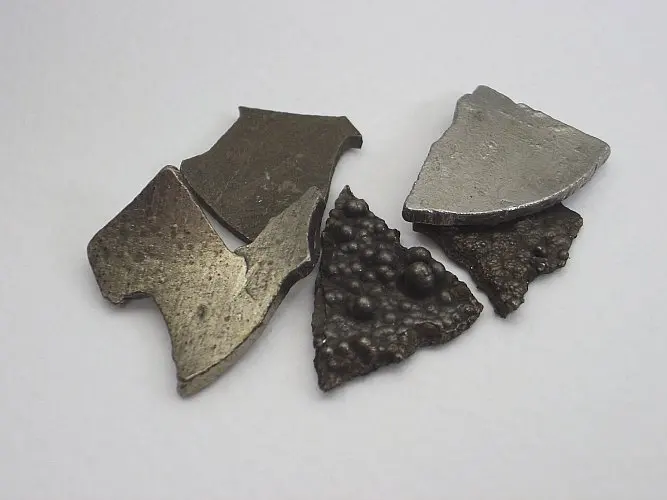
- Color. A shiny, silvery metal with a faint blue tint.
- Hard and strong. Harder than iron, and it keeps its strength when it is very hot.
- Heavy for its size. Its density is 8.86 g/cm³, almost nine times that of water.
- Melts at 1,495 °C, a little lower than iron (1,538 °C).
- Magnetic. Cobalt is ferromagnetic: a magnet attracts it, and it can be made into a magnet itself Grade 8: Magnetic materials. At room temperature only three elements are like this: iron, cobalt and nickel.
Heat a magnet and it loses its magnetism at a certain temperature Grade 8: Demagnetization by heating. For iron this is about 770 °C; for nickel only about 360 °C. Cobalt stays magnetic until more than 1,100 °C, the highest of any element. That is why the strongest magnets for hot places, inside motors and machines, are made with cobalt: alnico (aluminium, nickel and cobalt) and samarium–cobalt magnets.
A boy has a magnet and four coins, each made of a single metal. Which coin will the magnet pick up?
Pick an answer to see why.
How cobalt reacts
Cobalt is a fairly unreactive metal. In the reactivity series it sits just below iron, but still above hydrogen.
- In air it hardly changes, because a very thin layer of oxide forms on the surface and protects it. That is why cobalt is used to plate other metals.
- Heated strongly in air, it burns to a black oxide.
- It reacts slowly with dilute acids, giving off hydrogen Grade 9: Metals and dilute acids:
Co + 2HCl → CoCl₂ + H₂
Cobalt’s salts are famous for their colors. Dissolved in water, cobalt chloride or cobalt sulphate gives a pink solution. Melted into glass or fired into a glaze, cobalt gives a deep blue, so strong that a very little cobalt is enough.
Cobalt chloride: a test for water
Dry cobalt chloride (CoCl₂) is blue. Each CoCl₂ can take up six water molecules as water of crystallization, and then it is pink:
CoCl₂ (blue) + 6H₂O → CoCl₂·6H₂O (pink)
Warm it, and the water is driven off: it turns blue again. So paper soaked in cobalt chloride and dried is a test for water: blue paper turns pink when water touches it. It works like white copper sulphate turning blue. Little bags of silica gel, packed with new shoes and electronics to keep them dry, once often had blue beads that turned pink when the gel was full of water.
A strip of blue cobalt chloride paper is held near a leaf, and after a while it turns pink. What does this show?
Pick an answer to see why.
Cobalt in daily life
Batteries. The biggest use of cobalt today is in lithium-ion batteries. In 1980 the chemist John Goodenough found that lithium cobalt oxide (LiCoO₂) makes an excellent positive electrode: lithium ions can move in and out of it many times without it falling apart. Most phone and laptop batteries still use it, which won a Nobel Prize in Chemistry in 2019. Car batteries use less cobalt, and many now use none at all (lithium iron phosphate), because cobalt is costly and its mining causes harm.
Jet engines. The hottest parts of a jet engine, the turbine blades, spin in gas at over 1,000 °C. They are made of superalloys of nickel and cobalt, which stay strong where steel would sag.
Cutting tools. The tips of the drill bits used on stone and concrete are tiny, very hard grains of tungsten carbide, held together by cobalt as a kind of metal glue.
Magnets (above), and artificial joints: hip and knee joints are often made of a cobalt–chromium alloy, which is strong and does not corrode inside the body.
Color. Cobalt blue is still a favorite color of painters and potters, and cobalt glass is used where a deep blue is wanted.
Isotopes of cobalt
All natural cobalt is one isotope, cobalt-59 (27 protons, 32 neutrons). That is why cobalt’s atomic mass, 58.93, is so close to a whole number Grade 9: Atomic mass. Compare copper, a mixture of two isotopes, at 63.5.
Put cobalt-59 inside a nuclear reactor, and its nuclei catch one extra neutron each. They become cobalt-60, which is radioactive. A cobalt-60 nucleus gives out a beta particle (an electron), becomes nickel-60, and then gives out two strong gamma rays (Beta decay, gamma rays). Its half-life, the time for half of the atoms to decay, is 5.27 years.
The gamma rays of cobalt-60 can kill living cells, so they are used:
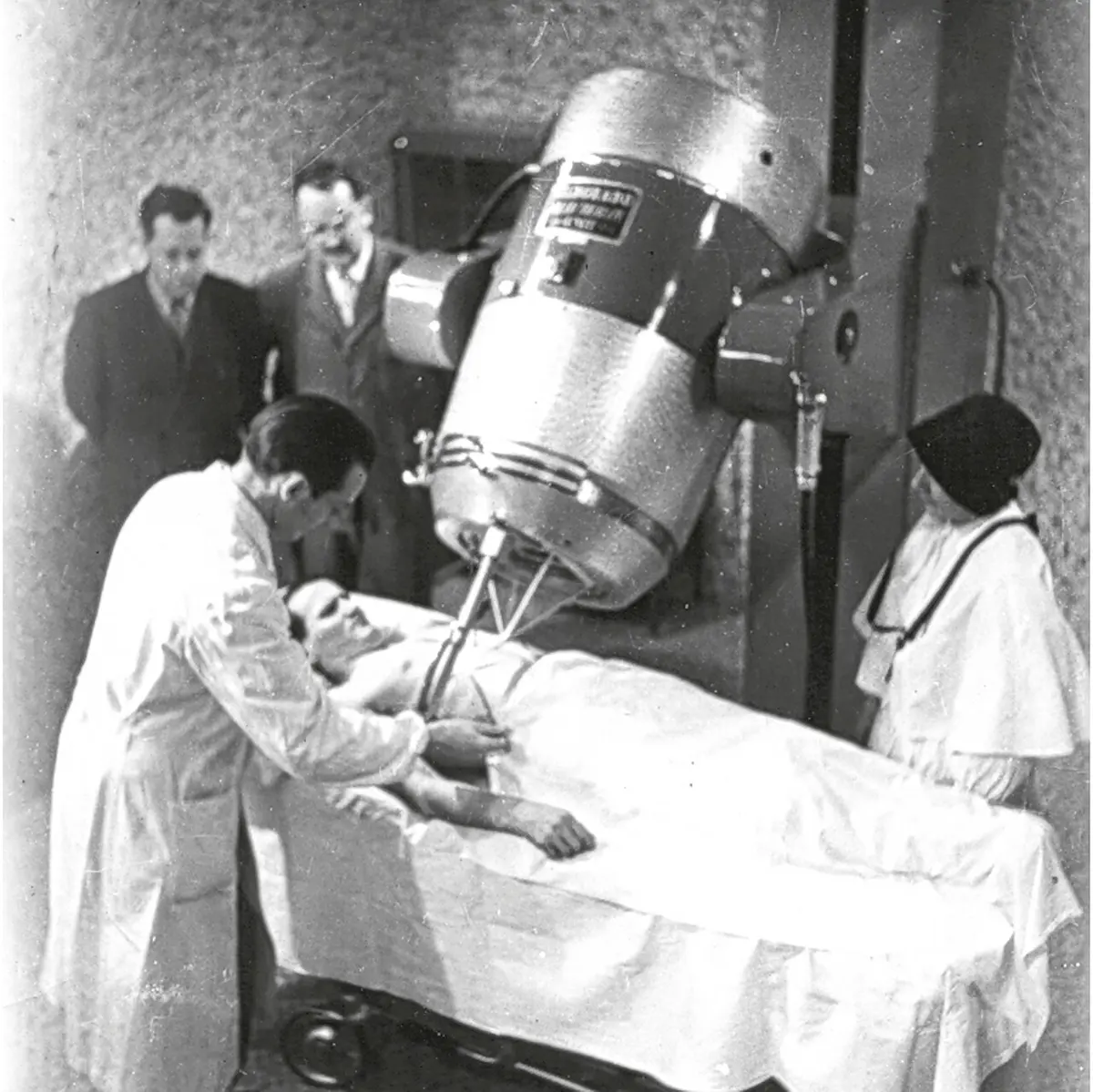
- against cancer: from 1951, first in Canada, cobalt-60 machines aimed a beam of gamma rays at tumors deep inside the body. Nepal’s first radiotherapy unit, at Bir Hospital in Kathmandu, opened in 1991 with one cobalt-60 machine, and the Bhaktapur Cancer Hospital has used one too. Many hospitals now use machines that make X-rays from electricity instead, which need no radioactive source;
- to sterilize syringes, gloves and bandages already sealed in their packets, and in some countries food;
- in industry, to see through thick metal welds, like an X-ray.
Cobalt and your health
Your body needs cobalt only in one form: vitamin B12. A B12 molecule is large, about 180 atoms, with one cobalt atom at its center. The British chemist Dorothy Hodgkin worked out its shape with X-rays in 1956, and it won her the Nobel Prize in Chemistry in 1964.
Vitamin B12 helps to:
- make red blood cells: without it, the body makes too few, large ones, a kind of anemia;
- keep nerves working, and the brain developing in a baby;
- copy DNA when cells divide.
An adult needs only about 2 micrograms of it a day (two millionths of a gram). Neither plants nor animals can make B12; only bacteria can. Cows, buffaloes and goats get it from the bacteria in their stomachs, which is why farmers sometimes add a little cobalt to the feed of animals grazing on poor soils. People get it from milk, curd, paneer, eggs, meat and fish. Plant foods have almost none, so people who eat no animal foods at all need B12 tablets.
In Bhaktapur, researchers have studied B12 in babies for years: in one study of about 470 breastfed babies, about one in six was short of it.
Surprising facts and records
- The hottest magnet. Cobalt stays magnetic above 1,100 °C, hotter than any other element.
- A goblin’s metal. Cobalt and nickel (from Kupfernickel, “copper-demon”) were both named by miners who thought their ores were cursed.
- A test of a law of nature. In 1956 Chien-Shiung Wu used cobalt-60 atoms, cooled almost to absolute zero and lined up by a magnet, to show that beta decay prefers one direction to the other (Broken symmetry).
- In exploding stars. The glow of some exploding stars fades week by week at the same rate as cobalt-56 decays, which is how astronomers know those stars make it.
In your science books
- Grade 8: magnetic materials (iron, cobalt and nickel), demagnetization by heating and the 2n² rule.
- Grade 9: variable valency, metals and dilute acids and radioactive elements.
- Grade 10: electronic configuration and transition metals.
- Going further: beta decay and gamma rays and where the atoms in your body came from.
More to explore
- Nobel Prizes with cobalt in them: the shape of vitamin B12 (1964), the lithium-ion battery (2019), broken symmetry (2008, tested with cobalt-60) and MOFs (2025, some of the first were built on cobalt ions).
- Play: find cobalt in Guess the Element and the Periodic Table Jigsaw.
- Read more: cobalt at the Royal Society of Chemistry and at PubChem.