
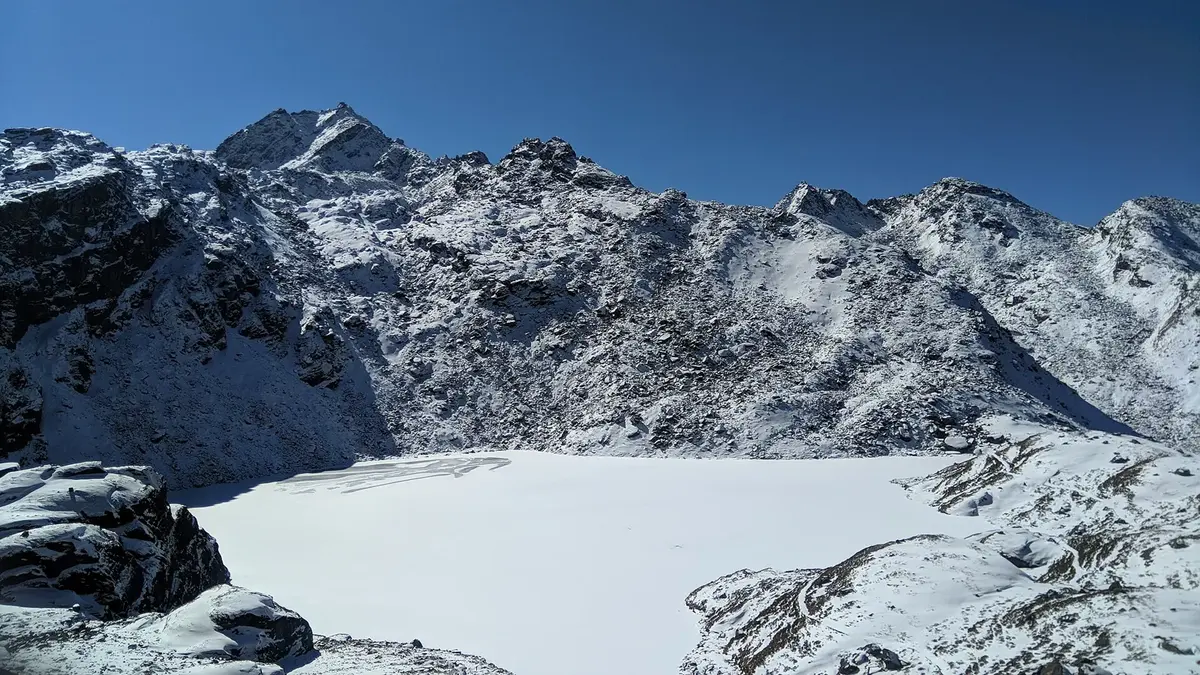
Every winter, Gosaikunda, the holy lake at 4,380 m in Rasuwa, freezes over. Pilgrims walk on its ice. Yet under that ice, the water stays liquid all winter long, at about 4 °C, and the lake comes alive again in spring. Why doesn’t the whole lake freeze solid, from the bottom up?
The answer is a strange habit of water, and it is one of the things this unit is about. You will also find out why steam burns worse than boiling water, why a glass cracks when you pour hot tea into it on a cold morning, why the sand on a beach burns your feet while the sea stays cool, and how to work out the temperature of a bucket of bath water before you mix it.
Four warnings, four reasons
You have probably heard all of these at home. Each has a scientific reason. Try to explain each one before you open the answer.
All four have something in common: they are about heat, about how it moves, and about what it does to things. Let’s start with what heat is.
Thermal energy, heat and temperature
All matter is made of atoms or molecules, and they are always moving: vibrating, spinning, rushing about. Because they move, they have kinetic energy. The molecules in lukewarm water move faster than those in cold water, and those in hot water move faster still.
Thermal energy is the total kinetic energy of all the molecules of a substance. Take equal masses of hot, tap and cold water: the hot water has the most thermal energy, and the cold water the least.
Not every molecule moves at the same speed; at any moment some are fast and some slow. So we talk about their average kinetic energy. Temperature is a measure of the average kinetic energy of the molecules of a substance. Hotter means the molecules are moving faster, on average.
The SI unit of temperature is the kelvin (K), though in daily life we use the degree Celsius (°C). Temperature is measured with a thermometer. A step of one kelvin is the same size as a step of one degree Celsius; only the starting point is different:
More thermal energy, but a lower temperature
Here’s a puzzle. A pan of boiling water is at 100 °C. A big bucket of lukewarm bath water is at 30 °C. Which has more thermal energy?
The molecules in the pan move faster, on average, so the pan has the higher temperature. But the bucket has far more molecules. Each moves more slowly, but there are so many of them that their total kinetic energy is bigger. So the lukewarm bucket has more thermal energy than the boiling pan. The thermal energy of a substance depends on its mass (how many molecules) and on the average speed of its molecules (its temperature).
Heat
Pour the pan of boiling water into the bucket. The fast molecules from the pan bump into the slower ones in the bucket and pass on some of their energy. Thermal energy moves from the hotter water to the cooler water.
The thermal energy that flows from one place to another because of a difference in temperature is called heat. Like every kind of energy, heat is measured in joules (J). It can be measured with an instrument called a calorimeter.
Heat travels in three ways: conduction (through a solid, from molecule to molecule, like the steel plate), convection (carried by a moving liquid or gas, like the hot water rising in a pot), and radiation (as invisible infrared rays, like the warmth you feel from the sun or a fire).
When you touch something and heat flows into your body from it, it feels hot. When heat flows out of your body into it, it feels cold.
Heat always flows from the object at the higher temperature to the object at the lower temperature, never the other way round by itself, until both reach the same temperature. Then the flow stops. This state is called thermal equilibrium.
A cup of hot tea is left on the table in a room at 20 °C. What happens?
Pick an answer to see why.
Which has more thermal energy: a teaspoon of water at 90 °C, or a swimming pool of water at 25 °C?
Pick an answer to see why.
Effect of heat on volume
In a solid, the particles are held close together in a fixed pattern by the forces of attraction between them. They don’t stay still: they vibrate about their places. In a liquid, they are still close but can slide past one another. In a gas, they are far apart and fly about freely (Figure 9.2).
When a solid is heated, its particles gain energy and vibrate harder. As they vibrate more and more, they push one another a little farther apart, and the force of attraction between them gets weaker. So the solid gets a little bigger: its volume increases. It expands. When it gives out heat, its particles slow down, the temperature falls, and the solid contracts. Most substances expand when heated and contract when cooled.
Engineers have to allow for expansion everywhere. Railway tracks and long bridges have small gaps so that they can grow on hot days without buckling; electric and telephone wires are hung a little loose so they don’t snap when they contract in winter. And you can use expansion yourself: if the metal lid of a glass jar is stuck, hold the lid under hot water. The metal expands more than the glass, and the lid comes loose.
A metal lid is stuck tight on a glass jar of pickle. What is the best way to loosen it?
Pick an answer to see why.
Anomalous expansion of water
Almost every substance expands when it is heated. Water does too, except in one small range of temperature, and that one exception matters enormously.
- When water is heated from 0 °C to 4 °C, it contracts: its volume decreases.
- Above 4 °C, it expands on heating, like everything else.
- Going the other way: water cooled down to 4 °C contracts, but cooled from 4 °C to 0 °C it expands.
So water has its smallest volume and its greatest density at 4 °C (more exactly, 3.98 °C). This unusual behavior is called the anomalous expansion of water (anomalous means “not following the usual rule”).
On top of that, when water at 0 °C freezes, it expands again by about 9%. Ice (density about 917 kg/m³) is less dense than water (1000 kg/m³), and that is why ice floats.
Effects of the anomalous expansion of water
Lakes freeze from the top, and fish survive
In winter, in cold places such as Nepal’s high mountains, the air gets colder than 0 °C. The water at the surface of a lake cools first.
- While the water is above 4 °C, the cooled surface water becomes denser and sinks, and warmer water rises to take its place. The whole lake cools this way, until all of it is at 4 °C.
- Now the surface water cools below 4 °C. It becomes less dense, so it stays on top. The heaviest water, at 4 °C, stays at the bottom.
- Layers form: from the bottom up, water at 4 °C, 3 °C, 2 °C, 1 °C and 0 °C. The top layer freezes into ice, which floats.
- The ice is a poor conductor of heat, so it works like a blanket: the water below it stays liquid, at about 4 °C at the bottom.
So the lake freezes from the top down, and fish, frogs and water plants live through the winter in the water under the ice.
Burst pipes and cracked bottles
In very cold places, water pipes burst in winter. As the water inside cools below 4 °C, it expands; when it freezes, it expands by about 9% more, and pushes on the pipe with an enormous pressure, far more than the pipe can bear. The same thing cracks a bottle full of water left in the freezer. People in cold places wrap their water pipes, bury them deep, or let the water run slowly through cold nights.
Why does ice float on water?
Pick an answer to see why.
Specific heat capacity
Put these pairs in the hot sun for 15–20 minutes: a steel plate and a ceramic plate; a plastic chair and a wooden chair; a tray of dry sand and a tray of wet soil; a steel vessel and a glass vessel. Then touch them. In each pair, one gets much hotter than the other. Different substances heat up at different rates, even in the same sunshine.
The amount of heat a thing takes in, and how much its temperature rises, depend on what it’s made of, on how much of it there is, and even on its shape and color (a dark, wide object takes in more sunlight).
What decides the heat needed
So the heat taken in (or given out) by a substance is:
- directly proportional to its mass , for the same change of temperature: … (i)
- directly proportional to its change in temperature , for the same mass: … (ii)
Combining (i) and (ii): , and so
where is a constant for each substance, called its specific heat capacity. This is the heat equation: the heat taken in or given out by a substance equals its mass × its specific heat capacity × its change in temperature. ( is the starting temperature and the final one. Some books write or for the change, and instead of .)
From (iii), . Put = 1 kg and = 1 °C, and . So:
The specific heat capacity of a substance is the amount of heat needed to raise the temperature of 1 kg of it by 1 °C.
Its SI unit is the joule per kilogram per degree Celsius (J/kg °C), which is the same as J/kg K, because a step of 1 °C is a step of 1 K.
| Substance | Specific heat capacity (J/kg °C) | Substance | Specific heat capacity (J/kg °C) |
|---|---|---|---|
| water | 4,200 | aluminium | 884 |
| ethyl alcohol | 2,400 | iron | 460 |
| kerosene oil | 2,010 | copper | 385 |
| ice | 2,100 | silver | 236 |
| mercury | 126 | gold | 130 |
So it takes 4,200 J to warm 1 kg of water by 1 °C, but only 2,100 J for 1 kg of ice, and just 130 J for 1 kg of gold. Water and ice are the same substance in two states, yet their specific heat capacities are different. Water’s is one of the highest of any common substance: water is very “hard to heat”, and just as slow to cool.
The same amount of heat is given to 1 kg of water and 1 kg of iron, both at 20 °C. Which gets hotter, and why?
Pick an answer to see why.
Specific heat capacity depends on:
Pick an answer to see why.
Calculating heat
Mixing hot and cold: heat lost = heat gained
When hot water is mixed with cold water, heat flows from the hot water to the cold water until they reach the same final temperature. If no heat escapes to the surroundings, all the heat given out by the hot water is taken in by the cold water:
This is called the principle of calorimetry (or the principle of mixtures).
Uses of specific heat capacity
Water’s specific heat capacity is very high: every kilogram of water must take in or give out 4,200 J to change its temperature by just 1 °C. That makes it useful in many ways.
- Cooling engines. The radiator of a car, bus or motorbike is full of water (with a little antifreeze). The water flows around the hot engine, takes in a large amount of heat without getting too hot itself, and gives it off to the air in the radiator. Thermal power stations use huge amounts of water for cooling for the same reason.
- Keeping warm. A hot water bag (bottle) filled with hot water gives out a lot of heat while cooling only slowly, so it stays warm for hours. It is used to warm a bed and to ease muscle pain (a hot compress).
- A wet cloth on the forehead helps bring down a high fever. The water takes in a lot of heat from the skin as it warms, and even more as it evaporates.
- Our bodies are mostly water: about 60% of an adult’s mass, more in a baby, and in some animals (a jellyfish) over 90%. All that water absorbs the heat our muscles make without our temperature shooting up, and helps keep us steady at about 37 °C.
Sea breeze and land breeze
On a sunny day the sun warms the land and the sea equally. But dry sand has a specific heat capacity of about 800 J/kg °C, roughly five times less than water’s. So the land heats up much faster than the sea. The air over the hot land becomes warm, expands, gets lighter, and rises, leaving low pressure behind. Cooler air from over the sea flows in to take its place. This cool wind from the sea in the daytime is the sea breeze.
At night, both lose heat by radiation. The land cools quickly; the sea, with its high specific heat capacity, stays warm. Now the warmer air over the sea rises, and cooler air flows from the land out to sea: the land breeze.
These breezes, and the sea itself, which warms and cools so slowly, keep places by the sea from getting very hot by day or very cold at night. In a desert, where there is little water in the sand or the air, the ground heats fast in the day and loses its heat fast at night: deserts can be 45 °C by day and near freezing by night.
On a sunny afternoon at the beach, the sand is burning hot but the sea water is cool. Why?
Pick an answer to see why.
Measurement of temperature
Our skin can be fooled (remember the three bowls), so we use thermometers. Each kind uses some property that changes with temperature.
a. Liquid-in-glass thermometer
It has a thin glass bulb filled with a liquid (mercury or colored alcohol), joined to a very fine tube, the capillary tube, with a scale beside it. When the bulb touches a hot object, heat flows into the liquid, the liquid expands, and it rises up the narrow tube. Where it stops on the scale is the temperature. Because the tube is so fine, a tiny expansion makes the thread move a long way, so it is easy to read.
Mercury is a good choice: it conducts heat well (so it responds quickly), it expands evenly, it is shiny and easy to see, it doesn’t stick to glass, and it stays liquid from −39 °C to 357 °C. In very cold places, alcohol thermometers are used instead, because alcohol freezes only at −114 °C. Mercury is poisonous, so under an international treaty, the Minamata Convention, mercury thermometers have been phased out since 2020 in many countries in favor of digital ones.
A clinical thermometer (for measuring body temperature) has a tiny bend, a kink, in its tube just above the bulb. When you take it out of your mouth, the mercury thread breaks at the kink and stays in place, so the doctor can read your temperature. It must be shaken down before it is used again.
b. Digital thermometer
A digital thermometer has a tiny thermistor at its tip: a resistor whose electrical resistance changes a lot with temperature. When the tip touches your body, heat flows into it, its resistance changes, so the current in the circuit changes, and a small chip turns that change into a temperature shown as numbers on the display.
c. Radiation (infrared) thermometer
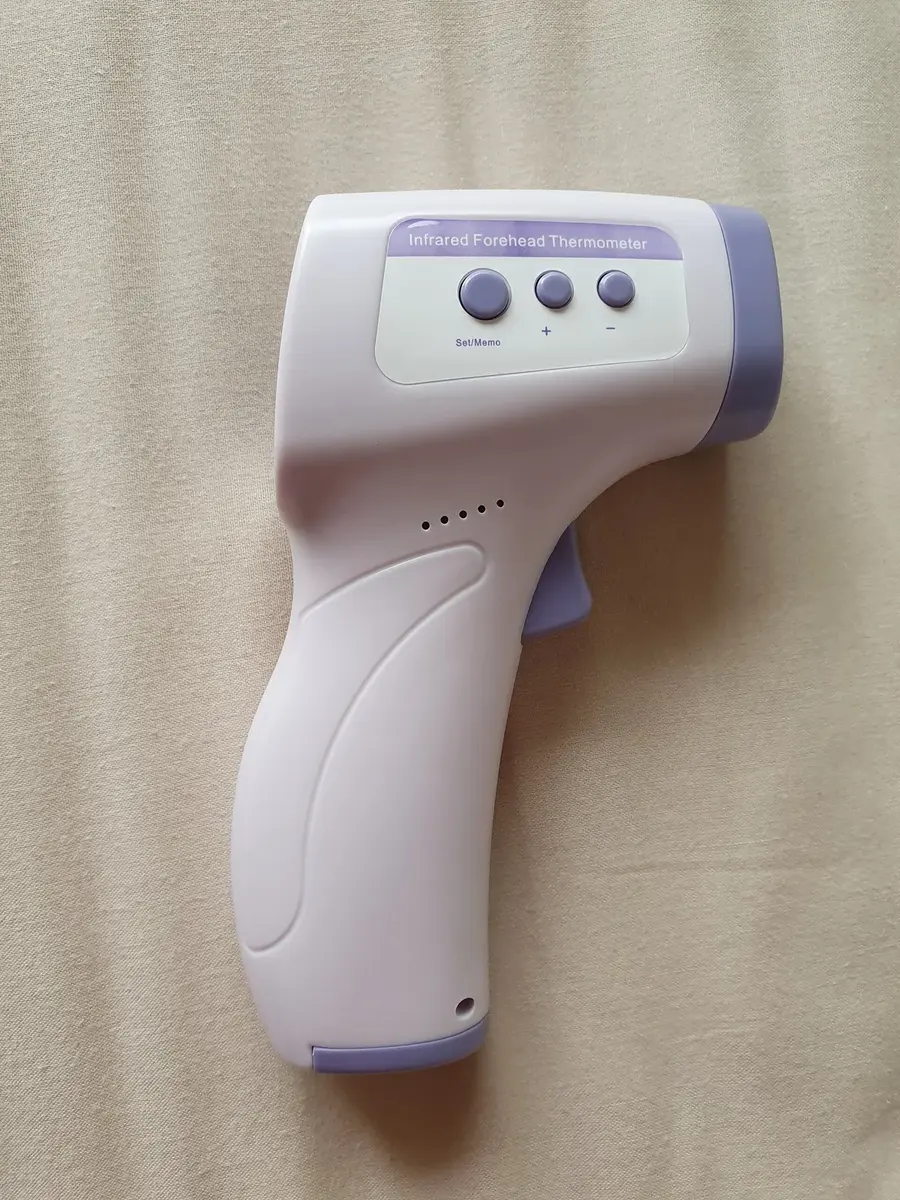
Every warm object gives out invisible infrared radiation; the hotter it is, the more. A radiation thermometer (infrared thermometer) has a lens that focuses the infrared coming from an object onto a sensor, which turns it into an electrical signal and shows the temperature. It needs no contact: you just point it at the forehead or at a hot pan. That makes it quick, safe and hygienic, which is why it was used everywhere at doorways during the COVID-19 pandemic.
Calibrating a thermometer
Calibration means marking the scale on a thermometer. First, two fixed points are marked:
- the lower fixed point: the temperature of pure melting ice, 0 °C;
- the upper fixed point: the temperature of the steam just above pure water boiling at one atmosphere of pressure (standard sea-level pressure), 100 °C.
The distance between the two is then divided into equal parts. On the Celsius scale it is divided into 100 parts, each 1 °C.
Different scales use different numbers for the same fixed points:
| Scale | Lower fixed point (ice melts) | Upper fixed point (water boils) | Parts between them |
|---|---|---|---|
| Celsius | 0 °C | 100 °C | 100 |
| Fahrenheit | 32 °F | 212 °F | 180 |
| Kelvin | 273 K | 373 K | 100 |
Since each scale spreads the same interval over its own number of parts, you can convert between them:
Boiling below 100 °C
Water boils at 100 °C only at sea-level pressure. A liquid boils when its molecules move fast enough to push bubbles of vapor open against the pressure of the air above. If the air pressure is lower, the bubbles form more easily, and water boils at a lower temperature.
The higher you go, the thinner the air and the lower its pressure, so the lower the boiling point. In Kathmandu and Bhaktapur (about 1,400 m) water boils at about 95 °C; at Namche Bazaar (3,440 m) at about 89 °C; and on the summit of Everest at only about 70 °C, not hot enough to cook rice or dal properly. That is why a pressure cooker is so useful in the hills: it traps the steam, raising the pressure inside to about twice that of the air, so the water boils at about 120 °C and food cooks fast.
Exercise
1. Choose the correct option
a. Which statement defines heat?
Pick an answer to see why.
b. When an object is heated, its volume increases. What happens to its atoms or molecules?
Pick an answer to see why.
c. The specific heat capacity of a substance depends on:
Pick an answer to see why.
d. Which of these is an effect of water’s high specific heat capacity?
Pick an answer to see why.
e. What is the best way to fit a wide pipe into a narrower pipe?
Pick an answer to see why.
f. What are the lower fixed points of the Celsius, Fahrenheit and Kelvin scales?
Pick an answer to see why.
2. Differentiate between
Thermal energy and heat
Answer
| Thermal energy | Heat |
|---|---|
| The total kinetic energy of all the molecules of a substance. | The thermal energy that flows from one object to another because of a temperature difference. |
| An object has it, whether or not anything is happening. | Exists only while energy is being transferred. |
| Depends on the mass and the temperature of the object. | Depends on the temperature difference (and the mass and substance). |
| Unit: joule (J) | Unit: joule (J) |
Heat and temperature
Answer
| Heat | Temperature |
|---|---|
| Energy transferred because of a temperature difference. | A measure of the average kinetic energy of the molecules. |
| A form of energy (a cause). | A condition of hotness (an effect of heating). |
| SI unit: joule (J). | SI unit: kelvin (K); also °C. |
| Measured with a calorimeter. | Measured with a thermometer. |
| Depends on mass: a bigger mass needs more heat for the same rise. | Doesn’t depend on mass: a cup and a bucket can be at the same temperature. |
The lower fixed point and the upper fixed point of a thermometer
Answer
| Lower fixed point | Upper fixed point |
|---|---|
| The temperature of pure melting ice. | The temperature of steam from pure water boiling at one atmosphere. |
| 0 °C, 32 °F, 273 K | 100 °C, 212 °F, 373 K |
| Marked by putting the bulb in melting ice. | Marked by holding the bulb in steam above boiling water. |
3. Give reasons
An iron bar gets hot when it is hammered again and again.
Answer
Each blow of the hammer does work on the bar. That energy makes the iron’s molecules vibrate faster, which increases their average kinetic energy. A higher average kinetic energy means a higher temperature, so the bar gets hot. Mechanical energy has been changed into thermal energy.
Tea in an open cup stops cooling after some time.
Answer
Heat flows from the tea to the surroundings only while the tea is hotter than the room. As it cools, the difference gets smaller, and when the tea reaches room temperature, the two are in thermal equilibrium. With no temperature difference, no more heat flows, so the tea stops cooling.
Water pipes crack in cold places in winter.
Answer
When water cools below 4 °C, it expands (the anomalous expansion of water), and when it freezes into ice, its volume increases by about 9% more. The pipe is already full, so the expanding water and ice push on its walls with a huge pressure, and the pipe cracks.
Water is kept in a car’s radiator to cool the engine.
Answer
Water has a very high specific heat capacity (4,200 J/kg °C). It can take in a large amount of heat from the hot engine while its own temperature rises only a little. It then gives this heat off to the air through the radiator, and comes back to cool the engine again. Water is also cheap and easy to get.
A hot water bag is used to give warmth (a hot compress) to parts of the body.
Answer
Because of its high specific heat capacity, hot water gives out a large amount of heat for each degree it cools. So the water in the bag stays warm for a long time, giving a steady, gentle warmth to the body. (The rubber bag is a poor conductor, so the heat flows out slowly and doesn’t burn the skin.)
There is not much difference between day and night temperatures in coastal areas.
Answer
The sea has a high specific heat capacity, so it warms slowly by day and cools slowly by night, and stays at a nearly steady temperature. By day, a cool sea breeze blows onto the land; at night, a land breeze blows the other way and the warm sea keeps the air from getting very cold. So the air temperature on the coast doesn’t rise or fall very much.
The temperature differs a lot between day and night in a desert.
Answer
A desert is mostly dry sand and rock, with very little water in the ground or the air. Sand has a low specific heat capacity, so it heats up quickly in the strong sun by day and loses its heat quickly at night. With no water nearby, and usually no clouds to keep the heat in, nothing slows these changes, so days are very hot and nights very cold.
4. Answer these questions
A man thinks that a bucket of lukewarm water contains more thermal energy than a large tank of cold water. Correct his understanding, using the meanings of thermal energy and temperature.
Answer
The lukewarm water has the higher temperature, which means the average kinetic energy of its molecules is higher. But thermal energy is the total kinetic energy of all the molecules. The tank holds far more water, so it has many more molecules. Even though each moves a little more slowly, together they have much more energy. So the large tank of cold water has more thermal energy than the bucket, even though it is at a lower temperature. A higher temperature does not mean more thermal energy.
A cup of hot tea feels hot to touch, but an ice cube feels cold. Explain this using the motion of their molecules.
Answer
The molecules of the hot tea (and the cup) move faster, on average, than the molecules of our skin. When they collide, the faster molecules give some of their energy to the slower ones, so heat flows into our hand, and we feel hot. The molecules of the ice move more slowly than those of our skin, so energy flows from our skin into the ice; our hand loses heat, and we feel cold.
The lid of a glass bottle won’t open. How can you open it using what you know about heat? Explain using the kinetic energy of molecules.
Answer
Pour hot water over the lid only (or hold it under a hot tap) for a minute. The heat increases the kinetic energy of the molecules of the lid, so they vibrate faster and move farther apart: the lid expands. Metal expands more than glass, and glass is a poor conductor so the bottle’s neck stays cooler, so the lid becomes slightly looser than the neck and can be turned easily.
Study this graph of the volume of 1 kg of water against temperature, and answer.
- i.What is this special property of water called?
- ii.How does the volume change when water is heated from 0 °C to 10 °C?
- iii.How is this different from other liquids?
- iv.Why is this knowledge important in daily life?
- v.Draw a model graph of the density of water against temperature, based on this graph.
Answer
- i.The anomalous expansion of water.
- ii.From 0 °C to 4 °C the volume decreases (from about 1000.13 cm³ to 1000.00 cm³). From 4 °C to 10 °C it increases again (to about 1000.27 cm³). The volume is smallest at 4 °C.
- iii.Other liquids expand steadily whenever they are heated, at all temperatures. Water contracts when heated from 0 °C to 4 °C, and only expands above 4 °C. (It also expands when it freezes, while most liquids contract when they become solid.)
- iv.It explains why lakes and ponds freeze from the top, so fish survive under the ice; why water pipes burst in winter in cold places; why bottles of water crack in the freezer; and why freezing water cracks rocks.
- v.Density is mass ÷ volume, so where the volume is smallest, the density is greatest. The graph rises from 0 °C to a peak at 4 °C (about 1000 kg/m³) and falls after that, like the right-hand graph of Figure 9.4.
One winter, drinking water from a steel jug on the table, Samir found that the water was warmer towards the bottom. Explain why, using science.
Answer
On a very cold winter morning, the water in the jug has cooled close to 0 °C. Because of the anomalous expansion of water, water is densest at 4 °C. The water at about 4 °C, being the densest, sinks to the bottom, while water colder than 4 °C is less dense and stays on top. So the bottom of the jug holds the “warmest” water (near 4 °C), and the top the coldest (near 0 °C). The steel jug, a good conductor, lets the water lose heat to the cold air quickly, which makes these layers form.
How do ghee and honey differ when they freeze, in volume and density? (Compare them with water.)
Answer
Ghee behaves like most substances: as it cools and becomes solid (in a cold Nepali winter, ghee in its jar sets solid), its volume decreases and its density increases. Solid ghee is denser than melted ghee, so it sinks in it, and the surface of set ghee often dips in the middle where it shrank last.
Honey is a thick solution of sugars in a little water. In a home freezer it doesn’t freeze into a solid at all; it just becomes very thick and stiff, while its volume decreases slightly and its density increases slightly. (Over time, cool honey can form sugar crystals, called granulating.)
Both are unlike water, which expands and becomes less dense when it freezes, which is why ice floats on water but solid ghee sinks in melted ghee.
Two identical ice cubes are kept, one in an aluminium box and the other in a wooden box. Which melts faster? Explain in terms of the melting process.
Answer
The ice in the aluminium box melts faster. To melt, ice must take in heat from its surroundings. Aluminium is a good conductor of heat, so heat from the warm air flows quickly through the box walls into the ice. Wood is a poor conductor (an insulator), so heat reaches the ice in the wooden box only slowly, and it melts more slowly.
What is specific heat capacity? Write its SI unit.
Answer
The specific heat capacity of a substance is the amount of heat needed to raise the temperature of 1 kg of it by 1 °C (or 1 K). Its SI unit is the joule per kilogram per degree Celsius, J/kg °C (or J/kg K).
What is the heat equation?
Answer
: the heat taken in or given out by a substance equals its mass × its specific heat capacity × its change in temperature. Here is the heat (J), the mass (kg), the specific heat capacity (J/kg °C), and and the starting and final temperatures (°C).
Write any two applications of specific heat capacity.
Answer
Any two of: water is used as a coolant in car radiators and power stations; hot water bags keep us warm for a long time; a wet cloth cools a feverish forehead; the sea keeps coastal climates mild (sea and land breezes); water in our bodies keeps our temperature steady; farmers flood fields on frosty nights so that the water, giving out heat slowly, protects the crops.
Describe a situation in which water boils below 100 °C.
Answer
Water boils at 100 °C only at standard sea-level pressure. Where the air pressure is lower, it boils at a lower temperature. At high altitude the air is thinner and its pressure lower: in Kathmandu (about 1,400 m) water boils at about 95 °C, at Namche Bazaar about 89 °C, and on Everest about 70 °C. Water also boils below 100 °C in a vacuum or in a syringe whose piston is pulled out while its nozzle is closed.
Name the kinds of thermometer used in daily life, and say how each works.
Answer
Liquid-in-glass thermometer: a liquid (mercury or alcohol) in a bulb expands when heated and rises up a fine capillary tube; the height of the thread against the scale gives the temperature.
Digital thermometer: a thermistor, whose electrical resistance changes with temperature, changes the current in a circuit; a chip shows this as a temperature on a display.
Radiation (infrared) thermometer: a lens focuses the infrared radiation given out by an object onto a sensor, which makes an electrical signal; the temperature is shown without touching the object.
What is the calibration of a thermometer? Describe how it is done.
Answer
Calibration is marking the scale on a thermometer. Two fixed points are marked first: the lower fixed point, by putting the bulb in pure melting ice and marking where the thread stops (0 °C); and the upper fixed point, by holding the bulb in the steam above water boiling at one atmosphere and marking where the thread stops (100 °C). The distance between the two marks is then divided into 100 equal parts, each 1 °C (or into 10 parts of 10 °C each, as in Activity 9.4).
5. Solve these problems
How much heat is needed to raise the temperature of 500 g of water from 15 °C to 85 °C? (Specific heat capacity of water = 4,200 J/kg °C)
Answer
= 500 g = 0.5 kg, = 4,200 J/kg °C, = 15 °C, = 85 °C
Q = 147,000 J = 147 kJ.
The specific heat capacity of iron is 460 J/kg °C. How much heat does an iron ball of mass 5 kg give out as it cools from 430 °C to 30 °C?
Answer
= 5 kg, = 460 J/kg °C, fall in temperature = 430 − 30 = 400 °C
Q = 920,000 J = 920 kJ.
2 kg of paraffin needs 42,000 J of heat to raise its temperature by 10 °C. How much heat is needed to raise the temperature of 4 kg of paraffin from 20 °C to 40 °C?
Hint
First find the specific heat capacity of paraffin from the first sentence.
Answer
Specific heat capacity of paraffin:
Heat for 4 kg, from 20 °C to 40 °C:
Q = 168,000 J = 1.68 × 10⁵ J. (A quicker way: twice the mass and twice the rise need 2 × 2 = 4 times the heat, 4 × 42,000 J.)
Some books print this question with 4,200 J, which gives paraffin 210 J/kg °C, a tenth of its real value (about 2,100 J/kg °C, half of water’s); the method is the same, and the answer is then 16,800 J.
A substance of mass 500 g needs 7,938 J of heat to raise its temperature from 100 °C to 226 °C. Find its specific heat capacity.
Answer
= 0.5 kg, = 7,938 J, rise = 226 − 100 = 126 °C
s = 126 J/kg °C, the same as mercury in the table.
A bucket holds 16 kg of water at 25 °C. 4 kg of water at 80 °C is mixed into it. What is the temperature of the mixture? (Ignore heat lost to the surroundings.)
Answer
Let the final temperature be . Both are water, so cancels.
Heat lost by the hot water = heat gained by the cold water:
, so
The mixture is at 36 °C. Check: it lies between 25 °C and 80 °C, closer to 25 °C because there is more cold water.
Practice every question in the book, and keep track of the ones you miss →