
- Atomic number
- 103
- Atomic mass
- 266.12
- Shells
- 2, 8, 18, 32, 32, 8, 3
- Configuration
- 1s² 2s² 2p⁶ 3s² 3p⁶ 4s² 3d¹⁰ 4p⁶ 5s² 4d¹⁰ 5p⁶ 6s² 4f¹⁴ 5d¹⁰ 6p⁶ 7s² 5f¹⁴ 7p¹
- In the table
- period 7, group none (f-block), f-block
- Kind
- Actinide
- Valency
- 3 (Lr³⁺)
- State at 25 °C
- solid
- Melts · boils
- 1,627 °C · not known
- Known since
- 1961
Lawrencium, element 103, is the last of the actinides, the row that starts with actinium. It is named after the man who invented the machine that made it and its neighbors possible, the cyclotron. Only a few atoms of it are ever made at a time, yet with single atoms scientists have found that its outermost electron is not where the rules you learn in Grade 10 would put it.
The lawrencium atom
A lawrencium atom has 103 protons (atomic number 103) and 103 electrons. Its longest-lasting known kind, lawrencium-266, has 266 − 103 = 163 neutrons.
By the order of filling Grade 10: The Aufbau principle, after 7s² and a full 5f¹⁴, electron 103 should go into 6d:
… 7s² 5f¹⁴ 6d¹
That gives the shells on the facts card, 2, 8, 18, 32, 32, 9, 2. But calculations that allow for how fast the electrons near such a big nucleus move predict that the last electron goes into 7p instead:
… 7s² 5f¹⁴ 7p¹
and then the shells are 2, 8, 18, 32, 32, 8, 3. It is an exception to the filling order, like copper’s. A measurement in 2015, below, agrees with the calculations.
Lawrencium is in period 7, the fifteenth and last actinide Grade 10: Features of the modern periodic table, under lutetium, the last lanthanide. Whichever subshell its last electron is in, it gives away three electrons and forms Lr³⁺, like lutetium.
How many neutrons are there in an atom of lawrencium-256, the kind used in the 2015 measurement?
Pick an answer to see why.
How lawrencium was found and named
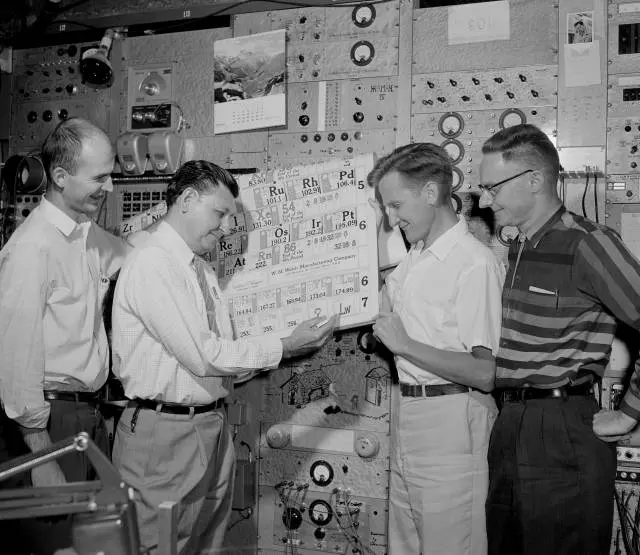
In early 1961, at Berkeley, California, Albert Ghiorso, Torbjørn Sikkeland, Almon Larsh and Robert Latimer fired boron nuclei (5 protons) from an accelerator at a tiny target of californium (98 protons): 98 + 5 = 103. The new atoms were blown by helium gas onto a moving tape, which carried them in front of detectors. They found atoms that gave out alpha particles with a half-life of about 8 seconds. The team named the element after Ernest Lawrence, who had died in 1958, and gave it the symbol Lw. The international union of chemists, IUPAC, accepted the name but changed the symbol to Lr.
Scientists at Dubna, near Moscow, made element 103 in 1965 by firing oxygen at americium (95 + 8 = 103), and argued that Berkeley had named the wrong kind of atom. They were right about that: the 8-second atoms were later shown to be lawrencium-258, not lawrencium-257 as first reported. Experiments at Berkeley in 1971 settled the remaining questions. In 1992, a working group of IUPAC and the physicists’ union, IUPAP, decided that the Berkeley and Dubna teams should share the credit. The name lawrencium stayed.
The cyclotron
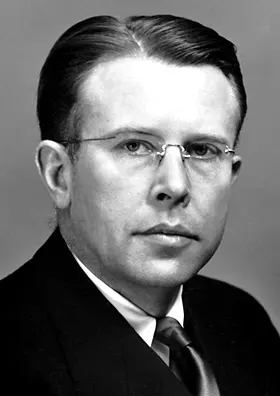
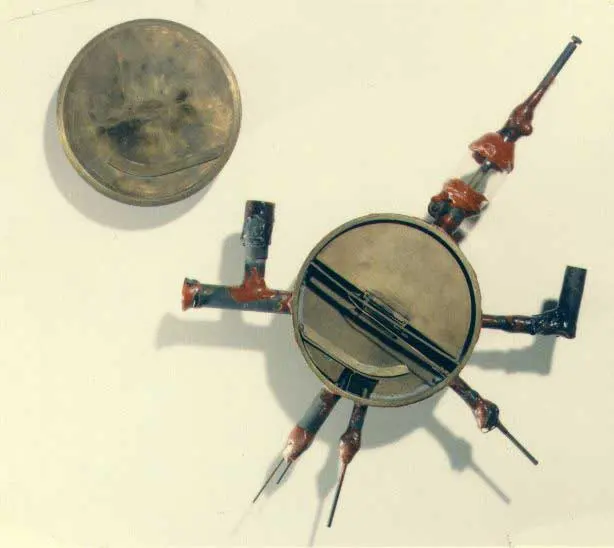
To join two nuclei, you must fire one at the other very fast, because both are positively charged and push each other away. In 1931, Lawrence and his students at Berkeley built a machine that does this in a small space. Charged particles go round and round between two D-shaped metal boxes inside a magnet, and get a push of voltage every time they cross the gap between the boxes. Each turn they go faster and swing out in a wider circle, until they shoot out at high speed. This is the cyclotron. Lawrence’s first one would fit in your hand; his later ones weighed many tonnes, and they made many of the new elements of the 1940s and 1950s.
What single atoms have shown
Lawrencium is still made the way it was found: light nuclei fired at heavy targets, a few atoms at a time. Its longest-lasting known kind, lawrencium-266, found in 2014 among the decay products of a much heavier element, has a half-life of about 10 hours. Chemists use lighter kinds that are easier to make, with half-lives of seconds to minutes.
What has been measured:
- In water and as a chloride, it behaves like the other actinides that form 3+ ions.
- In 2015, a team at the Japan Atomic Energy Agency in Tokai, Japan, measured how much energy it takes to pull the first electron off a lawrencium atom, using lawrencium-256, which has a half-life of only 27 seconds. They found 4.96 electronvolts, the lowest of all the actinides and lanthanides, just as the calculations for a lone 7p electron predicted. In 2018 they measured fermium, mendelevium and nobelium the same way.
The steady rise up to nobelium, and the sudden drop after it, showed that the 5f subshell fills up and is complete at nobelium, and that the actinides really do end with lawrencium.
What is only predicted: that lawrencium is a solid metal, and its melting point. The facts card’s 1,627 °C is an estimate (others say about 1,600 °C, close to lutetium’s). Its density and boiling point are unknown.
Where does it go in the table?
Your Grade 10 book puts lanthanum and actinium under yttrium in group 3, and lawrencium at the end of the actinide row. Some chemists put lutetium and lawrencium there instead, because they fit the pattern of the elements after them better, and lawrencium’s low ionization energy is one of their arguments. IUPAC has not made a final ruling. Either way, lawrencium is the 103rd element, with the same atom and the same chemistry.
In your science books
- Grade 9: radioactive elements and shells and their energy.
- Grade 10: the actinides, the Aufbau principle and how properties change across periods and down groups.
- Going further: alpha decay and half-life.
More to explore
- Nobel Prizes: Lawrence’s prize (1939) for the cyclotron, and Seaborg and McMillan’s prize (1951) for the elements beyond uranium.
- Its neighbors: nobelium, the element before it, rutherfordium, the first element after the actinides, and lutetium, the element above it.
- Play: find lawrencium in Guess the Element and the Periodic Table Jigsaw.
- Read more: lawrencium at the Royal Society of Chemistry and at PubChem.