
- Atomic number
- 17
- Atomic mass
- 35.45
- Shells
- 2, 8, 7
- Configuration
- 1s² 2s² 2p⁶ 3s² 3p⁵
- In the table
- period 3, group 17 (VIIA), p-block
- Kind
- Halogen
- Valency
- 1 (chloride, Cl⁻); also 3, 5 and 7 with oxygen
- State at 25 °C
- gas
- Melts · boils
- −101 °C · −34 °C
- Density
- 2.5 × as heavy as air
- Known since
- 1774
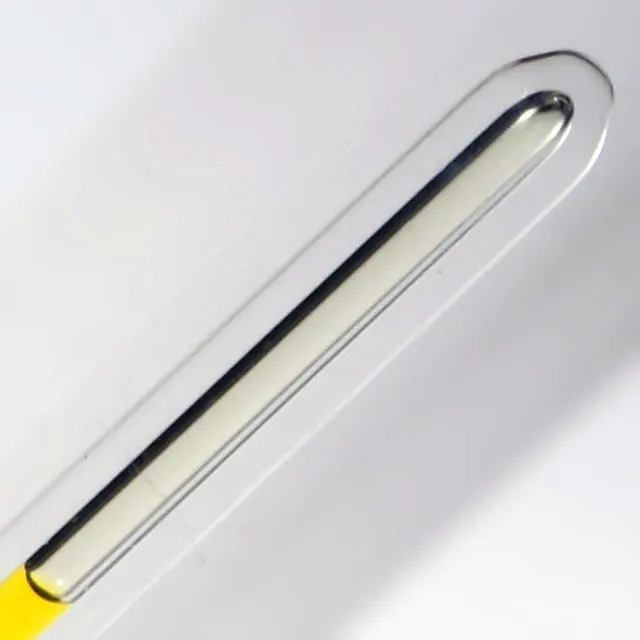
Sprinkle salt on your rice and you are eating chlorine. Swim in a pool and the sharp smell is chlorine too, and so is the faint taste of the tap water in many towns. Yet on its own, chlorine is a poisonous yellow-green gas, used as a weapon in the First World War.
How can the same element be a poison, the salt on your food and the thing that keeps your drinking water safe? The answer is in its atom: chlorine is one electron short of being content.
The chlorine atom
A chlorine atom has 17 protons, so chlorine’s atomic number is 17, and 17 electrons. Three atoms in four have 18 neutrons (chlorine-35); the rest have 20 (chlorine-37).
By the 2n² rule Grade 8: Bohr and Bury’s rule, the shells hold 2, 8, 7. In subshells it is 1s² 2s² 2p⁶ 3s² 3p⁵ Grade 10: The Aufbau principle: the 3p subshell has room for 6 and holds 5.
Its place in the periodic table
- Period 3, because its electrons are in three shells, between sulphur and argon.
- Group 17, called VIIA in the older naming many books use, because it has 7 outer electrons.
- p-block, because its last electron goes into a p subshell. It is a non-metal Grade 10: Non-metals.
One electron short
Seven outer electrons is one short of an octet Grade 9: Octet rule. So a chlorine atom pulls hard on any electron it can get. Given one by a metal, it becomes the chloride ion, Cl⁻, with the electrons 2, 8, 8, like argon Grade 9: Ions. Its valency is 1.
Two chlorine atoms can also share a pair of electrons, one from each, so that each counts 8. That is a covalent bond, and it is why chlorine gas is made of molecules of two atoms, Cl₂ Grade 9: Covalent bond.
With oxygen, which pulls on electrons even harder, chlorine can use more of its outer electrons and show valencies of 3, 5 and 7: in potassium chlorate, KClO₃, used in matches, its valency is 5.
A chlorine atom has 17 electrons and a chloride ion has 18. Which has the electrons 2, 8, 8?
Pick an answer to see why.
The halogens
Chlorine is one of the halogens, the elements of group 17: fluorine, chlorine, bromine, iodine and the rare, radioactive astatine. Every one has 7 outer electrons, so every one forms ions with a charge of −1 and molecules of two atoms (F₂, Cl₂, Br₂, I₂).
Going down the group the atoms get bigger, the pull on an extra electron gets weaker, and the halogens get less reactive. They also get darker and harder to boil Grade 10: Chemical reactivity.
How chlorine was found and named
People have used salt for at least eight thousand years, and medieval alchemists in the Middle East made hydrochloric acid from it. But chlorine itself was first made and described in 1774 by the Swedish chemist Carl Wilhelm Scheele. He warmed hydrochloric acid with a black mineral, pyrolusite (manganese dioxide), and got a greenish-yellow gas with a choking smell. He noticed that it bleached litmus paper, flowers and leaves, killed insects, and dissolved in water to make an acid.
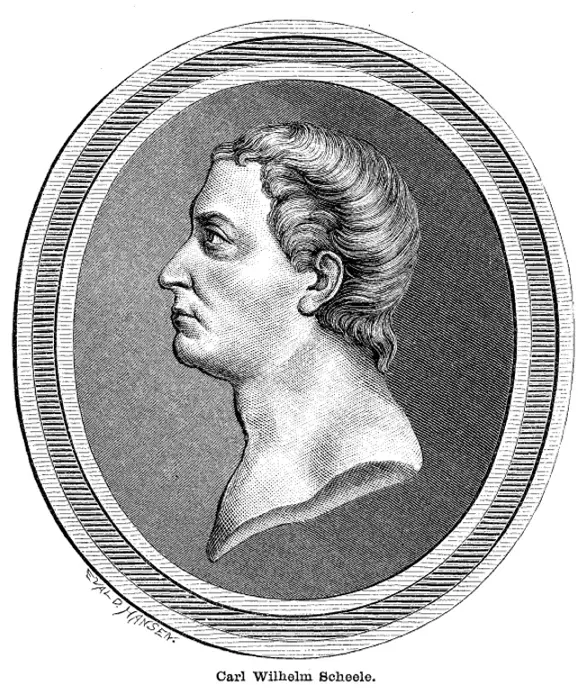
Scheele, like everyone then, thought every acid contained oxygen, so he took the gas for a compound with oxygen. In 1810 the English chemist Humphry Davy showed that nothing, not even red-hot charcoal, could take oxygen out of it: it was an element. He named it from the Greek chloros, pale green or yellow-green: hence the symbol Cl. A year later, chemists called it a halogen, “salt-maker”, because it joins with metals to make salts; the name was later given to its whole group.
In Nepali, chlorine is simply क्लोरिन: it has no older Nepali name. Its best-known compound has one: common salt is नुन.
Where chlorine is found
In the universe. Chlorine is made in big stars and the explosions that end their lives (Getting the atoms out). It is rarer than its neighbors sulphur and argon.
On the Earth, chlorine is far too reactive to be found free. Almost all of it is chloride, and most of that is in the sea: each liter of seawater holds about 19 g of chloride ions, more than half of everything dissolved in it. Where ancient seas dried up, they left thick beds of rock salt, the mineral halite (NaCl), which is mined around the world. Ordinary rock holds only about 150 grams of chlorine per tonne.
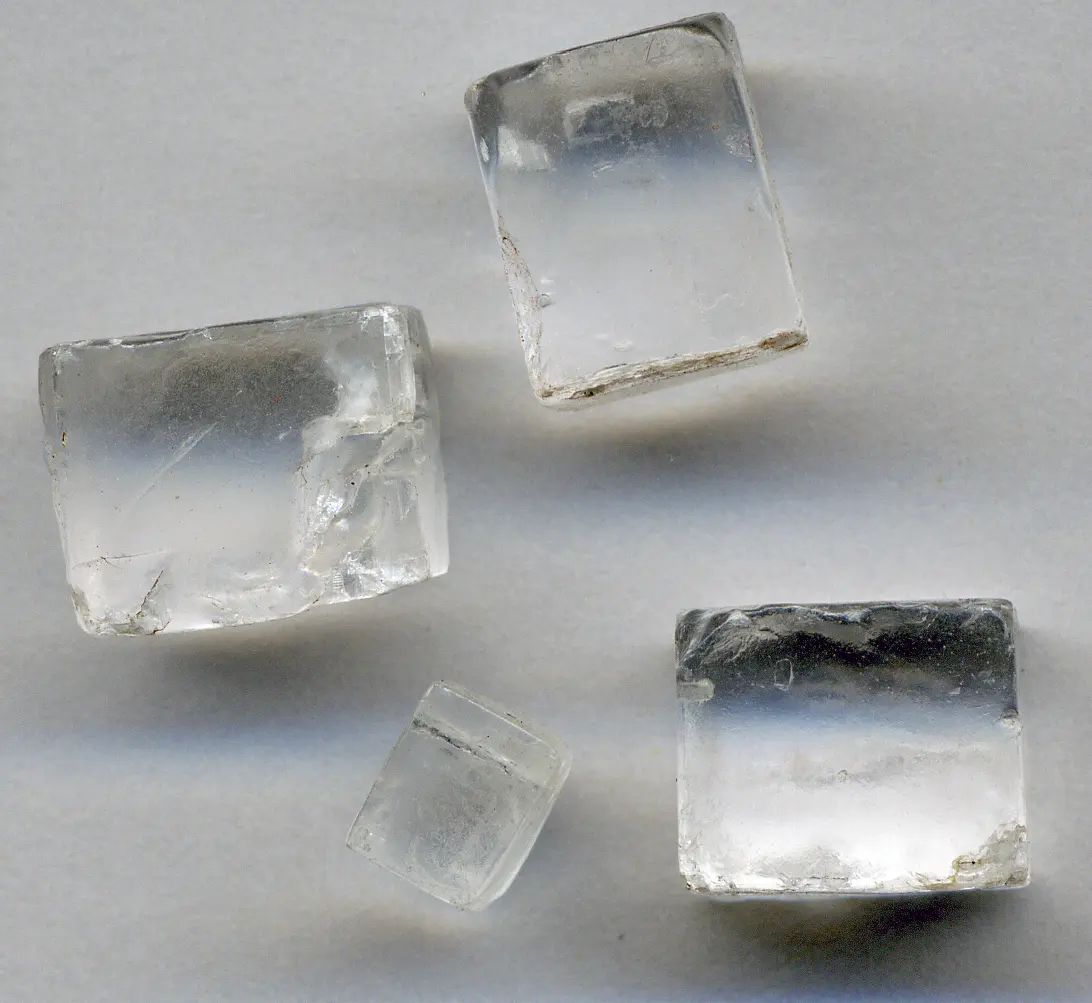
In Nepal. Nepal has no salt mines. For centuries people in the high mountains, such as Dolpo and Humla, carried salt from the salt lakes of Tibet on yaks and sheep and traded it for grain from the lower hills. Today Nepal’s salt comes from India, with iodine added to it.
What chlorine is like
- A yellow-green gas with a sharp, choking smell, the smell of a swimming pool but much stronger. It is made of molecules, Cl₂.
- Heavy: about 2½ times heavier than air, so a leak spreads along the ground and gathers in low places.
- Easy to turn into a liquid: it boils at −34 °C, and squeezed to about seven times the air’s pressure it becomes a yellow liquid at room temperature. It is moved and sold as a liquid in steel cylinders and tanks.
- It dissolves in water, some 7 g in a liter, and reacts with it.
- Very reactive: it joins with almost every element, and is a strong oxidizing agent.
How chlorine reacts
With metals. A piece of hot sodium burns in chlorine with a bright yellow flame, and white smoke of sodium chloride settles out. Each sodium atom gives its one outer electron to a chlorine atom Grade 9: Formation of sodium chloride:
2Na + Cl₂ → 2NaCl
A soft, dangerous metal and a poisonous gas make a harmless white solid that you eat. That is the difference between an element and a compound: in salt, chlorine is not chlorine gas any more but chloride ions, which are already full and want nothing.
With hydrogen. Hydrogen and chlorine react to make hydrogen chloride gas, HCl, by sharing a pair of electrons Grade 9: Formation of HCl. In the dark the mixture reacts slowly; in bright sunlight it can explode.
H₂ + Cl₂ → 2HCl
Hydrogen chloride dissolved in water is hydrochloric acid, one of the strong acids in your laboratory, and the acid in your own stomach, which helps digest food and kills germs.
With water. Chlorine reacts with water to make hydrochloric acid and hypochlorous acid, HOCl:
Cl₂ + H₂O → HCl + HOCl
Hypochlorous acid is what makes chlorine useful: it kills germs and bleaches colors, by taking electrons from the molecules of microbes and dyes and breaking them apart. So damp blue litmus paper held in chlorine first turns red (the acids) and then white (bleached): the test for chlorine gas.
With other halides. A more reactive halogen pushes a less reactive one out of its compounds, just as a more reactive metal does Grade 10: Single displacement. Bubble chlorine through colorless potassium iodide solution and it turns brown with iodine:
Cl₂ + 2KI → 2KCl + I₂
A test for chlorides. Add silver nitrate solution to a solution of any chloride, and a white precipitate of silver chloride forms Grade 10: Double displacement: NaCl + AgNO₃ → AgCl + NaNO₃. Tap water often gives a faint cloudiness, from its chloride.
Bromine water is added to potassium chloride solution. What happens?
Pick an answer to see why.
How chlorine is made
Almost all chlorine is made from salt, by passing electricity through brine, a strong solution of salt in water: electrolysis. Chlorine gas comes off at the positive electrode (the anode), and hydrogen at the negative one (the cathode). What is left is sodium hydroxide, caustic soda, which is just as useful, for soap, paper and aluminium. This is the chlor-alkali process:
2NaCl + 2H₂O → 2NaOH + H₂ + Cl₂
The world makes many tens of millions of tonnes of chlorine a year this way, and it takes a great deal of electricity.
Chlorine in daily life
Safe water
In the 1800s, cholera and typhoid, spread by dirty water, killed millions of people in growing cities. In 1897 the town of Maidstone in England disinfected its whole water supply with chlorine after an outbreak of typhoid, and from 1905 Lincoln in England chlorinated its water permanently. Within a few years cities around the world did the same, and deaths from water-borne diseases fell sharply.
A little chlorine is added to the water after it is filtered. Its hypochlorous acid kills bacteria and viruses in minutes, and a tiny amount stays in the water, a few tenths of a milligram in a liter, to keep it safe in the pipes and tanks on its way to your tap.
In Nepal, many town water supplies are chlorinated, and families can treat their own water with a few drops of a chlorine solution. Piyush, made in Kathmandu since 1998 by the Environment and Public Health Organization (ENPHO), and since 2002 from common salt, is sold in small bottles and was handed out after the 2015 earthquake. Bleaching powder is used to disinfect wells and tanks, especially after floods.
Bleach
In 1785 the French chemist Claude Berthollet used chlorine to bleach cloth, a job that had taken weeks of laying it out in the sun. Soon it was made into sodium hypochlorite solution (household bleach, NaOCl) and, from 1799, into solid bleaching powder, which is easier to carry.
Plastics, medicines and more
Much of the world’s chlorine goes into PVC (polyvinyl chloride), the plastic of water pipes, electric wire coverings, floor sheets and raincoats. Chlorine is used in making most medicines, many pesticides, and the hydrochloric acid used to clean steel.
Chlorine and the ozone layer
CFCs, gases of carbon, chlorine and fluorine, were once used in refrigerators, air conditioners and spray cans. They are so unreactive that they drift up, unchanged, into the stratosphere. There ultraviolet light breaks them and frees chlorine atoms, and each chlorine atom can destroy many thousands of ozone molecules, because it comes out of each reaction unchanged Grade 9: Depletion of the ozone layer. The scientists who found this won the Nobel Prize in Chemistry in 1995, and CFCs were banned worldwide by the Montreal Protocol (1987). The ozone layer is slowly recovering.
Isotopes of chlorine
Natural chlorine is a mixture of two isotopes, neither radioactive: about 75.8% chlorine-35 (18 neutrons) and 24.2% chlorine-37 (20 neutrons). That is why chlorine’s atomic mass is 35.5, the famous non-whole number in your books Grade 9: Atomic mass.
Chlorine-37 has a strange job. Once in a very long while, a neutrino from the Sun turns a chlorine-37 atom into an atom of argon. Raymond Davis filled a tank with 600 tonnes of a chlorine-rich cleaning fluid, deep underground, and counted the argon atoms: a few a week. It won him the Nobel Prize in Physics in 2002.
Chlorine and your health
Your body needs chloride ions. With sodium and potassium ions they keep the right amount of water in your cells and blood, carry the signals of your nerves, and make the hydrochloric acid in your stomach. Almost all of it comes from salt, so people rarely run short.
The problem is the opposite: too much salt raises blood pressure, which can lead to heart attacks and strokes. The World Health Organization advises adults to eat less than 5 g of salt a day, about a teaspoon. Studies in Nepal have found adults eating more than twice that; much of it comes from pickles, instant noodles, chips and salt added while cooking.
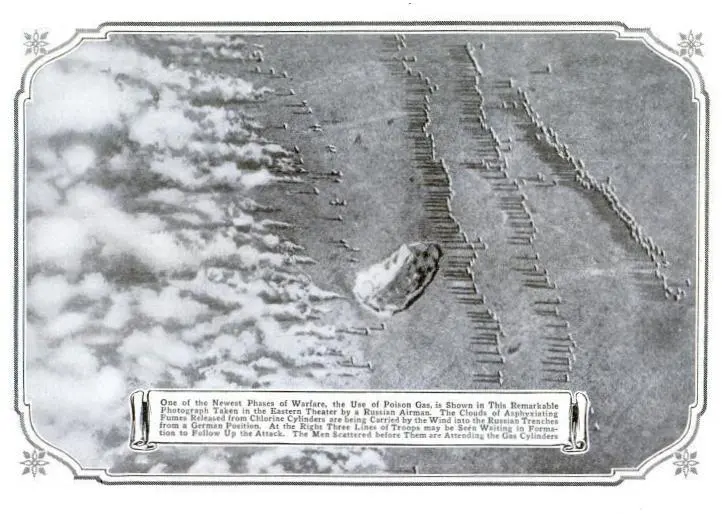
On 22 April 1915, near Ypres in Belgium, the German army opened thousands of cylinders of chlorine and let the wind carry the heavy cloud into the enemy trenches. Thousands of soldiers were killed or injured. The chemist who led this work, Fritz Haber, had won a Nobel Prize for making ammonia for fertilizers (Bread from air). Poison gas has been banned by international law since 1925.
Surprising facts and records
- The record electron-grabber. Of all the elements, chlorine gives out the most energy when a single atom takes one extra electron: even more than fluorine, whose tiny atom is crowded.
- The swimming-pool smell isn’t chlorine. It comes mostly from chloramines, made when chlorine reacts with sweat and urine in the water. A clean, well-run pool hardly smells at all.
- Chlorine in nature. Living things make thousands of chlorine compounds of their own, such as some sea sponges and seaweeds, and a fungus that rots wood.
In your science books
- Grade 8: the first 20 elements, the 2n² rule, valency, groups and salts.
- Grade 9: the octet rule, ions, sodium chloride, hydrogen chloride, atomic mass and the ozone layer.
- Grade 10: the Aufbau principle, reactivity down a group, single and double displacement.
- Going further: why salt melts at 801 °C and where the atoms in your body came from.
More to explore
- Nobel Prizes: the ozone layer (1995), neutrinos caught by chlorine (2002), bread from air (1918, Fritz Haber), the structure of salt crystals (1915) and the chemical bond (1954).
- Play: make salt, hydrochloric acid, chlorine gas and bleach in Molecule Kitchen, or find chlorine in Guess the Element and the Periodic Table Jigsaw.
- Read more: chlorine at the Royal Society of Chemistry and at PubChem.