
- Atomic number
- 111
- Atomic mass
- 282.17
- Shells
- 2, 8, 18, 32, 32, 17, 2
- Configuration
- 1s² 2s² 2p⁶ 3s² 3p⁶ 4s² 3d¹⁰ 4p⁶ 5s² 4d¹⁰ 5p⁶ 6s² 4f¹⁴ 5d¹⁰ 6p⁶ 7s² 5f¹⁴ 6d⁹ (predicted)
- In the table
- period 7, group 11 (IB), d-block
- Kind
- Transition metal
- Valency
- Not measured; expected 3 most often (also 1 and 5)
- State at 25 °C
- expected to be a solid
- Melts · boils
- not known · not known
- Known since
- 1994
Gold, silver and copper are the metals of coins and jewelry, the coinage metals of group 11. Under gold sits a fourth member that no jeweler will ever hold: roentgenium, element 111. A few atoms of it have been made, each lasting seconds or less. Calculations say that if you could collect enough of it, it would be a noble metal like gold, but with its electrons arranged differently.
The roentgenium atom
A roentgenium atom has 111 protons (atomic number 111) and 111 electrons. Its longest-lasting known kind, roentgenium-282, has 282 − 111 = 171 neutrons.
It is in period 7 and group 11, under copper, silver and gold, a d-block element, a transition metal Grade 10: Features of the modern periodic table.
Copper, silver and gold are all exceptions to the order of filling Grade 10: The Aufbau principle. By the rule, copper should end 3d⁹ 4s²; really it is 3d¹⁰ 4s¹, because one s electron moves in to make the d subshell full. Silver and gold do the same. Some periodic tables print roentgenium the same way, 6d¹⁰ 7s¹.
Calculations say roentgenium does not. In such a heavy atom the inner electrons move so fast (a good fraction of the speed of light) that the 7s subshell is pulled in close to the nucleus and its two electrons are held very tightly. So roentgenium is predicted to keep both: 6d⁹ 7s², exactly as the filling order says, which gives the shells on the facts card, 2, 8, 18, 32, 32, 17, 2.
By the order of filling alone, gold (79 electrons) would end 5d⁹ 6s². What is gold’s real configuration?
Pick an answer to see why.
Made at GSI, a month after element 110
On 8 December 1994, a month after the first atom of element 110 (darmstadtium), the same team at the GSI laboratory near Darmstadt, Germany, led by Sigurd Hofmann with Peter Armbruster and Gottfried Münzenberg, made element 111. They fired nickel-64 nuclei (28 protons) at a bismuth-209 target (83 protons): 28 + 83 = 111. They saw three atoms of roentgenium-272, each lasting only a few thousandths of a second. A team at Dubna in the Soviet Union had tried the same reaction in 1986 and found nothing.
Three atoms were not enough for the international judges, IUPAC and IUPAP: in 2001 they asked for more. GSI repeated the experiment in 2002 and saw three more, and in 2003 the judges agreed that GSI had found element 111.
Named after the discoverer of X-rays
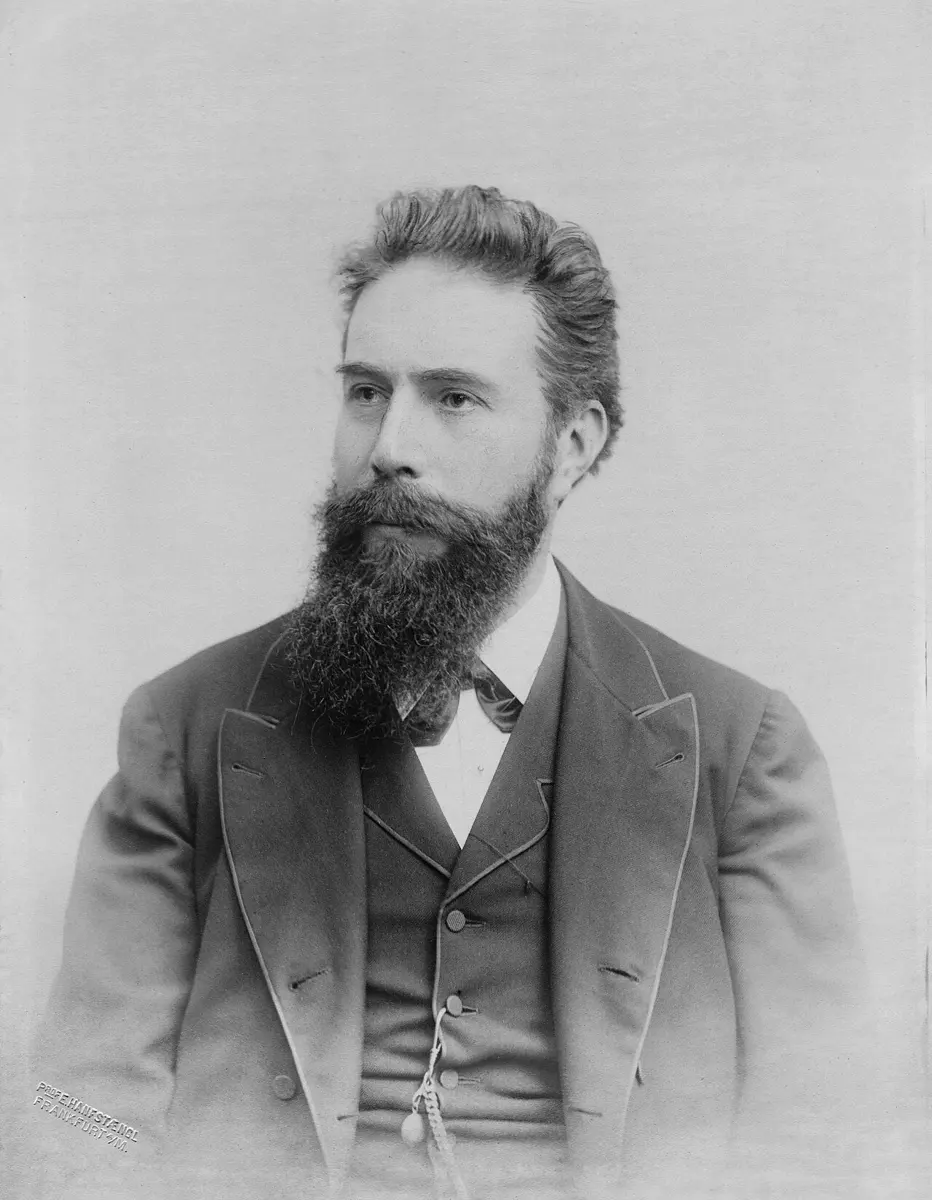
GSI proposed the name roentgenium, symbol Rg, after Wilhelm Conrad Röntgen (1845–1923; in English often spelled Roentgen). IUPAC accepted it on 1 November 2004, almost exactly 109 years after Röntgen’s discovery.
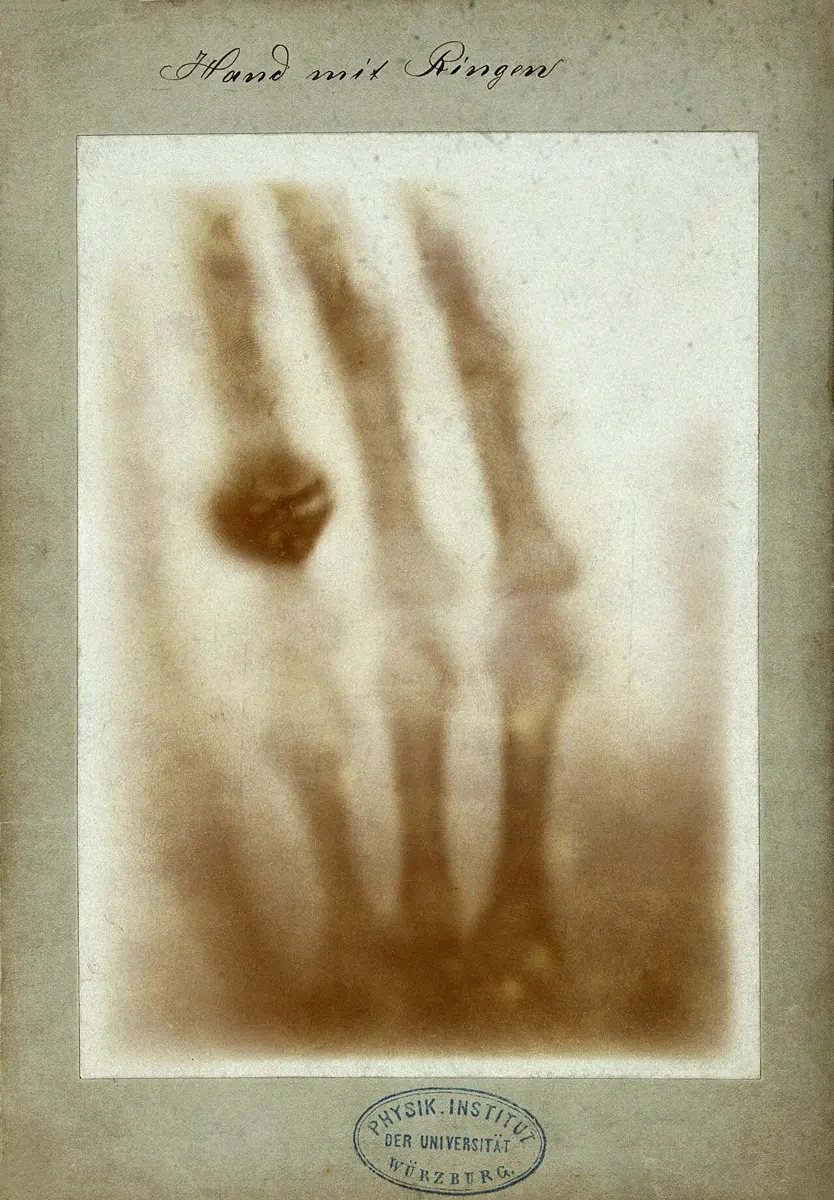
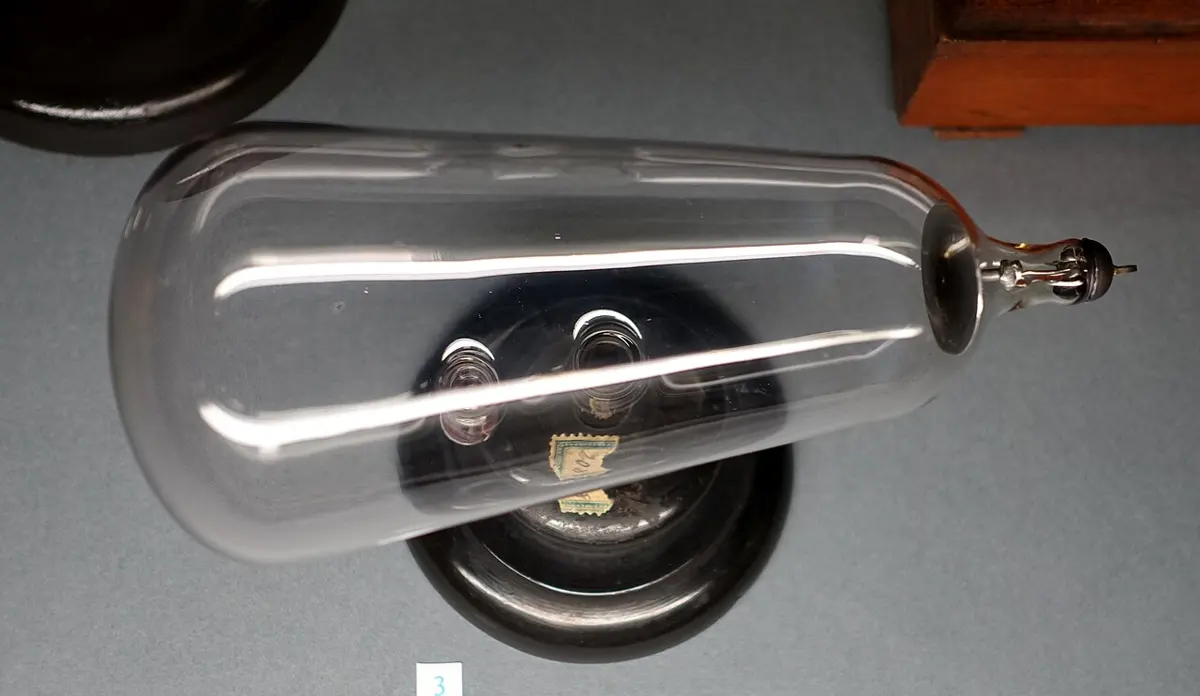
On 8 November 1895, at the University of Würzburg in Germany, Röntgen was passing electricity through a glass tube with most of the air pumped out. He had covered it in black card, yet a screen across the room began to glow. Something invisible was coming out of the tube and passing through the card. He called these unknown rays X-rays. Within weeks he had photographed the bones in his wife’s hand, and in 1901 he won the first Nobel Prize in Physics (the full story). Every X-ray picture taken in a hospital in Nepal today follows from that evening.
What has been measured, and what is only predicted
Roentgenium is made a few atoms at a time, often at the end of the decay of heavier elements. Its longest-lasting known kind, roentgenium-282, has a half-life of about two minutes (measurements range from about 100 to 130 seconds). That would be long enough for a chemistry experiment, but it is made too rarely.
What has been measured: how its nuclei decay (mostly by giving out alpha particles) and how long they last. No chemistry has been done.
What is only predicted:
- that it is a solid, very heavy noble metal, perhaps silvery, with a density of about 22 to 24 g/cm³, more than gold’s 19.3;
- that acids would attack it even less than they attack gold;
- that its most stable valency is 3, as in gold’s compounds such as AuCl₃, and that it can also show 1 and 5.
In your science books
- Grade 9: X-rays, X-ray imaging and radioactive elements.
- Grade 10: features of the modern periodic table and the Aufbau principle.
- Going further: alpha decay and half-life.
More to explore
- Nobel Prizes: Röntgen’s prize (1901), the full story of X-rays.
- Its neighbors: gold, silver and copper above it, darmstadtium before it and copernicium after it.
- Play: find roentgenium in Guess the Element and the Periodic Table Jigsaw.
- Read more: roentgenium at the Royal Society of Chemistry and at PubChem.