
- Atomic number
- 57
- Atomic mass
- 138.91
- Shells
- 2, 8, 18, 18, 9, 2
- Configuration
- 1s² 2s² 2p⁶ 3s² 3p⁶ 4s² 3d¹⁰ 4p⁶ 5s² 4d¹⁰ 5p⁶ 6s² 5d¹
- In the table
- period 6, group none (f-block), f-block
- Kind
- Lanthanide
- Valency
- 3 (La³⁺)
- State at 25 °C
- solid
- Melts · boils
- 918 °C · 3,464 °C
- Density
- 6.2 × as heavy as water
- Known since
- 1839
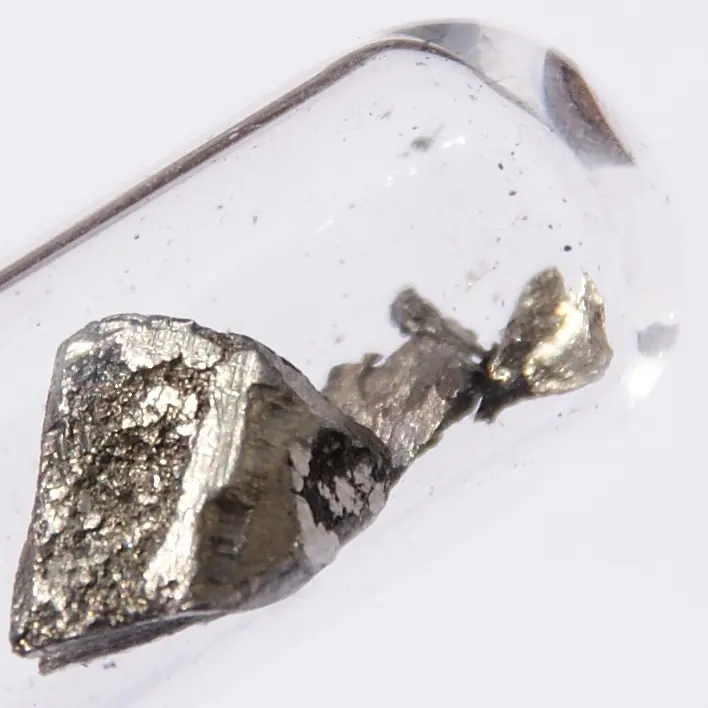
A good camera lens, the rechargeable AA batteries in a torch, the battery of a hybrid car, the “flint” of a pocket lighter: all of them hold a soft, silvery metal most people have never heard of, lanthanum (say LAN-tha-num).
Its name means “hidden”, and it earned it: it hid inside another element’s oxide for 36 years before anyone noticed. Lanthanum is also the first of the lanthanides, fifteen elements so alike that chemists took more than a hundred years to tell them all apart. This page tells lanthanum’s own story, and why its whole row is so hard to sort.
The lanthanum atom
A lanthanum atom has 57 protons, so its atomic number is 57, and 57 electrons. Almost every lanthanum atom has 82 neutrons, so its mass number is 57 + 82 = 139.
By shells, its 57 electrons are 2, 8, 18, 18, 9, 2. The first three shells fill as the 2n² rule says Grade 8: Bohr and Bury’s rule. The N shell, which could hold 32, has only 18, because the outer shells start filling before it is full.
In subshells Grade 10: The Aufbau principle, barium, just before lanthanum, ends with 6s². The diagonal rule says 4f comes next. But lanthanum’s 57th electron goes into 5d instead:
1s² 2s² 2p⁶ 3s² 3p⁶ 4s² 3d¹⁰ 4p⁶ 5s² 4d¹⁰ 5p⁶ 6s² 5d¹
4f and 5d have almost the same energy here, and with only one electron to place, 5d wins. From the next element, cerium, the 4f subshell starts to fill.
How are lanthanum’s 57 electrons arranged in shells?
Pick an answer to see why.
Its place in the periodic table
- Period 6, because its electrons are in six shells. It comes right after barium (56).
- It is the first of the lanthanides, the 15 elements from lanthanum (57) to lutetium (71), which are printed in a separate row below the main table Grade 10: Features of the modern periodic table. They belong in the gap under yttrium, in group 3.
- Its row is the f-block, where the 4f subshell fills. Lanthanum itself has no 4f electron yet, so some tables put lanthanum under yttrium, in the d-block, and count the f-block from cerium.
Its valency
Lanthanum loses its three outer electrons, the two 6s and the one 5d, to become La³⁺ Grade 9: Cations. Its valency is 3, and La³⁺ has the same electrons as the noble gas xenon. With no 4f or 5d electrons left, lanthanum’s compounds are white or colorless.
With the criss-cross method Grade 9: The criss-cross method, lanthanum (3) and oxygen (2) give La₂O₃, lanthanum oxide; with chloride, LaCl₃.
The lanthanides: fifteen near-twins
Lanthanum’s row is famous for one thing: its elements are almost impossible to tell apart. The reason is in where the new electrons go.
From cerium to lutetium, each element adds one electron to the 4f subshell. But 4f lies deep inside the atom, under the 5s, 5p and 6s electrons. On the outside, all fifteen look the same: two 6s electrons and a third that is easy to lose. Chemistry happens on the outside, so they all react in the same way, and nearly all form an ion with a charge of 3+.
They differ only a little in size. Each extra proton pulls the electrons in a bit more, so the ions shrink step by step across the row, from La³⁺ (about 103 pm) to Lu³⁺ (about 86 pm). This is called the lanthanide contraction.
Ions with the same charge and almost the same size fit the same places in a crystal. So the lanthanides are always found together, in the same minerals, and pulling them apart took chemists of the 1800s years of dissolving and crystallizing the same salts again and again. Today it is done by solvent extraction: the mixture is shaken with a liquid in which each lanthanide dissolves very slightly better or worse, many times over, in a long row of tanks.
The lanthanides, with scandium and yttrium, are called the rare-earth elements. They are not really rare. An old chemist’s earth was a metal oxide that does not melt in a fire, and these were “rare” because they came from a few odd minerals from Sweden (yttrium’s story). There are about 39 grams of lanthanum in a tonne of the Earth’s crust, more than lead.
Each of them still has something of its own. Cerium can lose a fourth electron, which none of the others does easily in water; praseodymium’s salts are green and it helps make the strongest magnets; lanthanum has the largest ion and no 4f electrons at all.
How lanthanum was found and named
- 1803. Chemists in Sweden and Germany found a new earth, ceria, in a heavy mineral from the Bastnäs mine in Sweden. Its metal was named cerium.
- 1839. Carl Gustaf Mosander, a Swedish chemist in Stockholm, heated some cerium nitrate until it partly broke down, then treated the oxide with dilute nitric acid. Most of it did not dissolve, but some did: the oxide of a new element. He called it lanthana, from the Greek lanthanein, “to lie hidden”, because it had hidden in ceria all along. The symbol is La.
- 1841. Mosander found that his lanthana held yet another earth, which he called didymia, “the twin” (see praseodymium).
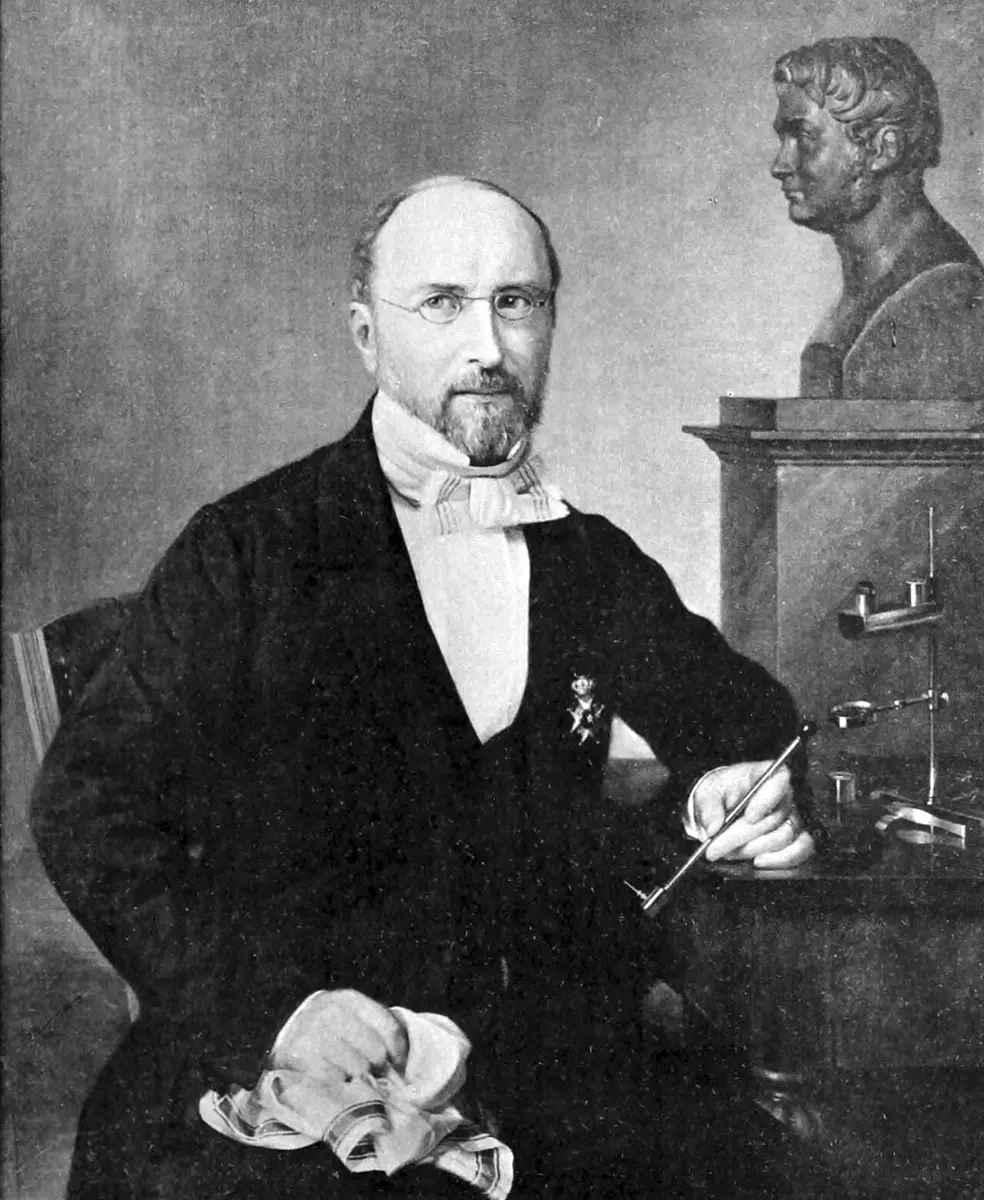
Fairly pure lanthanum metal was not made until 1923: the metal holds on to oxygen so tightly that it can only be freed by a more reactive metal, such as calcium, or by electrolysis of the molten chloride.
Where lanthanum is found
In the universe. Lanthanum is made in stars by catching neutrons, mostly slowly in old giant stars, partly in a flash in exploding or colliding stars (Catching neutrons). Lanthanum-139 has 82 neutrons, one of the especially stable numbers, so it builds up more than its neighbors.
In the Earth’s crust. Lanthanum is mined together with the other rare earths, from two main minerals: bastnäsite (a carbonate with fluoride) and monazite (a phosphate). Bastnäsite can be over a third lanthanum, monazite about a quarter. In 2025 the world mined rare earths equal to about 390,000 tonnes of their oxides, about 70% of it in China (USGS, 2026). India, Nepal’s neighbor, takes monazite from the sands of its southern beaches.
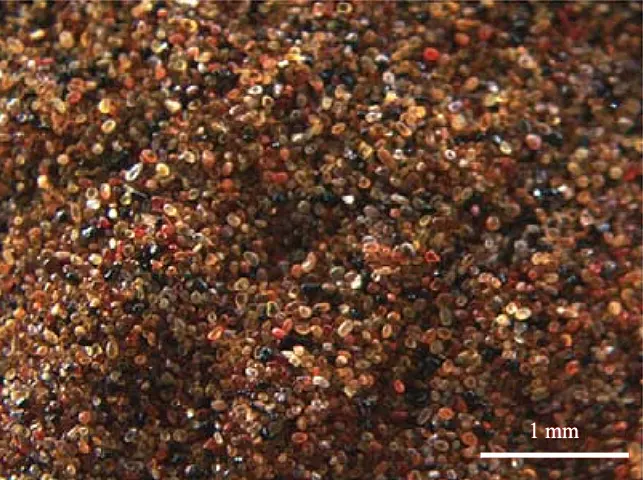
In Nepal and in your body. Nepal mines no rare earths. Your body has only a tiny trace of lanthanum and no use for it.
What lanthanum is like and how it reacts
- A soft, silvery-white metal, soft enough to cut with a knife Grade 9: Properties of metals.
- Density 6.15 g/cm³, a little less than iron (7.9).
- Tarnishes fast. A fresh surface goes dark in air within hours, and the oxide does not protect it the way aluminium’s does: it flakes off, like rust. So lanthanum is stored under oil or in sealed bags.
- Burns easily when heated, to white lanthanum oxide Grade 9: Metals react with oxygen:
4La + 3O₂ → 2La₂O₃ - Reacts with water slowly, giving lanthanum hydroxide and hydrogen Grade 9: Very reactive metals and water:
2La + 6H₂O → 2La(OH)₃ + 3H₂
Lanthanum has a valency of 3. What is the formula of lanthanum chloride?
Pick an answer to see why.
Lanthanum in daily life
Sharp lenses. When light enters a lens, it bends Grade 10: Refraction, and different colors bend by slightly different amounts Grade 10: Dispersion, which blurs a photo with colored fringes. Glass with lanthanum oxide in it bends light more strongly but spreads the colors little. So a lens can be thinner and less curved for the same power, and gives clearer pictures: it is used in good camera, microscope and telescope lenses.
Rechargeable batteries. In a nickel–metal hydride (NiMH) battery, one electrode is an alloy of nickel with lanthanum, often mixed with cerium and the other light rare earths. It soaks up hydrogen when the battery charges and gives it back when it is used. Rechargeable AA cells and the batteries of many hybrid cars are of this kind. An alloy of lanthanum and nickel (LaNi₅) can hold up to 400 times its own volume of hydrogen gas, like a sponge.
Making petrol. Much of the world’s lanthanum goes into catalysts Grade 10: Catalyst that crack the big molecules of crude oil into the smaller ones of petrol, in oil refineries.
Lighter flints. Lanthanum makes up about a quarter of mischmetal, the rare-earth mixture in lighter flints (see cerium).
Medicine. People whose kidneys have failed cannot remove phosphate from their blood. Chewable tablets of lanthanum carbonate, taken with meals, bind the phosphate from food in the gut so that it leaves the body instead of entering the blood.
Isotopes of lanthanum
Natural lanthanum is 99.91% lanthanum-139, which is stable. The other 0.09% is lanthanum-138, which is radioactive, but so slowly that its half-life is about 100 billion years, more than seven times the age of the universe. So lanthanum’s atomic mass, 138.91, is very close to 139 Grade 9: Atomic mass.
Lanthanum and your health
Lanthanum has no known job in the human body, and very little of it is absorbed from food, which is why lanthanum carbonate can work in the gut and leave again. Its dust should not be breathed in, and the metal’s shavings can catch fire.
In your science books
- Grade 8: the 2n² rule.
- Grade 9: cations, the criss-cross method, atomic mass and the properties of metals.
- Grade 10: the lanthanides in the periodic table, the Aufbau principle, refraction, dispersion and catalysts.
- Going further: where lanthanum is made.
More to explore
- Nobel Prizes with lanthanum in them: the first warm superconductor (1987) and buckyballs (1996: a lanthanum atom was trapped inside one).
- Its neighbors: barium before it, cerium and praseodymium after it, and yttrium above it.
- Play: find lanthanum in Guess the Element, the Periodic Table Jigsaw and Higher or Lower.
- Read more: lanthanum at the Royal Society of Chemistry and at PubChem.