
- Atomic number
- 64
- Atomic mass
- 157.25
- Shells
- 2, 8, 18, 25, 9, 2
- Configuration
- 1s² 2s² 2p⁶ 3s² 3p⁶ 4s² 3d¹⁰ 4p⁶ 5s² 4d¹⁰ 5p⁶ 6s² 4f⁷ 5d¹
- In the table
- period 6, group none (f-block), f-block
- Kind
- Lanthanide
- Valency
- 3 (Gd³⁺)
- State at 25 °C
- solid
- Melts · boils
- 1,313 °C · 3,273 °C
- Density
- 7.9 × as heavy as water
- Known since
- 1880
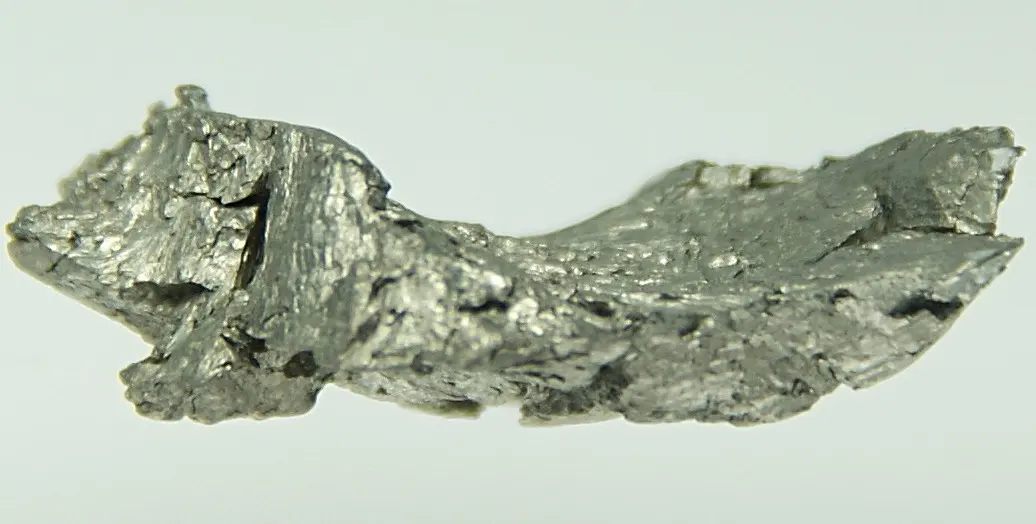
Before some MRI scans, a nurse injects a clear liquid into the patient’s arm. It makes the pictures sharper, and helps doctors see a tumor or an inflamed spot that might otherwise hide. The liquid carries gadolinium (say gad-oh-LIN-ee-um), the eighth lanthanide.
Gadolinium has another trick. Science books name three metals that a magnet attracts strongly: iron, cobalt and nickel. Gadolinium is a fourth, but only when it is cool: on a cold morning a magnet holds it, and on a warm afternoon it lets go.
The gadolinium atom
A gadolinium atom has 64 protons and 64 electrons. Natural gadolinium is a mixture of seven isotopes; the commonest, gadolinium-158 (about 25%), has 94 neutrons: 64 + 94 = 158.
The diagonal rule would put the 64th electron into 4f, making 4f⁸. But europium, just before it, already has a half-full 4f⁷, which is especially stable. So gadolinium keeps 4f⁷ and puts its new electron into 5d, just as lanthanum does:
1s² 2s² 2p⁶ 3s² 3p⁶ 4s² 3d¹⁰ 4p⁶ 5s² 4d¹⁰ 5p⁶ 6s² 4f⁷ 5d¹
By shells that is 2, 8, 18, 25, 9, 2: the 5d electron belongs to the fifth shell (O).
How are gadolinium’s 64 electrons arranged in shells?
Pick an answer to see why.
Its place and valency
- Period 6, the eighth lanthanide (f-block), in the middle of the row (fifteen near-twins).
- It loses its two 6s electrons and its 5d electron to become Gd³⁺, with a valency of 3: gadolinium oxide is Gd₂O₃, the chloride GdCl₃ Grade 9: The criss-cross method.
- Gd³⁺ keeps the half-full 4f⁷: seven unpaired electrons, the most any ion can have in one subshell. Each electron is a tiny magnet, and here none of them is paired off with an opposite one, so the Gd³⁺ ion is a strong little magnet. This is the secret behind gadolinium’s uses.
How gadolinium was found and named
In 1880, in Geneva, the Swiss chemist Jean Charles Galissard de Marignac found the oxide of a new element among the rare earths, at first by the new lines it gave in a spectrum. In 1886 the French chemist Paul-Émile Lecoq de Boisbaudran, who had found samarium, separated it too, and proposed the name gadolinium, which Marignac accepted. The symbol is Gd.
The name comes from the mineral gadolinite, which honors Johan Gadolin, the Finnish chemist who in 1794 first studied the black rock from Ytterby in Sweden that started the whole rare-earth story (yttrium’s story).
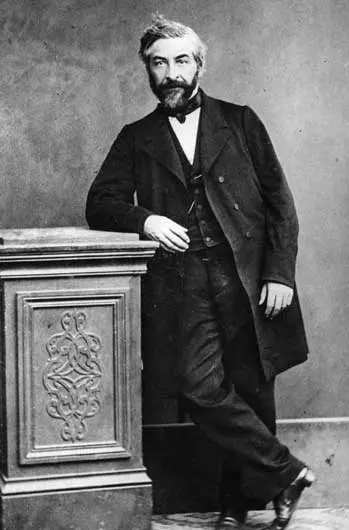
The pure metal was first made only in 1935, by the French chemist Félix Trombe.
Where gadolinium is found
In the universe, it is made in stars by catching neutrons (Catching neutrons).
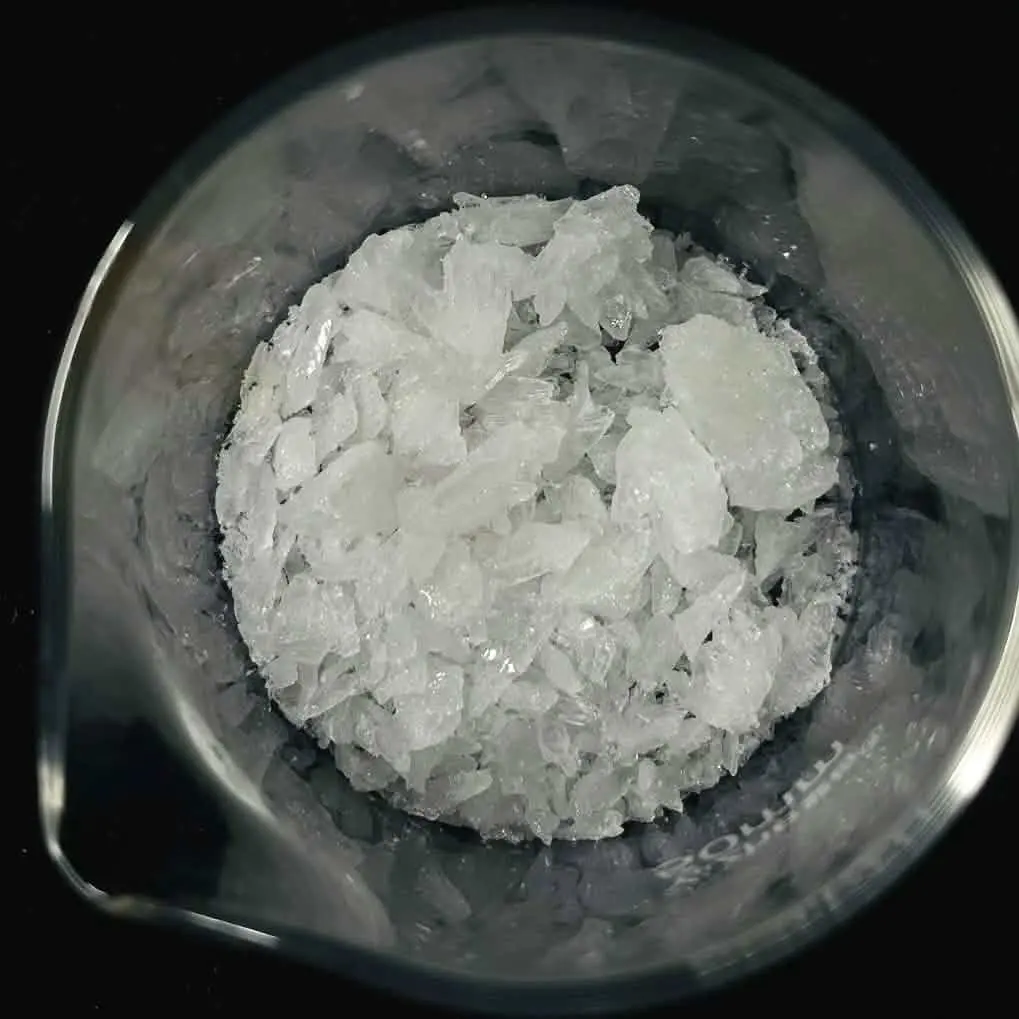
In the Earth’s crust there are about 5 to 6 grams in a tonne of rock. It is mined with the other rare earths, mostly from monazite and bastnäsite (where the rare earths come from). In 2025 gadolinium oxide cost about 30 US dollars a kilogram. Almost all of it is separated in China, which in April 2025 began to limit its export (USGS, 2026).
In Nepal and in your body. Nepal mines no rare earths. Your body has no use for gadolinium.
A magnet only when cool
Heat a magnet, and above a certain temperature it stops being magnetic Grade 8: Demagnetization by heating. The heat shakes the atoms’ tiny magnets out of line Grade 8: Molecular theory of magnetism. For iron that temperature is about 770 °C. For gadolinium it is only about 20 °C, a cool room. (Different measurements give between about 17 and 20 °C.)
So a lump of gadolinium taken from a fridge sticks to a magnet. Hold it in your warm hand for a while and it falls off. Above 20 °C a strong magnet still pulls on it, but only weakly. Below 20 °C, gadolinium is pulled even more strongly than nickel.
On a winter morning in Kathmandu, at 6 °C, and on a summer afternoon in the Terai, at 36 °C, would a magnet hold up a small piece of pure gadolinium?
Pick an answer to see why.
What gadolinium is like and how it reacts
- A soft, silvery-white metal that can be hammered and drawn out.
- In dry air it stays bright, but in moist air it tarnishes, and the oxide flakes off and lets more metal tarnish, as rust does.
- With water, slowly when cold and quickly when hot Grade 9: Very reactive metals and water:
2Gd + 6H₂O → 2Gd(OH)₃ + 3H₂ - With dilute acids, readily, giving colorless solutions: Gd³⁺, with its half-full 4f, soaks up no visible light Grade 9: Metals and dilute acids.
2Gd + 3H₂SO₄ → Gd₂(SO₄)₃ + 3H₂
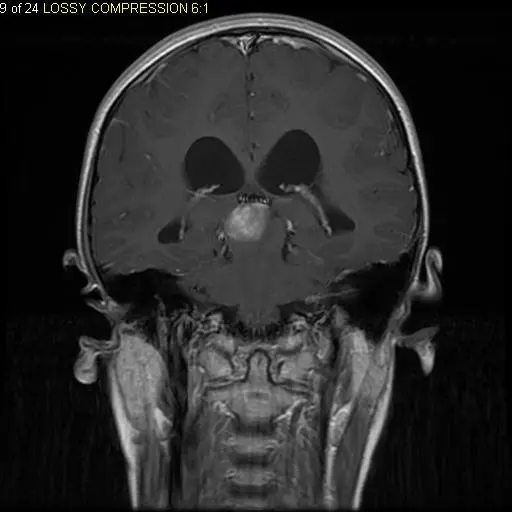
Gadolinium in the MRI scanner
An MRI scanner takes its pictures with a giant magnet and radio waves, by listening to the nuclei of the hydrogen atoms in the body’s water (How magnetic resonance works; Uses of magnets). After each radio pulse, the hydrogen nuclei take a moment to settle back.
A Gd³⁺ ion, with its seven unpaired electrons, is a strong little magnet. Water molecules that pass close to it settle back much faster, and in the usual kind of MRI picture those places show up brighter. Gadolinium injected into a vein travels with the blood. Where blood vessels are leaky or crowded, as in many tumors and inflamed tissue, more of it collects, and that spot lights up.
Loose Gd³⁺ ions would be poisonous. So in the injection each gadolinium ion is locked inside a cage-shaped molecule that holds it tightly, and healthy kidneys wash the whole thing out into the urine. For people whose kidneys have badly failed, doctors avoid it where they can, because in them it can rarely cause a serious illness that thickens the skin and organs.
The best neutron catcher
Of all the elements, gadolinium is the best at catching neutrons, mostly thanks to two of its isotopes, gadolinium-155 and gadolinium-157. So it is used in nuclear reactors to soak up neutrons and help control the chain reaction Grade 9: Nuclear fission.
A little gadolinium has other uses too. Just 1% of it makes alloys of iron and chromium easier to work and better at standing heat. And gadolinium oxysulphide, with a little terbium, coats the screens that turn X-rays into green light in X-ray machines.
Gadolinium and your health
Gadolinium has no job in the body. The metal and its insoluble compounds are of low risk, but loose gadolinium ions are poisonous, which is why the medicine wraps them so carefully.
In your science books
- Grade 8: magnetic materials, uses of magnets, the molecular theory of magnetism and demagnetization by heating.
- Grade 9: the criss-cross method, nuclear fission, X-ray imaging and metals and dilute acids.
- Grade 10: the Aufbau principle and the lanthanides.
- Going further: where gadolinium is made.
More to explore
- The Nobel Prize for MRI: pictures from magnets and radio waves (2003).
- Its neighbors: europium before it, terbium after it, and lanthanum, with the story of the whole row. The other magnetic metals: iron, cobalt and nickel.
- Play: find gadolinium in Guess the Element, the Periodic Table Jigsaw and Higher or Lower.
- Read more: gadolinium at the Royal Society of Chemistry and at PubChem.