
- Atomic number
- 71
- Atomic mass
- 174.97
- Shells
- 2, 8, 18, 32, 9, 2
- Configuration
- 1s² 2s² 2p⁶ 3s² 3p⁶ 4s² 3d¹⁰ 4p⁶ 5s² 4d¹⁰ 5p⁶ 6s² 4f¹⁴ 5d¹
- In the table
- period 6, group none (f-block), f-block
- Kind
- Lanthanide
- Valency
- 3 (Lu³⁺)
- State at 25 °C
- solid
- Melts · boils
- 1,663 °C · 3,402 °C
- Density
- 9.8 × as heavy as water
- Known since
- 1907
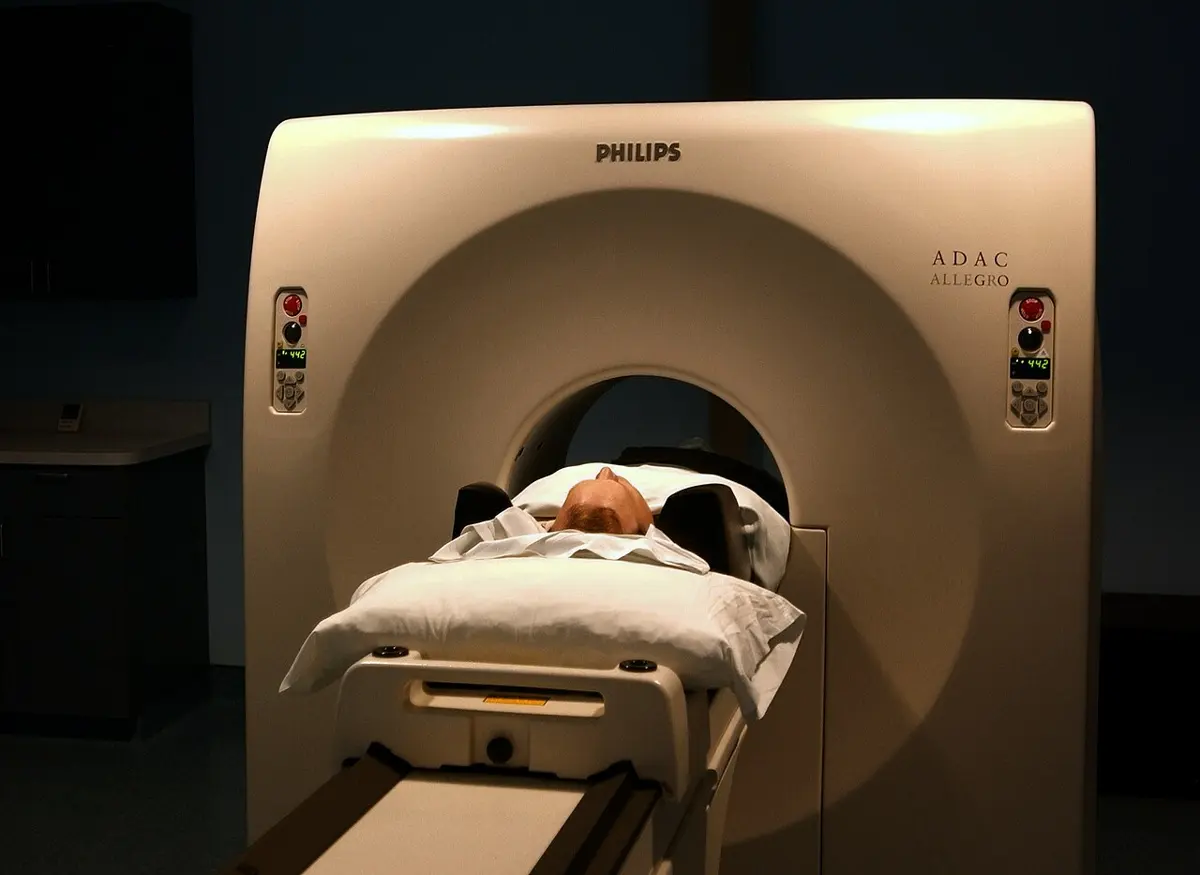
In a hospital’s PET scanner, a patient lies inside a ring. Around them, thousands of small crystals wait for flashes of gamma rays coming out of the body, and each time one is struck, it glows for an instant. In most modern scanners those crystals are made with lutetium (say loo-TEE-shee-um), the fifteenth and last of the lanthanides, and the last of them to be discovered in a natural mineral.
The lutetium atom
A lutetium atom has 71 protons and 71 electrons. Natural lutetium is a mixture of two isotopes: lutetium-175 (about 97%), with 104 neutrons, and lutetium-176 (about 3%), which is slightly radioactive.
By shells its electrons are 2, 8, 18, 32, 9, 2. In subshells it ends 6s² 4f¹⁴ 5d¹ Grade 10: The Aufbau principle. Its 4f subshell was already full at ytterbium, so lutetium’s new electron goes into 5d, as lanthanum’s does at the start of the row.
Its place and valency
- Period 6, the last lanthanide, after ytterbium (70) (fifteen near-twins). Next comes hafnium (72), in group 4.
- It loses its two 6s electrons and its 5d electron and becomes Lu³⁺, with a valency of 3, and never anything else: lutetium oxide is Lu₂O₃, lutetium chloride LuCl₃.
- With its 4f full, lutetium’s outer electrons are arranged like those of yttrium (4d¹ 5s²) and scandium (3d¹ 4s²). So some chemists put lutetium, not lanthanum, under yttrium in group 3. Most tables, like the one in your book, still count it as the last lanthanide Grade 10: Features of the modern periodic table.
Nearly every lutetium compound is white or colorless. Why?
Pick an answer to see why.
How lutetium was found and named
Lutetium hid in the oxide ytterbia, which Marignac had found in 1878 and believed to be pure. In 1907, three chemists in three countries showed that it held a second element:
- Georges Urbain, at the Sorbonne in Paris, who was the first to publish;
- Carl Auer von Welsbach, in Austria, who had separated it at about the same time;
- Charles James, in the USA, who had the most of it but had not yet published.
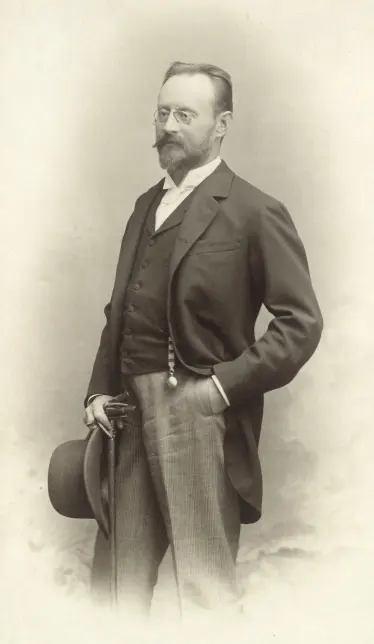
Because Urbain published first, his name was chosen: lutecium, from Lutetia, the old Roman name of Paris. It was spelled lutetium from 1949, and its symbol is Lu. Auer had called it cassiopeium, after the stars of Cassiopeia, and German chemists went on using that name for many years. Pure lutetium metal was first made in 1953.
Where lutetium is found
In the universe, lutetium is made in stars by catching neutrons (Catching neutrons).
In the Earth’s crust there is only about half a gram in a tonne of rock, so it is one of the rarest lanthanides. It is never the main metal of a mineral; it comes out in small amounts with the other rare earths, mainly from monazite and from clays in southern China, which supplies most of it.
In Nepal and in your body. Nepal mines no rare earths. Your body has no use for lutetium.
What lutetium is like and how it reacts
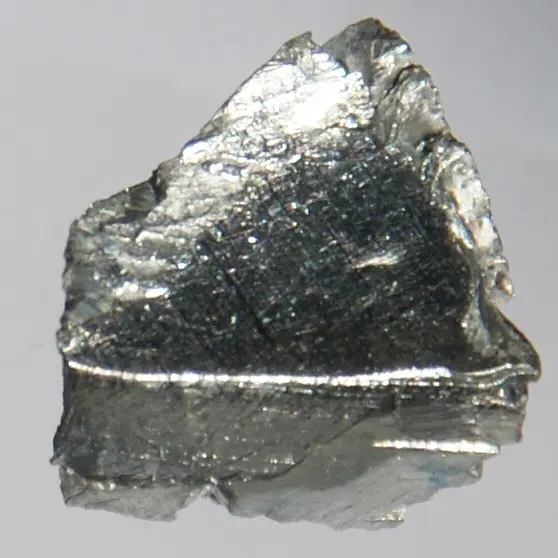
- A silvery-white metal, the hardest and densest of the lanthanides (9.84 g/cm³) and the one with the highest melting point, 1,663 °C. Across the row, each extra proton pulls the electrons in a little more, so the atoms shrink (the lanthanide contraction), and lutetium’s, the smallest, pack most tightly.
- In air it keeps its shine when dry and tarnishes in moist air. Heated, it burns to the white oxide: 4Lu + 3O₂ → 2Lu₂O₃.
- With water, slowly when cold and fast when hot, giving lutetium hydroxide and hydrogen; with dilute acids, readily, giving hydrogen and a colorless solution of Lu³⁺.
Lutetium in medicine
Crystals that flash
A PET scan (positron emission tomography) shows which parts of the body are busiest, such as a growing tumor or an active part of the brain. The patient is given a little sugar-like substance carrying a radioactive atom that gives out positrons, particles like electrons but with a positive charge. A positron goes only a millimeter or so before it meets an electron. Both vanish, and in their place two gamma rays fly out in exactly opposite directions Grade 9: Gamma rays.
The ring of the scanner is lined with crystals that contain lutetium, often mixed with yttrium. Lutetium is so dense and heavy that the crystals stop gamma rays well, and when one is struck it gives a tiny flash of light, which is turned into an electric signal. Two crystals flashing at the same moment tell the computer that the positron met its electron somewhere on the line between them. Millions of such lines, crossing, build up the picture.
A medicine that carries radiation
A third isotope, lutetium-177, is made in nuclear reactors. It gives out beta particles, which travel only a millimeter or two in the body. Joined to a molecule that sticks to certain cancer cells, it is carried to the tumor, wherever it is, and its radiation damages the cancer cells from close by. Lutetium-177 has a half-life of under a week, about 6.7 days, so it does not stay radioactive in the body for long. Medicines of this kind are now used for some cancers of the prostate and some tumors of the body’s hormone-making cells.
A clock in old rocks
Lutetium-176 is radioactive, but very slowly: its half-life is about 37 billion years, nearly three times the age of the universe. It decays, by beta decay, into hafnium-176. By measuring how much hafnium-176 has built up in a rock or a meteorite, geologists can tell how old it is (A clock inside the atom).
Lutetium and your health
Lutetium has no known job in the body and is of low toxicity. As a fine powder the metal can catch fire.
In your science books
- Grade 9: radioactive elements, gamma rays and the properties of metals.
- Grade 10: the Aufbau principle and the lanthanides.
- Going further: where lutetium is made, beta decay and dating rocks with atoms.
More to explore
- Its neighbors: ytterbium, in whose oxide it hid; yttrium and scandium, whose outer electrons it shares; lanthanum, at the other end of the row.
- Play: find lutetium in Guess the Element, the Periodic Table Jigsaw and Higher or Lower.
- Read more: lutetium at the Royal Society of Chemistry and at PubChem.