
- Atomic number
- 16
- Atomic mass
- 32.06
- Shells
- 2, 8, 6
- Configuration
- 1s² 2s² 2p⁶ 3s² 3p⁴
- In the table
- period 3, group 16 (VIA), p-block
- Kind
- Non-metal
- Valency
- 2, 4 and 6 (as in H₂S, SO₂ and SO₃)
- State at 25 °C
- solid
- Melts · boils
- 115 °C · 445 °C
- Density
- 2.1 × as heavy as water
- Known since
- ancient times
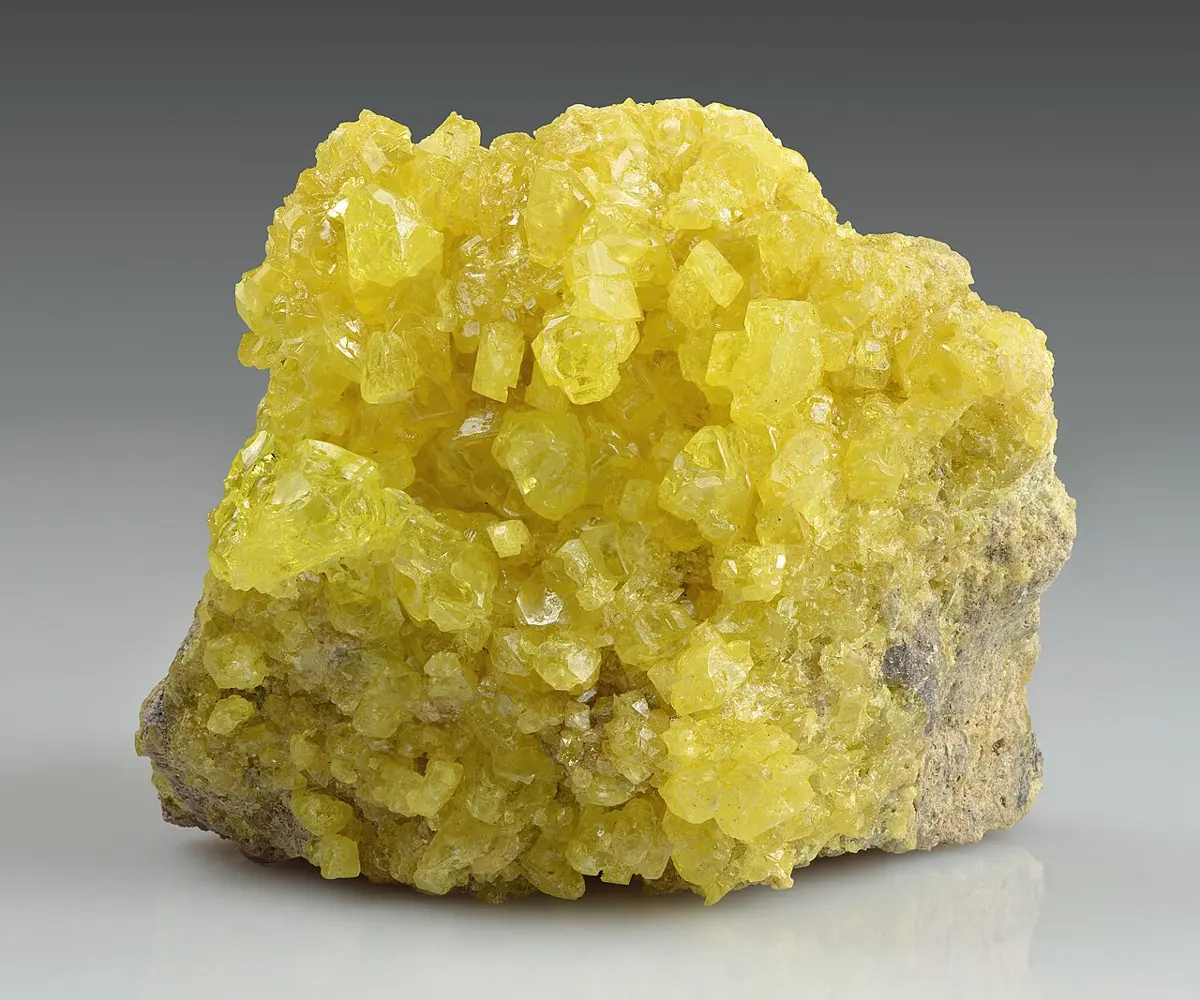
Strike a match and smell the sharp smoke: that is sulphur burning. Crack a rotten egg, walk past a blocked drain, or fry onions until your eyes water, and the smells come from compounds of sulphur too. The same element is in the black rubber of every bicycle tyre, in the acid of a car battery and in the hair on your head.
Nepali calls it गन्धक, from गन्ध, smell. In English it was long called brimstone, “burning stone”, because it is one of the few stones that catch fire. Here is its story.
The sulphur atom
A sulphur atom has 16 protons, so sulphur’s atomic number is 16. A neutral atom also has 16 electrons. Most sulphur atoms have 16 neutrons as well, so their mass number is 16 + 16 = 32.
By the 2n² rule Grade 8: Bohr and Bury’s rule, the K shell takes 2 electrons, the L shell 8, and the 6 left over go into the M shell: 2, 8, 6. In subshells it is 1s² 2s² 2p⁶ 3s² 3p⁴ Grade 10: The Aufbau principle.
Its place in the periodic table
- Period 3, because its electrons are in three shells. It comes after phosphorus and before chlorine Grade 8: Characteristics of periods.
- Group 16, called VIA in the older naming many books use, because it has 6 outer electrons.
- p-block, because its last electrons go into a p subshell. It is a non-metal Grade 10: Non-metals.
Above sulphur in group 16 is oxygen (2, 6), with the same six outer electrons; below are selenium, tellurium and polonium. That is why sulphur so often takes oxygen’s place in a compound: hydrogen sulphide, H₂S, is built just like water, H₂O.
Three valencies
To complete an octet Grade 9: Octet rule, a sulphur atom needs 2 more electrons. It can take them from a metal and become the sulphide ion, S²⁻ (2, 8, 8), as in zinc sulphide, ZnS. Or it can share two pairs of electrons with two hydrogen atoms, as in H₂S. Either way its valency is 2.
But sulphur is a bigger atom than oxygen, with room in its third shell, so it can also share 4 or all 6 of its outer electrons with oxygen. So sulphur has variable valency Grade 9: Variable valency: 2 in H₂S, 4 in sulphur dioxide (SO₂) and 6 in sulphur trioxide (SO₃) and sulphuric acid (H₂SO₄). Some books list only 2 and 6; SO₂ shows that 4 is common too.
What is the valency of sulphur in sulphur dioxide, SO₂?
Pick an answer to see why.
How sulphur was found and named
Sulphur was known long before anyone wrote history, because it lies on the ground as pure yellow crystals around volcanoes and hot springs. People burned it to drive away insects and germs, and to bleach cloth. Ayurveda has long used purified गन्धक as a medicine, especially for skin diseases, and ancient Egyptian doctors used a sulphur ointment for sore eyelids.
Around the 9th century, Chinese alchemists found that a mixture of saltpeter (potassium nitrate), charcoal and sulphur burns violently: gunpowder (बारुद), the first explosive.
For a long time chemists were not sure that sulphur was an element. In 1777 the French chemist Antoine Lavoisier argued that it was. In 1808 the English chemist Humphry Davy claimed that it contained hydrogen, but his sample was impure, and in 1809 the French chemists Joseph Louis Gay-Lussac and Louis-Jacques Thénard showed that pure sulphur cannot be broken into anything simpler.
The name. “Sulphur” comes from the Latin sulpur or sulfur, a word whose origin is not certain: hence the symbol S Grade 8: The first 20 elements. Scientists today spell it sulfur, and Nepal’s books spell it sulphur: both are right, and both are used in exams.
Where sulphur is found
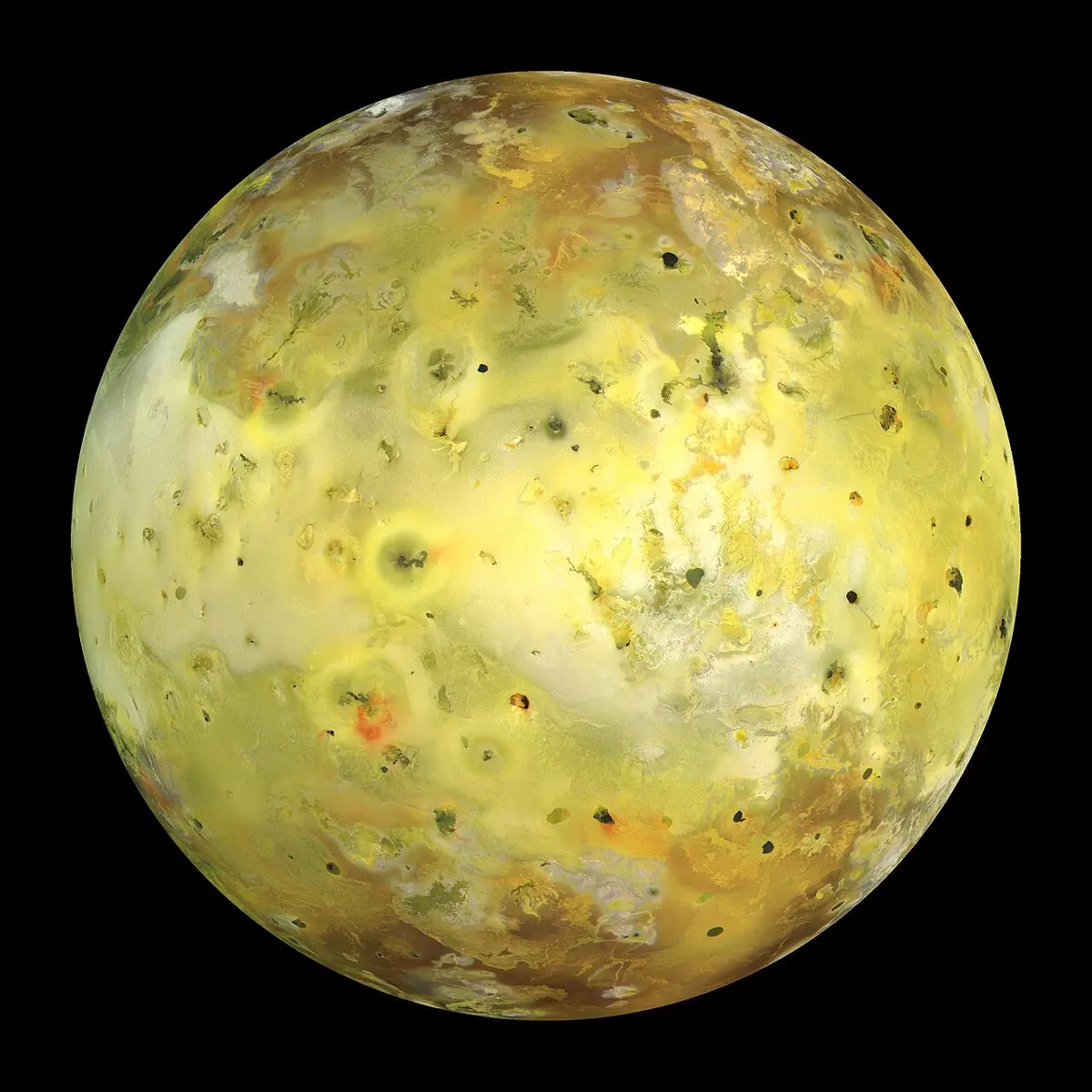
In the universe. Sulphur is about the tenth most common element. It is made in the cores of big stars, where smaller nuclei such as silicon and helium fuse, and scattered when the star explodes (Getting the atoms out). Jupiter’s moon Io, the most volcanic place in the solar system, owes its yellows, oranges and reds to sulphur and its compounds. In 2024 NASA’s Curiosity rover drove over a rock on Mars and cracked it open: inside were crystals of pure sulphur.
In the Earth’s crust. Ordinary rock holds about 350 grams of sulphur per tonne. Some of it is pure sulphur, around volcanoes and in old salt deposits, which is why sulphur counts as a mineral that is a single element Grade 8: What a mineral is. Most of it is in compounds: the sulphide ores of metals, such as shiny yellow pyrite (FeS₂, “fool’s gold”), galena (PbS) and zinc blende (ZnS), and the sulphates, such as gypsum (CaSO₄·2H₂O), used in plaster and cement.
From oil and gas. Fossil fuels contain sulphur, because they were made from living things. Before petrol, diesel and natural gas are sold, refineries take the sulphur out, partly to prevent acid rain. That is now where almost all the world’s sulphur comes from: about 84 million tonnes in 2025, nearly a quarter of it in China (USGS, 2026).

In Nepal. Nepal has no sulphur mines, and imports what it uses. The Nepali dictionary describes a hot spring, तातोपानी, as water that comes up from underground heated with गन्धक and lime, and hot springs around the world often smell of sulphur’s gases.
In your body. An adult holds about 140 grams of sulphur, more than of sodium or chlorine. You take in about 1 gram a day, mostly in proteins.
What sulphur is like
- A yellow, brittle solid, which crumbles to powder. It has no smell of its own: the “sulphur smell” belongs to its compounds.
- Light for a solid: 2.07 g/cm³, about twice as heavy as water.
- It does not dissolve in water, but it does dissolve in a few liquids such as carbon disulphide.
- A poor conductor of heat and electricity, like most non-metals Grade 9: Metals and non-metals.
- It melts at only 115 °C, a little hotter than boiling water, and boils at 445 °C.
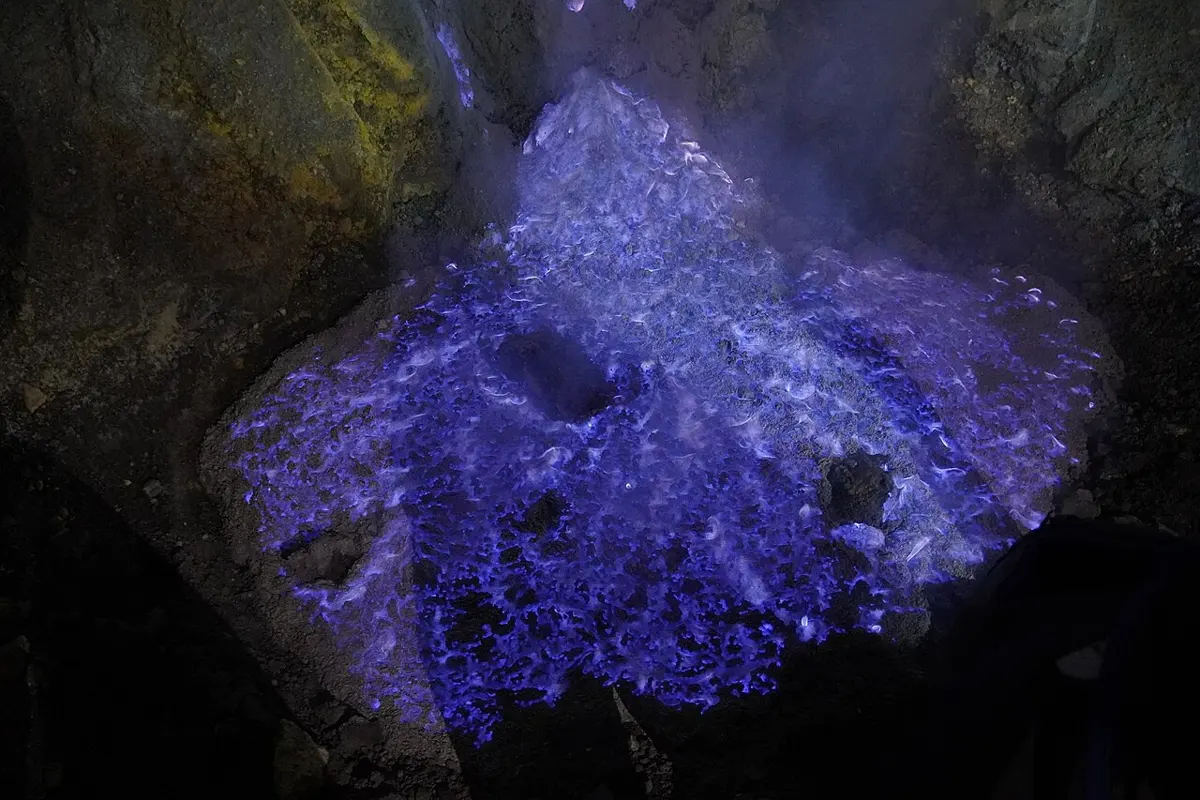
- It burns with a pale blue flame.
Rings of eight
In solid sulphur the atoms are joined in rings of eight, S₈, each atom sharing a pair of electrons with each neighbor. The ring is not flat: it zigzags up and down, like a crown. These little crowns pack into crystals that cannot conduct electricity: every electron is held in a bond.
When you heat sulphur, something surprising happens.
- At 115 °C the crystals melt into a pale yellow, runny liquid. The S₈ crowns are still whole, and they slide past each other easily.
- At about 160 °C the rings start to break open. Each broken ring has a free bond at each end, so the pieces join end to end into long chains of thousands of atoms, which tangle like noodles. The liquid turns dark red-brown and becomes more than ten thousand times thicker. You can turn the tube upside down and it does not run out.
- Hotter still, the chains break into shorter pieces, and the liquid becomes runnier again, until it boils at 445 °C.
- Pour the hot dark liquid into cold water, and the chains have no time to curl back into rings. You get plastic sulphur: brown, soft and stretchy like chewing gum. Over a day or two it slowly turns back into yellow, brittle crystals.
Different forms of the same element, like these, are called allotropes, just as diamond and graphite are both carbon. Sulphur has more than 30, more than any other element: even its solid crystals come in two forms, rhombic and needle-shaped monoclinic sulphur, the same S₈ rings packed in two ways.
Why does hot liquid sulphur become so thick at about 160 °C?
Pick an answer to see why.
How sulphur reacts
With oxygen. Sulphur burns in air or oxygen with a blue flame, making sulphur dioxide, a colorless gas with a choking smell, the sharp smell of a struck match Grade 9: Chemical properties of oxygen:
S + O₂ → SO₂
Sulphur dioxide is an acidic oxide: it dissolves in water to make sulphurous acid, H₂SO₃, which turns blue litmus red. Non-metals give acidic oxides, metals basic ones.
With metals. Heated with metals, sulphur takes their electrons and makes sulphides. A mixture of iron filings and sulphur powder glows red-hot once it starts to react, and leaves a black solid, iron(II) sulphide, which a magnet no longer picks up Grade 10: Combination reaction:
Fe + S → FeS
With hydrogen. Sulphur and hydrogen make hydrogen sulphide, H₂S, the gas with the smell of rotten eggs. When the proteins in eggs, or in waste in a drain, rot without air, bacteria make H₂S from their sulphur. Water, H₂O, is a liquid, but H₂S, with heavier atoms, is a gas: it boils at −60 °C (Water: the odd one out).
Sulphuric acid: the king of chemicals
Most of the world’s sulphur is turned into sulphuric acid, H₂SO₄, a heavy, oily liquid and one of the strongest acids. About 250 million tonnes are made every year, more than 30 kg for every person on Earth, one of the largest amounts of any chemical Grade 8: Uses of acids. It is made in three steps, called the contact process:
- Sulphur is burned: S + O₂ → SO₂
- Sulphur dioxide and more oxygen pass over hot vanadium pentoxide (V₂O₅), a catalyst, at about 450 °C: 2SO₂ + O₂ → 2SO₃
- The sulphur trioxide is absorbed into strong sulphuric acid and then mixed with water: SO₃ + H₂O → H₂SO₄
Sulphuric acid is used to make fertilizers (above all the phosphates), to clean steel, to refine oil, to make detergents, dyes and medicines, and it is the acid in the lead–acid batteries of cars, motorbikes and inverters.
Concentrated sulphuric acid also pulls water out of things. Pour it on sugar (C₁₂H₂₂O₁₁), and it takes away the hydrogen and oxygen as water, leaving a smoking black column of carbon.
Acid rain
Coal, diesel and petrol contain a little sulphur. When they burn in power stations, brick kilns, factories and vehicles, the sulphur becomes sulphur dioxide, which rises into the air. There it reacts with oxygen and water and becomes sulphuric acid, which falls as acid rain Grade 10: What acid rain is. Volcanoes, and metal works that roast sulphide ores Grade 10: Roasting, give it out too.
Acid rain eats away marble and limestone statues, harms the leaves of trees and makes lakes too acidic for fish Grade 10: Effects of acid rain. The cure is to take the sulphur out of fuels before they are burned and to clean the smoke from chimneys Grade 10: Ways to prevent acid rain. Many countries have done this since the 1980s, and in Europe and North America acid rain is now much less of a problem than it was. The sulphur taken out of fuels is the sulphur the world now uses.
Which of these does most to cut acid rain?
Pick an answer to see why.
Sulphur in daily life
Rubber. Natural rubber goes sticky in hot weather and brittle in cold. In 1839 the American inventor Charles Goodyear found that heating rubber with sulphur makes it strong and springy whatever the weather. The sulphur atoms build short bridges between the long rubber molecules, tying them together (How the chains are arranged). The process is called vulcanization, after Vulcan, the Roman god of fire, and every tyre is made this way.
Matches. The head of a safety match holds sulphur (or a sulphur compound) mixed with potassium chlorate, which supplies oxygen. Rubbing it on the side of the box heats it enough to catch fire, and the sulphur keeps it burning long enough to light the wood.
Farming. Sulphur is one of the secondary nutrients plants need Grade 9: Nutrients for plants, to make proteins: mustard, onions and garlic need a lot. Fine sulphur powder has been dusted on grapes and vegetables for over 2,000 years against powdery mildew, a fungus, and it is still allowed in organic farming.
Smell on purpose. LPG, the cooking gas in Nepal’s cylinders, has no smell of its own. A tiny amount of a strong-smelling sulphur compound is added, so that you can smell a leak at once (Smell, in the 2004 Nobel Prize).
Isotopes of sulphur
Natural sulphur is a mixture of four isotopes, none of them radioactive: about 94.99% sulphur-32 (16 neutrons), 0.75% sulphur-33, 4.25% sulphur-34 and 0.01% sulphur-36 Grade 9: Atomic mass.
Sulphur and your health
Two of the building blocks of proteins, the amino acids cysteine and methionine, contain sulphur, so every protein in your body needs it. In your hair and nails, a protein called keratin is held firm by sulphur–sulphur bridges, which is why burning hair smells so bad. Two vitamins, B₁ (thiamine) and biotin, contain sulphur too.
Eggs, dal, meat, fish, milk, onions, garlic and cabbage-family vegetables give plenty, so a diet with enough protein has enough sulphur. The sulphur compounds of onions are what make your eyes water when you cut them; those of garlic give its smell and taste.
Sulphur itself is only mildly harmful. Its compounds are another matter:
- Sulphur dioxide irritates the eyes, nose and lungs, and makes asthma worse; it is one of the gases measured to judge how dirty the air is (What is in dirty air).
- Hydrogen sulphide is as dangerous as it smells (see above).
- Concentrated sulphuric acid burns skin and destroys cloth.
Surprising facts and records
- Sulphur cools the Earth. A big volcanic eruption throws sulphur gases high into the sky, where they make a haze of tiny droplets that reflect sunlight. After Mount Pinatubo in the Philippines erupted in 1991, the whole world was about half a degree cooler for a year or two (Line up the suspects).
- Life without sunlight. On the deep sea floor, bacteria get their energy from hydrogen sulphide coming out of hot vents, and giant tube worms, crabs and shrimps live on those bacteria, in complete darkness.
In your science books
- Grade 8: the first 20 elements, the 2n² rule, valency, period 3, minerals, uses of sulphuric acid and acid rain.
- Grade 9: the octet rule, variable valency, sulphur burning in oxygen and plant nutrients.
- Grade 10: the Aufbau principle, non-metals, combination reactions, roasting sulphide ores and acid rain.
- Going further: why water is a liquid and H₂S a gas, the sulphur bridges in rubber, volcanoes and climate and where the atoms in your body came from.
More to explore
- Nobel Prizes: how we smell (2004, and why gas companies add a sulphur smell) and superacids (1994, acids stronger than pure sulphuric acid).
- Play: make sulphuric acid, hydrogen sulphide, sulphur dioxide and pyrite in Molecule Kitchen, or find sulphur in Guess the Element and the Periodic Table Jigsaw.
- Read more: sulphur at the Royal Society of Chemistry and at PubChem.