
- Atomic number
- 4
- Atomic mass
- 9.01
- Shells
- 2, 2
- Configuration
- 1s² 2s²
- In the table
- period 2, group 2 (IIA), s-block
- Kind
- Alkaline earth metal
- Valency
- 2 (Be²⁺)
- State at 25 °C
- solid
- Melts · boils
- 1,287 °C · 2,471 °C
- Density
- 1.9 × as heavy as water
- Known since
- 1798
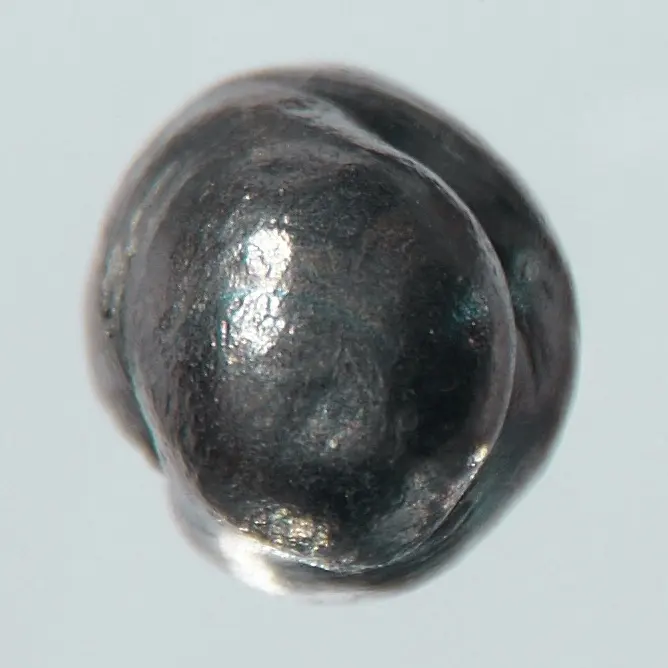
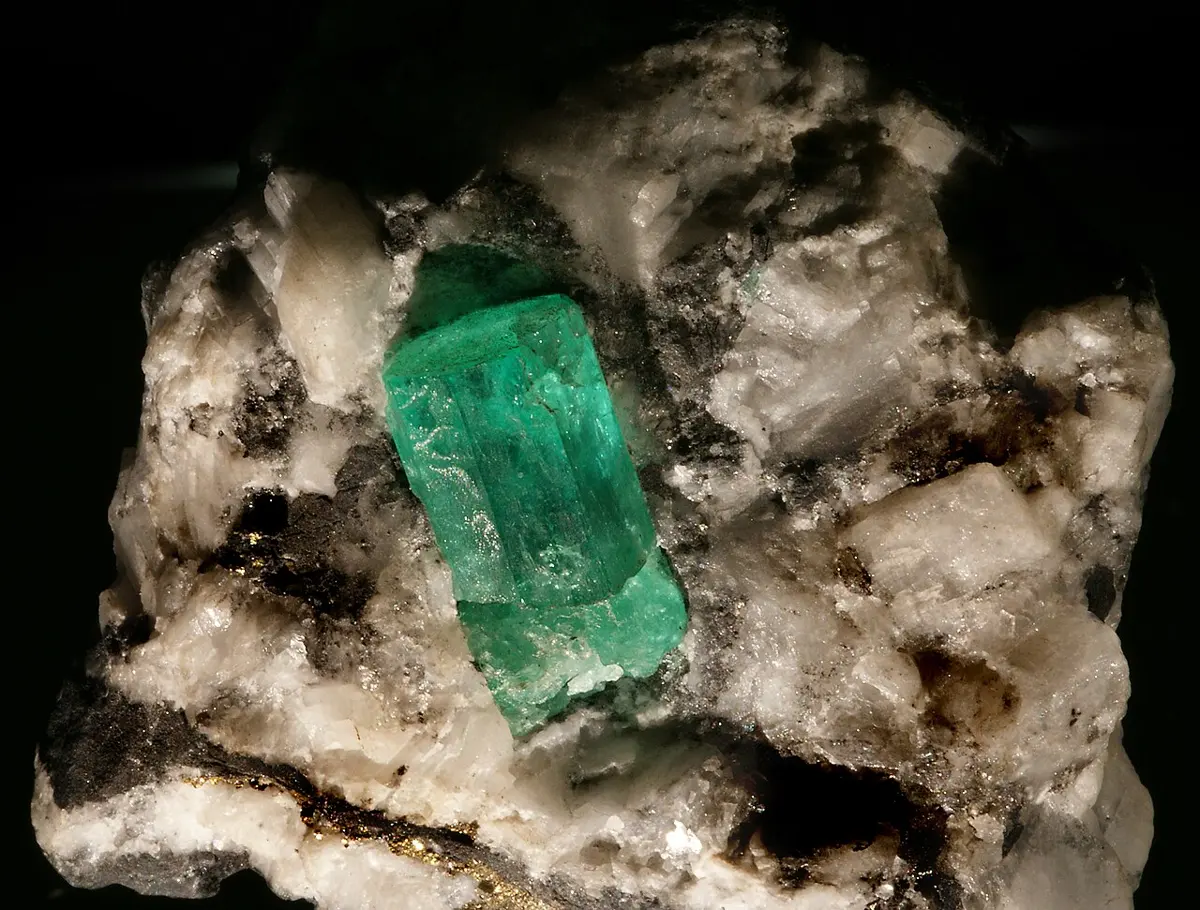
A green emerald in a ring and a blue aquamarine in a necklace are the same mineral, beryl, with a different trace of color. Beryl hides a metal that few people have ever seen: beryllium. It is so light and so stiff that the giant mirror of the James Webb Space Telescope, the most powerful telescope ever sent into space, is made of it. X-rays pass through it almost as if it were not there. And its dust is one of the most dangerous in any factory.
Beryllium is element number 4, one of the very first elements in the periodic table, yet it is rare. Here is its story.
The beryllium atom
Every beryllium atom has 4 protons in its nucleus, so beryllium’s atomic number is 4. A neutral atom has 4 electrons. Almost every beryllium atom on Earth also has 5 neutrons, so its mass number is 4 + 5 = 9.
By the 2n² rule Grade 8: Bohr and Bury’s rule, the K shell takes 2 electrons and the other 2 go into the L shell: 2, 2. In Grade 10’s subshells Grade 10: The Aufbau principle that is 1s² 2s²: both subshells completely full, and nothing in 2p.
Its place in the periodic table
- Period 2, because its electrons are in two shells. It sits between lithium (3) and boron (5).
- Group 2, called IIA in the older naming, because it has two outer electrons in an s subshell.
- s-block, because its last electron goes into an s subshell.
Group 2 is the family of the alkaline earth metals: beryllium, magnesium, calcium, strontium, barium and radium Grade 10: Alkaline earth metals. Each has two electrons in its outermost shell. Beryllium is at the top, the smallest and the least reactive of them.
Its valency
A beryllium atom reaches a stable duplet, like helium’s, by giving away its two outer electrons Grade 9: Duplet rule. It becomes the ion Be²⁺, so its valency is 2 Grade 9: Cations. Its oxide is BeO and its chloride BeCl₂.
But the beryllium atom is tiny, and its two outer electrons are close to the nucleus, which holds them tightly. So in many compounds, beryllium chloride among them, beryllium shares its two electrons in covalent bonds instead of giving them away. It is the most “non-metal-like” of the group 2 metals.
Helium (1s²) and beryllium (1s² 2s²) both end in s². Why is helium not in group 2 with beryllium?
Pick an answer to see why.
How beryllium was found and named
Beryllium was found inside gemstones.
- In 1798, the French mineralogist René-Just Haüy noticed that crystals of beryl and of emerald had exactly the same shape. Perhaps they were the same mineral? He asked the chemist Louis-Nicolas Vauquelin to analyze them. Vauquelin found that both contained the oxide of a new element.
- Its compounds tasted sweet, so it was first called glucinium, from the Greek glykys, “sweet” (the word in glucose). Chemists then still tasted new substances. We now know beryllium compounds are poisonous: never taste a chemical.
- In 1828, Friedrich Wöhler in Germany and Antoine Bussy in France, working separately, got the metal itself. They heated beryllium chloride with potassium, a much more reactive metal, which pushed the beryllium out:
BeCl₂ + 2K → 2KCl + Be
Both names, glucinium and beryllium, were used for over a hundred years, until chemists agreed on beryllium in 1949.
The name. Beryllium comes from the mineral beryl, Greek bēryllos. The Greeks borrowed the word from an Indian language (Prakrit veruliya, a blue-green gem), probably named after the town of Belur in southern India. So the name of element 4 began in South Asia. Nepali has no word of its own for the element: the books call it बेरिलियम.
Where beryllium is found
In the universe. Beryllium is surprisingly rare for such a light element. The Sun has less than one beryllium atom for every billion hydrogen atoms. Stars do not make it: in a star’s hot core, beryllium is destroyed faster than it forms. Most of it was made in space, when cosmic rays, nuclei flying at nearly the speed of light, smashed into carbon, nitrogen and oxygen atoms and chipped off small pieces (Getting the atoms out).
In the Earth’s crust. Ordinary rock holds only about 2 to 6 grams of beryllium per tonne. It is found in over a hundred minerals, but two matter:
- beryl, Be₃Al₂Si₆O₁₈, a beryllium aluminium silicate, which grows as six-sided crystals in a coarse kind of granite called pegmatite;
- bertrandite, a beryllium silicate, mined in Utah in the United States.
In 2025 the whole world mined only about 430 tonnes of beryllium, more than half of it in the United States (USGS, 2026). Compare that with about 23 million tonnes of copper.
The gem family. Pure beryl is colorless. A trace of another element gives it color:
| Gem | Color | Colored by |
|---|---|---|
| emerald | green | chromium (and sometimes vanadium) |
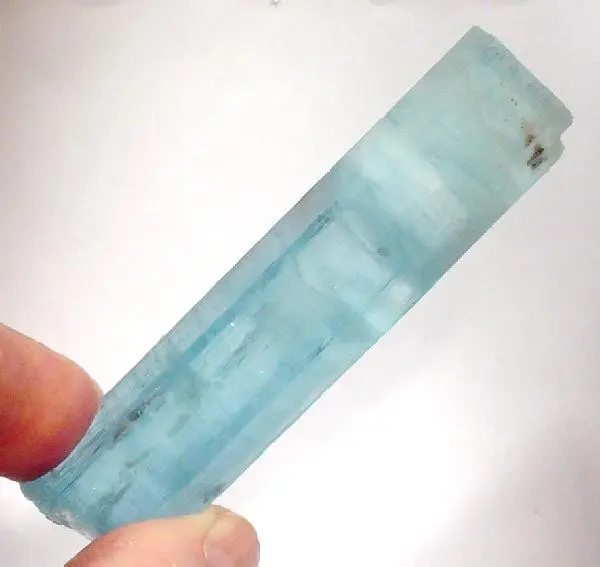
| aquamarine | sea-blue | iron |
| heliodor | yellow | iron |
| morganite | pink | manganese |
In Nepal. Aquamarine is one of the gems of Nepal’s hills. It grows in pegmatites in the east, in Taplejung (the Yamrang pegmatite, studied by Nepal’s geologists) and in Sankhuwasabha, where gem pockets have been mined for decades alongside tourmaline Grade 8: Gems from Nepal’s hills. Fine crystals have also come from Rasuwa, near Ganesh Himal, and from Jajarkot. Nepal’s aquamarine is mined as a gem, not as an ore of the metal.
In your body. Only a tiny trace, far less than a milligram, taken in with food and air. The body has no use for it.
What beryllium is like
- Steel-gray and hard, but brittle at room temperature: struck hard, it cracks instead of bending.
- Very light. Its density is 1.85 g/cm³, less than twice that of water and only two-thirds that of aluminium (2.70 g/cm³).
- Very stiff. Push on a beryllium bar and it bends less than a steel bar of the same size: beryllium is about a third stiffer than steel, at less than a quarter of steel’s weight.
- A high melting point for a light metal: 1,287 °C, about twice that of aluminium (660 °C) or magnesium (650 °C).
- Not magnetic, and a good conductor of heat and electricity, like other metals Grade 9: Properties of metals.
Stiff and light together is beryllium’s great gift. Most metals are alike in one surprising way: a stiffer metal is also heavier, in the same proportion. Beryllium breaks that rule.
Why X-rays pass through it
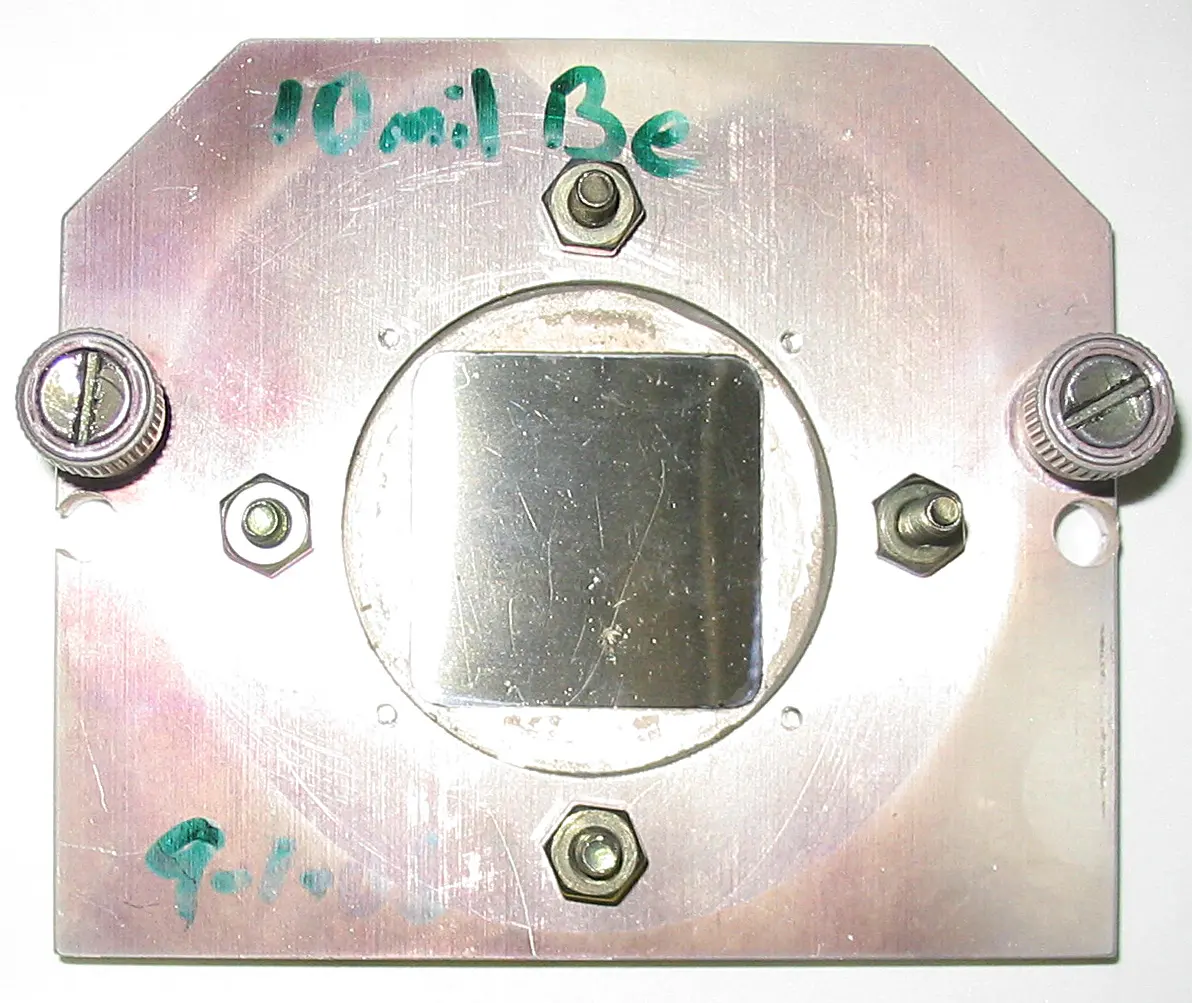
X-rays are stopped mainly by electrons: the more electrons an atom has, the more X-rays it absorbs Grade 9: X-rays. That is why bones, rich in calcium (20 electrons per atom), show up white on an X-ray, while flesh, made mostly of carbon, hydrogen, oxygen and nitrogen, lets them through. A beryllium atom has only 4 electrons, fewer than any other metal except lithium. So a thin sheet of beryllium lets almost all X-rays through, yet it is a strong metal that can hold back air. This is why the window of an X-ray tube, where the rays come out, is often a thin sheet of beryllium.
A sheet of aluminium (13 electrons per atom) and a sheet of beryllium (4 electrons per atom), equally thick, are put in front of an X-ray beam. What happens?
Pick an answer to see why.
How beryllium reacts
Like aluminium, beryllium protects itself. In air, its surface is at once covered with a very thin, invisible layer of beryllium oxide, a few millionths of a millimeter thick, which keeps the air away from the metal underneath. So a piece of beryllium stays bright for years. As a fine powder, though, heated strongly, it burns with a brilliant white light Grade 9: Metals react with oxygen:
2Be + O₂ → 2BeO
- With water: no reaction, not even with hot water.
- With dilute hydrochloric acid: it dissolves, giving off hydrogen Grade 9: Metals and dilute acids:
Be + 2HCl → BeCl₂ + H₂
Down group 2, the metals get more reactive, because the outer electrons are farther from the nucleus and easier to lose Grade 10: Chemical reactivity. Beryllium will not react with water; magnesium reacts slowly with hot water and faster with steam; calcium fizzes in cold water.
Beryllium oxide is unusual too. Most metal oxides are basic: they react with acids. Beryllium oxide reacts with acids and with strong alkalis, like aluminium oxide. Such an oxide is called amphoteric (from the Greek for “both”).
Three metals of group 2 are dropped into cold water: beryllium, magnesium and calcium. Which reacts fastest?
Pick an answer to see why.
Beryllium at work
Beryllium is expensive and dangerous to work with, so it is used only where nothing else will do.
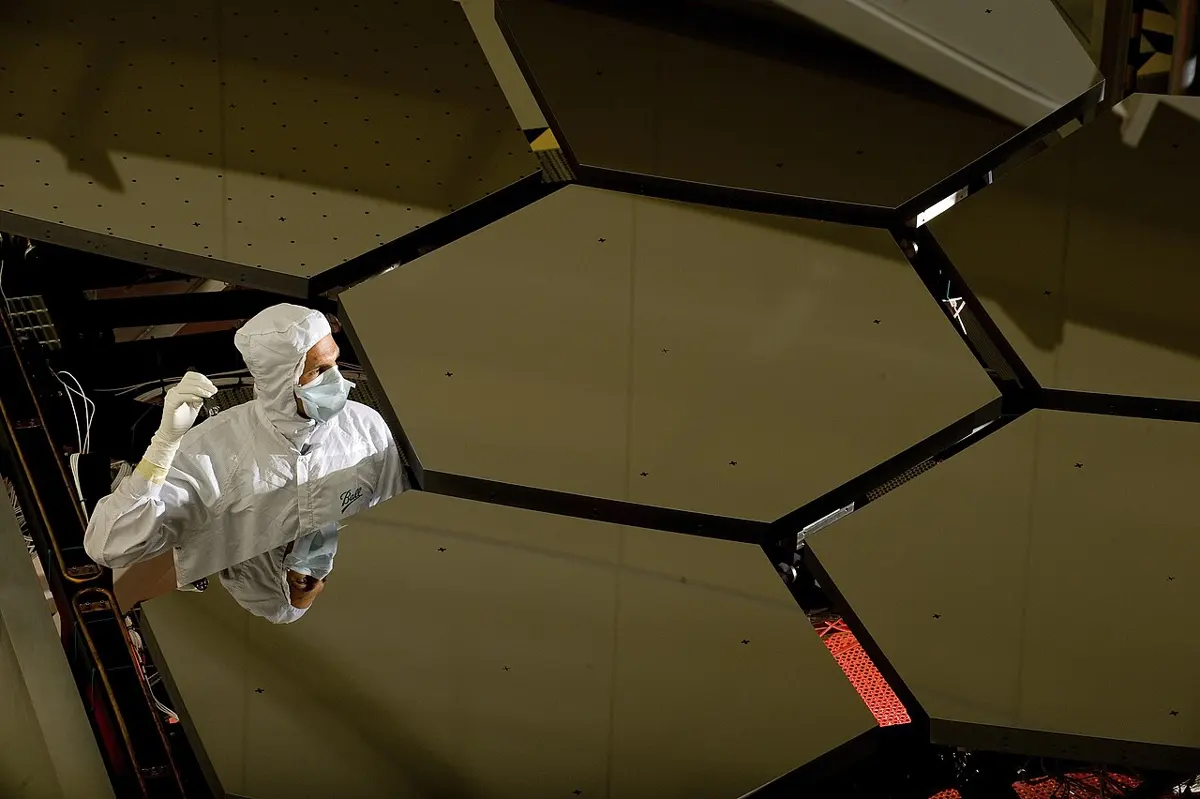
The James Webb Space Telescope. Its main mirror, 6.5 meters across, is made of 18 six-sided pieces of beryllium, each coated with a very thin layer of gold, which reflects infrared light well Grade 8: Uses of spherical mirrors. In space the mirror works at about −230 °C. Glass would be heavier, and as it cooled it would change shape more; beryllium is light, and keeps its shape almost perfectly in the cold.
Beryllium copper. Copper with about 2% beryllium is several times stronger than copper alone, springy, and still a good conductor. It makes the tiny springs and contacts in switches, connectors and phones. Tools of beryllium copper do not make sparks when they strike steel, so workers use them in places full of flammable gas, such as oil refineries.
Other uses. X-ray windows (above); parts of satellites, aircraft and precision instruments; the pipe around the point where particles collide in the Large Hadron Collider; and, as beryllium oxide, an unusual material that insulates electricity yet conducts heat like a metal, used under powerful transistors.
Beryllium and the neutron
When an alpha particle (a helium nucleus) hits a beryllium nucleus, the two can join to make carbon, and one neutron flies out:
⁹Be + ⁴He → ¹²C + n
In 1932 the British physicist James Chadwick studied the strange, penetrating radiation that came out of beryllium hit by alpha particles. He showed that it was a stream of particles with no charge and about the mass of a proton: the neutron, the third particle of the atom Grade 8: Neutron. He won the Nobel Prize in Physics in 1935. Mixtures of beryllium with an alpha-emitter are still used as small neutron sources in laboratories.
Isotopes of beryllium
Natural beryllium is only one isotope, beryllium-9. So its atomic mass, 9.012, is almost a whole number, unlike copper’s 63.5 or chlorine’s 35.5, which are mixtures Grade 9: Atomic mass.
Two other isotopes have stories:
- Beryllium-8 does not survive: it splits into two helium nuclei in less than a millionth of a millionth of a second. Inside old stars, though, a third helium nucleus sometimes hits it in that instant, making carbon-12: this is how stars make the carbon in your body (Helium into carbon).
- Beryllium-10 is made in the air by cosmic rays and falls to the ground with rain and snow. It is radioactive, with a half-life of about 1.4 million years, so scientists use it to date layers of ice and how long rocks have lain at the surface.
Beryllium and your health
The body does not need beryllium, and it is toxic. The danger is mainly its dust. Breathed in, even tiny amounts of beryllium dust or fumes can cause berylliosis (chronic beryllium disease) in some people: the lungs become inflamed and scarred, and breathing gets harder. It can appear years after the dust was breathed, and it cannot be cured. Beryllium is also known to cause lung cancer.
This was learned the hard way. From 1938, fluorescent tube lights were coated inside with a beryllium compound, and many of the workers who made them fell ill. Beryllium was taken out of tube lights in 1949. Today factories that work with it keep the dust in closed machines and check the air.
Surprising facts and records
- A stiffness record. For its weight, beryllium is about six times stiffer than steel, aluminium or titanium.
- Hot for a light metal. It melts at 1,287 °C, the highest melting point of the light metals.
- A gem that is also an ore. Low-grade beryl, too cloudy to be a gem, is crushed and treated to get beryllium metal.
In your science books
- Grade 8: atoms and symbols, the 2n² rule, the neutron, the metals’ place in the table, gems from Nepal’s hills and the James Webb telescope’s mirror.
- Grade 9: the duplet rule, cations, properties of metals and X-rays.
- Grade 10: electronic configuration, the alkaline earth metals and reactivity down a group.
- Going further: where the atoms in your body came from, with how stars jump over beryllium.
More to explore
- Nobel Prizes with beryllium in them: the first radioactive atoms made by people (1935, which starts with beryllium and the neutron), a second kind of neutrino (1988, made by protons hitting a beryllium target) and the most precise clocks (2012, which trapped single ions, among them beryllium).
- Play: find beryllium in Guess the Element and the Periodic Table Jigsaw.
- Read more: beryllium at the Royal Society of Chemistry and at PubChem.