
- Atomic number
- 110
- Atomic mass
- 282.17
- Shells
- 2, 8, 18, 32, 32, 16, 2
- Configuration
- 1s² 2s² 2p⁶ 3s² 3p⁶ 4s² 3d¹⁰ 4p⁶ 5s² 4d¹⁰ 5p⁶ 6s² 4f¹⁴ 5d¹⁰ 6p⁶ 7s² 5f¹⁴ 6d⁸ (predicted)
- In the table
- period 7, group 10 (VIIIB), d-block
- Kind
- Transition metal
- Valency
- Not measured; expected 2, 4 and 6, like platinum
- State at 25 °C
- expected to be a solid
- Melts · boils
- not known · not known
- Known since
- 1994
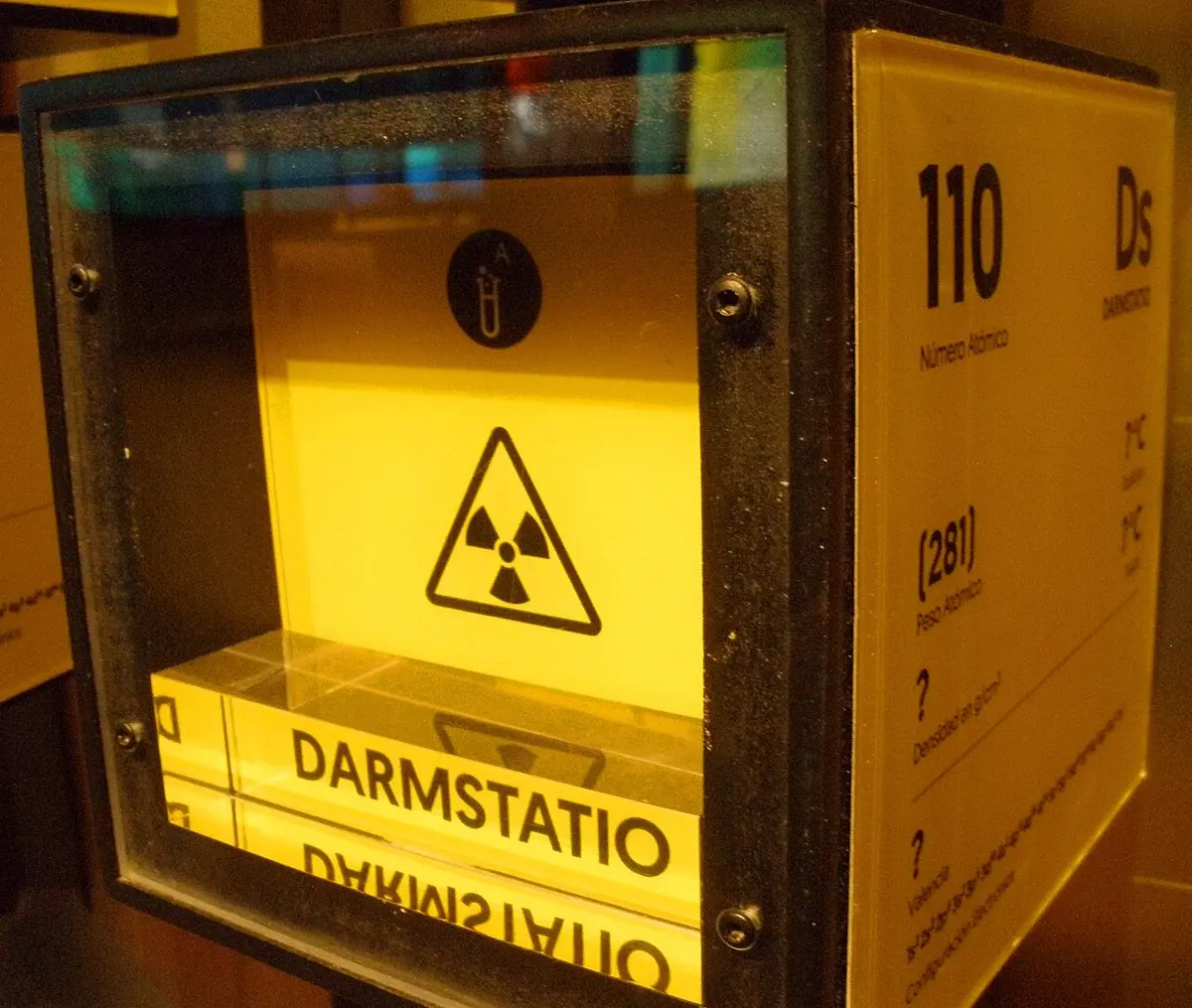
On the afternoon of 9 November 1994, at 4:39 pm, a detector in a laboratory in Germany recorded something no one had seen before: a single atom with 110 protons. It lasted for less than a thousandth of a second. That atom was the first of element 110, darmstadtium, named after the city where it was made.
The darmstadtium atom
A darmstadtium atom has 110 protons (atomic number 110) and 110 electrons. Its longest-lasting known kind, darmstadtium-281, has 281 − 110 = 171 neutrons.
Calculations predict that its electrons follow the order of filling Grade 10: The Aufbau principle exactly:
… 6p⁶ 7s² 5f¹⁴ 6d⁸
which gives the shells on the facts card, 2, 8, 18, 32, 32, 16, 2. That puts darmstadtium in period 7, group 10, a d-block element, a transition metal, under nickel, palladium and platinum Grade 10: Features of the modern periodic table. Platinum itself is an exception to the filling order (5d⁹ 6s¹, not 5d⁸ 6s²), so some tables print darmstadtium as 6d⁹ 7s¹ to match. The calculations say no: in such a heavy atom, the 7s electrons are held so tightly that both stay in 7s.
The first atom of darmstadtium was made by joining a nickel-62 nucleus (28 protons) to a lead-208 nucleus (82 protons). The new nucleus then threw out one neutron. What was its mass number?
Pick an answer to see why.
Found in Darmstadt
The atom was made at the GSI laboratory (Gesellschaft für Schwerionenforschung, “Society for Heavy Ion Research”) on the edge of Darmstadt, Germany, by a team led by Sigurd Hofmann, with Peter Armbruster and Gottfried Münzenberg. Teams at Dubna in Russia, at Berkeley in the USA, and at GSI itself had tried and failed since the 1980s.
The team fired nickel nuclei at a thin lead foil for days. Almost always, nothing happened. A machine called SHIP separated the rare new atoms from the beam within a millionth of a second and planted them in a detector. Each new atom then gave out an alpha particle and became hassium-265, an atom of element 108 the team already knew well: they had made 75 atoms of it earlier and measured its alpha particles. A known daughter is the proof that the parent really had 110 protons. Three atoms were found in November 1994, and soon after, more atoms of a second kind, darmstadtium-271, made from nickel-64.
In 2001 the international unions of chemists and physicists, IUPAC and IUPAP, agreed that GSI had found element 110.
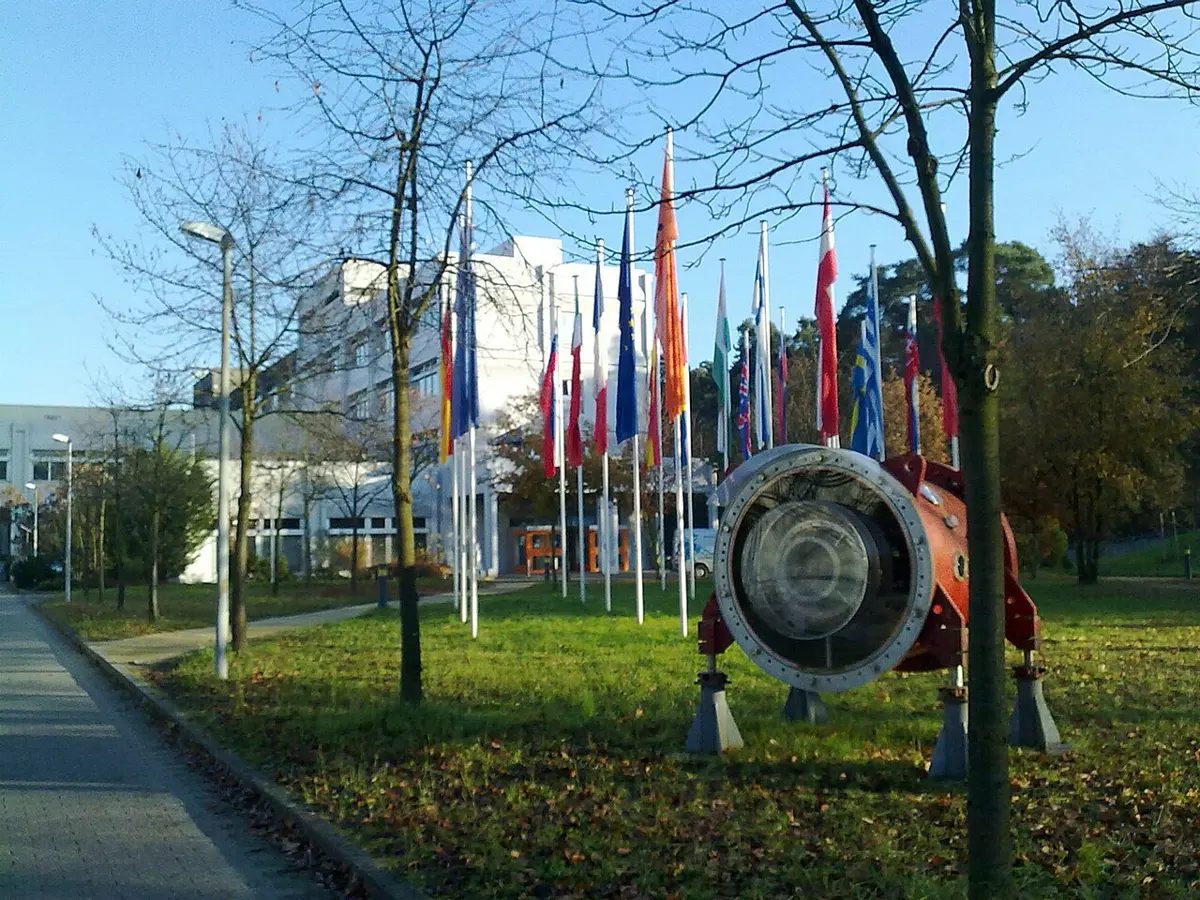
A city’s name
Every team that thought it had made element 110 suggested a name. The Russian team proposed becquerelium, after Henri Becquerel, who discovered radioactivity; the American team proposed hahnium, after Otto Hahn. The GSI team thought of wixhausium, after Wixhausen, the part of Darmstadt where GSI stands, and joked about policium, because 110 is Germany’s telephone number for the police. They chose darmstadtium, symbol Ds, and IUPAC approved it on 16 August 2003.
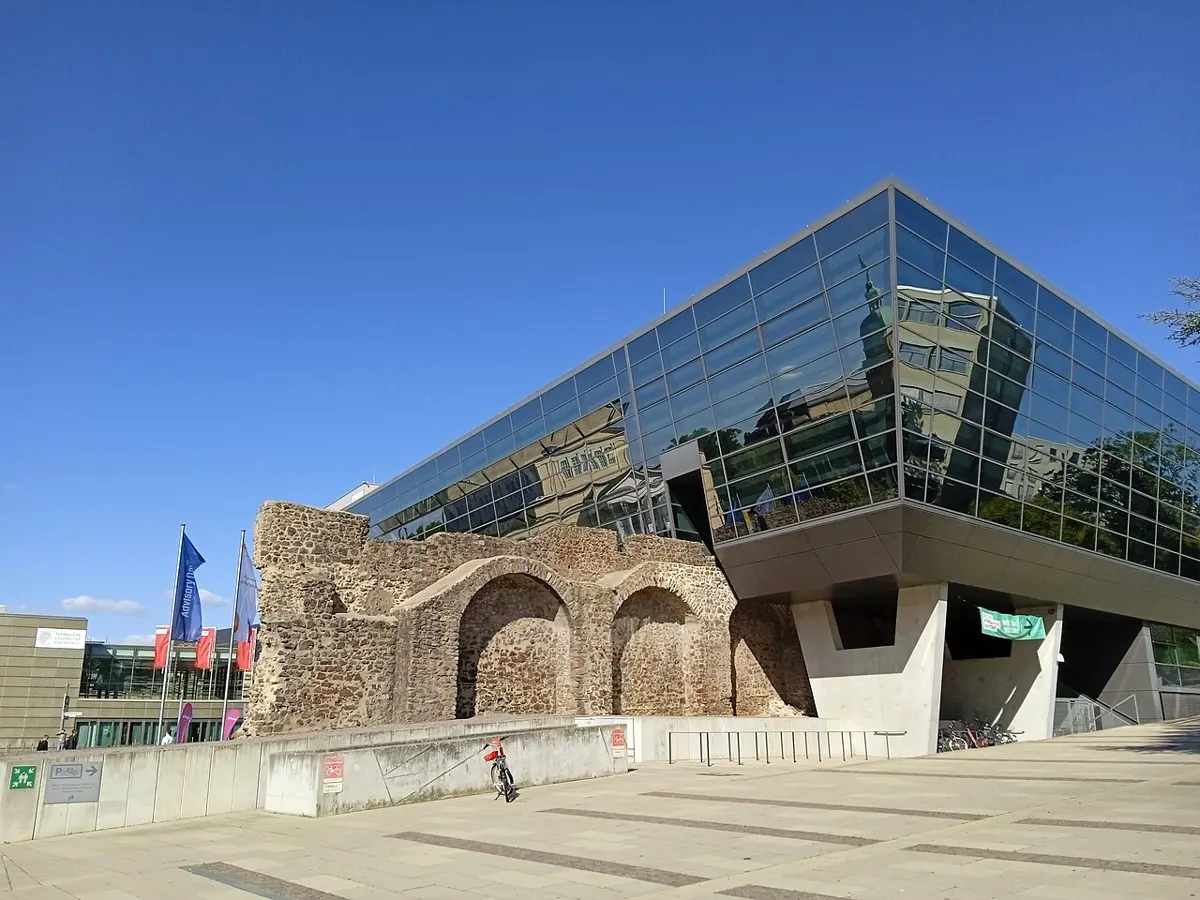
Darmstadt was proud of it. In 2007 the city opened a new science and congress center, and named it after the element: the darmstadtium.
What has been measured, and what is only predicted
Only a small number of darmstadtium atoms have ever been made. Most of its kinds last for thousandths of a second. The longest-lasting known one, darmstadtium-281, has a half-life of about 13 to 14 seconds and is made only at the end of the decay of heavier elements, a few atoms at a time.
What has been measured: how its nuclei decay, by alpha particles or by splitting in two, and how long they last. Nothing else.
What is only predicted:
- that it is a solid metal, a noble metal like platinum, which acids hardly touch;
- that it would form compounds such as DsF₆, like platinum’s PtF₆;
- that it is extremely dense, about 26 to 27 g/cm³, more than any element whose density has been measured.
No one has done any chemistry with darmstadtium. A chemistry experiment on single atoms needs a kind that lasts at least a second, and at least one atom a week; darmstadtium-281 lasts long enough, but it can be made so rarely that no experiment has yet been tried.
In your science books
- Grade 9: the structure of an atom and radioactive elements.
- Grade 10: features of the modern periodic table and the Aufbau principle.
- Going further: alpha decay and half-life.
More to explore
- Its neighbors: roentgenium, made at GSI a month later, and platinum, above it in group 10.
- Play: find darmstadtium in Guess the Element and the Periodic Table Jigsaw.
- Read more: darmstadtium at the Royal Society of Chemistry and at PubChem.