
Sumnima is in the science lab, playing with two bar magnets. North pole to south pole: they snap together. North to north: they push each other away, as if there were an invisible cushion between them. Then a magnet slips off the bench and breaks into pieces. She picks up the pieces and tries again. Some pieces pull together, others push apart. Every broken piece is still a magnet, with a north and a south pole of its own. How can that be?
Just then the lights go out. The teacher looks at the board on the wall and says, “The MCB has tripped. Something is wrong in the circuit.”
This unit answers both puzzles. In the first half you will find out what a magnet really is inside, how it can lose its magnetism, and why the whole Earth behaves like a giant magnet. In the second half you will follow electricity from the power station into your house, and meet the switches, meters, fuses, wires and plugs that make it useful, and keep you safe.
8.1 Magnet
Open an old radio or television and you will find a heavy, round, dark ring stuck to the back of the loudspeaker. Drop a few screws near it and they jump onto it and cling. Drop a few bits of wood or plastic and nothing happens. The ring is a magnet.
A magnet is a substance that attracts iron and a few other metals. The materials it attracts are called magnetic materials: iron, cobalt and nickel, and alloys made from them, such as steel. Wood, plastic, paper, glass, rubber, copper, aluminium, gold and silver are non-magnetic: a magnet doesn’t pull them at all.
The region around a magnet where its pull can be felt is its magnetic field. A magnet attracts a magnetic material only when the material is inside this field, which is why a magnet must be brought close before a pin jumps to it.
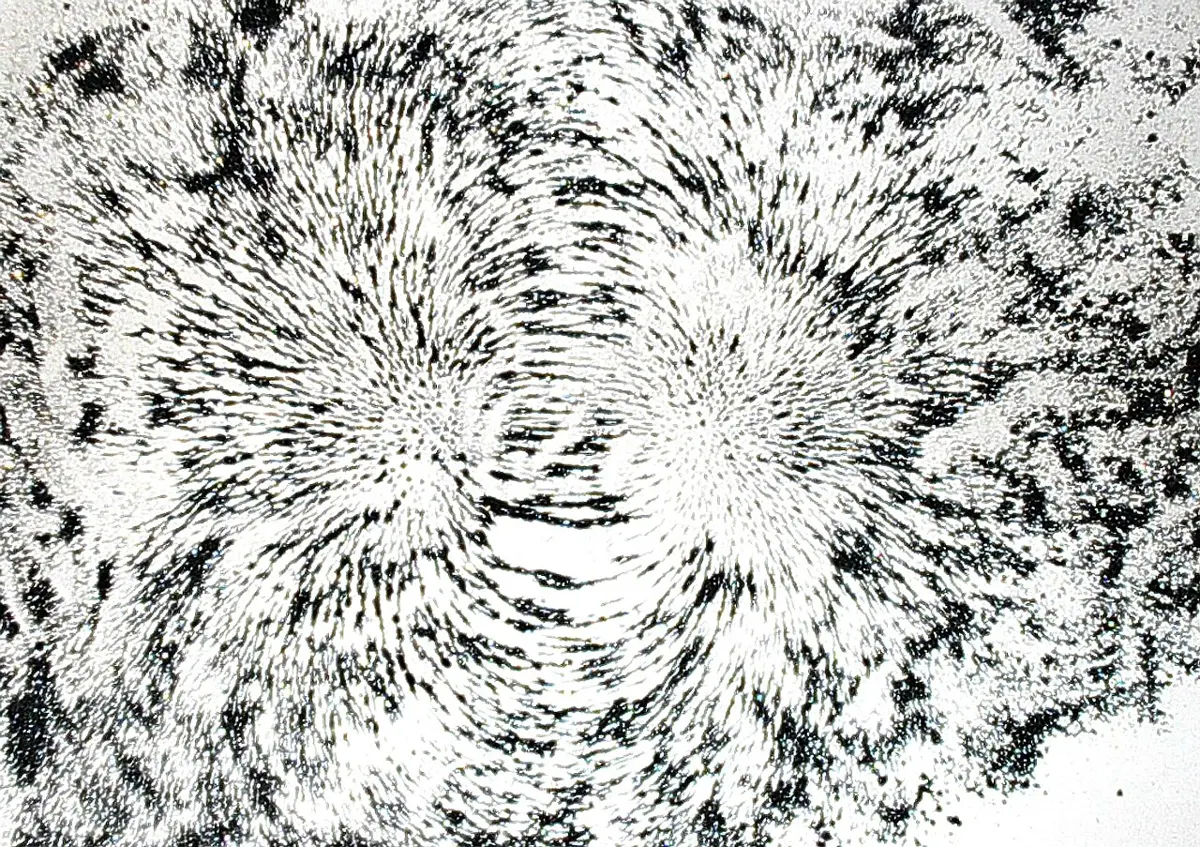
Every magnet has two ends where its pull is strongest. These are its poles: a north pole (N-pole) and a south pole (S-pole). When two magnets meet:
- unlike poles attract: N pulls S, and S pulls N;
- like poles repel: N pushes N away, and S pushes S away.
Attracting magnetic materials, pointing north–south when freely suspended (hung so it can turn), attracting unlike poles and repelling like poles: these are the magnetic properties of a magnet.
Which of these will a magnet pick up?
Pick an answer to see why.
You bring the north pole of a magnet near one end of an iron rod, and the rod is attracted. Then you bring the south pole near the same end. What happens?
Pick an answer to see why.
8.1.1 Natural and artificial magnets
Natural magnets
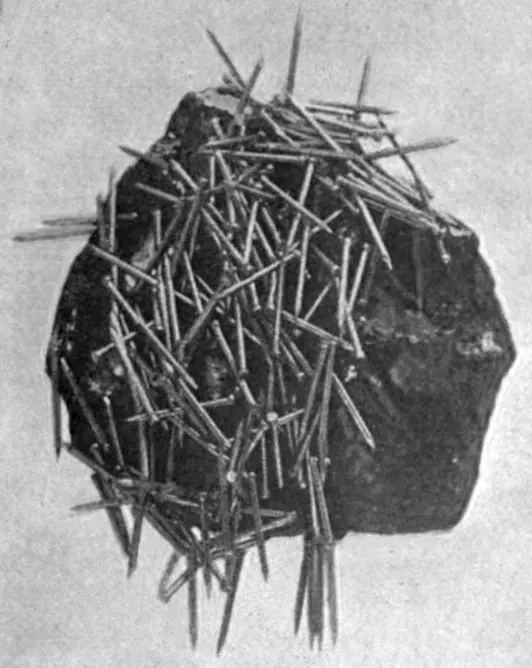
Some rocks are magnets all by themselves, straight out of the ground. They are natural magnets. The best known is lodestone (also spelled loadstone), a lump of the iron-rich mineral magnetite. A lodestone has a north pole and a south pole like any other magnet. It is found in the Earth’s crust, often close to the surface, and we can’t make its magnetism stronger or weaker as we wish.
Artificial magnets
Magnets that people make, in the shape and strength they need, are artificial magnets. A bar magnet, a horseshoe (U-shaped) magnet, the ring magnet in a loudspeaker, the flat magnet on a fridge door and the tiny magnets in earphones are all artificial. Their strength can be chosen when they are made.
Artificial magnets are of two kinds:
- Permanent magnets keep their magnetism for a long time once they are made, such as bar and horseshoe magnets of hard steel or special alloys.
- Temporary magnets are magnetic only while something keeps them magnetized. The most useful one is the electromagnet.
An electromagnet is a magnet made by passing an electric current through a coil of wire wound around a piece of magnetic material, usually soft iron. Switch the current on and it is a magnet; switch it off and the magnetism is gone.
Uses of magnets
Magnets are hidden in things all around you:
- a.electric fans, mixers, washing machines, refrigerators, generators and every electric motor; radios, televisions and electric bells;
- b.computers, hard disks, sensors, the speakers of your phone, headphones and earphones, and old tape recorders;
- c.MRI machines (magnetic resonance imagers) in hospitals, which use very strong magnets to take pictures of the inside of the body;
- d.huge electromagnets that lift iron plates, rods and scrap in factories and ports, and drop them when switched off;
- e.the magnetic compass, used to find directions;
- f.electromagnetic locks on doors and gates, which stay shut while current flows;
- g.induction cookers, which use a fast-changing magnetic field to heat an iron pot directly.
Which is the main advantage of an electromagnet over a bar magnet in a crane that lifts scrap iron?
Pick an answer to see why.
8.1.2 Molecular theory of magnetism
Why is an iron nail not a magnet, while a steel bar magnet is? Both are made mostly of iron. And why did each piece of Sumnima’s broken magnet become a complete magnet?
In the 1800s the German scientist Wilhelm Weber suggested an answer, and the Scottish scientist James Alfred Ewing improved it. It is called the molecular theory of magnetism. Its main points are:
- a.Every magnet and every magnetic material is made of tiny molecular magnets (magnetic molecules). Each one is a complete little magnet with its own north and south pole.
- b.In a magnetic material that is not a magnet, such as a plain nail, the molecular magnets are joined head to tail in little loops, called closed chains. In each loop the poles cancel one another, so the material as a whole shows no magnetism.
- c.When the molecular magnets are made to line up in rows, all pointing the same way, they form open chains. Their poles now add up instead of canceling, and the material becomes magnetized: one end becomes a north pole and the other a south pole.
- d.When all the molecular magnets are lined up, the material is as strongly magnetized as it can ever be. This is called magnetic saturation. Stroking it more can’t make it any stronger.
Now Sumnima’s puzzle is easy. Breaking a magnet doesn’t change how the molecular magnets inside are lined up. Each piece has rows of little magnets all pointing the same way, so each piece has a north pole at one end and a south pole at the other. You can break a magnet into smaller and smaller pieces, and you will never get a north pole on its own.
The theory also explains why the poles are at the ends. In the middle of a magnet, the N of each molecular magnet sits against the S of the next one, and they cancel. Only at the ends are the poles left free.
A magnet is broken into three pieces. How many north poles are there now?
Pick an answer to see why.
In the molecular theory, what is the difference between an iron nail and a magnet?
Pick an answer to see why.
8.1.3 Demagnetization
A magnet can lose its magnetism. When the molecular magnets that were lined up in one direction are jumbled up again into random directions or closed chains, the magnetism is lost. Losing magnetic properties in this way is called demagnetization. It can happen in five ways:
- a.heating the magnet;
- b.hammering it or dropping it again and again;
- c.passing alternating current through a coil around it;
- d.keeping like poles of two magnets pressed together for a long time;
- e.natural loss, slowly, over time.
a. Heating the magnet
When a magnet is heated, its molecular magnets vibrate harder and harder. The shaking breaks up their neat rows, and they fall back into closed chains. Heat a magnet strongly enough and its magnetism is gone. (For iron, the magnetism disappears completely at about 770 °C, when it glows red. Iron hotter than this is hardly attracted by a magnet at all.)
b. Hammering the magnet
When a magnet is hammered, or dropped hard onto the floor again and again, each blow jolts the molecular magnets out of line. Bit by bit they turn in random directions, and the magnet becomes weaker and weaker until it is demagnetized.
c. Passing alternating current
Put a magnet inside a coil of wire and pass alternating current (a.c.) through the coil. Alternating current keeps reversing its direction: in Nepal it goes back and forth 50 times every second. So the coil’s magnetic field keeps flipping, and it shakes the molecular magnets one way and then the other. If the magnet is pulled out of the coil slowly while the a.c. is on, the molecular magnets are left jumbled up, and the magnet is demagnetized.
d. Keeping like poles together
Like poles repel. If the north poles (or the south poles) of two magnets are forced together and kept that way for a long time, the push between them slowly turns the molecular magnets out of line, and both magnets get weaker.
e. Natural loss
Even a magnet that is left alone slowly gets weaker, especially if it is kept carelessly in an open place without its keepers. Its own poles act on its molecular magnets and slowly turn some of them out of line. An old bar magnet from the school lab is usually weaker than a new one.
Taking care of a magnet
To keep a magnet strong:
- a.don’t heat it;
- b.don’t hammer it or drop it on a hard floor;
- c.keep it away from wires carrying current, and from other strong magnets;
- d.when it is not being used, keep it with its keepers.
Bar magnets are stored in pairs, side by side, with the north pole of one beside the south pole of the other and a piece of wood between them. Two small bars of soft iron, the keepers, are laid across their ends. The magnetism then flows round in a closed loop through the two magnets and the keepers, and the molecular magnets stay neatly lined up.
Your father’s old bar magnet barely picks up a pin. Which of these would not have weakened it?
Pick an answer to see why.
Geomagnetism
Hang a magnet freely, anywhere on Earth, and it turns to point north–south. Something must be pulling it. That something is the Earth itself, which behaves like a huge magnet. The magnetic properties of the Earth are called geomagnetism or terrestrial magnetism (geo and terra both mean “earth”).
Why the Earth is a magnet
Deep inside the Earth, below the rocky mantle, is the core. The inner core is a solid ball of iron and nickel. Around it is the outer core, about 2,200 km thick, made of molten (liquid) iron and nickel at roughly 4,000 to 5,500 °C. This liquid metal is always moving: hot metal rises, cooler metal sinks (convection currents), and the Earth’s spin twists the flow. Moving molten metal carries electric currents, and electric currents make magnetism, just as in your electromagnet. That is the source of the Earth’s magnetism.
The Earth’s magnet has a north and a south pole, as every magnet does. Its field is shaped as if a giant bar magnet sat inside the Earth, tilted a little (about 10°) from the line the Earth spins on.
The Earth’s magnetic poles are not fixed. They slowly wander. The magnetic pole in the north moved from northern Canada towards Siberia over the last century, at times by more than 50 km a year. Over hundreds of thousands of years, the Earth’s magnetic poles have even swapped places many times.
Evidence that the Earth is a magnet
- a.An iron rod buried in the ground in the north–south direction, and left for a long time, becomes slightly magnetized by the Earth’s field. Old iron railings, poles and pillars that have stood in one place for years are often found to be weak magnets.
- b.A freely hung magnet always comes to rest pointing roughly north–south, wherever it is on Earth.
- c.Near a magnet, at certain places the magnet’s field and the Earth’s field are equal and opposite, and cancel. At these neutral points a compass needle doesn’t point any particular way. They exist only because the Earth has a field of its own.
- d.Natural magnets such as lodestone, and magnetized rocks, are found in the ground: they were magnetized in the Earth’s field.
Why geomagnetism matters
- a.A shield from the Sun. The Sun sends out a stream of fast, electrically charged particles, the solar wind. The Earth’s magnetic field turns most of them aside, and steers the rest towards the north and south polar regions, where they glow in the upper air as the aurora. Without this shield, far more of these particles would reach the air around the Earth.
- b.Reading the rocks. When molten lava cools into igneous rock, its magnetic minerals freeze in the direction of the Earth’s field at that time. Since the field has flipped many times, the magnetism of rocks helps geologists work out their age, and magnetic surveys help find buried ores of iron and other metals.
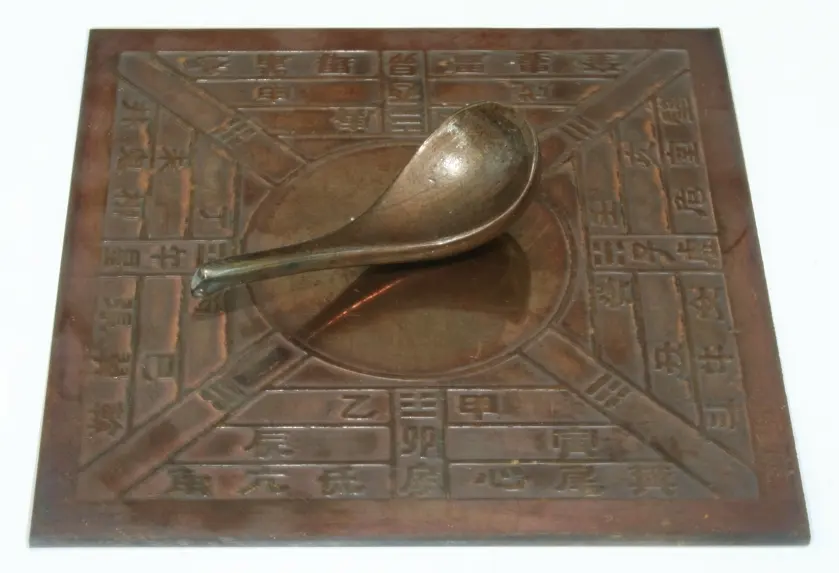
- c.Finding the way. A magnetic compass works because of the Earth’s field. Ships, submarines, airplanes and trekkers use it to find directions, and every smartphone has a tiny magnetic sensor that does the same job.

A compass needle’s N-pole points towards the geographic North Pole. What kind of magnetic pole is near the geographic North Pole?
Pick an answer to see why.
Elements of terrestrial magnetism
A compass needle doesn’t point exactly at the geographic North Pole, and it doesn’t lie quite flat either. Two angles describe how the Earth’s field points at a place: the angle of declination and the angle of dip.
Magnetic declination
First, two imaginary planes. Picture a huge vertical sheet passing through the place where you stand and through the geographic North and South Poles. It is the geographic meridian: the true north–south line at that place. Now picture a vertical sheet passing through your place along the direction a compass needle settles. It is the magnetic meridian (or geomagnetic meridian): the north–south line according to the compass.
The two are usually not the same, because the magnetic poles are not at the geographic poles. The angle between the geographic meridian and the magnetic meridian at a place is called the magnetic declination (angle of declination). It is measured in degrees, east or west of true north.
Declination is different from place to place, and it changes slowly over the years as the magnetic poles wander. In some places it is more than 20° east or west; close to the magnetic poles it can be anything up to 180°. In Nepal it is very small: from about 0° in the east to about 1° east of north in the far west, and about 0.4° in Kathmandu (as of 2025). So a compass here points almost exactly to true north. It is found with an instrument called a declinometer, or from declination charts, aeronautical maps, and computer programs that calculate it from a model of the Earth’s field. Pilots and ship navigators need it: they add or subtract the declination to turn a compass reading into a true direction.
Magnetic inclination, or the angle of dip
A compass needle is mounted to turn only flat (horizontally). Now imagine a magnetic needle that can turn up and down, on a horizontal axle, in the plane of the magnetic meridian. It doesn’t lie flat: in the northern half of the world, where Nepal is, its north end dips down towards the ground. The angle that a freely hung magnetic needle makes with the horizontal at a place is called the angle of dip, or magnetic inclination. It is measured with a dip needle fixed in a dip circle, a vertical scale marked in degrees.
Why does it dip? Look back at Figure 8.9. The Earth’s field lines leave the Earth in the south, curve round, and dive back into it in the north. A needle lines up with the field line where it is, so it tilts the way the line tilts.
- At the magnetic equator, the field lines run parallel to the ground, so the needle lies flat: the angle of dip is 0°.
- At the magnetic poles, the lines go straight down into the ground, so the needle stands upright: the angle of dip is 90°.
- In between it has values between 0° and 90°. In Kathmandu it is about 44° (as of 2025).
The angle of dip is used in making geographical and geological maps, and in surveys that look for magnetic ores.
Where on the Earth would a dip needle stand straight up and down?
Pick an answer to see why.
8.2 Electricity
Electricity is a form of energy, and the easiest kind to send from one place to another. In Nepal most of it is made in hydropower stations, by water spinning the turbines of huge generators, which work with magnets. From there it travels along transmission lines, the wires on tall steel towers you see crossing the hills, joined together into the national grid.
To lose less energy on the way, electricity travels on these lines at very high voltage: from 66,000 V up to 400,000 V. Before it can come into houses, transformers at substations, and then smaller transformers on poles, lower it step by step to about 230 V. A cable from the pole then brings it into your house.
8.2.1 Household electrification
Bringing electricity from the power station into people’s houses through transmission lines is called household electrification (or domestic electrification). Inside the house, the electricity has to reach every light, fan and appliance. The wiring done in a house to bring electric power safely to its lamps, fans and appliances, following all the safety rules, is called domestic wiring. It uses copper cables, because copper conducts electricity very well. Appliances (loads) can be joined in a series combination, a parallel combination, or a mix of both, but at home almost everything is joined in parallel, as you will see.
The cable from the pole first passes through a few devices that measure and protect: the electric meter, the main switch, and the distribution board with its MCBs or fuses. Only then does it branch out to the rooms.
Devices used in domestic wiring
Electric meter
The electric meter measures the electrical energy used by everything in the house: its electricity consumption. It is fixed in a box of plastic, metal or wood, the meter box, near where the cable enters, and is connected in series with the main switch, so that every bit of current going into the house passes through it. A modern meter shows the energy used as a number on a digital display.
Electrical energy is sold in a unit called the kilowatt-hour (kWh), which everyone calls one unit:
1 unit = 1 kWh = the energy used by a 1,000 W (1 kW) appliance working for 1 hour.
A 100 W bulb would take 10 hours to use one unit; a 2,000 W heater only half an hour. If the meter shows 40 units used in a month, and one unit costs Rs 8, the bill is 40 × Rs 8 = Rs 320.
To work out the energy used from the appliances themselves:
where E.C. is the energy consumed (in kWh, or units), is the power of one appliance (in kilowatts), is the number of such appliances, and is the time each is used (in hours). Then
Main switch
The main switch (master switch) is fixed between the electric meter and the distribution board. Every bit of current into the house goes through it, so it is connected in series with all the loads. Turning it off cuts the electricity to the whole house at once: the first thing to do before any repair, or in an emergency such as a fire or someone getting a shock. A main switch is made for a certain largest current, its rating, such as 15 A, 30 A or more, chosen to suit the house.
Distribution board
From the main switch, the current goes to the distribution board, which divides it into separate circuits: one for the lights, one for the kitchen sockets, one for the water heater, and so on. Each circuit has its own MCB (or fuse), so a fault in one circuit doesn’t black out the whole house.
Miniature circuit breaker (MCB)
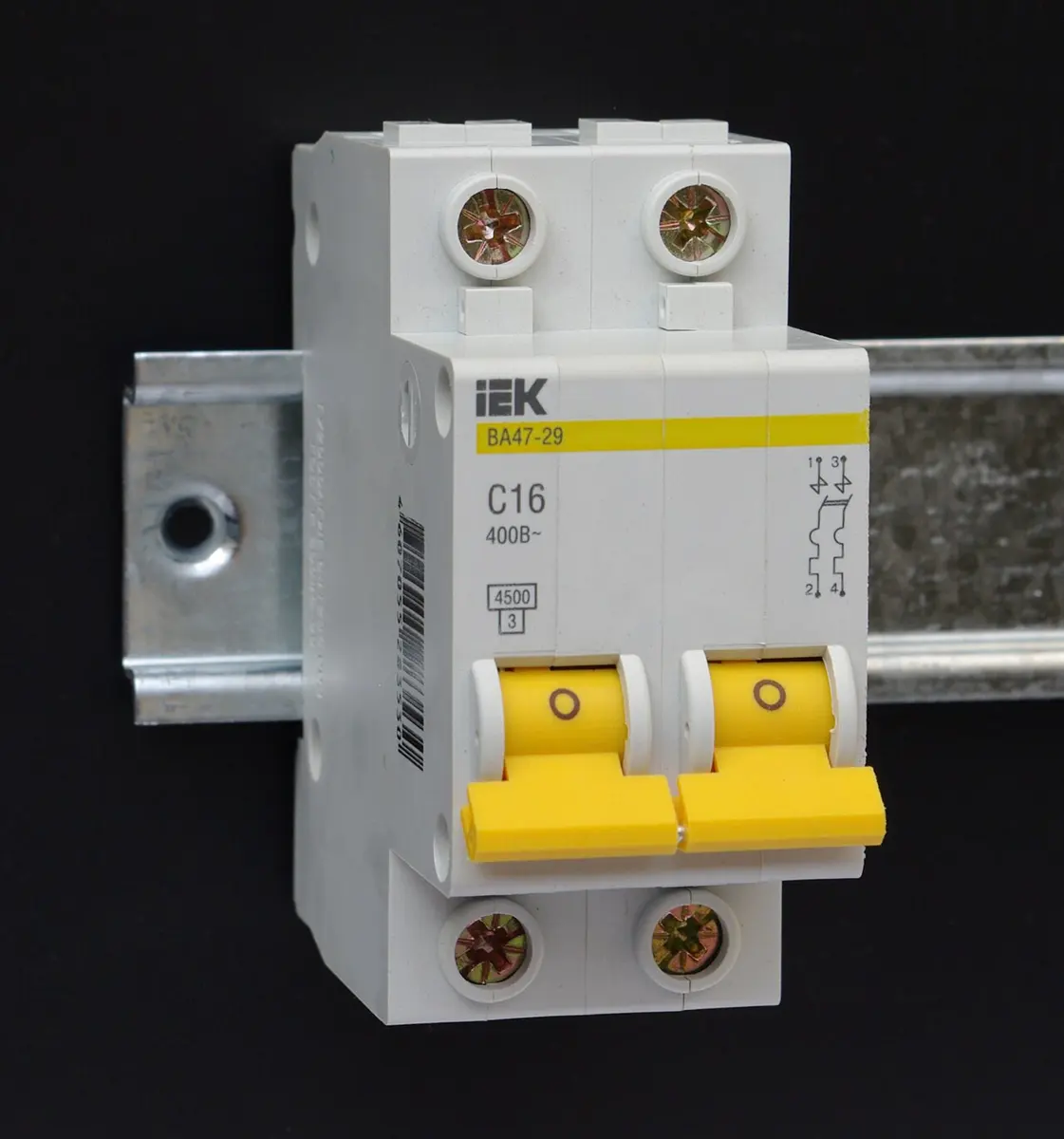
An MCB (miniature circuit breaker) is an automatic switch that opens (“trips”) by itself when too much current flows. It sits in the distribution board, next to the meter and main switch, in a plastic box. Inside it, a strip of two metals bends when it gets hot, and an electromagnet pulls hard when a sudden huge current flows; either one throws the switch off.
Too much current flows in two cases:
- Overloading: too many appliances are switched on at once in one circuit, and together they draw more current than the wiring is made for.
- Short circuit: the live and neutral wires touch directly (because of damaged insulation, for example), so the current takes a shortcut with almost no resistance and becomes enormous.
Either way, the wires could overheat and start a fire. The MCB trips first. Once the fault is fixed, you just push its lever back up: no part has to be replaced. That is what happened in Sumnima’s lab.
Fuse
A fuse is the older safety device that does the same job. It is a short piece of thin wire made of an alloy of tin and lead, held in a small porcelain (ceramic) holder. The alloy has a low melting point, and the wire is thin, so it has a fairly high resistance for its size. It is connected in series with the loads, in the live wire. If too much current flows, the fuse wire heats up and melts (the fuse “blows”), breaking the circuit before the house wiring or appliances can be damaged. A blown fuse wire must be replaced with a new one of the same rating. Fuses from about 5 A to 30 A are used in houses.
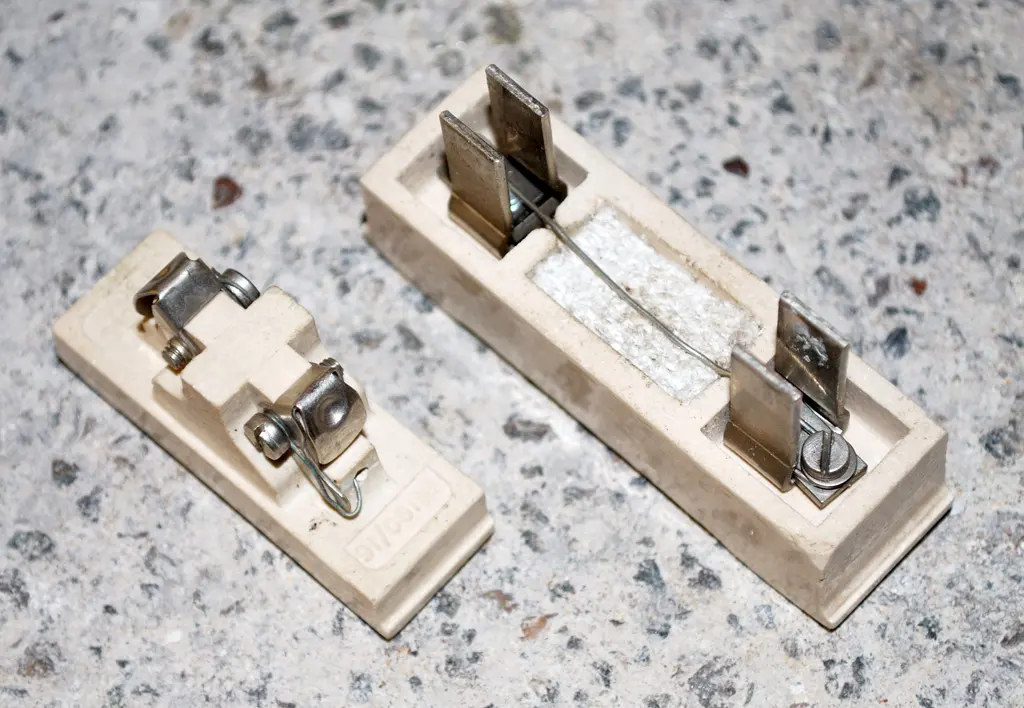
| Fuse | MCB |
|---|---|
| A thin wire that melts | An automatic switch that trips |
| Must be replaced (rewired) after it blows | Just switched back on after the fault is fixed |
| Slower; can be rewired with the wrong wire | Faster and more reliable |
| Cheap | Costs more |
Switch
A switch turns the current in a circuit on or off. It is connected in series with the appliance it controls, and always in the live wire (the phase wire), never in the neutral, so that when the switch is off, no part of the appliance is connected to the live supply. Usually each lamp or fan has its own switch, so each can be used separately; a single switch can also control several things together.
Plug and socket
A socket is fixed on the wall; a plug is fixed on the end of an appliance’s cable. Pushing the plug into the socket connects the appliance to the house wiring, and the appliance can be moved from one socket to another. Sockets have two holes (two-pin) or three (three-pin); a three-pin socket has the extra earth connection. Several plugs can be connected to one socket through a multi-plug, but too many heavy appliances on one socket overload it. Plugs and sockets are designed so that no one can touch the live metal, which cuts the risk of an electric shock.
Electric bulb
An electric bulb changes electrical energy into light. In a house, bulbs are connected in parallel, each with its own switch. In decorative strings of tiny lights, such as those put up for Tihar, the bulbs are often joined in series.
There are several kinds of bulbs:
- A filament bulb has a thin coil of tungsten wire inside a glass bulb. The wire glows white-hot. Most of the energy, more than 90%, comes out as heat, not light.
- A fluorescent tube and a CFL (compact fluorescent lamp) make light from a glowing gas inside. They contain a small amount of mercury, which is poisonous.
- An LED (light-emitting diode) bulb is the most efficient. A 9 W LED bulb gives as much light as a 60 W filament bulb.
Broken bulbs and tubes must be thrown away carefully: the glass is sharp, and fluorescent tubes and CFLs contain harmful chemicals.
Your mother switches on the water heater, the electric kettle and the iron at the same time, and the lights in the kitchen go out. What most likely happened?
Pick an answer to see why.
Why is a fuse made of a tin–lead alloy and not of copper?
Pick an answer to see why.
8.2.2 Electric wire
Electric current flows only along a path of conductors, so we can’t make a circuit without conducting wires. House wires are made of copper, covered with plastic insulation. Three kinds of wires are used in domestic wiring: the live (phase) wire, the neutral wire, and the earth wire.
Live wire (phase wire)
The live wire carries the current from the supply at a high voltage (a high electric potential): it is at about 230 V compared with the ground. Touching it gives a dangerous electric shock, because current flows from it through your body to the ground. Switches and fuses (or MCBs) are put in the live wire, so that when a switch is off or a fuse has blown, the live supply can’t reach the appliance. The live wire is usually red in older wiring and brown in newer cables.
Neutral wire
The neutral wire carries the current back to the supply. It is kept at about the same voltage (potential) as the ground, close to zero. Current flows through an appliance because of the difference in voltage between the live and neutral wires. The neutral wire is usually black (older wiring) or blue (newer). Even though it is at almost zero voltage, never touch it: a fault or wrong wiring can make it live.
Earth wire
The earth wire is a safety wire. It joins the metal body of each appliance (and the earth pin of each three-pin socket) to a copper plate or rod buried deep in damp ground near the house, through the distribution board. Normally no current flows in it.
Now suppose a loose live wire inside an iron kettle touches its metal body. Without an earth wire, the whole kettle is now at 230 V, and whoever touches it gets a shock. With an earth wire, the current rushes straight down the earth wire, which has a very low resistance, into the ground. The current is so large that the fuse blows or the MCB trips at once, and the kettle is made safe. This way of safely sending leaking (leakage) current into the ground is called earthing. It protects people from shocks and appliances from damage, and prevents electrical fires.
In a three-pin socket or plug, the earth pin is the top one, and the biggest. The earth wire is green, or green with yellow stripes in newer cables.
Using a different color for each wire makes it easy to see which wire is which, so that switches and fuses go in the live wire, and a damaged wire can be found and repaired quickly.
Which wire is connected to the metal body of an electric iron?
Pick an answer to see why.
8.2.3 Wiring in plug and socket
Plugs and sockets are the most common devices in a house circuit. Sometimes a wire comes loose inside and must be fixed, and a new appliance or extension may need a new plug. A plug is wired like this:
- a.Unscrew the cover of the plug with a screwdriver.
- b.With a knife or wire stripper, carefully cut away about 3–4 cm of the outer covering of the cable, without cutting the three wires inside, and separate them.
- c.Identify the live, neutral and earth wires by their colors, and strip about 1–1.5 cm of insulation from the end of each.
- d.Twist the bare copper strands of each wire tightly together, and bend the tip slightly.
- e.Loosen the screw of the right-hand pin (seen from the back of the plug, where you wire it), push the twisted end of the live wire (red or brown) into its hole, and tighten the screw.
- f.In the same way, connect the neutral wire (black or blue) to the left-hand pin.
- g.Connect the earth wire (green, or green-and-yellow) to the top pin, the biggest one.
- h.Tighten the cord grip over the cable, so that a tug on the cable pulls on the grip, not on the three screws.
- i.Put the cover back and tighten its screw.
- j.A socket is wired in the same way: looking at its face, live on the right, neutral on the left, earth at the top.
Some plugs, in the style used in Britain, have rectangular pins and a small cartridge fuse inside, joined to the live pin. They are wired the same way: the live wire goes to the terminal beside the fuse.
Seen from the front of a three-pin socket, which hole is the live one?
Pick an answer to see why.
8.2.4 Electric circuit of light bulbs
In a house, the light bulbs are connected in parallel: each bulb sits on its own branch between the live and the neutral wire. That has three advantages:
- each bulb gets the full 230 V, so every bulb gives its full brightness (bulbs of the same power are equally bright);
- each bulb has its own switch, in the live wire of its branch, so it can be turned on and off without affecting the others;
- if one bulb fuses, the others keep working.
In series, the same current would have to pass through all the bulbs one after another. They would share the voltage, so all would be dim, one switch would turn them all on or off together, and if one bulb broke, they would all go out. That is why there is a separate switch for each bulb in every room.
In your house, one bulb fuses. What happens to the other bulbs?
Pick an answer to see why.
Words to know
| Word | Meaning |
|---|---|
| crust | the outer, rocky layer of the Earth |
| imaging equipment | hospital machines that make pictures of the organs inside the body, such as MRI scanners, which use strong magnets and radio waves |
| transformer | a device that raises or lowers the voltage of alternating current |
| solenoid | a long coil of insulated wire |
| keeper | a piece of soft iron laid across the poles of stored magnets |
| tester | a screwdriver-shaped tool whose small lamp glows when it touches a live wire |
Exercise
1. Choose the correct answer
a. Which of these is a natural magnet?
Pick an answer to see why.
b. To which wire in a house’s wiring is a switch connected?
Pick an answer to see why.
c. Which of the four experiments in Figure 8.20 gives evidence of geomagnetism?
Pick an answer to see why.
d. Earthing protects electrical appliances from damage. How is earthing done in house wiring?
Pick an answer to see why.
2. Differentiate between
Natural magnet and artificial magnet
Answer
| Natural magnet | Artificial magnet |
|---|---|
| Found in nature, already magnetic. | Made by people. |
| Has an irregular shape. | Made in a useful shape: bar, horseshoe, ring, needle. |
| Its strength can’t be changed as we wish; it is usually weak. | Its strength can be chosen; it can be made very strong. |
| Always a permanent magnet. | Can be permanent or temporary (an electromagnet). |
| e.g. lodestone | e.g. bar magnet, electromagnet, the magnet in a speaker |
Plug and socket
Answer
| Plug | Socket |
|---|---|
| Fixed on the end of an appliance’s cable. | Fixed on the wall (or on a multi-plug). |
| Has metal pins that stick out. | Has holes with metal contacts inside. |
| Moves with the appliance. | Stays in place. |
| Connects the appliance to the supply when pushed in. | Brings the supply from the house wiring. |
Live wire and neutral wire
Answer
| Live wire | Neutral wire |
|---|---|
| Brings the current from the supply. | Takes the current back to the supply. |
| At a high voltage (about 230 V) compared with the ground. | At about zero voltage. |
| Touching it gives a dangerous shock. | Normally doesn’t give a shock, but must not be touched. |
| Switches and fuses are put in it. | No switch or fuse is put in it. |
| Red (older) or brown (newer). | Black (older) or blue (newer). |
3. Give reasons
A magnet gets demagnetized when it is hammered.
Answer
In a magnet the molecular magnets are lined up in open chains, all pointing the same way. Each blow of the hammer jolts them out of line. After many blows they point in random directions or form closed chains, their effects cancel, and the magnet loses its magnetism.
The angle of dip at the magnetic poles is 90°.
Answer
A dip needle lines up with the Earth’s magnetic field lines. At the magnetic poles the field lines go straight down into the Earth (or come straight up), at right angles to the ground. So the needle stands vertical, making an angle of 90° with the horizontal.
Different colored wires are used in domestic wiring.
Answer
So that the live, neutral and earth wires can be told apart at a glance. Then switches and fuses can be put in the live wire, each wire can be joined to the right pin of a plug or socket, and if something goes wrong, the damaged wire and its place can be found easily and safely.
The fuse is always connected in the live wire in domestic wiring.
Answer
The live wire is the one at a high voltage. If the fuse is in the live wire, then when it blows, the appliance is cut off from the live supply and is safe to touch. If it were in the neutral wire, a blown fuse would stop the current, but the appliance would still be joined to the live wire, and touching it could give a shock.
4. Answer the following questions
What are the conditions under which a magnet is demagnetized? Explain any one of them briefly.
Answer
A magnet is demagnetized by:
- i.heating it,
- ii.hammering it or dropping it again and again,
- iii.passing alternating current through a coil around it,
- iv.keeping like poles of two magnets together for a long time,
- v.natural loss over time, especially without keepers.
Heating: when a magnet is heated, its molecular magnets vibrate strongly. Their parallel rows (open chains) break up and they fall back into closed chains or random directions, so their effects cancel and the magnet loses its magnetism.
Explain the molecular theory of magnetism, with a diagram.
Answer
The molecular theory of magnetism was given by Wilhelm Weber and improved by James Alfred Ewing. It says:
- i.Every magnet and magnetic material is made of tiny molecular magnets, each with a north and a south pole.
- ii.In an unmagnetized magnetic material, the molecular magnets are arranged in closed chains, so their poles cancel and the material shows no magnetism.
- iii.When they are lined up in open chains, all pointing the same way, the material becomes a magnet: free north poles at one end make its N-pole and free south poles at the other its S-pole.
- iv.When all of them are lined up, the magnetism is the greatest possible: magnetic saturation.
Diagram: draw Figure 8.6: (i) closed loops of small arrows for an unmagnetized bar, (ii) rows of arrows all pointing one way, with N at one end and S at the other, for a magnet.
Write any three uses of magnets.
Answer
- i.In electric motors, fans, generators and loudspeakers.
- ii.In a magnetic compass, to find directions.
- iii.As electromagnets in cranes, to lift heavy iron and scrap in factories and ports.
(Others: MRI machines in hospitals, computer hard disks, electromagnetic door locks, induction cookers, electric bells.)
What is terrestrial magnetism?
Answer
The magnetism of the Earth is called terrestrial magnetism (geomagnetism). The Earth behaves like a huge magnet, with a magnetic pole near each geographic pole, because of electric currents in the molten iron and nickel moving in its outer core. Its field makes a freely hung magnet point north–south.
Write any three applications of terrestrial magnetism.
Answer
- i.It works the magnetic compass, used for finding directions on ships, submarines and airplanes.
- ii.It shields the Earth from the harmful charged particles of the solar wind, turning them aside or steering them to the polar regions.
- iii.The magnetism frozen into igneous rocks helps scientists estimate their age, and magnetic surveys help find ores of metals.
What is household electrification? Write the characteristics of the neutral and phase (live) wires used in it.
Answer
Bringing the electricity made at a power station into people’s houses through transmission lines, and wiring it safely to the lamps, fans and appliances, is household electrification.
Phase (live) wire: brings the current from the supply; is at a high voltage (about 230 V) compared with the ground; gives a dangerous shock if touched; switches and fuses are put in it; red (older) or brown (newer) in color.
Neutral wire: takes the current back to the supply; is at about zero voltage; the current flows because of the voltage difference between live and neutral; no switch or fuse is put in it; black (older) or blue (newer); must still not be touched.
“Magnetic materials in nature are magnetized by the effect of terrestrial magnetism.” Justify this statement with examples.
Answer
Magnetic materials that lie in the Earth’s magnetic field for a long time slowly get their molecular magnets lined up along it, and become magnets. Examples:
- i.An iron rod buried in the ground in the north–south direction for a long time becomes magnetized.
- ii.Old iron railings, poles and pillars that have stood for years often turn out to be weak magnets.
- iii.Natural magnets such as lodestone, and the magnetic minerals in igneous rocks, which line up with the Earth’s field as lava cools, are found in the ground.
So these materials, which would otherwise be unmagnetized, are magnetized by the Earth’s field. (Lightning strikes may also magnetize some lodestones strongly.)
Write the steps of wiring a plug.
Answer
- i.Unscrew the cover of the plug.
- ii.Cut away about 3–4 cm of the cable’s outer covering and separate the three wires.
- iii.Identify the live, neutral and earth wires and strip about 1–1.5 cm of insulation from each.
- iv.Twist the bare strands of each wire and bend the tips slightly.
- v.Connect the live wire (red or brown) to the right-hand pin, the neutral (black or blue) to the left-hand pin, and the earth (green, or green-and-yellow) to the top pin, tightening each screw. (Right and left as seen from the back of the plug.)
- vi.Tighten the cord grip over the cable.
- vii.Put the cover back and tighten its screw. Check before use.
What is earthing? Why is earthing necessary in domestic wiring?
Answer
Earthing is joining the metal bodies of appliances (and the earth pins of sockets), by a low-resistance earth wire, to a metal plate buried in damp ground, so that any leaking current flows safely into the ground.
It is necessary because if a live wire inside an appliance touches its metal body, the body becomes live. With earthing, a large current flows into the ground at once, the fuse blows or the MCB trips, and the appliance is cut off. This protects people from electric shocks, and protects appliances and the wiring from damage and fire.
“The arrangement of the molecular magnets decides whether a substance is a magnet or not.” According to this statement, can the magnetic and non-magnetic states of a magnetic substance change into each other? Justify.
Answer
Yes. A magnetic substance always has molecular magnets; only their arrangement differs. If they are lined up in open chains (for example, by stroking the substance with a magnet or putting it in a coil carrying current), it becomes a magnet. If they are disturbed back into closed chains or random directions (by heating, hammering or alternating current), it loses its magnetism. So the same piece of iron can be changed from non-magnetized to magnetized and back again. (A non-magnetic substance such as wood or copper has no molecular magnets to arrange, so it can’t be made a magnet.)
Is there a connection between magnets and electricity? Explain the connection with an activity.
Answer
Yes. An electric current produces magnetism.
Activity: wind insulated copper wire around an iron nail, and connect its ends to a cell through a switch (Activity 8.2). With the switch on, the nail picks up pins; with it off, they drop. The current in the coil has made the nail a magnet, an electromagnet.
The same link is why alternating current in a coil can demagnetize a magnet (Activity 8.3): the current’s magnetism keeps flipping and jumbles the molecular magnets.
The link works the other way too: moving a magnet near a coil of wire makes a current flow in it. That is how the generators in hydropower stations make electricity.
5. Solve these numerical problems
The electric meter in Bhawana’s house records 75 units of electricity used in 15 days. Calculate the average monthly electricity bill (for 30 days) if one unit costs Rs 9.50.
Hint
A month of 30 days is twice as long as 15 days.
Answer
Units in 15 days = 75
Units in 30 days = 75 × 2 = 150 units
Bill = units × rate = 150 × Rs 9.50 = Rs 1,425
Eight bulbs of 25 W each are used in a house for 4 hours 40 minutes every day. Calculate the electricity consumed in a day, in units.
Answer
= 25 W = 25/1000 kW = 0.025 kW
= 8
= 4 h 40 min = 4 + 40/60 h = 4.667 h (exactly 14/3 h)
E.C. = = 0.025 × 8 × 14/3 = 0.2 × 14/3 = 0.933 units (about 0.93 kWh)
The sub-meter in Sharmila’s room records 8.5 units of electricity in a month. If the only appliance in her room is one bulb of 65 W, on average for how long is the bulb used each day? (Take a month as 30 days.)
Answer
Units in a day = 8.5 ÷ 30 = 0.2833 kWh
= 65 W = 0.065 kW, = 1
From E.C. = : = E.C. ÷ () = 0.2833 ÷ 0.065 = 4.36 hours a day (about 4 hours 22 minutes)
A municipality has put up 14 street lights, each of 1,500 W. They are used for 6.5 hours a day on average. If the electricity costs Rs 12.50 a unit, calculate the monthly bill (30 days) the municipality pays.
Answer
= 1,500 W = 1.5 kW, = 14, = 6.5 h
Units a day = 1.5 × 14 × 6.5 = 136.5 units
Units a month = 136.5 × 30 = 4,095 units
Bill = 4,095 × Rs 12.50 = Rs 51,187.50
Practice every question in the book, and keep track of the ones you miss →