
Take a deep breath. In that one breath you pulled in about half a liter of air: mostly nitrogen, which goes in and comes straight back out; about a fifth oxygen, which your blood carries to every cell; and a pinch of argon, carbon dioxide and other gases. You can’t see any of them, smell them or taste them, and yet without them you would last only a few minutes.
This unit is about three gases, hydrogen, oxygen and nitrogen: how to make each of them in the laboratory, how to recognize them, how they behave and what we use them for. It ends high above Mount Everest, in a thin layer of a fourth gas, ozone, that protects every living thing on Earth.
Gases around us
The atmosphere is the layer of air that covers the Earth all around. It is a mixture of many gases.
About 99% of the air is nitrogen (78%) and oxygen (21%). The last 1% is mostly argon, with a little carbon dioxide and traces of neon, helium, methane, krypton, hydrogen, ozone and others. Air also holds water vapor, from almost none in a dry winter to about 4% on a humid monsoon day.
Gases are not only in the air. They are locked up in compounds in plants, animals, water, food and rocks: oxygen in water and in limestone, hydrogen in water and in every sugar, nitrogen in every protein. By mass, about 96% of the human body is just four elements, oxygen (about 65%), carbon (18%), hydrogen (10%) and nitrogen (3%); three of them are gases as elements. Living things use gases in respiration and photosynthesis, and to build compounds.
We get the gases we need from the atmosphere, or by making them in factories. For scientific study, we prepare them in the laboratory.
Which gas makes up most of the air?
Pick an answer to see why.
Hydrogen gas
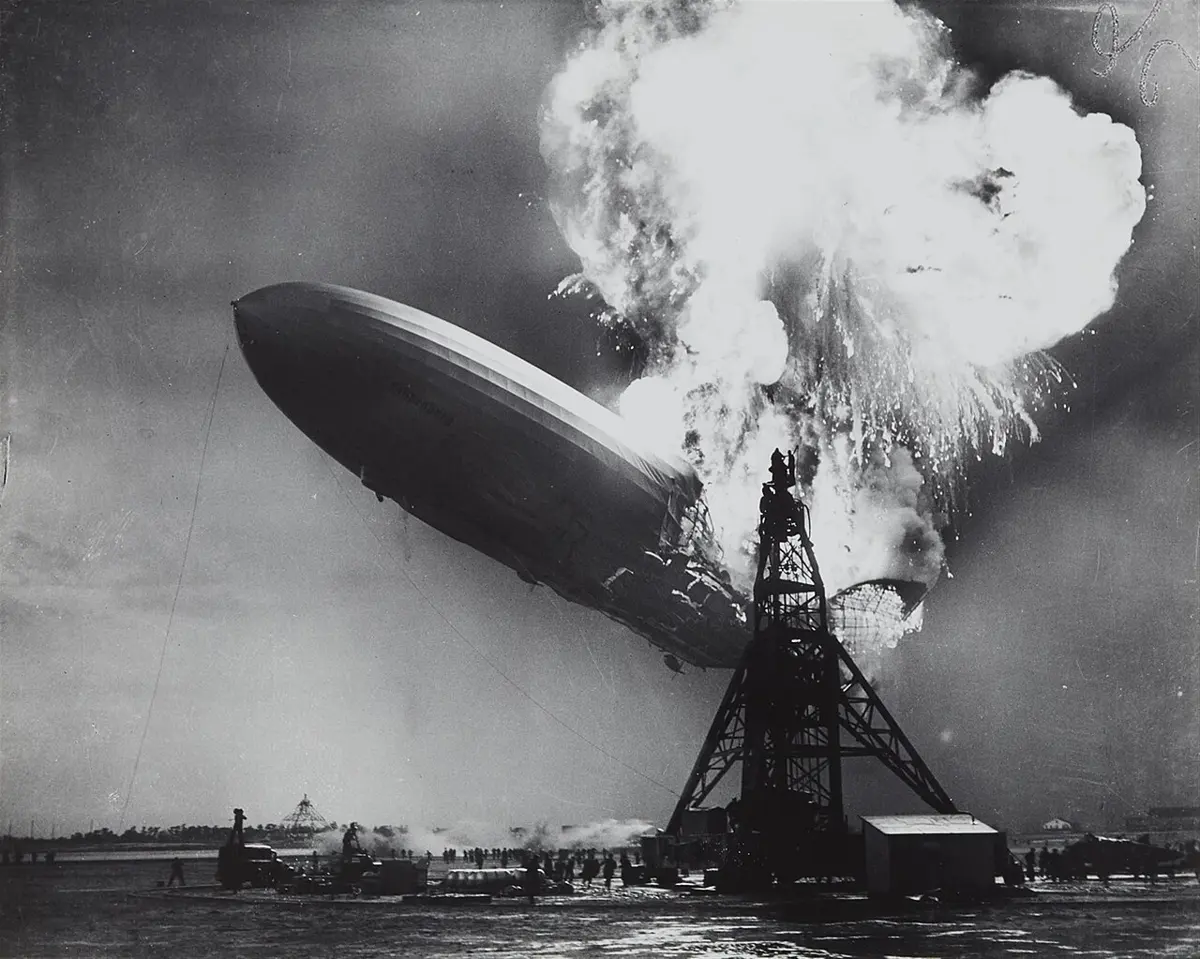
Hydrogen is the lightest gas there is, and the most common element in the universe: the Sun and the stars are mostly hydrogen. On Earth there is very little free hydrogen gas; it is found in compounds: water, acids, bases, hydrocarbons (like the methane in biogas), carbohydrates, proteins and fats.
Hydrogen has three isotopes: atoms of the same element, with the same atomic number but different mass numbers.
| Isotope | Protons | Neutrons | Mass number |
|---|---|---|---|
| protium, ¹₁H | 1 | 0 | 1 |
| deuterium, ²₁H | 1 | 1 | 2 |
| tritium, ³₁H | 1 | 2 | 3 |
Almost all hydrogen is protium; deuterium is rare, and tritium is radioactive.
In 1766 the English chemist Henry Cavendish made hydrogen by pouring acids on metals, and showed that it is a separate gas that burns; he called it “inflammable air”. The French chemist Antoine Lavoisier named it hydrogen, from the Greek for “water-former”, because it burns in oxygen to make water.
| Symbol | Atomic number | Atomic mass | Molecular formula | Density |
|---|---|---|---|---|
| H | 1 | 1 | H₂ | 0.09 kg/m³ (air: about 1.29 kg/m³) |
Laboratory preparation of hydrogen gas
Active metals like zinc and magnesium displace hydrogen from dilute acids. So in the laboratory, hydrogen is made by the reaction of granulated zinc with dilute hydrochloric acid (dilute sulphuric acid also works):
(The arrow ↑ after H₂ means it escapes as a gas.) Very pure zinc reacts only slowly; impure (commercial, granulated) zinc reacts much faster, because the traces of other metals, such as copper, in it speed up the reaction.
Precautions
- Wash all the apparatus well.
- Use impure (granulated) zinc, so that the reaction is quick.
- Make every joint airtight, so that no gas escapes.
- Use dilute acid. Concentrated sulphuric acid and nitric acid give other gases instead of hydrogen (sulphur dioxide and oxides of nitrogen).
- The lower end of the thistle funnel must dip under the acid, so the gas can’t escape through it; the end of the delivery tube inside the bottle must stay above the acid, so only gas goes into it.
- Fill the gas jar completely with water, with no air bubble left in it.
- Keep flames away: hydrogen mixed with air explodes when lit.
Test for hydrogen gas
Bring a burning splint (or a lit candle) to the mouth of a test tube or jar of hydrogen. The hydrogen burns with a “pop” sound and a pale blue flame, and the splint itself goes out if pushed inside the jar. The pop is a tiny explosion of hydrogen mixing with the oxygen of the air: 2H₂ + O₂ → 2H₂O. No other common gas does this.
Physical properties of hydrogen gas
- It is a colorless, odorless and tasteless gas.
- It is the lightest gas: about 14 times lighter than air.
- It hardly dissolves in water.
- It has no effect on litmus paper: it is a neutral gas.
- It turns into a liquid at −253 °C and freezes to a solid at −259 °C.
Chemical properties of hydrogen gas
- With oxygen it forms water. A mixture of hydrogen and oxygen explodes when lit:
2. With some non-metals, at high temperatures:
3. With very active metals (sodium, potassium, calcium), heated, it forms solid hydrides, which react with water to give hydrogen back:
4. It takes oxygen away from the oxides of less reactive metals. When hydrogen is passed over the red-hot oxide of a metal like iron, copper or lead, it combines with the oxygen to form water and leaves the free metal:
With copper oxide you can watch it happen: the black powder turns into shiny, pinkish-brown copper.
The removal of oxygen from a compound (or the addition of hydrogen to it) is called reduction, and these are reduction reactions. Hydrogen is a reducing agent.
In CuO + H₂ → Cu + H₂O, what happens to the copper oxide?
Pick an answer to see why.
Uses of hydrogen gas
- To get metals from their oxides (reduction).
- To make ammonia, by combining it with nitrogen in the Haber process; most ammonia becomes fertilizer.
- To turn liquid vegetable oils into solid fat, vanaspati ghee, by hydrogenation. (Partly hydrogenated fats contain trans fats, which are bad for the heart, so many countries now limit them.)
- As rocket fuel: liquid hydrogen burning with liquid oxygen gives a huge amount of energy, which launches rockets.
- For welding and cutting metals: hydrogen burning in oxygen gives the oxy-hydrogen flame, at about 2,800 °C.
- To fill weather balloons, and as a clean fuel in some cars and buses, whose only exhaust is water.
Oxygen gas
Living things need oxygen for respiration. It makes up about 21% of the air by volume, and is found in compounds everywhere: in organic compounds such as carbohydrates, proteins, fats and wood, and in inorganic compounds such as calcium carbonate (limestone), silica (sand) and water. By mass, nearly half the Earth’s crust is oxygen.
In 1774 the English scientist Joseph Priestley made oxygen by heating red mercuric oxide (HgO) with sunlight focused through a large lens; the Swedish chemist Carl Scheele had made it a little earlier, but published later. Lavoisier showed what it really is, and named it oxygen.
| Symbol | Atomic number | Atomic mass | Molecular formula | Density |
|---|---|---|---|---|
| O | 8 | 16 | O₂ | 1.43 kg/m³ |
Laboratory preparation of oxygen gas
A. By heating
Some compounds rich in oxygen give it off when heated. In the laboratory, oxygen is made by heating potassium chlorate (KClO₃) with a little manganese dioxide (MnO₂) as a catalyst:
The manganese dioxide is not used up; it makes the potassium chlorate give its oxygen at a much lower temperature, and more steadily.
Precautions
- Clamp the hard-glass test tube with its mouth slightly lower than its closed end, as in the figure. Any moisture in the chemicals that condenses near the mouth then runs out, instead of running back onto the hot glass and cracking it.
- Make every joint airtight.
- Fill the gas jar completely with water, leaving no air.
- When you finish, take the delivery tube out of the water before you stop heating. Otherwise, as the tube cools, water is sucked back into the hot test tube and cracks it.
B. Without heating
Oxygen can also be made at room temperature by the decomposition of hydrogen peroxide (H₂O₂), with manganese dioxide as a catalyst:
Precautions
- Make every joint airtight.
- Pour in enough hydrogen peroxide to cover the end of the thistle funnel, so no oxygen escapes through it.
- Use pure manganese dioxide.
Test for oxygen gas
Put a glowing splint (a wooden splint lit and then blown out, so that only its tip glows red) into a jar of the gas. If it bursts into flame again, the gas is oxygen. A burning candle or splint put into oxygen burns much more brightly, with a bigger flame, than in air.
Physical properties of oxygen gas
- It is a colorless, odorless and tasteless gas.
- It is slightly heavier than air.
- It is slightly soluble in water: just enough for fish to breathe.
- It has no effect on litmus paper: it is a neutral gas.
- It turns into a pale blue liquid at −183 °C and freezes at about −219 °C.
- It doesn’t burn itself, but it supports burning: things burn much more fiercely in it than in air.
Chemical properties of oxygen gas
- Metals burn in oxygen to form metal oxides. Metal + oxygen → metal oxide:
- Non-metals burn in oxygen to form non-metal oxides. Non-metal + oxygen → oxide of the non-metal:
3. Hydrocarbons burn in oxygen to give carbon dioxide, water and energy. Hydrocarbon + oxygen → carbon dioxide + water + energy:
4. Glucose reacts with oxygen to give carbon dioxide, water and energy. This is what happens in respiration in living things:
5. Alcohol burns in oxygen, giving carbon dioxide, water and energy:
Uses of oxygen gas
- All living things (except a few microbes) use oxygen for respiration, to get energy from food.
- For welding and cutting metals, with the oxy-acetylene flame (about 3,200 °C) or the oxy-hydrogen flame.
- In hospitals, for patients who have difficulty breathing.
- In cylinders, where there isn’t enough of it to breathe: for mountaineers, miners, divers, astronauts and in submarines.
- In making steel: oxygen blown through molten iron burns away its impurities.
- With liquid hydrogen or kerosene, as the oxidizer in rocket engines.
How do you test whether a gas is oxygen?
Pick an answer to see why.
Ozone
Ozone is a form of oxygen whose molecule has three oxygen atoms, O₃ (ordinary oxygen is O₂). It is a pale blue gas with a sharp smell; you may notice it near a photocopier, or in the air after a thunderstorm. As a liquid it is deep blue.
High in the atmosphere, ultraviolet (UV) rays from the Sun split some oxygen molecules into single oxygen atoms (sometimes called nascent oxygen). An oxygen atom then joins an oxygen molecule to make ozone:
The ozone made this way forms a layer in the stratosphere, the part of the atmosphere above the clouds and the weather. This is the ozone layer. It lies roughly 15 to 35 km above the ground, with the most ozone at about 20 to 25 km. (Books give slightly different heights for it, from about 15 to 50 km; the layer has no sharp edges.)
Importance of the ozone layer
The ozone layer absorbs most of the ultraviolet rays from the Sun, so these harmful rays can’t reach the Earth’s surface. That is why it is called the protective layer of the Earth.
- a.It helps keep the Earth’s climate and temperature in balance (by absorbing UV, it warms the stratosphere, and so shapes how the atmosphere moves).
- b.It protects living things on land and in water, and the ecosystems they form.
- c.It keeps ecosystems from being destroyed, and keeps them in balance.
- d.It protects people, animals and plants from the diseases and damage that UV radiation causes.
Depletion of the ozone layer
The thinning of the ozone layer in the stratosphere is called ozone layer depletion. The chief chemicals that deplete it are chlorofluorocarbons (CFCs), once used in refrigerators, air conditioners, aerosol sprays and foam. Others are halons (used in fire extinguishers), carbon tetrachloride, methyl chloroform, methyl bromide (used to kill pests in soil) and oxides of nitrogen (especially nitrous oxide, N₂O, from nitrogen fertilizers).
These gases are very stable in the lower air, so they last for years and slowly drift up into the stratosphere. There, UV rays break them up and set free atoms of chlorine or bromine. Each chlorine atom destroys ozone, and is set free again to destroy more:
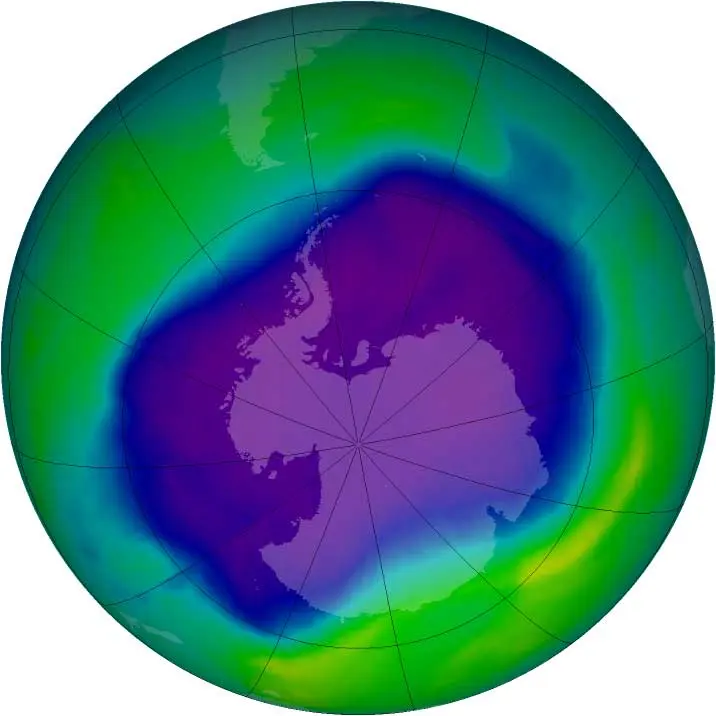
Because the chlorine atom isn’t used up, one chlorine atom can destroy many thousands of ozone molecules before it is finally locked away in another compound. Continued depletion thins the layer so much that, over Antarctica every spring (September to November), a hole opens in it.
Effects of ozone layer depletion
When the ozone layer thins, more UV rays from the Sun reach the Earth’s surface. They harm both living things and the environment:
- a.On human health: UV burns and irritates the eyes and causes cataracts (the lens of the eye goes cloudy); it causes sunburn, itching and blistering of the skin, and skin cancer; and it weakens the body’s immune system. UV also damages DNA, which can cause harmful changes (mutations).
- b.On plants: UV slows down the growth of plants and the rate of photosynthesis, so crops give less.
- c.On the ecosystem: UV harms the tiny plankton at the surface of the sea that feed fish, and the eggs and young of many animals, so whole food chains and ecosystems are thrown out of balance.
- d.On materials: UV makes plastics, paints and rubber crack and fade faster.
Ways to protect the ozone layer
- a.Stop using devices and products that release CFCs and other ozone-depleting chemicals; dispose of old refrigerators and air conditioners safely, so their gases are collected, not let out.
- b.Use substitutes that don’t harm the ozone layer. Hydrofluorocarbons (HFCs) replaced CFCs because they contain no chlorine, but they are strong greenhouse gases, so under a 2016 change to the Montreal Protocol (the Kigali Amendment) they too are being phased out, in favor of gases such as isobutane, now used in many new refrigerators.
- c.Use nitrogen fertilizers only as much as crops need, because the extra produces nitrous oxide, which also depletes ozone.
- d.Use fewer petrol and diesel vehicles, which give out oxides of nitrogen, and more electric vehicles. Nepal, which makes its electricity mostly from rivers, is a good place for electric vehicles.
Nitrogen gas
In 1772 the Scottish scientist Daniel Rutherford found that air in which a candle had burned out and mice had breathed still had a gas left in it that would support neither burning nor life. In 1790 the French chemist Jean-Antoine Chaptal named it nitrogen, “niter-former”, because it is part of niter (saltpeter).
Nitrogen is much less reactive than most gases: under ordinary conditions it hardly reacts with any element or compound. The reason is the very strong triple bond holding its two atoms together (N≡N). Yet it is everywhere in living things, in proteins, enzymes, DNA and RNA, and in some rocks and minerals, as nitrates.
Laboratory preparation of nitrogen gas
In the laboratory, nitrogen is made by gently heating a solution of sodium nitrite (NaNO₂) and ammonium chloride (NH₄Cl):
Precautions
- Fit the apparatus airtight, and heat the mixture gently: once it starts, the reaction gives out heat and can become violent.
- Make the solution before heating. Dry ammonium chloride, when heated, turns straight from a solid into a gas (it sublimes) instead of reacting.
Test for nitrogen gas
- A burning splint goes out in nitrogen, and the gas doesn’t burn: nitrogen neither burns nor supports burning. (Carbon dioxide does the same, but nitrogen doesn’t turn lime water milky.)
- A strongly burning magnesium ribbon, lowered into a jar of nitrogen, keeps burning and leaves a yellowish powder, magnesium nitride. Add a few drops of water to the powder: if you smell ammonia, the gas was nitrogen.
Physical properties of nitrogen gas
- It is a colorless, odorless and tasteless gas.
- It is slightly lighter than air.
- It is sparingly soluble in water.
- It is neutral: it doesn’t affect litmus paper.
- It neither burns nor supports burning.
- It turns into a liquid at about −196 °C and freezes at −210 °C.
Chemical properties of nitrogen gas
Nitrogen is unreactive under ordinary conditions, but under special conditions it reacts with several substances.
- With hydrogen, it forms ammonia, at about 450 °C and a high pressure (about 200 times the pressure of the air; books give 200 to 500 atm), with an iron catalyst. This is the Haber process. (Many books add “a little molybdenum as a promoter” and write Fe/Mo over the arrow, and an exam accepts it; today’s plants help the iron with potassium and aluminium oxides instead.)
2. With oxygen, it forms nitric oxide, only at about 2,000 to 3,000 °C, in an electric arc, or in a flash of lightning:
3. With burning magnesium, calcium or aluminium, it forms metal nitrides:
Uses of nitrogen gas
- To make ammonia and nitric acid, which are used to make nitrogen fertilizers such as urea.
- To fill packets of food, like chips and biscuits: with no oxygen inside, the food doesn’t go stale, and the gas cushions it.
- To fill electric bulbs (usually mixed with argon), so that the hot tungsten filament doesn’t burn away.
- As liquid nitrogen (at −196 °C), to freeze and store things: blood, cells, and the frozen semen used by vets in Nepal for artificial insemination of cows and buffaloes; and to cool equipment in laboratories.
Project work
Exercise
1. Choose the correct answer
a. Which compound is heated to prepare oxygen gas in the laboratory?
Pick an answer to see why.
b. Which compound is formed when magnesium burns in oxygen?
Pick an answer to see why.
c. When dry hydrogen is passed over a hot metal oxide, the metal and water are formed. What is this process called?
Pick an answer to see why.
d. Which is the main gas that depletes the ozone layer?
Pick an answer to see why.
e. Which compound fills the blank? C₆H₁₂O₆ + 6O₂ → 6 …… + 6H₂O + energy
Pick an answer to see why.
2. Give reasons
The ozone layer is called the protective layer.
Answer
The ozone layer in the stratosphere absorbs most of the harmful ultraviolet rays coming from the Sun (all UV-C and most UV-B), so they don’t reach the Earth’s surface. UV rays would cause skin cancer, cataracts and weak immunity in people, and harm plants, animals and ecosystems. Because it shields life on Earth from these rays, it is called the protective layer.
Hydrogen and oxygen gases are collected by the displacement of water.
Answer
Hydrogen is almost insoluble in water and oxygen is only slightly soluble, so very little of either is lost by dissolving. Each pushes the water down and out of an upside-down jar full of water. This also gives a pure gas, unmixed with air, and lets us see when the jar is full.
The ice on mountains is melting faster and faster.
Answer
Because of global warming. Greenhouse gases such as carbon dioxide, methane and CFCs, released by burning fuels, cutting forests and other human activities, trap more heat in the atmosphere, so the Earth’s temperature is rising. Snow and glaciers on the mountains melt faster than new snow can replace them. Soot settling on the snow darkens it, so it absorbs more sunlight and melts faster still.
3. Answer the following questions
Write the chemical equation used in the laboratory preparation of hydrogen gas.
Answer
Granulated zinc and dilute hydrochloric acid:
Zn(s) + 2HCl(aq) → ZnCl₂(aq) + H₂(g)
(With dilute sulphuric acid: Zn + H₂SO₄ → ZnSO₄ + H₂.)
Draw a labeled diagram of the laboratory preparation of hydrogen gas, and write the procedure step by step.
Answer
Draw Figure 16.2: a Woulfe’s bottle with granulated zinc and dilute HCl, a thistle funnel dipping into the acid, a delivery tube from just below the cork to a beehive shelf in a trough of water, and an upside-down gas jar on the shelf. Label each part.
Procedure:
- Put some granulated zinc in the Woulfe’s bottle.
- Fit a thistle funnel through one neck and a delivery tube through the other, with airtight corks.
- Lead the delivery tube under water to the beehive shelf in the trough.
- Turn a gas jar full of water upside down on the beehive shelf.
- Pour dilute hydrochloric acid through the thistle funnel until its end dips into the acid.
- Hydrogen is given off (Zn + 2HCl → ZnCl₂ + H₂) and collected by downward displacement of water. Let the first bubbles (air) escape before collecting.
Write any four physical properties and any four uses of hydrogen.
Answer
Physical properties: (1) it is colorless, odorless and tasteless; (2) it is the lightest gas, about 14 times lighter than air; (3) it hardly dissolves in water; (4) it is neutral to litmus; (5) it liquefies at −253 °C.
Uses: (1) to make ammonia (Haber process); (2) to make vanaspati ghee from vegetable oil (hydrogenation); (3) as rocket fuel; (4) in the oxy-hydrogen flame for welding and cutting metals; (5) to get metals from their oxides.
Write any four physical properties and any four uses of nitrogen.
Answer
Physical properties: (1) it is colorless, odorless and tasteless; (2) it is slightly lighter than air; (3) it dissolves only a little in water; (4) it is neutral to litmus; (5) it neither burns nor helps things burn; (6) it turns liquid at −196 °C.
Uses: (1) to make ammonia and nitric acid, from which fertilizers such as urea are made; (2) to fill food packets, so the food doesn’t go stale; (3) to fill electric bulbs, so the filament doesn’t burn away; (4) as liquid nitrogen, to freeze and keep blood, cells and semen.
How do you identify the hydrogen gas in a gas jar?
Answer
Bring a burning splint to the mouth of the jar. If the gas burns with a “pop” sound and a pale blue flame (and the splint goes out when pushed inside), the gas is hydrogen.
Which compounds are formed when these substances react with hydrogen? Write balanced equations. (i) sodium (ii) oxygen (iii) calcium (iv) ferric oxide
Answer
- i.Sodium hydride: 2Na + H₂ → 2NaH
- ii.Water: 2H₂ + O₂ → 2H₂O
- iii.Calcium hydride: Ca + H₂ → CaH₂
- iv.Iron and water (reduction): Fe₂O₃ + 3H₂ → 2Fe + 3H₂O
Explain, with a diagram, the method of preparing oxygen in the laboratory without heating.
Answer
Draw Figure 16.5. Oxygen is made by decomposing hydrogen peroxide with manganese dioxide as a catalyst: 2H₂O₂ → 2H₂O + O₂ (MnO₂ over the arrow).
- Put some manganese dioxide in a clean conical flask.
- Fit a thistle funnel and a delivery tube through a two-holed cork, airtight; lead the delivery tube to a beehive shelf in a trough of water, under an upside-down gas jar full of water.
- Pour hydrogen peroxide through the thistle funnel until the funnel’s end is under the liquid.
- Oxygen is given off at once, without heating, and is collected by downward displacement of water.
Describe, with a diagram, the laboratory preparation of nitrogen.
Answer
Draw Figure 16.9. Nitrogen is made by gently heating a solution of sodium nitrite and ammonium chloride: NaNO₂ + NH₄Cl → NaCl + N₂ + 2H₂O (Δ over the arrow).
- Put about 5 g of sodium nitrite and 4 g of ammonium chloride in a clean round-bottom flask and dissolve them in about 50 mL of water.
- Set the flask on wire gauze on a tripod, hold it with a clamp, and fit an airtight delivery tube through the cork.
- Lead the delivery tube to the beehive shelf in a trough of water, under an upside-down gas jar full of water.
- Heat the solution gently with a burner. Once the first bubbles (the air from the flask) have escaped, collect the nitrogen by downward displacement of water.
Careful: heat gently, because the reaction gives out heat itself; and don’t heat dry ammonium chloride, which sublimes.
Explain, with a diagram, the method of preparing oxygen in the laboratory by heating.
Answer
Draw Figure 16.4. Oxygen is made by heating potassium chlorate with manganese dioxide as a catalyst: 2KClO₃ → 2KCl + 3O₂ (MnO₂ and heat over the arrow).
- Mix four parts of potassium chlorate with one part of manganese dioxide in a clean, dry hard-glass test tube.
- Close it with a cork carrying a delivery tube, and clamp it with its mouth slightly lower than its closed end.
- Lead the delivery tube to a beehive shelf in a trough of water, under an upside-down gas jar full of water.
- Heat the mixture gently with a burner. Oxygen is given off and collected by downward displacement of water.
- At the end, remove the delivery tube from the water before stopping the heating, so that water isn’t sucked back.
Write any four physical properties and four uses of oxygen.
Answer
Physical properties: (1) colorless, odorless and tasteless; (2) slightly heavier than air; (3) slightly soluble in water; (4) neutral to litmus; (5) liquefies at −183 °C to a pale blue liquid.
Uses: (1) respiration in living things; (2) welding and cutting metals in the oxy-acetylene flame; (3) for patients with difficulty breathing, in hospitals; (4) in cylinders for mountaineers, divers, miners and astronauts; (5) in steel making.
How do you identify the oxygen gas in a gas jar?
Answer
Put a glowing splint into the jar. If it bursts into flame, the gas is oxygen. (A burning splint or candle burns more brightly in it than in air.)
Which compounds are formed when these substances react with oxygen? Write balanced equations. (i) magnesium (ii) carbon (iii) methane (iv) glucose
Answer
- i.Magnesium oxide: 2Mg + O₂ → 2MgO
- ii.Carbon dioxide: C + O₂ → CO₂
- iii.Carbon dioxide and water: CH₄ + 2O₂ → CO₂ + 2H₂O + energy
- iv.Carbon dioxide and water: C₆H₁₂O₆ + 6O₂ → 6CO₂ + 6H₂O + energy
What is the ozone layer? How is it formed, and how is it depleted? Write with equations.
Answer
The ozone layer is a layer of ozone gas (O₃) in the stratosphere, roughly 15 to 35 km above the Earth, which absorbs most of the Sun’s ultraviolet rays.
Formation: UV rays split oxygen molecules into oxygen atoms, and each atom joins an oxygen molecule to form ozone:
O₂ → O + O (UV rays)
O₂ + O → O₃
Depletion: CFCs and similar chemicals rise into the stratosphere, where UV rays break them and release chlorine atoms. Each chlorine atom breaks ozone into oxygen and is set free again, so one atom destroys thousands of ozone molecules:
CFCl₃ → CFCl₂ + Cl (UV rays)
Cl + O₃ → ClO + O₂
ClO + O → Cl + O₂
Write the role of the ozone layer in protecting living things on the Earth.
Answer
The ozone layer absorbs most of the Sun’s harmful ultraviolet rays. In doing so it protects people from sunburn, skin cancer, cataracts and weakened immunity; protects plants, whose growth, photosynthesis and crops UV would reduce; protects plankton and young animals, and so the food chains and ecosystems on land and in water; and it helps keep the climate of the atmosphere in balance. Without it, life on land would hardly be possible.
Human beings are mainly responsible for the increase in radiation reaching the Earth. Justify the statement with an example.
Answer
The extra UV radiation reaching the ground comes from the thinning of the ozone layer, and that thinning was caused by chemicals people made and used. For example, CFCs from old refrigerators, air conditioners, aerosol sprays and foam rose into the stratosphere, where their chlorine destroyed ozone; this opened the ozone hole over Antarctica, first reported in 1985. Halons from fire extinguishers, methyl bromide pesticides and nitrous oxide from over-used fertilizers did the same. Nature doesn’t make these chemicals in large amounts, so the increase is mainly people’s doing. (That is also why, when people stopped making CFCs under the Montreal Protocol, the ozone layer began to heal.)
In one place on the Earth, an increase in the radiation from the Sun was measured. Write its causes and effects.
Answer
Causes: the ozone layer above that place has become thin. Ozone-depleting chemicals such as CFCs, halons, carbon tetrachloride, methyl bromide and oxides of nitrogen reach the stratosphere, where UV rays release chlorine and bromine atoms that destroy ozone. With less ozone, more ultraviolet rays get through. (Height matters too: high places have less air above them, so they always get more UV.)
Effects: more sunburn, eye irritation, cataracts and skin cancer, and weaker immunity in people; slower growth, less photosynthesis and smaller harvests in plants; harm to plankton and young animals, which upsets food chains and ecosystems; and plastics, paints and rubber that crack and fade faster.
4. Complete and balance these equations
2H₂ + …… → 2H₂O
Answer
2H₂ + O₂ → 2H₂O
Na + H₂ → ……
Answer
2Na + H₂ → 2NaH (sodium hydride)
…… → KCl + O₂↑
Answer
2KClO₃ → 2KCl + 3O₂↑ (heated, with MnO₂ as catalyst)
…… + O₂ → CO₂ + 2H₂O + energy
Answer
CH₄ + 2O₂ → CO₂ + 2H₂O + energy (methane)
C₆H₁₂O₆ + O₂ → …… + …… + energy
Answer
C₆H₁₂O₆ + 6O₂ → 6CO₂ + 6H₂O + energy
Mg + O₂ → ……
Answer
2Mg + O₂ → 2MgO
4P + 5O₂ → ……
Answer
4P + 5O₂ → 2P₂O₅ (phosphorus pentoxide)
Zn + …… → ZnSO₄ + H₂
Answer
Zn + H₂SO₄ → ZnSO₄ + H₂ (dilute sulphuric acid)
Practice every question in the book, and keep track of the ones you miss →