
- Atomic number
- 51
- Atomic mass
- 121.76
- Shells
- 2, 8, 18, 18, 5
- Configuration
- 1s² 2s² 2p⁶ 3s² 3p⁶ 4s² 3d¹⁰ 4p⁶ 5s² 4d¹⁰ 5p³
- In the table
- period 5, group 15 (VA), p-block
- Kind
- Metalloid
- Valency
- 3 and 5 (Sb₂O₃, Sb₂O₅); 3 in stibine, SbH₃
- State at 25 °C
- solid
- Melts · boils
- 631 °C · 1,587 °C
- Density
- 6.7 × as heavy as water
- Known since
- ancient times
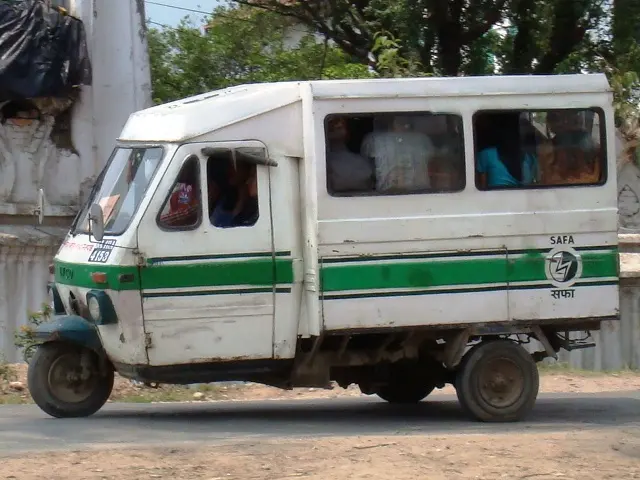
In the streets of Kathmandu, the white-and-green Safa tempos carry passengers silently, many of them on electricity from big lead–acid batteries. Many homes in Nepal keep the same kind of battery for an inverter, to run the lights when the power goes off. The lead plates inside such a battery are often hardened with a few per cent of antimony.
Antimony is an odd element. It is shiny and silvery like a metal, but it shatters like glass when you hit it, and it conducts electricity poorly. People have used its black ore for thousands of years, to paint their eyes. Here is its story.
The antimony atom
Every antimony atom has 51 protons, so antimony’s atomic number is 51, and a neutral atom has 51 electrons. The commoner kind of antimony atom has 70 neutrons, so its mass number is 51 + 70 = 121.
By the 2n² rule Grade 8: Bohr and Bury’s rule, the K, L and M shells take 2, 8 and 18 electrons; the N shell takes 18 more before a fifth shell starts; and the last 5 go into the O shell: 2, 8, 18, 18, 5.
In subshells Grade 10: The Aufbau principle, after 5s and 4d are full, three electrons go into 5p:
1s² 2s² 2p⁶ 3s² 3p⁶ 4s² 3d¹⁰ 4p⁶ 5s² 4d¹⁰ 5p³
So the outer shell holds 5s² 5p³: 5 valence electrons, like nitrogen (2s² 2p³) at the top of its group.
Its place in the periodic table
- Period 5, because its electrons are in five shells.
- Group 15, called VA in the older naming: nitrogen, phosphorus, arsenic, antimony and bismuth, the nitrogen family.
- p-block, because its last electrons go into a p subshell.
Going down group 15, the elements turn from non-metals into a metal Grade 10: Electropositivity. Nitrogen is a gas and phosphorus a non-metal solid; bismuth, at the bottom, is a metal. Arsenic and antimony, in between, are metalloids Grade 10: Metalloids: they look like metals but behave partly like non-metals.
Antimony shares three of its electrons in covalent bonds, as nitrogen does in ammonia (NH₃) Grade 9: Covalent bond, or uses all five. So its valency is 3 or 5 Grade 9: Variable valency: antimony trioxide is Sb₂O₃, antimony pentoxide Sb₂O₅, and antimony’s hydride, a poisonous gas called stibine, is SbH₃.
Antimony is a metalloid. Which description fits it?
Pick an answer to see why.
How antimony was known, found and named
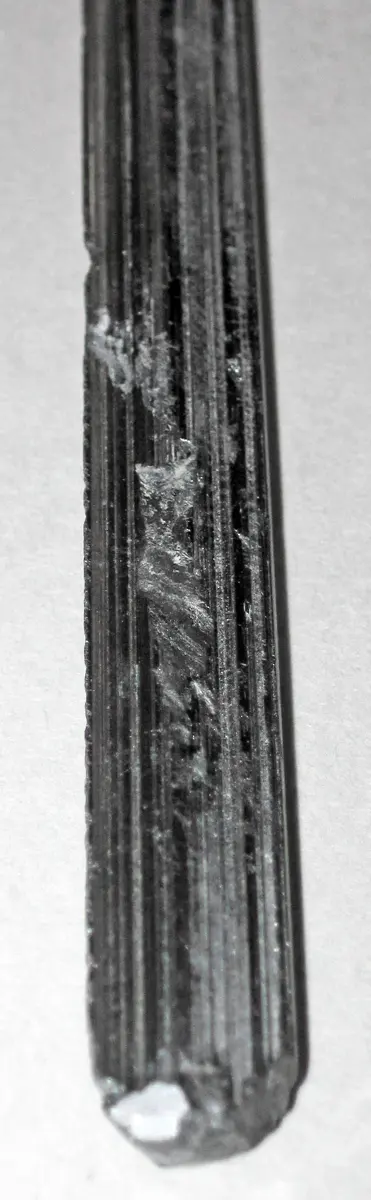
Antimony’s main ore is stibnite, antimony sulphide (Sb₂S₃): long, shiny, lead-gray crystals that crumble into a soft black powder. In the ancient Middle East and Egypt, people ground dark minerals like this into kohl, the black paint they drew around their eyes, both for beauty and in the belief that it protected the eyes. When chemists later tested what was left in ancient Egyptian kohl pots, most turned out to be galena (lead sulphide), but stibnite was used too, and it gave antimony its old Latin name.
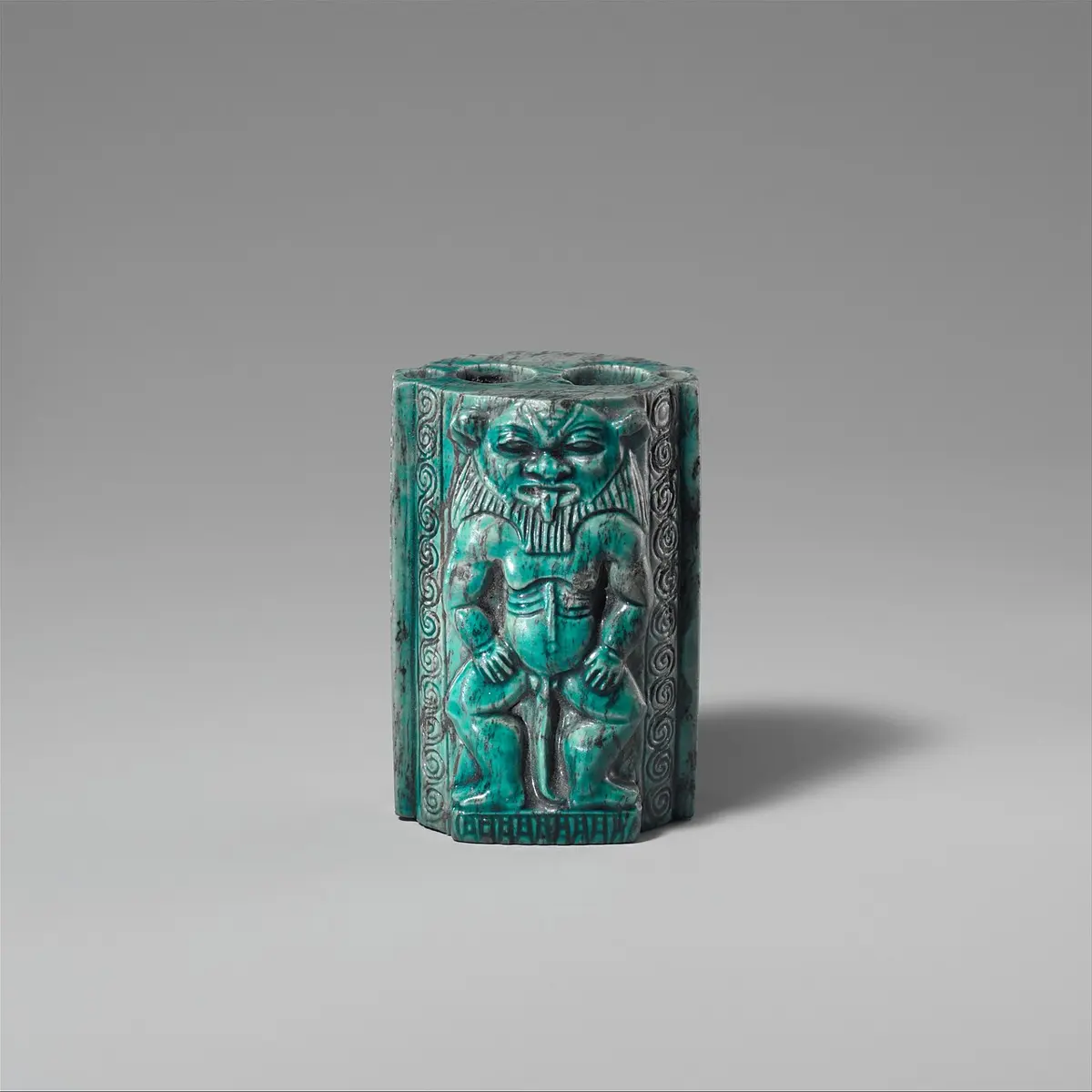
The metal itself was known very early too. A piece of metal found at Tello, in today’s Iraq, about 5,000 years old, is said to be part of a vase cast in nearly pure antimony; it is now in the Louvre museum in Paris, though some archaeologists doubt it was a vase. The first clear description of how to make the metal from its ore was written by the Italian metalworker Vannoccio Biringuccio in 1540, and the French chemist Nicolas Lémery wrote a whole book about antimony and its compounds in 1707.
The names. The Latin word for the black eye paint was stibium, which probably goes back through Greek to an ancient Egyptian word for it. In the early 1800s the Swedish chemist Berzelius took the symbol Sb from stibium. Where the name antimony comes from, nobody is sure. One old suggestion is the Greek anti-monos, “not alone”, because it is never found by itself; others trace it to an Arabic word. A popular story that it means “monk-killer”, because it poisoned monks who were alchemists, is only a joke on the word.
In South Asia the eye powder is still sold as सुर्मा (surma), which the Nepali dictionary describes as a fine blue-black mineral powder put on the eyes. The black गाजल that families put on babies’ eyes is different: it is made from soot, carbon collected over an oil lamp.
Where antimony is found
In the universe. Antimony was made in stars that slowly add neutrons to atoms, and in the violent collisions of dead stars (Heavier than iron).
In the Earth’s crust. Antimony is not common: about 0.2 grams in every tonne of rock. But it is found in more than 100 different minerals, and rarely as the pure element. Nearly all of it is mined as stibnite.
The world’s biggest antimony mine is Xikuangshan in Hunan, China. Its name means “tin mine mountain”: centuries ago, its miners took the shiny gray ore for tin. In 2024 the world mined about 100,000 tonnes of antimony, about 60% of it in China; Tajikistan and Russia came next. Because so much comes from one country, many countries call antimony a critical mineral.
In Nepal. Nepal mines no antimony; it arrives inside batteries, plastics, glass and medicines.
In your body. Only tiny traces, with no job to do.
What antimony is like
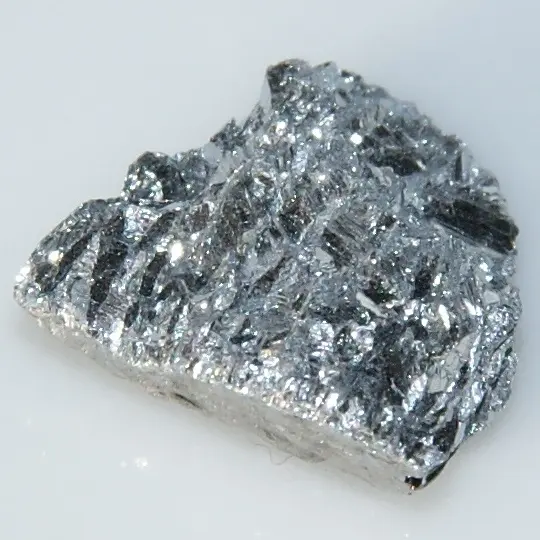
- Color. A shiny, silvery-white solid, often with a bluish tinge, and big flat crystal faces on a broken piece.
- Brittle. It cannot be hammered into sheets or drawn into wires: struck, it shatters, and it can be ground to powder. Metals are malleable and ductile; antimony is not Grade 9: Malleable.
- A poor conductor of heat and electricity, far worse than true metals.
- Melts at 631 °C, boils at 1,587 °C.
- Density 6.68 g/cm³.
- It grows as it freezes. Most metals shrink as they turn from liquid to solid. Antimony is one of the few substances, like water and bismuth, that expand slightly instead. That is the secret of its most famous alloy, below.
How antimony reacts
With air. At room temperature antimony stays bright. Heated strongly in air, it burns with a bluish-white flame and gives off white smoke of antimony trioxide:
4Sb + 3O₂ → 2Sb₂O₃
Sb₂O₃ is an amphoteric oxide: unlike the basic oxides of metals Grade 9: Metals react with oxygen, it reacts with both acids and bases, one more sign that antimony is only partly a metal.
With dilute acids. Antimony is below hydrogen in the reactivity series, so it does not give off hydrogen with dilute hydrochloric or sulphuric acid Grade 9: Metals and dilute acids.
With chlorine. Powdered antimony sprinkled into chlorine gas catches fire by itself, making antimony trichloride:
2Sb + 3Cl₂ → 2SbCl₃
A piece of antimony is dropped into dilute hydrochloric acid. What happens?
Pick an answer to see why.
Getting antimony from stibnite
Antimony is made from stibnite in two ways, both using the steps of metallurgy Grade 10: Metallurgy.
Roasting, then reduction. Stibnite is first roasted in air Grade 10: Roasting, which turns the sulphide into the oxide and drives the sulphur off as sulphur dioxide. Then the oxide is heated with carbon, which takes its oxygen away Grade 10: Reduction:
2Sb₂S₃ + 9O₂ → 2Sb₂O₃ + 6SO₂
Sb₂O₃ + 3C → 2Sb + 3CO
Pushing it out with iron. Rich stibnite can simply be melted with scrap iron. Iron joins with the sulphur more strongly than antimony does, so it takes the sulphur, and molten antimony sinks to the bottom:
Sb₂S₃ + 3Fe → 2Sb + 3FeS
The old makers of printing type did just this, throwing horseshoe nails into the pot with the stibnite.
Antimony in daily life and in Nepal
Hardening lead. Lead is soft. A few per cent of antimony makes it much harder and stronger. Such antimonial lead is used for the plates of lead–acid batteries (in vehicles, inverters and the Safa tempos), for bullets, and for the sheaths of cables. Batteries that are emptied deeply and recharged every day, like those in electric tempos and inverters, are usually made with lead–antimony plates, which stand that treatment best.
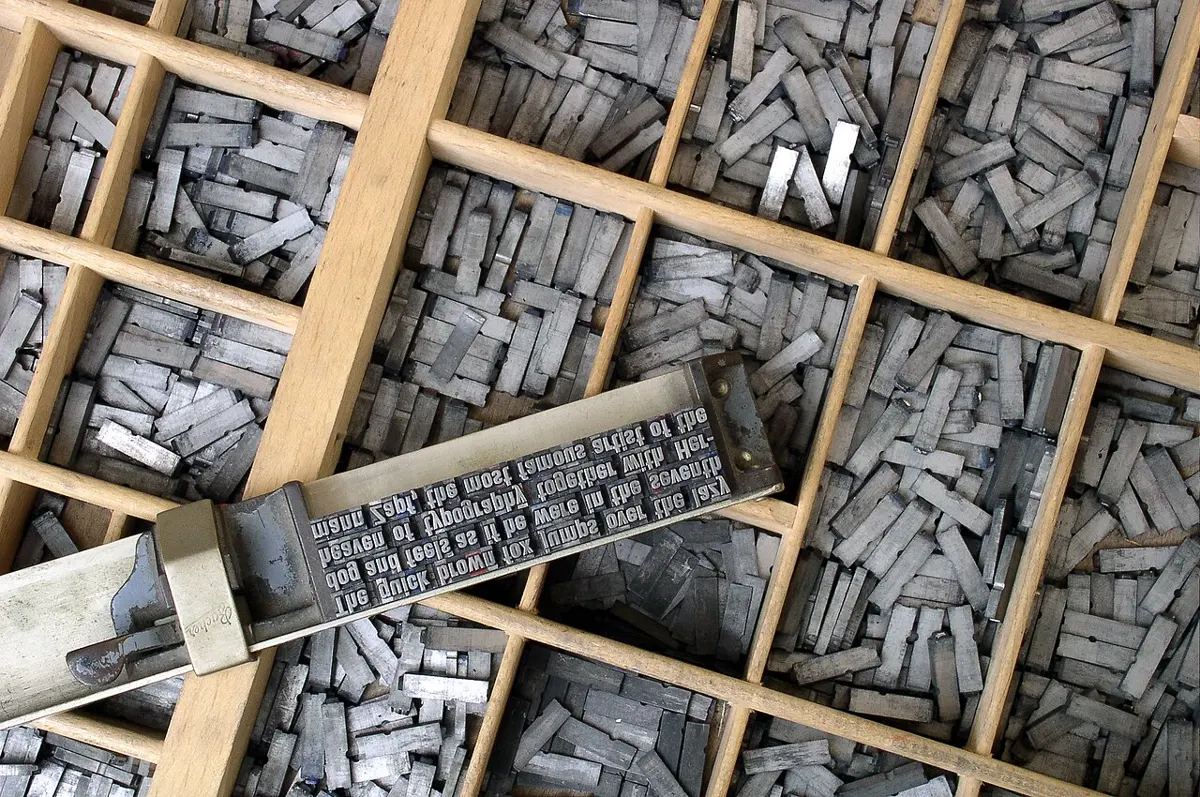
Printing type. For 500 years, from Gutenberg in the 1450s until the computer, books and newspapers were printed from letters cast in type metal: lead with about 11–30% antimony and some tin. Pure lead shrinks as it cools and sags in the mold, so its letters come out with rounded, blurred edges. Antimony, which expands as it freezes, cancels most of that shrinking, so type metal fills every corner of the mold and the letters come out sharp. It is also much harder, so they don’t wear down.
Fire-proofing. One of antimony’s two biggest uses is antimony trioxide, added together with bromine compounds to the plastics of televisions, cables and electrical goods so that they do not easily catch fire.
Other uses. Antimony compounds help make PET, the plastic of drinking bottles; they clear tiny bubbles out of glass, such as the glass of screens and solar panels; and indium antimonide detects infrared light in heat cameras (Indium). The heads of many safety matches also contain antimony sulphide.
Antimony against kala-azar
Kala-azar (कालाजार, “black fever”) is a disease spread by the bite of tiny sandflies. A parasite settles in the liver and spleen, causing long fevers, a swollen belly and weight loss, and without treatment it usually kills. It has long been found in the southern plains of India, Bangladesh and Nepal, including the Terai.
Isotopes of antimony
Natural antimony is a mixture of two stable isotopes Grade 9: Atomic mass: about 57% antimony-121 (70 neutrons) and 43% antimony-123 (72 neutrons). With two isotopes in nearly equal amounts, the atomic mass ends up between them.
Antimony and your health
Antimony has no use in the body. Its compounds are poisonous, in much the same way as arsenic’s, its neighbor in group 15, though less strongly. Swallowed, they cause vomiting; breathed in as dust for years, they harm the lungs. That is why medicines made with antimony were given only by doctors, in measured doses.
You meet only tiny amounts in daily life. A little antimony can pass from PET bottles into drinks, more in bottles left in the sun for a long time, but tests find it far below safety limits.
Surprising facts and records
- Explosive antimony. A strange form of antimony, made by passing electricity through antimony trichloride, is a dark, glassy solid. Scratch it and it suddenly turns into ordinary antimony with a bang and a puff of hot smoke.
- The everlasting pill. In the Middle Ages, people swallowed small balls of antimony as a laxative. They passed through the body unchanged, so they were collected and used again; it is said some were handed down in families.
In your science books
- Grade 8: the 2n² rule, groups and periods and alloys.
- Grade 9: metals, non-metals and metalloids, properties of metals, variable valency, atomic mass and harmful effects of lead.
- Grade 10: electronic configuration, metalloids, roasting and reduction.
- Going further: where the atoms in your body came from.
More to explore
- Nobel Prizes with antimony in them: superacids (1994, made with antimony pentafluoride, SbF₅).
- Neighbors: arsenic above it in group 15, tin and lead, which it hardens.
- Play: find antimony in Guess the Element and the Periodic Table Jigsaw.
- Read more: antimony at the Royal Society of Chemistry and at PubChem.