
- Atomic number
- 69
- Atomic mass
- 168.93
- Shells
- 2, 8, 18, 31, 8, 2
- Configuration
- 1s² 2s² 2p⁶ 3s² 3p⁶ 4s² 3d¹⁰ 4p⁶ 5s² 4d¹⁰ 5p⁶ 6s² 4f¹³
- In the table
- period 6, group none (f-block), f-block
- Kind
- Lanthanide
- Valency
- 3 (Tm³⁺), sometimes 2
- State at 25 °C
- solid
- Melts · boils
- 1,545 °C · 1,950 °C
- Density
- 9.3 × as heavy as water
- Known since
- 1879
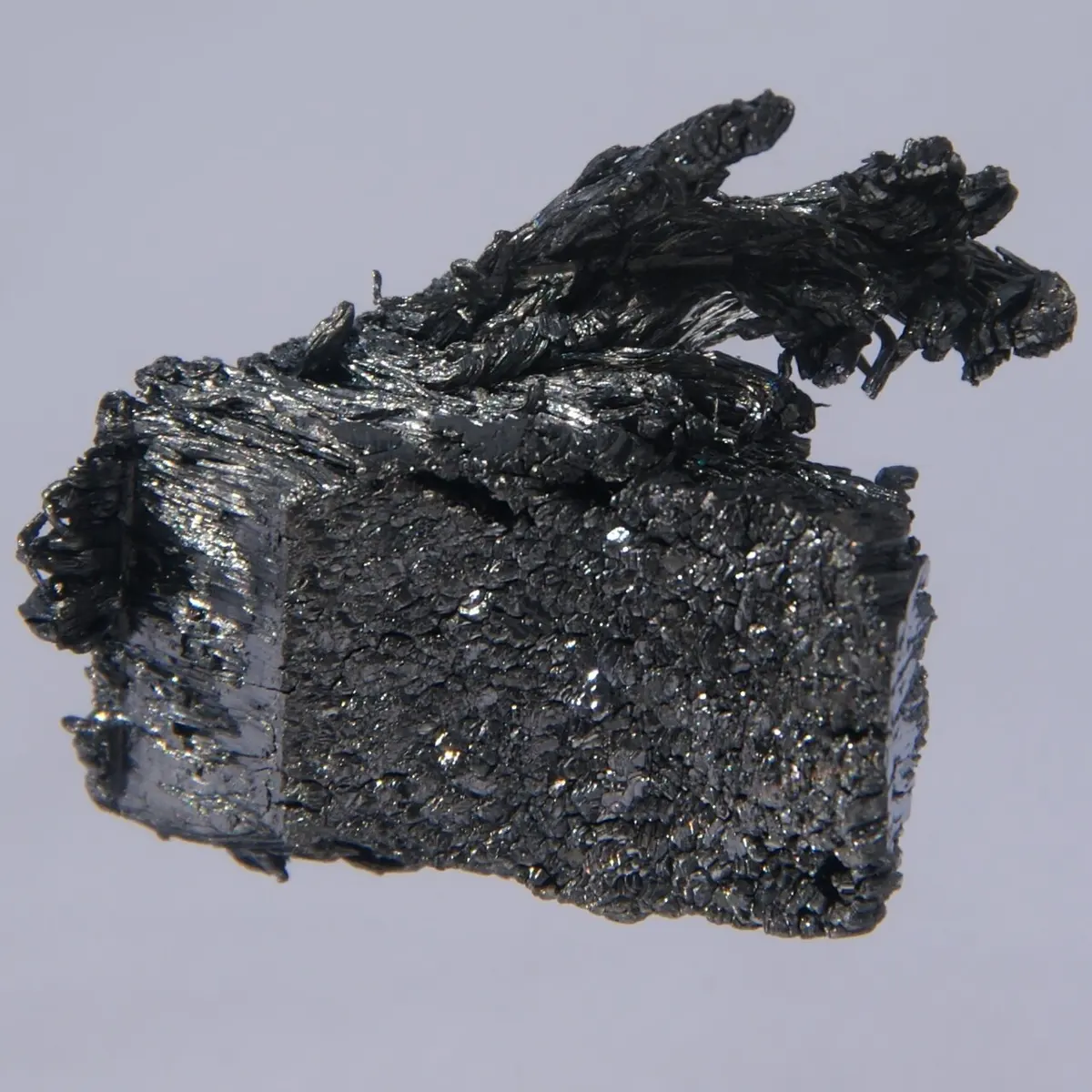
Picture an X-ray machine with no plug, no battery and no switch: a small lead pot with a grain of metal inside, which you can carry to a pipeline in the mountains to check its welds. The grain is thulium (say THOO-lee-um) that has spent some weeks inside a nuclear reactor. Thulium is the thirteenth lanthanide, and after radioactive promethium it is the rarest of them all.
The thulium atom
A thulium atom has 69 protons and 69 electrons. Natural thulium has only one isotope, thulium-169, with 100 neutrons: 69 + 100 = 169.
By shells its electrons are 2, 8, 18, 31, 8, 2 (Bohr and Bury’s 2n² rule). The fourth shell, N, can hold 2 × 4² = 32, so it is one short of full. In subshells thulium ends 6s² 4f¹³: one electron short of a full 4f Grade 10: The Aufbau principle.
Its place and valency
- Period 6, the thirteenth lanthanide (f-block), between erbium (68) and ytterbium (70) (fifteen near-twins).
- Like the other lanthanides, it loses three electrons and becomes Tm³⁺, with a valency of 3: thulium oxide is Tm₂O₃ and thulium chloride TmCl₃. In a few solid compounds it has a valency of 2.
Most elements have atomic masses far from a whole number (chlorine 35.45, copper 63.55). Thulium’s is 168.93, very close to 169. Why?
Pick an answer to see why.
How thulium was found and named
Thulium comes out of the same black rock from the quarry at Ytterby, in Sweden, as yttrium, erbium and several more elements (erbium’s story). In 1879 the Swedish chemist Per Teodor Cleve, at Uppsala, noticed that erbia, the oxide of erbium, weighed slightly differently depending on where it came from. It had to be a mixture. He split it into erbia itself and two new oxides: a brown one, holmia (see holmium), and a green one, which he called thulia.
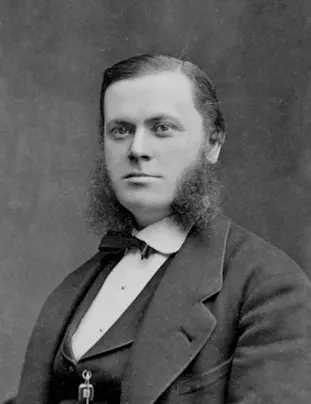
He named it after Thule, the name that ancient Greek and Roman writers gave to a land far in the north, at the very edge of the known world. Cleve took it to mean Scandinavia. Its symbol is Tm.
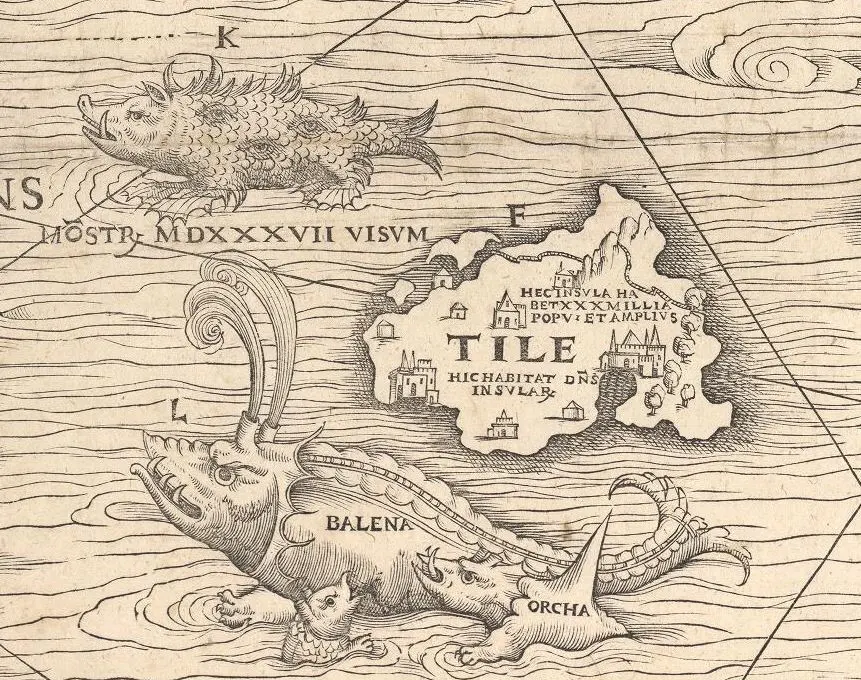
Thulium was so scarce that nobody had a pure sample for over thirty years. In 1911 the chemist Charles James, in the USA, finally purified it by dissolving and crystallizing one of its salts again and again, about 15,000 times.
Where thulium is found
In the universe, thulium is made in stars by catching neutrons (Catching neutrons).
In the Earth’s crust there is only about half a gram in a tonne of rock. It is mined with the other rare earths from minerals such as monazite, and from clays in southern China, which supplies most of the world’s thulium.
In Nepal and in your body. Nepal mines no rare earths. Your body has no use for thulium.
What thulium is like and how it reacts
- A bright, silvery-gray metal, soft enough to cut with a knife, and easy to hammer or draw into wire Grade 9: Properties of metals.
- In air it tarnishes slowly. Heated in air, it burns to the oxide: 4Tm + 3O₂ → 2Tm₂O₃.
- With water, slowly when cold and quickly when hot, giving thulium hydroxide and hydrogen:
2Tm + 6H₂O → 2Tm(OH)₃ + 3H₂ - With dilute acids, readily, giving hydrogen and a pale green solution of Tm³⁺.
How many electrons does a Tm³⁺ ion have?
Pick an answer to see why.
An X-ray source with no electricity
Thulium’s best-known use starts in a nuclear reactor. A small piece of thulium-169 is placed among the reactor’s neutrons, and some of its atoms catch one, becoming thulium-170 (69 protons, 101 neutrons). Thulium-170 is radioactive Grade 9: Radioactive elements. As it decays into ytterbium-170, it gives out X-rays and weak gamma rays Grade 9: X-rays.
Put a pellet of it in a small lead pot with one opening, and you have an X-ray source that needs no electricity. It is used in industrial radiography: the rays are aimed through a weld in a pipe, a tank or a machine part, onto a sheet of film. Where there is a hidden crack or bubble in the metal, the rays meet less steel, more of them reach the film, and the flaw shows up dark Grade 9: X-ray imaging. Its rays are fairly weak, so a small lead pot is enough to keep them in when it is not in use.
Thulium lasers
A crystal or a glass fiber with a little thulium in it makes a laser whose invisible infrared light has a wavelength of about 2,000 nm Grade 9: Infrared rays. Water soaks up light of this wavelength very strongly. Our bodies are mostly water, so the light’s energy stays in a very thin layer of tissue, and surgeons use thulium lasers to cut and remove soft tissue precisely. Its neighbor holmium makes a laser with a similar wavelength.
Thulium and your health
Thulium has no known job in the body and is of low toxicity. As a fine powder the metal can catch fire. Its radioactive form, thulium-170, is handled only by trained workers.
In your science books
- Grade 8: Bohr and Bury’s 2n² rule.
- Grade 9: atomic mass, radioactive elements, the properties of metals, X-rays and infrared rays.
- Grade 10: the Aufbau principle and the lanthanides.
- Going further: where thulium is made and what happens when a nucleus decays.
More to explore
- Its neighbors: erbium before it, with the story of the earth it came from; ytterbium after it, which thulium-170 turns into; holmium, found by Cleve in the same year; lanthanum, with the story of the whole row.
- Play: find thulium in Guess the Element, the Periodic Table Jigsaw and Higher or Lower.
- Read more: thulium at the Royal Society of Chemistry and at PubChem.