
Rutherfordium: first after the actinides
Element 104: Rutherfordium, the full story
- Atomic number
- 104
- Atomic mass
- 267.12
- Shells
- 2, 8, 18, 32, 32, 10, 2
- Configuration
- 1s² 2s² 2p⁶ 3s² 3p⁶ 4s² 3d¹⁰ 4p⁶ 5s² 4d¹⁰ 5p⁶ 6s² 4f¹⁴ 5d¹⁰ 6p⁶ 7s² 5f¹⁴ 6d²
- In the table
- period 7, group 4 (IVB), d-block
- Kind
- Transition metal
- Valency
- 4 (Rf⁴⁺, as in RfCl₄)
- State at 25 °C
- solid
- Melts · boils
- not known · not known
- Known since
- 1969
After lawrencium, the actinide row is finished. Element 104, rutherfordium, goes back into the main body of the periodic table, under hafnium. Is it really like hafnium? To find out, chemists had to test the chemistry of an element they could make only a few atoms at a time, each lasting seconds or minutes. They did, and the periodic table was right.
The rutherfordium atom
A rutherfordium atom has 104 protons (atomic number 104) and 104 electrons. Its longest-lasting known kind, rutherfordium-267, has 267 − 104 = 163 neutrons. By shells, the electrons are 2, 8, 18, 32, 32, 10, 2, and in subshells Grade 10: The Aufbau principle:
… 6p⁶ 7s² 5f¹⁴ 6d²
The 5f subshell is already full, so the new electrons go into 6d. That makes rutherfordium a d-block element, a transition metal: the first of period 7’s transition metals in the main table, in group 4, under titanium, zirconium and hafnium Grade 10: Features of the modern periodic table. Like them it has four electrons outside the full subshells (two 7s and two 6d), and is expected to give all four away: valency 4, as in RfCl₄.
Hafnium’s chloride is HfCl₄. What would you expect rutherfordium’s chloride to be?
Pick an answer to see why.
Two teams, two names
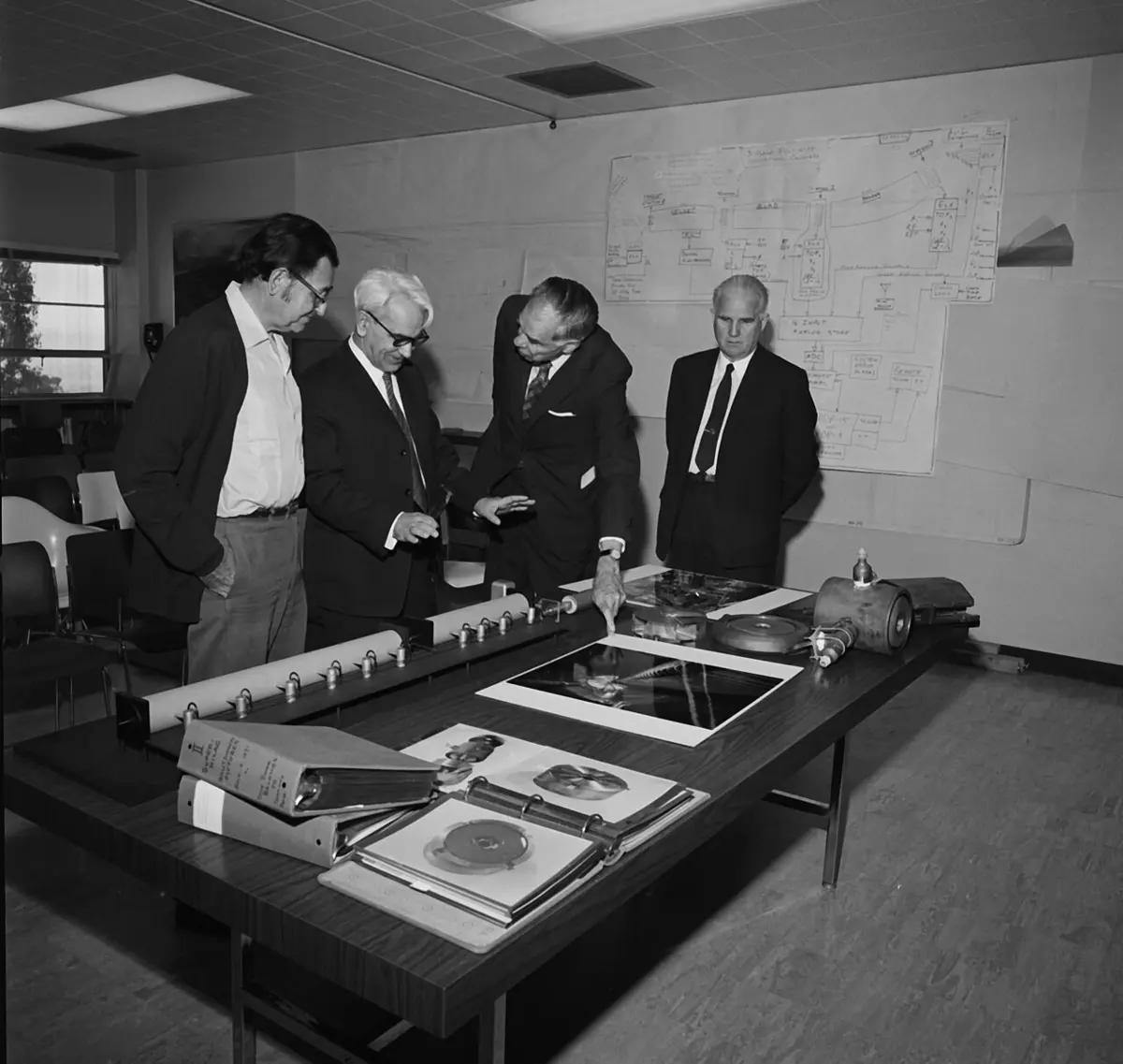
1964. At Dubna, near Moscow in the Soviet Union, Georgy Flerov’s team fired neon nuclei (10 protons) at plutonium (94): 94 + 10 = 104. They reported atoms that split in two with a half-life of about 0.3 seconds. In later experiments they turned the products into chlorides and found one that traveled through a hot tube more easily than the actinides’ chlorides, as element 104’s should. They proposed the name kurchatovium, after Igor Kurchatov, who had led the Soviet Union’s nuclear research.
1969. At Berkeley, California, Albert Ghiorso’s team fired carbon nuclei (6) at californium (98): 98 + 6 = 104. They identified rutherfordium-257 by the alpha particles it gives out and by the nobelium it turns into. They could not find the 0.3-second atoms, and later work showed that no kind of element 104 has that half-life. They proposed rutherfordium, after Ernest Rutherford.
For over twenty years, books in the Soviet Union and in the West used different names. While the question was open, element 104 also had a stand-in name built from its digits, unnilquadium (un-nil-quad: 1-0-4).
1992. A working group of IUPAC and IUPAP studied both claims and decided that the two teams should share the credit. The Berkeley team disagreed strongly with how the Dubna work had been judged; the working group kept its conclusion.
1997. After one more round of proposals, IUPAC settled the names of elements 104 to 109. Element 104 became rutherfordium, symbol Rf, and element 105 was named dubnium, after Dubna.
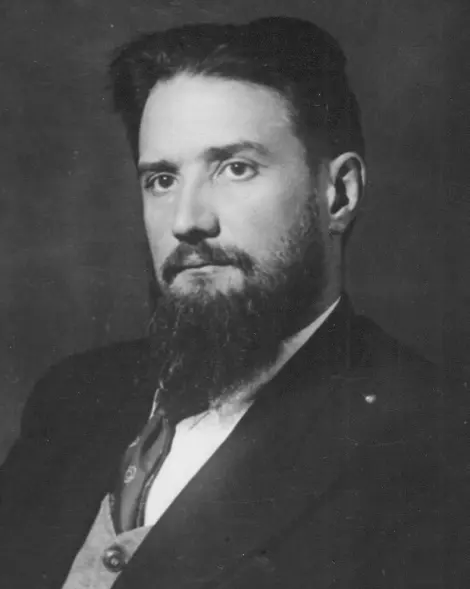
Who was Ernest Rutherford?
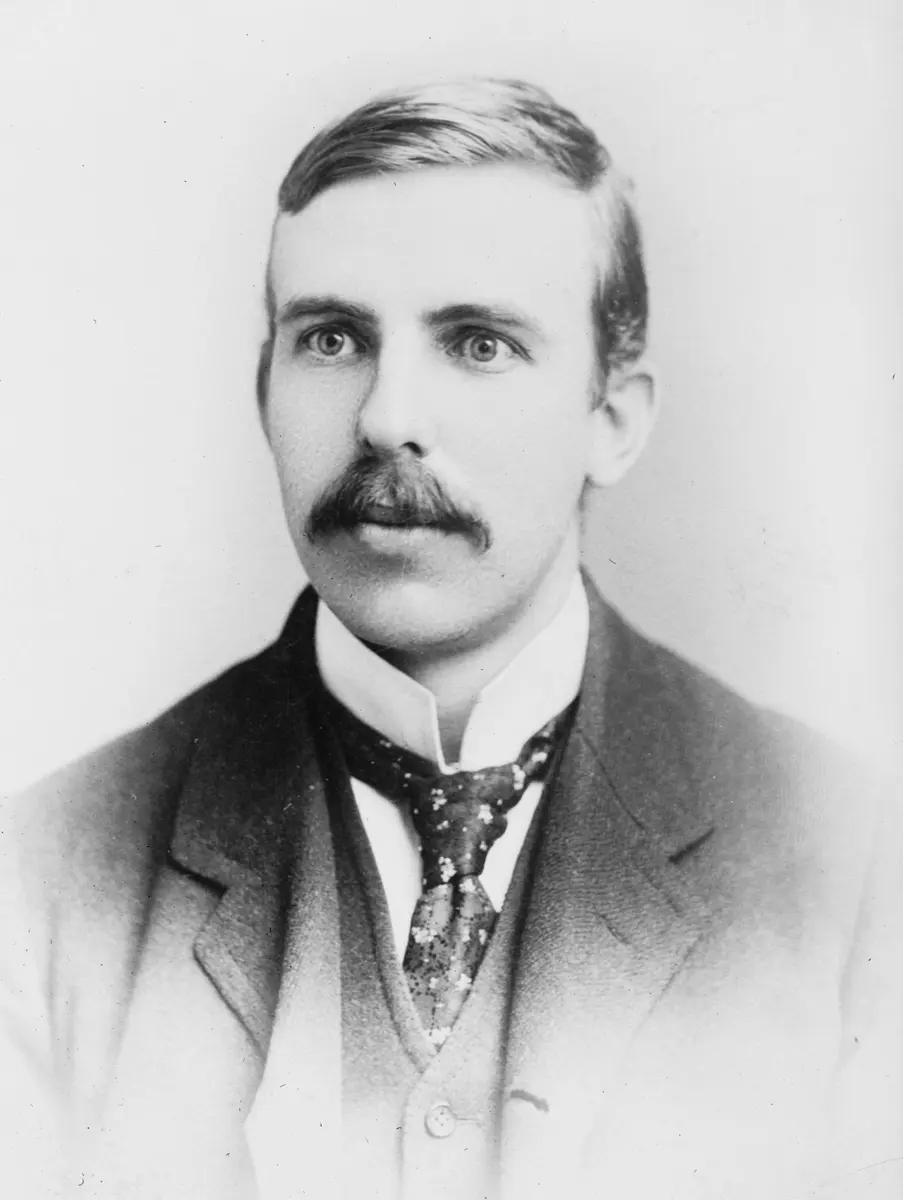
Ernest Rutherford (1871–1937) was born in New Zealand and worked in Canada and England. He found that radioactive elements turn, by themselves, into other elements, and won the 1908 Nobel Prize in Chemistry for it (Rutherford’s prize). In 1911, from the gold foil experiment in his laboratory, he worked out that every atom has a tiny, heavy, positive nucleus at its center Grade 9: Structure of an atom. Every element after uranium is made by changing nuclei, so an element named after him is a fitting one.
Chemistry with single atoms
Rutherfordium is made a few atoms at a time, for example from carbon and californium, or oxygen and curium. Its longest-lasting known kind, rutherfordium-267, has been seen only a few times, at the end of the decay of much heavier elements; its half-life seems to be about an hour (one recent estimate is 48 minutes), but so few atoms have been seen that this is not certain. Chemists use rutherfordium-261, which lasts about a minute but can be made more often.
In that minute, each atom must be caught, carried away by a stream of gas, made to react, and detected when it decays. Repeated many times, such experiments have shown:
- Rutherfordium forms a chloride, RfCl₄, and a bromide, which pass through a hot tube as vapors, like the chlorides and bromides of zirconium and hafnium, and much more easily than the actinides’.
- In acid solutions, teams in Japan and elsewhere found that it behaves like zirconium and hafnium, and not like the actinides.
So rutherfordium really does belong in group 4, as the periodic table predicted.
What is only predicted: that it is a solid, heavy metal (about 17 g/cm³, but this is a calculation), and its melting and boiling points; the facts card leaves them out because none has been measured.
The body has no use for rutherfordium, and so few atoms have ever existed that no one meets it outside a laboratory.
In your science books
- Grade 9: the structure of an atom, variable valency and radioactive elements.
- Grade 10: features of the modern periodic table, the Aufbau principle and valency.
- Going further: alpha decay, where Rutherford and Soddy find that elements change into others, and half-life.
More to explore
- Nobel Prizes: Rutherford’s prize (1908), the full story, and Lawrence’s prize (1939) for the cyclotron.
- Its neighbors: lawrencium, the last actinide, and hafnium and zirconium, above it in group 4.
- Play: find rutherfordium in Guess the Element and the Periodic Table Jigsaw.
- Read more: rutherfordium at the Royal Society of Chemistry and at PubChem.