
- Atomic number
- 33
- Atomic mass
- 74.92
- Shells
- 2, 8, 18, 5
- Configuration
- 1s² 2s² 2p⁶ 3s² 3p⁶ 4s² 3d¹⁰ 4p³
- In the table
- period 4, group 15 (VA), p-block
- Kind
- Metalloid
- Valency
- 3 and 5 (As₂O₃, As₂O₅); 3 in arsine, AsH₃
- State at 25 °C
- solid
- Turns to gas
- 615 °C, never melts
- Density
- 5.8 × as heavy as water
- Known since
- ancient times
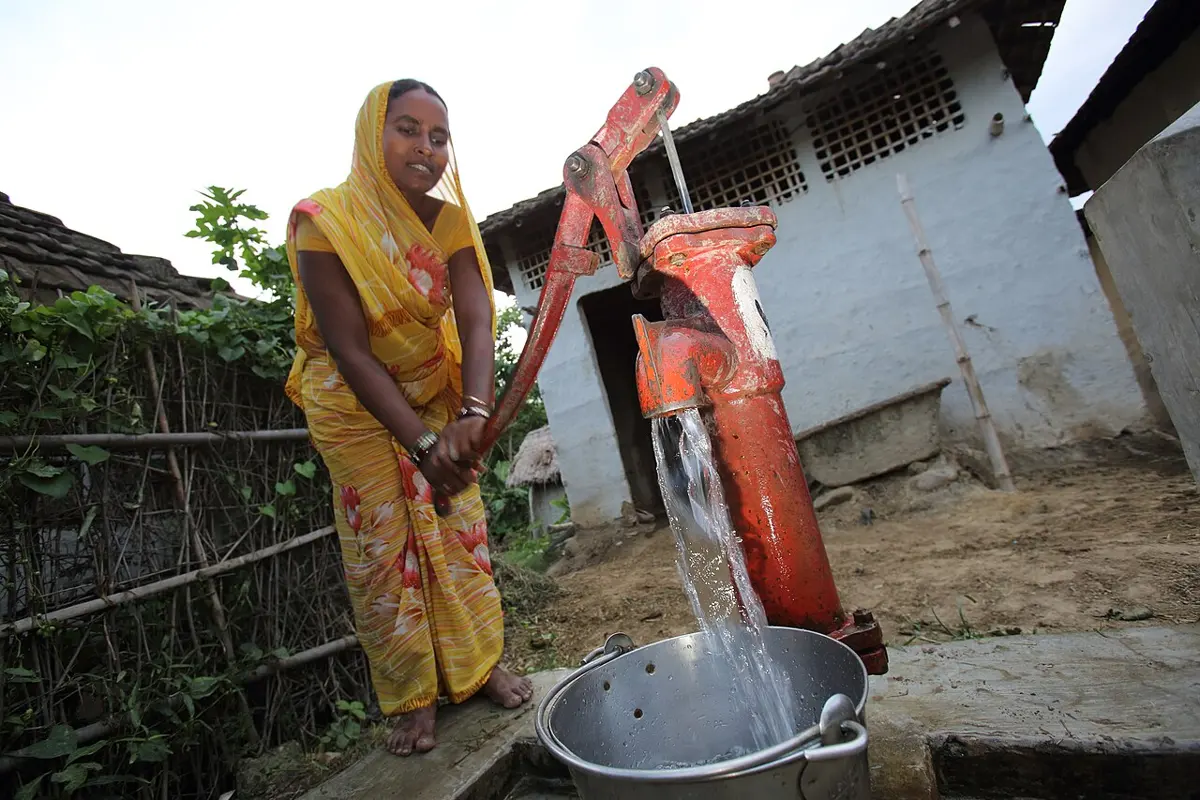
In many villages of the Terai, people drink water pumped by hand from a tube well. It comes from deep underground, so it looks clean and is free of the germs in a river or pond. But in some wells it carries something you cannot see, smell or taste: arsenic, an element famous for centuries as a poison. Drunk for years, even a little of it makes people ill.
Arsenic has another side too. A pinch of it, joined to gallium, makes the chips that send your phone’s signal and the bright red lights on a charger. Here is its story.
The arsenic atom
Every arsenic atom has 33 protons, so arsenic’s atomic number is 33, and a neutral atom has 33 electrons. All natural arsenic is one isotope, with 42 neutrons: mass number 33 + 42 = 75.
Its shells and subshells
By the 2n² rule Grade 8: Bohr and Bury’s rule, the shells fill as 2, 8, 18, leaving 5 electrons for the N shell: 2, 8, 18, 5.
In subshells Grade 10: The Aufbau principle, after 4s and 3d are full, the last three electrons go into 4p:
1s² 2s² 2p⁶ 3s² 3p⁶ 4s² 3d¹⁰ 4p³
The N shell holds 4s² 4p³: 5 valence electrons, just like nitrogen (2s² 2p³) and phosphorus (3s² 3p³) above it.
Its place in the periodic table
- Period 4, because its electrons are in four shells.
- Group 15, called VA in the older naming: nitrogen, phosphorus, arsenic, antimony and bismuth, the nitrogen family.
- p-block, because its last electrons go into a p subshell.
Down group 15 the elements change from non-metals (nitrogen, phosphorus) to a metal (bismuth). Arsenic, in between, is a metalloid Grade 10: Metalloids: it looks like a metal, but it is brittle and conducts electricity only a little.
To fill its outer shell, arsenic would need three more electrons, so it usually shares three in covalent bonds Grade 9: Covalent bond, as nitrogen does in ammonia (NH₃) and arsenic does in arsine (AsH₃), a deadly gas. Its valency is 3 or 5 Grade 9: Variable valency: arsenic trioxide is As₂O₃ and arsenic pentoxide is As₂O₅.
Which pair of elements has the same number of valence electrons as arsenic?
Pick an answer to see why.
How arsenic was known, found and named
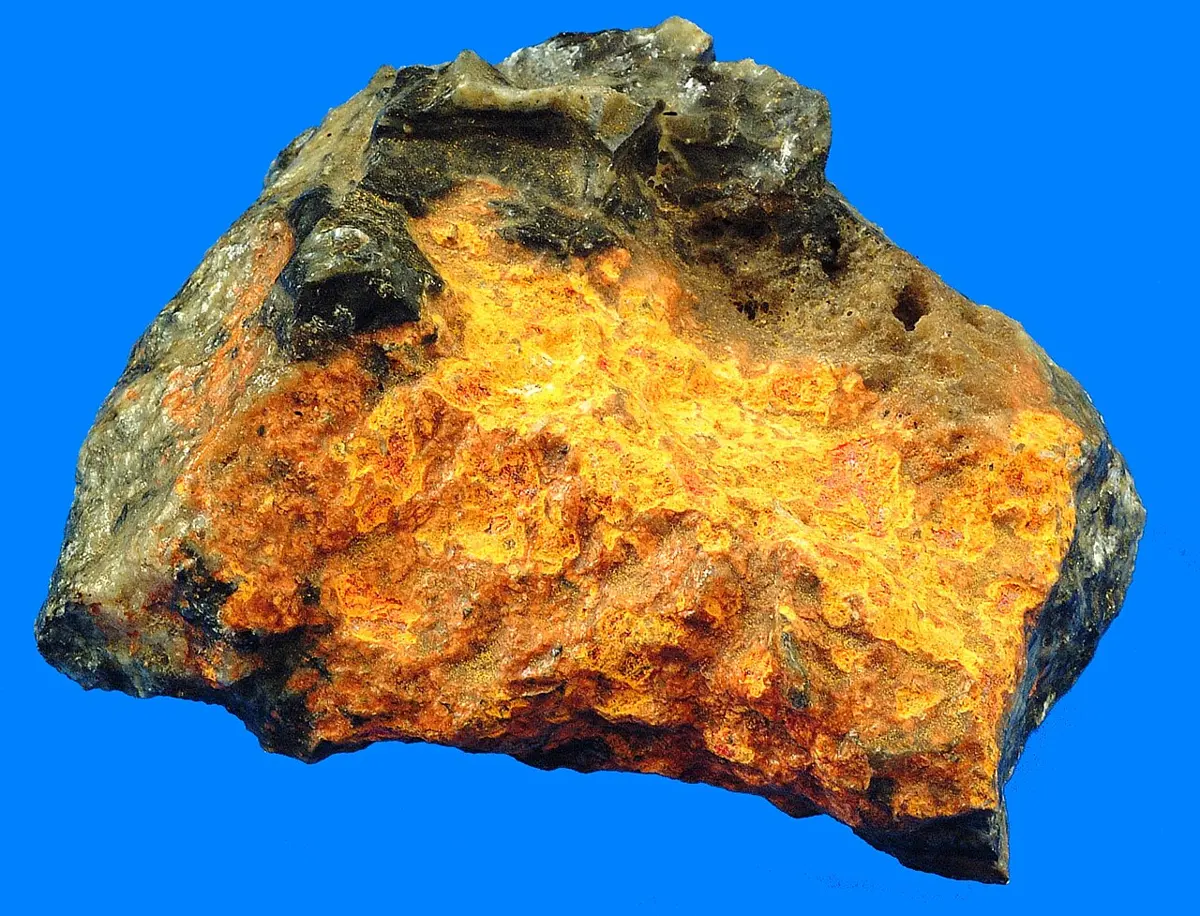
Arsenic’s colorful compounds were known long before the element. Two minerals of arsenic and sulphur stand out: golden-yellow orpiment (As₂S₃), called हरिताल in Nepali, and orange-red realgar (As₄S₄), मनःशिला in Sanskrit. For thousands of years painters ground them into yellow and orange paints, and healers used them as medicines.
Arsenic and the first bronze. The first “bronze” made in many places, over 5,000 years ago, was copper with a little arsenic, not tin. Arsenic hardens copper, and ores that held both gave it by chance. Smelting them released poisonous arsenic fumes, and the copper page’s Ötzi, the Iceman, had a lot of arsenic in his hair (Copper).
The element itself is usually said to have been first made in about 1250, by the German scholar Albertus Magnus, who heated orpiment with soap.
The name. The Persian word for orpiment was zarnikh, from zar, gold, for its color. The Greeks turned it into arsenikon, which sounded to them like their word for “strong” or “male”. From that come “arsenic” and the symbol As. In Nepali the element is simply आर्सेनिक.
Where arsenic is found
In the universe. Arsenic was made inside aging giant stars, as lighter atoms slowly caught neutrons, and in exploding stars (Slowly, in giant stars).
In the Earth’s crust. Arsenic is scarce, about 2 grams in every tonne of rock. Its commonest mineral is arsenopyrite (FeAsS), and it is often found in the ores of copper, gold and lead. Nobody mines arsenic for itself: it collects as a white dust, arsenic trioxide, in the chimneys of copper and gold smelters. In 2025 the world produced about 61,000 tonnes of arsenic trioxide, almost all of it in Peru, China and Morocco (USGS, 2026).
In Nepal. Arsenic is not produced in Nepal. But it is in the ground under the Terai, and that matters to millions of people (below).
What arsenic is like
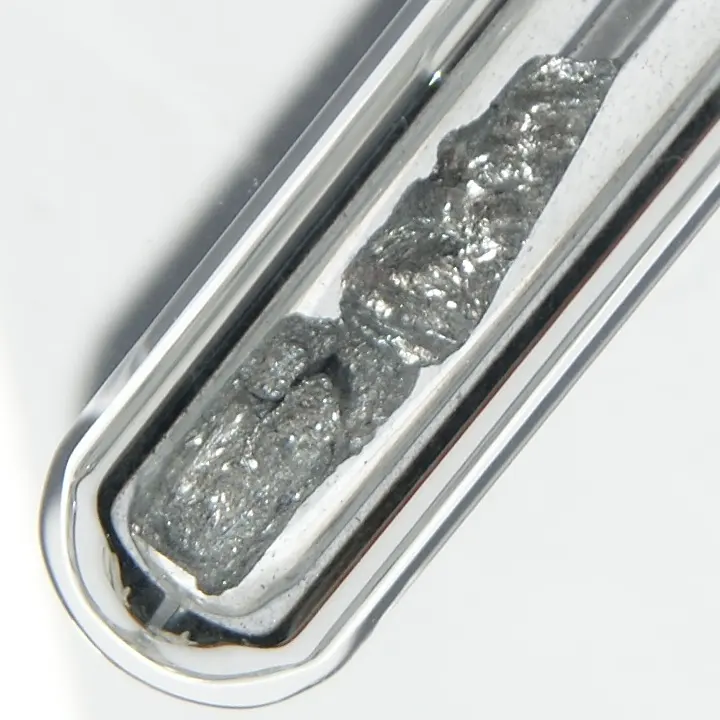
- Gray arsenic, the common form, is steel-gray and shiny, like a metal, but brittle: it crumbles under a hammer.
- Density about 5.7 g/cm³.
- It doesn’t melt. Heated in air at ordinary pressure, it turns straight from a solid into a gas at about 615 °C. This is called sublimation, the change you may have seen with camphor or naphthalene balls. Only under high pressure does arsenic melt, at 817 °C.
- Yellow arsenic, made by cooling arsenic vapor quickly, is soft and waxy, like white phosphorus, and changes back to gray arsenic in light.
- It conducts electricity, but not well: as a metalloid, it sits between the metals and the non-metals.
Arsenic is heated in an open dish to 650 °C. What will you see?
Pick an answer to see why.
How arsenic reacts
- Air. Arsenic slowly tarnishes in moist air. Heated in air, it burns with a bluish flame and gives off white fumes of arsenic trioxide, with a smell like garlic:
4As + 3O₂ → 2As₂O₃
- Water and acids. Arsenic does not react with water or with dilute hydrochloric acid. Hot concentrated nitric acid turns it into arsenic acid, H₃AsO₄.
- Metals. Like phosphorus and sulphur, it combines with many metals. With gallium it forms gallium arsenide (GaAs), a semiconductor.
Arsenic trioxide, As₂O₃, is the white powder called “white arsenic”. It dissolves a little in water, and has almost no taste or smell. That made it the favorite poison of murderers for centuries, until chemists learned to find it.
Arsenic in the water of the Terai
Arsenic is in groundwater in more than 70 countries, and is at its worst in the great river plains of South Asia: Bangladesh and West Bengal, Bihar and the Terai of Nepal. The World Health Organization (WHO) estimates that about 140 million people around the world have been drinking water with too much arsenic.
Nobody put this arsenic there. It came down from the Himalaya. For thousands of years rivers have carried sand and silt down to the plains. Each grain of sand has a thin rusty coating of iron oxide, and a little arsenic is stuck to it. Under the ground, buried plant remains feed microbes, which use up all the oxygen in the water. Then they dissolve the rusty coating, and its arsenic goes into the water.
Nepal found the problem in 1999, when water from tube wells in the Terai was first tested for arsenic. Between about 2003 and 2008, the government and its partners tested more than a million tube wells in 20 Terai districts. Most were safe, but roughly 2 in every 100 had more arsenic than Nepal’s limit of 50 micrograms per liter (a microgram is a millionth of a gram). Many more were above the stricter limit of 10 that the WHO recommends. Nawalparasi was among the worst areas. (In Bangladesh, where the problem is far bigger, unsafe wells were painted red and safe ones green.)
How to make the water safe
Arsenic cannot be boiled away: boiling drives off some water and leaves the arsenic more concentrated. Instead there are three ways:
- Use another source: a well that has tested safe, often a deeper one, rainwater, or a piped supply.
- Remove it with iron. Around 2002 Nepal’s Environment and Public Health Organization (ENPHO) and the Massachusetts Institute of Technology (MIT), in the USA, developed the Kanchan filter (कञ्चन, “pure”). Water poured into it flows over a layer of iron nails. The nails rust, and the rust grabs the arsenic, Bunsen’s antidote again. The rust flakes, with their arsenic, are then caught in a bed of sand. Tens of thousands of homes in the Terai have used one.
- Test again. A well’s arsenic can change over the years, so wells need testing from time to time.
A family’s tube well has too much arsenic. What should they do with its water before drinking it?
Pick an answer to see why.
Arsenic in daily life
In the past, poisons for pests. For a hundred years, arsenic compounds were sprayed on crops against insects and used to kill rats. Most countries have now banned them, because they poison people and soils too.
Wood that lasts. Chromated copper arsenate (CCA) is soaked into wooden poles and posts to stop insects and fungi from eating them. In the USA, more than 80% of the arsenic used still goes into wood preservatives and pesticides (USGS, 2026).
Harder lead. A little arsenic hardens lead, in the plates of car batteries and in lead shot.
Glass. Arsenic trioxide is added to some glass to clear it of bubbles.
Chips and lights. Very pure arsenic (99.9999%) joined with gallium gives gallium arsenide, a semiconductor whose electrons move faster than in silicon. It is used in:
- the chips that amplify your phone’s radio signal to the mobile tower;
- red and infrared LEDs and lasers, like those in TV remote controls;
- the best solar cells, on satellites.
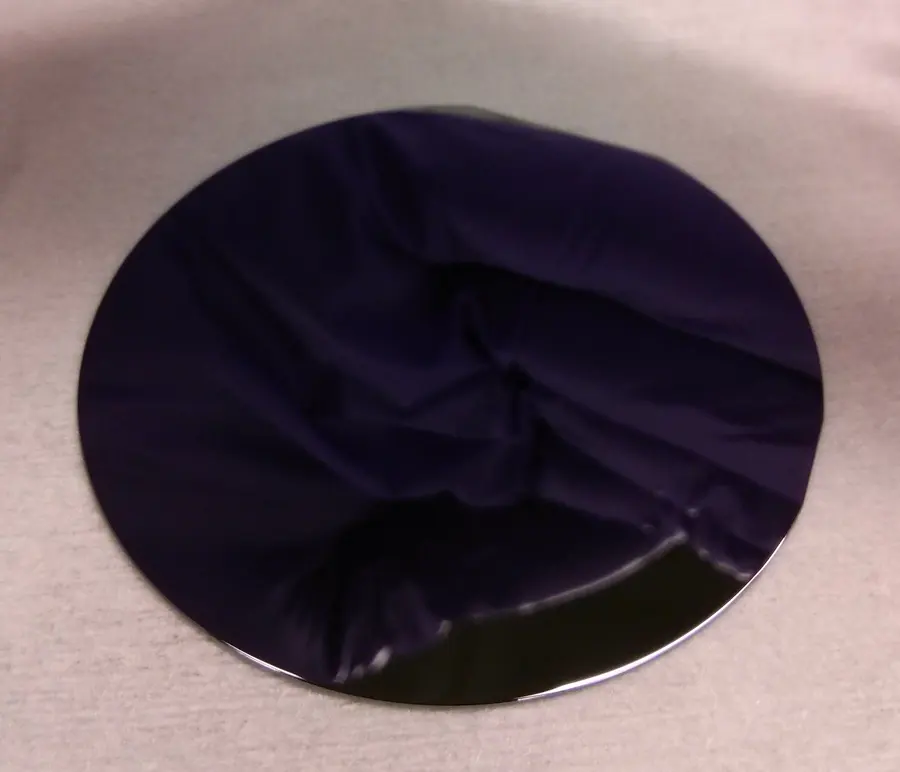
The first tiny semiconductor lasers were made of gallium arsenide in 1962, and layering it with other semiconductors won the Nobel Prize in Physics in 2000.
Medicine. Arsenic compounds were medicines for centuries, often doing more harm than good. But in 1910 the German doctor Paul Ehrlich made Salvarsan, an arsenic compound that cured syphilis: the first modern medicine designed to kill one germ inside the body. And today a carefully measured dose of arsenic trioxide cures most patients with one rare kind of blood cancer, acute promyelocytic leukemia.
Yellow paper that insects won’t eat
Many old manuscripts in Nepal were written on lokta paper, made from the bark of a Himalayan shrub. Some pages are bright yellow: the paper was coated with orpiment, हरिताल, to keep insects away, since the arsenic in it poisons them. If you ever handle a yellow page, do it gently, and wash your hands afterwards.
Arsenic and your health
Arsenic is not needed by the body. Its danger depends on its form:
- Inorganic arsenic, as in groundwater and in white arsenic, is the dangerous form. A large dose causes vomiting, stomach pain and diarrhea, and can kill.
- Organic arsenic compounds in fish and prawns pass through the body and are far less harmful.
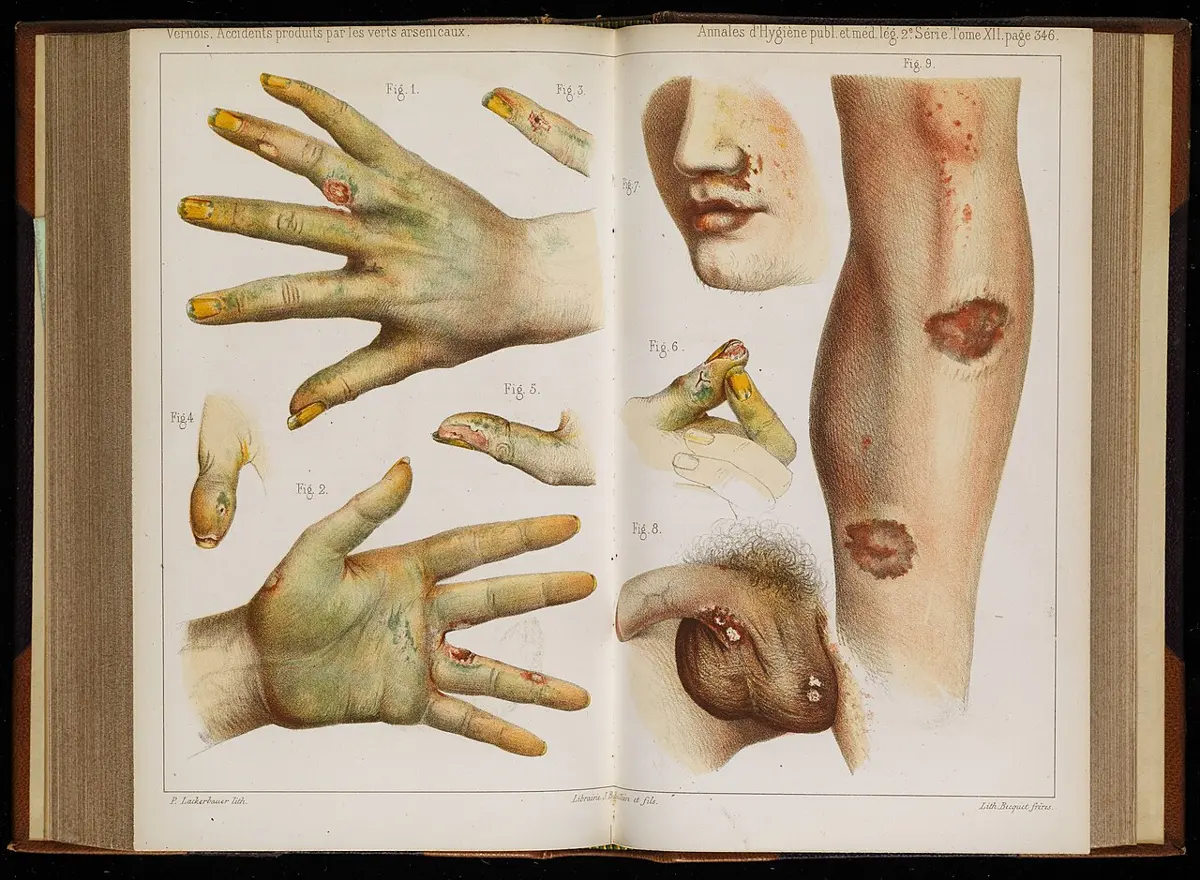
The real problem is a small dose taken every day for years. According to the WHO, the first signs, usually after about five years, are on the skin: dark and pale spots, and hard patches on the palms and the soles of the feet. Later it can cause cancers of the skin, bladder and lungs, and heart disease. Children who drink it can learn less well. Arsenic also builds up in hair and nails, so doctors test them to see who has been exposed.
Rice soaks up more arsenic from its soil and water than most crops. Cooking rice in plenty of water and pouring off the extra (माड) removes part of it.
Surprising facts and records
- A single isotope. All natural arsenic is arsenic-75. That is why its atomic mass, 74.92, is so close to a whole number.
- The smell of garlic. Strike an arsenic mineral with a hammer, or heat arsenic in air, and you smell garlic, from the arsenic trioxide fumes.
- The green wallpaper. Some people believe Napoleon, who died in 1821, was poisoned by the arsenic green wallpaper of his room. Tests of his hair since then have not settled it.
In your science books
- Grade 8: the 2n² rule, groups in the periodic table, safety in the laboratory (Bunsen’s accident) and hard water (how groundwater picks up what is in the rocks).
- Grade 9: covalent bonds and variable valency.
- Grade 10: electronic configuration, metalloids and chemicals that ripen fruit (why calcium carbide is dangerous).
- Going further: where the atoms in your body came from.
More to explore
- Nobel Prizes with arsenic in them: the chip and the tiny laser (2000, gallium arsenide lasers) and the glowing jellyfish protein (2008, used to make bacteria that glow when water holds arsenic).
- Elements next door: phosphorus above it, germanium and selenium on either side, and gallium, its partner in gallium arsenide.
- Play: find arsenic in Guess the Element and the Periodic Table Jigsaw.
- Read more: arsenic at the Royal Society of Chemistry and at PubChem.